Bakery and confectionery production equipment is the machinery used to handle ingredients, make doughs or confectionery masses, form products, control heat and cooling, and deliver them to packaging. This application guide maps those stages to hygiene risks and component checks. It does not specify a complete recipe, thermal process or NHK turnkey production line.
Start with the equipment-by-process overview for the industry cluster. Here, the deciding conditions are flour and sugar dust, fat-bearing deposits, allergen changeovers and local temperature exposure. A dry flour station, wet tray washer and chocolate enrober can need different cleaning and component decisions even when they share a building.
Process steps × hygiene risks × component requirements
Use this map as a design-review starting point. A particular bakery or confectionery line may omit stages or use different equipment; its hazard assessment and actual cleaning procedure govern acceptance.
| Process step and equipment | Main hygiene or safety risk | Component requirements to review | Installed checkpoint |
|---|---|---|---|
| Ingredient receiving, storage and dosing: silos, feeders, sieves | Flour/sugar dust, allergen distribution, moisture pockets | Accessible frames without dust shelves; sealed bearing interfaces; suitable dust collection and assessed ignition risks | Inspect hopper supports, cable routes and concealed ledges |
| Mixing and dough handling: mixers, dividers, sheeters | Dough retained behind seals; raw ingredients and allergen carryover | Inspectable seals, removable contact parts and cleanable fastener/mounting joints | Expose bowl interfaces, scraper backs and drive-side recesses |
| Baking, cooking and hot transfer: ovens, cookers, discharge conveyors | Heat, thermal cycling, deposits and possible lubricant transfer | Complete bearing, seal, wheel and lubricant assemblies suited to measured local exposure | Record component temperature and inspect supports after cycling |
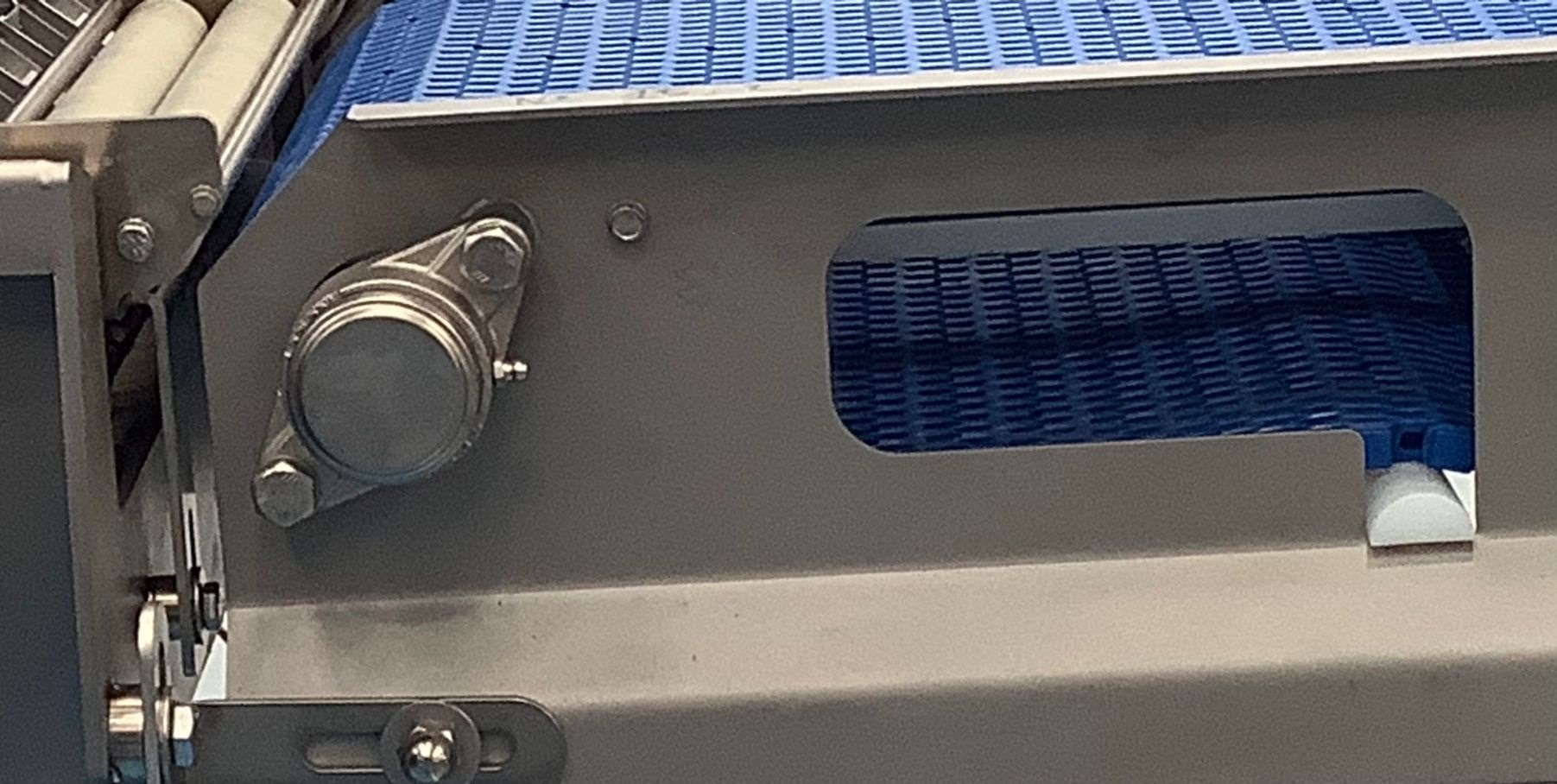
| Cooling, slicing and packing bakery products | Recontamination where ready-to-eat product is exposed; crumbs and allergens | Accessible belt returns and guides; controlled overhead/drip paths; cleanable supports | Inspect cooling conveyor undersides and slicer interfaces |
| Confectionery cooking and depositing | Sticky sugar deposits; water/steam where used; formulation changeovers | Contact materials and seals matched to product and cleaning; accessible depositor and drip tray joints | Check nozzle backs, scraper edges and retained material after removal |
| Chocolate refining, conching and tempering | Fat-bearing residue, moisture sensitivity, heat and allergens | Accessible product paths; defined removal/cleaning method; sealed interfaces and compatible compounds | Inspect product bypasses and joint pockets; do not infer sanitation from process warmth |
| Moulding, enrobing, cooling and packing confectionery | Nut/milk/soy or other recipe-specific cross-contact; exposed finished product | Removable guides/scrapers, inspectable belt paths and controlled tools | Check reassembly, belt tracking and residue at transfer points |
Send your application data and get a component recommendation
A product-contact zone touches food; a splash zone receives product or cleaning spray without intended direct contact. Include foreseeable transfer from overhead brackets, bearing lubricant or cooling condensate, even if a drawing calls the component non-contact. A harborage point is a location where residue or microorganisms can persist through routine cleaning.
Bakery production line hygiene: flour dust and dough deposits
Loose flour can settle on flat frame tops, guards, motor fins and exposed support threads. Removing the visible flour does not prove that a bracket lap joint or hollow tube is clean. Make dust shelves visible and reachable, close hollow sections properly, and avoid recesses that require improvised tools to clear.
Dough is a different soil: it can pack into shaft interfaces, scraper holders and under removable guards. Once moisture mixes with flour, a loose deposit can become a retained paste. Specify the dismantling steps and inspection points needed to reach it, rather than relying on longer exterior cleaning. Removal must follow the machine’s safe isolation and stored-energy procedure.
Flour and sugar dust can be combustible. Suitability of vacuum equipment, electrical and mechanical equipment, collection arrangements and ignition controls needs a competent assessment; a household vacuum is not an acceptable default. Do not use compressed air as the routine way to move dust off one machine onto another. The sibling grain dust and component-design guide provides the dedicated dust-zone and cereal-handling route.
Do not infer explosion suitability from stainless construction, an ingress rating or hygienic certification. Bearings can also create heat through misalignment, contamination or incorrect servicing; maintenance findings belong in the safety review, not only the hygiene log. This page assigns no dust-zone classification or allowable surface temperature.
Dry cleaning and controlled wet intervention
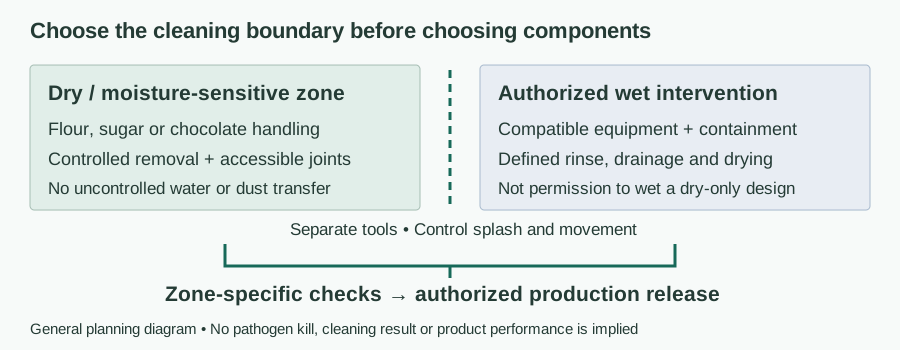
Low-moisture food does not mean pathogen-free food. Pathogens can survive in dry environments even where conditions do not support growth; adding uncontrolled water can create niches and spread contamination. Choose a cleaning procedure from the product, soil, hazards and equipment, not from the assumption that all bakery machinery should be hosed down.
For a dry-cleaning zone, use approved collection and removal tools, protect adjacent clean surfaces and separate allergen-containing residue. The procedure should identify tool storage, direction of work, dismantling and waste handling. A vacuum removes accessible loose material; it does not automatically remove a fat film or material lodged behind a seal.
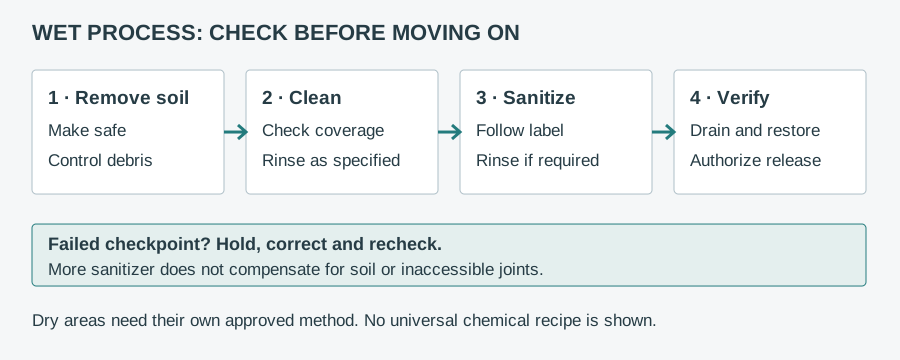
If wet cleaning is necessary, control its boundary. Agree what is removed for separate cleaning, what can be wetted in place, how liquid is contained and where it drains. Verify compatibility of bearings, plastics, seals and electrical equipment. Restore a dry area only after the required drying and acceptance checks; visible exterior dryness is not proof that a hollow section or mounting joint is dry inside.
EHEDG Guideline 55 distinguishes bakery equipment designed for dry and wet cleaning; a dry-only design must not be wet-cleaned. Its bakery scope does not cover special confectionery machinery. Codex CXC 75-2015 distinguishes dry and controlled wet cleaning for low-moisture foods, including chocolate: an authorised intervention is not permission to hose any machine.
COP, cleaning out of place, means removed parts are cleaned separately; CIP, cleaning in place, means designed internal paths are cleaned without routine dismantling. Neither term describes simply spraying an exterior housing. Use the related cleaning-cluster method and sanitation-checkpoint guide when defining boundaries, rinse instructions, drying and release responsibilities.
Confectionery production: sugar, fats and allergens
Sugar deposits differ between dry dosing, cooked aqueous masses and fat-based coatings. A sticky deposit on a cooling conveyor can attract additional crumbs and dust; a hardened film behind a scraper may be missed by a visible-surface check. Record the soil state, location and permitted removal method before choosing tools or chemicals.
Fat-bearing confectionery residues need an assessment of both cleaning action and material compatibility. Do not select a seal solely because it is called food grade, or assume every compound in a polymer family tolerates the proposed product and detergent. Request the actual compound and intended-use evidence. Scraping must not cut the seal or scratch a contact surface into a new residue-retention location.
An allergen changeover is the controlled transition between recipes with different allergen profiles. Identify the ingredients actually used—such as wheat, milk, eggs, nuts, sesame or soy where applicable—rather than treating every line as having the same allergen list. Include shared tools, rework, mobile racks, transfer chutes and concealed conveyor returns in the assessment.
Plan product sequencing and segregation with QA, but do not use them to excuse an uncleanable joint. Cleaning-effectiveness evidence and routine verification should answer the particular allergen question. ATP is a biological-residue indicator, not an allergen-specific test or microbiological count. Visual cleanliness, ATP and allergen-specific methods are not interchangeable release evidence.
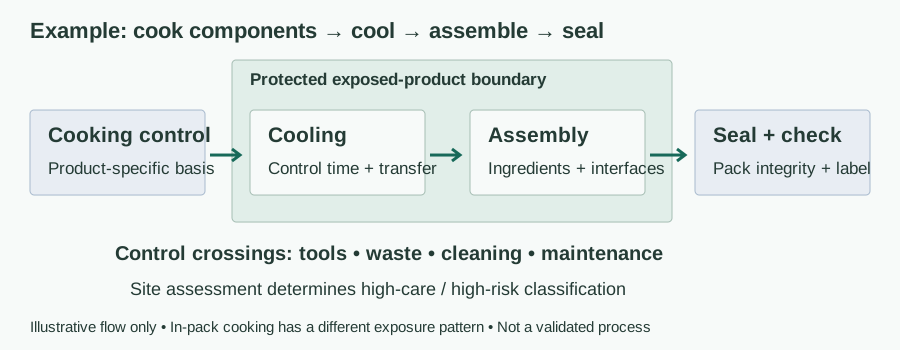
Where bakery components enter chilled assembled products, use the meal-assembly zoning and component checks to review the complete product flow and ingredient/tool transfers.
Chocolate production equipment: moisture and temperature boundaries
Refining and conching change the chocolate mass, while tempering manages crystallisation for the intended product properties. Moulding and enrobing create additional belts, scrapers, return paths and transfer interfaces. These stages should not be described as a validated pathogen-kill process merely because the product is heated.
Trace the chocolate path through recirculation, bypasses, removable screens and depositor interfaces. Dead spaces are pockets not reached by the intended removal or cleaning action; crevices are narrow gaps that retain material. Hot flushing or displacement can be part of an approved method, but its effect on microbial or allergen hazards needs separate assessment.
Moisture can compromise a moisture-sensitive product and create an environmental-control problem. Do not improvise water addition to improve removal. Where an engineered system uses an approved aqueous cycle, confirm coverage, compatibility, drainage, drying and restoration. Keep cleaning tools and condensation from neighbouring wet areas out of dry chocolate-handling zones.
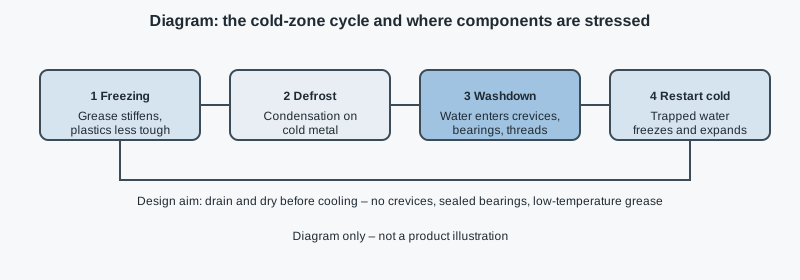
Cooling creates another boundary: assess condensation on covers, utilities and adjacent surfaces that can drip toward open product. Inspect after changes to cooling, insulation or ventilation. Do not transfer a dry-zone bearing or support specification to a wet utility area solely because both machines handle chocolate.
The migrated solid, modular and mesh belt hygiene comparison adds construction, transport and removal criteria for unpackaged products and bulk powders.
Bearings, levelling feet, castors and conveyor interfaces
Match the component to its installed duty. For bearings, record shaft/load conditions, speed, alignment, dust exposure, local heat and permitted cleaning. Include the cover and mounting gasket arrangement; a sealed housing can still have an inaccessible frame interface. NHK’s sealed bearing families for dust and cleaning-condition enquiries are a browsing route, not a rating for every unit.
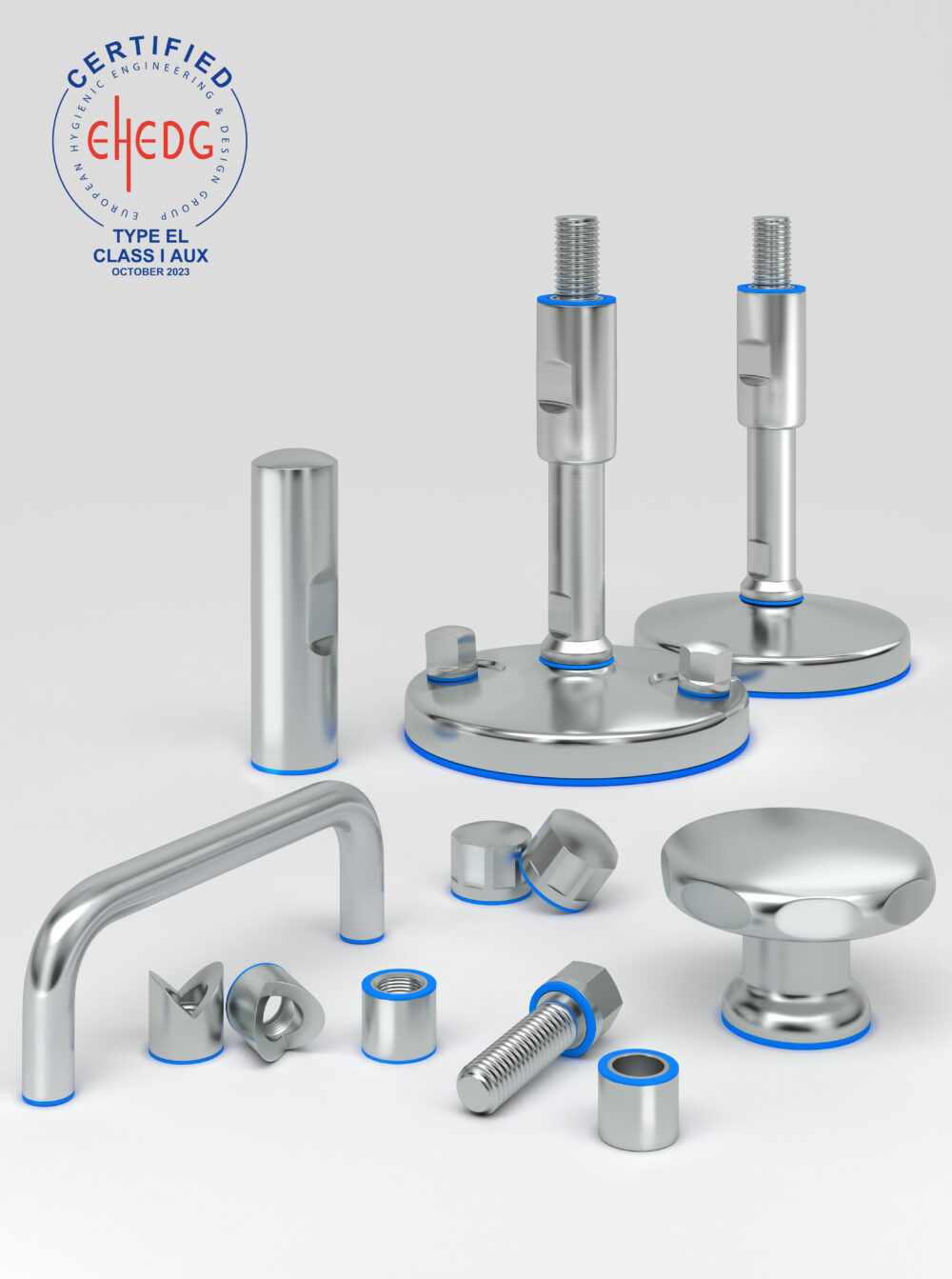
Levelling feet need an assessed support distribution, adjustment range, fixing arrangement and cleanable base/stem interface. Mixer vibration or an uneven floor can change how loads are shared; do not size supports simply by dividing mass by the number shown on a drawing. Avoid exposed threads collecting flour and define how the installed floor joint is inspected.
For mobile racks and castors, measure temperature at the wheel, bearing and brake under the actual route, dwell and thermal cycling. Oven setpoint is not a component rating. Confirm load, tread, lubrication and braking behaviour as an assembly; no NHK high-temperature availability is asserted here. The sibling machine-assembly and mounting guide explains how supports, drives and bought-in parts interact.
Material grade follows product and cleaning exposure, not the sector name. AISI 304 can be considered for appropriate mild conditions; 316L can offer an advantage where chloride exposure matters, but neither grade makes a joint cleanable or immune to corrosion. Inspect welds, surface damage and retained liquids. The related hygienic-design cluster’s installed access and contamination-path rules provide the design framework without adding a universal finish value.
Inspection and acceptance before a recipe change or restart
- Make safe and expose the designated interfaces. Account for removed parts and inspect belt returns, guides, scraper backs, seals and support joints.
- Classify remaining soil. Separate loose dust, dough paste, sticky sugar and fat film; an ineffective removal method should trigger review, not more uncontrolled water or air.
- Check condition and transfer paths. Look for worn seals, loose fasteners, grease escape, roughened surfaces, cooling drips and wet pockets.
- Verify the specified clean and restoration. Apply QA-approved visual, residue, allergen or microbiological checks as appropriate. Record drying, seal seating, guards and parts accountability.
- Resolve deviations before release. Assign responsibility for re-cleaning, product disposition and any component redesign. Reassess changed ingredients, tooling, chemicals or thermal duty.
Use the migrated component contamination and inspection checklist when diagnosing fragments, lubricant leakage or persistent retained residue. No generic swab threshold, cleaning frequency or production-release result is assigned by this guide.
Example: a shared chocolate enrobing conveyor
Example — hypothetical assumptions, not an NHK installation. A line changes from a milk-chocolate product with nut pieces to a recipe without those ingredients. A removable scraper holds fat-bearing residue behind its clamp, and the neighbouring rack-washing area can splash toward the conveyor. No successful removal or safety outcome is assumed.
Map the recipe-specific allergen risks and retained-residue location. Resolve scraper access or mounting geometry, define the approved removal/cleaning method and keep wet-area tools and splash separate. QA selects appropriate effectiveness and routine verification evidence, then controls release. Purchasing requests compatible replacement seals and the revised assembly drawing, rather than relying on an exterior visual pass.
Supplier documents and copyable application fields
Ask for drawings and supplied item identity, material/compound evidence, cleaning and maintenance instructions, actual thermal/mechanical limits and relevant dust suitability where required. EC 1935/2004 covers food-contact materials; EU 10/2011 adds plastics requirements; FDA 21 CFR 177.2600 concerns repeated-use rubber. Match evidence to the supplied article and intended use, not a generic food-grade label.
EHEDG certifies specific designs and 3-A Symbol authorisation follows Third Party Verification; both are voluntary. Request exact scope if specified, not certification of the entire bakery; use the design-document and supplied-item verification route to organise that check. IP67 is an immersion test, not washdown evidence; IP69K under ISO 20653 is an ingress designation, not hygiene certification or unlimited chemical resistance.
Copy and complete: “Process step; component/part number, drawing revision and quantity; product, ingredients, allergens and changeover; zone and transfer paths; cleaning method, chemicals and frequency; measured component temperature, peaks, dwell and cycles; load, speed, support layout, dimensions and mounting; materials, seal compound and lubrication; dust assessment and suitability documents; contact declarations, specified design certificate and acceptance checks; delivery country.”
Send these details to NHK
NHK can review the application, clarify component documents, suggest a part and prepare a quote. Browse conveyor hardware families for bakery and confectionery component requests as the secondary path. Direct contact is HMP@nhkgroup.eu and (+45) 2492 5030; no stock, response time, process approval or performance guarantee is invented.