Meeting rigorous hygiene and environmental standards means that processing equipment can be cleaned reliably, is built from compliant food-contact materials, and uses as little water, chemicals and energy as possible doing so. Food, dairy, beverage, bakery, cosmetics and pharmaceutical producers face both sets of demands at once. This guide separates legal requirements from voluntary schemes, shows where hygiene and environmental goals overlap, and lists the evidence each component should come with.
For a detailed map of the standards themselves, see hygienic machine design standards in 2025.
Which requirements apply?
Requirements fall into three groups:
| Requirement | Type | What it covers | Evidence from components |
|---|---|---|---|
| EU food hygiene (Regulation 852/2004) | Legal, for food businesses | Hygienic premises and equipment, cleaning | Cleanable design, cleaning instructions |
| EU machinery legislation with EN 1672-2 / EN ISO 14159 | Legal / harmonised standards | Hygienic design of food machinery | Design to these standards, technical file input |
| EC 1935/2004 (EU 10/2011 for plastics) | Legal | All food-contact materials | Declaration of compliance |
| FDA 21 CFR (e.g. 177.2600 for rubber) | Legal, US | Food-contact substances | Supplier statement of conformity |
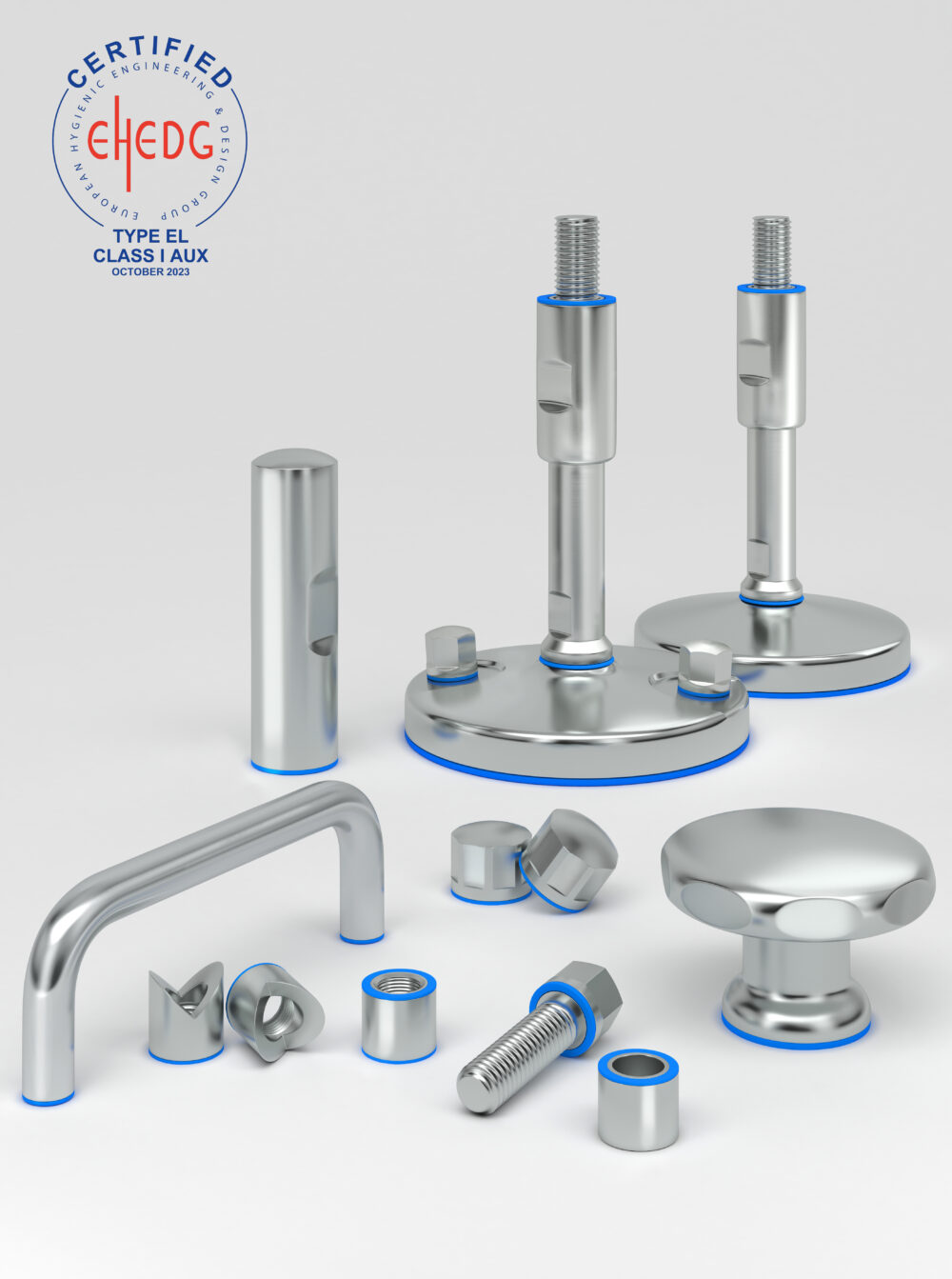
| EHEDG certification | Voluntary | Cleanability of a specific design | Certificate naming the model |
| 3-A Symbol | Voluntary | Conformity to a 3-A Sanitary Standard after Third Party Verification | 3-A authorisation for the part |
| Local wastewater and environmental permits | Legal, site-specific | Effluent, chemicals, water use | Indirect: lower cleaning demand |
| ISO 14001 environmental management | Voluntary, site-level | Environmental management system | Data on water, chemicals, life |
The key point: EHEDG and 3-A are voluntary and certify specific designs, not companies or materials. They are strong evidence of hygienic design, but the machine builder remains responsible for the conformity of the complete machine, and the food business for its hygiene.
What EHEDG and 3-A actually cover
The European Hygienic Engineering & Design Group (EHEDG) develops guidelines for hygienic processing and packaging of food, and certifies equipment designs that are easy to clean and prevent bacterial contamination. Certification is widely used to demonstrate hygienic design to European customers and beyond.
3-A Sanitary Standards, Inc. (3-A SSI) is widely recognised in the United States, mainly for dairy and food equipment. Its aim is to protect public health by ensuring equipment can be cleaned and sanitised effectively. Equipment conforming to a 3-A Sanitary Standard may carry the 3-A Symbol after a Third Party Verification.
Neither scheme rates environmental performance. Their environmental value is indirect, through easier cleaning.
Where hygiene and environmental goals meet
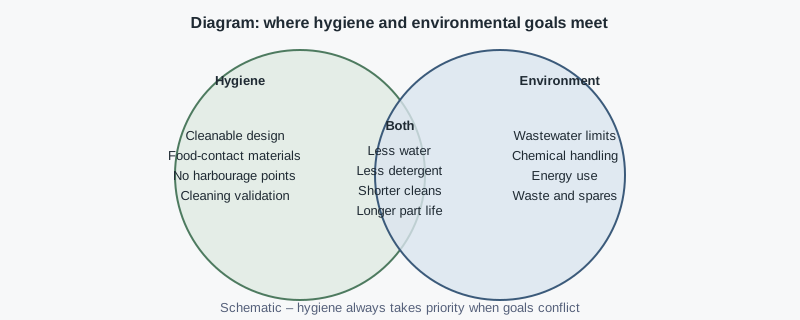
Hygienic design prevents contamination by eliminating harbourage points – places where residue and bacteria survive cleaning, such as exposed threads, crevices and dead spaces. The same features that make equipment cleanable also make cleaning shorter: smooth, self-draining surfaces (shaped so liquid runs off) and low surface roughness Ra release soil faster. EHEDG guidance refers to Ra ≤ 0.8 µm for product-contact surfaces. Less soil retained means less water, detergent, hot-water energy and effluent per clean.
Durability adds a second link: corrosion-resistant materials that withstand rigorous cleaning last longer, reducing replacement parts and waste.
When the goals conflict – for example, pressure to shorten rinses – hygiene takes priority. A failed clean that must be repeated costs more water than it saved.
Component by component: what to check
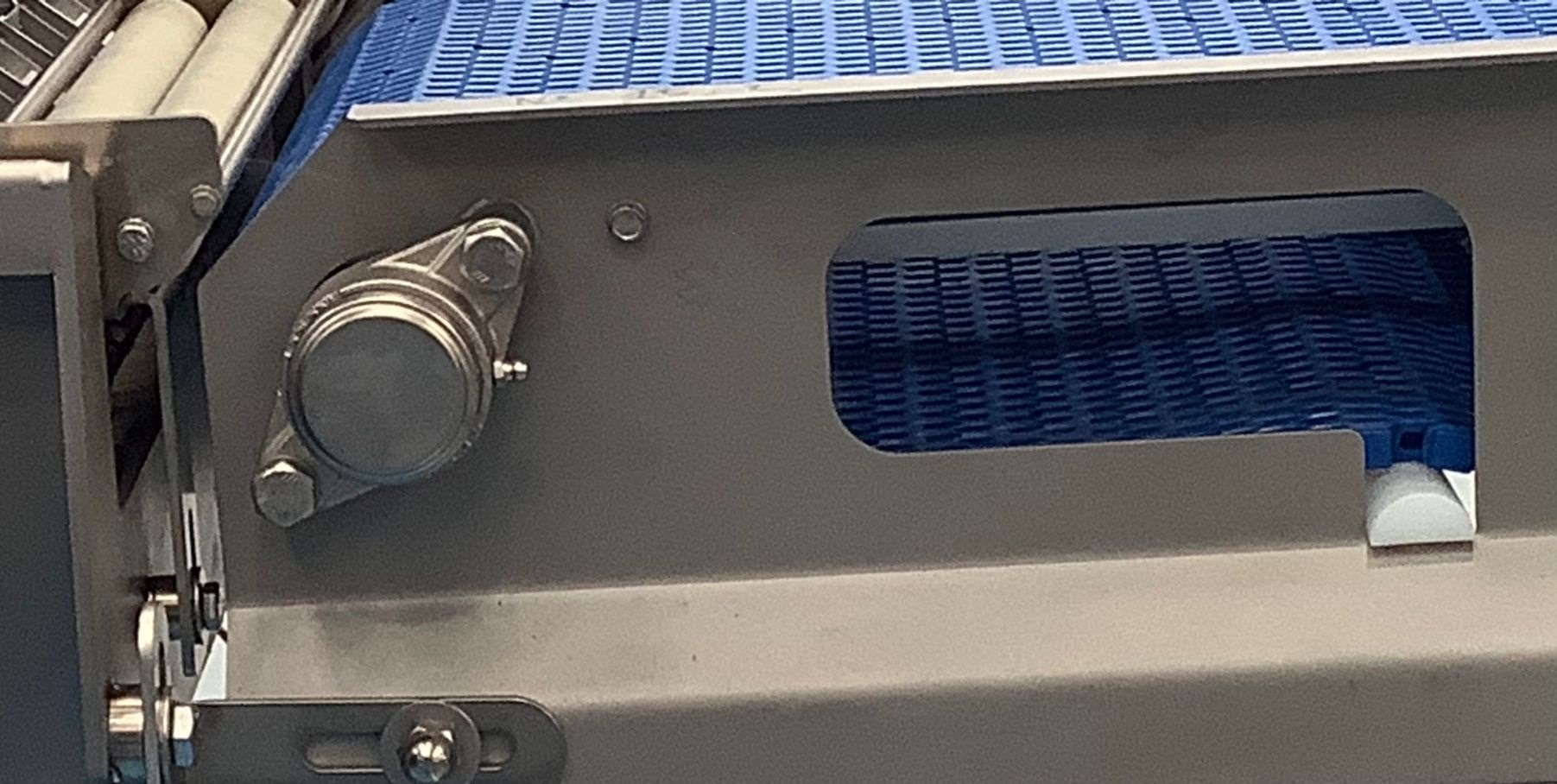
Sealed bearing units
Bearing units in wet areas need protection from moisture and cleaning chemicals. IP67 (IEC 60529) means dust-tight and protected against temporary immersion; it is not a high-pressure washdown test (that is IP69K, ISO 20653), and no IP rating is a hygiene certificate. Check seal design, elastomer compatibility and whether a certificate names the specific unit.
Sanitary enclosure parts
Enclosure parts designed to 3-A sanitary standards are intended to be cleaned easily and thoroughly in dairy and food equipment. Ask for the 3-A authorisation covering the specific part; a part alone does not make the equipment 3-A conforming.
Hygienic adjustable leveling feet
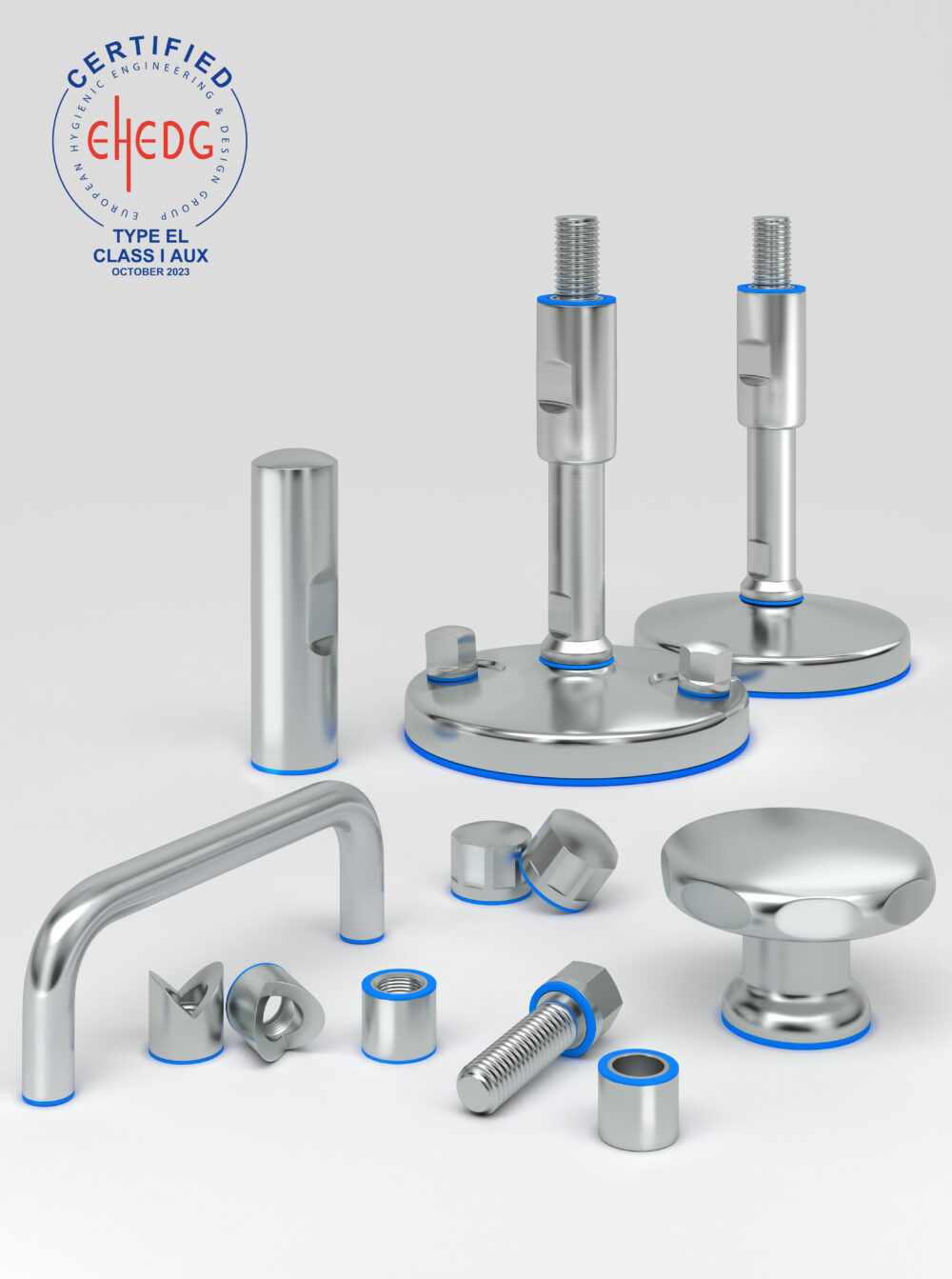
Stainless steel leveling feet with a sealed thread and smooth body give stable, hygienic support and prevent dirt and bacteria building up at floor level. Choose AISI 316L where chlorides are present, because it resists chloride pitting (local corrosion by chloride ions) better than 304. EHEDG certification, where claimed, applies to the named foot design.
How to demonstrate compliance: a documentation checklist
Where GMP is specified, check manufacturing scope and equipment records rather than treating sanitary component evidence as approval of the whole machine.
- Define the zone of each component – product-contact, splash zone (wetted by spray but not product) or non-contact – since requirements rise towards the product.
- Collect a declaration of compliance for every food-contact material (EC 1935/2004; EU 10/2011 for plastics; FDA references for US markets).
- Get material certificates for stainless steel grades (e.g. AISI 304 or 316L).
- Check certificates and authorisations – EHEDG certificate or 3-A authorisation naming the exact model, valid at purchase.
- Record ratings from the datasheet: IP rating, temperature range, load, chemical compatibility of elastomers (EPDM, FKM, VMQ).
- Add cleaning instructions – method (CIP, foam, high-pressure), chemicals and limits – to the technical file.
- Capture environmental data where available: cleaning time, water and detergent per clean before and after changes.
Example
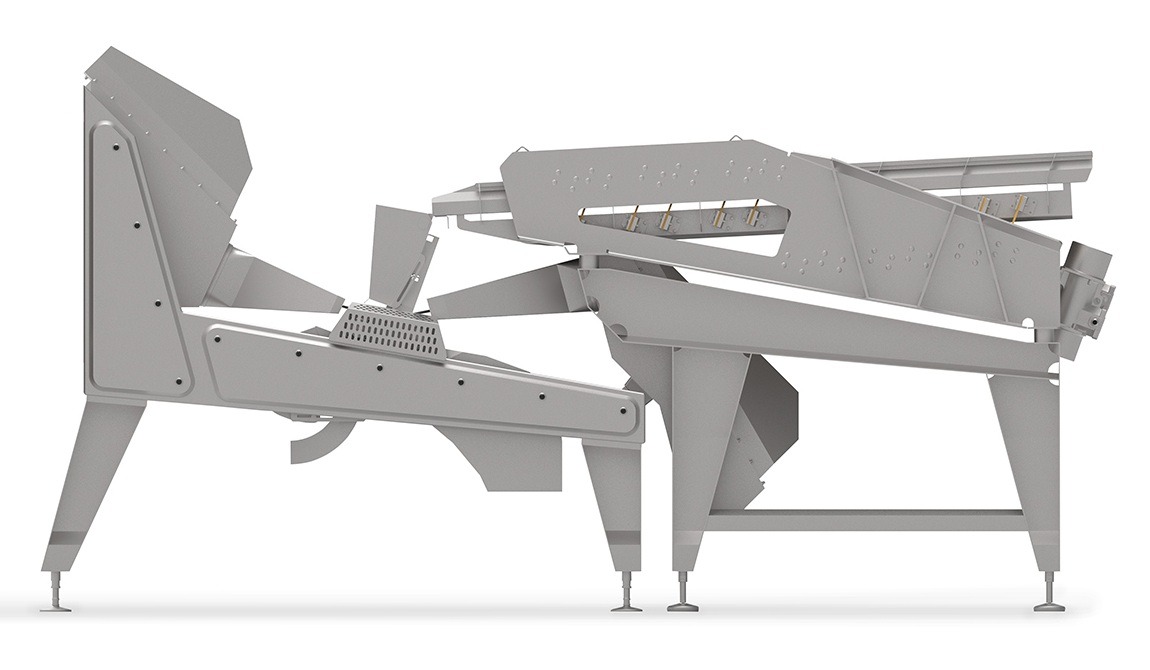
Assumptions (illustrative only): an OEM builds a cheese-handling conveyor for a customer that sells in both the EU and the US and runs an ISO 14001 system.
- Legal: EN 1672-2 design, declarations of compliance for belt, seals and plastic parts, FDA statements for the US.
- Voluntary: the customer prefers EHEDG-certified feet and 3-A-authorised parts where available; the OEM lists certificate references per item.
- Environmental: the customer asks for water and detergent per clean; the OEM documents sealed bearing units, sealed-thread feet and self-draining frames, and agrees to measure consumption during commissioning.
Applications across industries
- Food and dairy: hygiene law, food-contact materials and, in the US, 3-A standards for dairy equipment.
- Beverage and brewery: CIP-heavy lines where water and detergent use dominate.
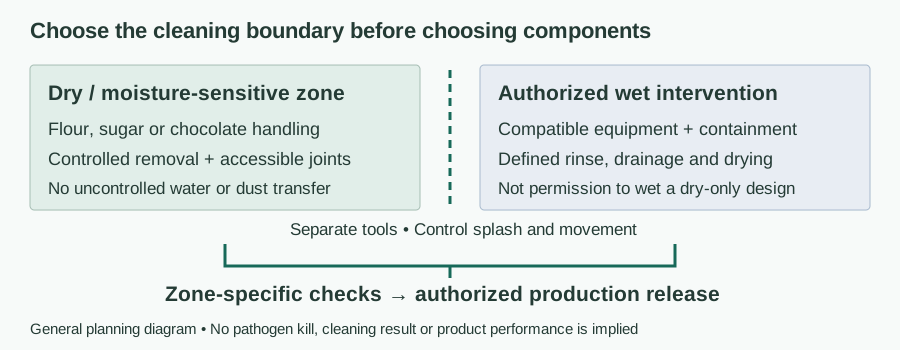
- Bakery and confectionery: dry cleaning and allergen control; wet cleaning only where needed.
- Meat and seafood: daily wet cleaning with chlorinated agents; corrosion resistance is key.
- Cosmetics and pharmaceuticals: GMP and cleaning validation, with full material documentation.
- Chemical and healthcare: chemical resistance and cleanability per local requirements.
For measuring and cutting cleaning consumption in practice, see reducing water and cleaning detergent usage.
NHK's related pages: EHEDG and 3-A SSI certified components and meeting rigorous hygiene and environmental standards.