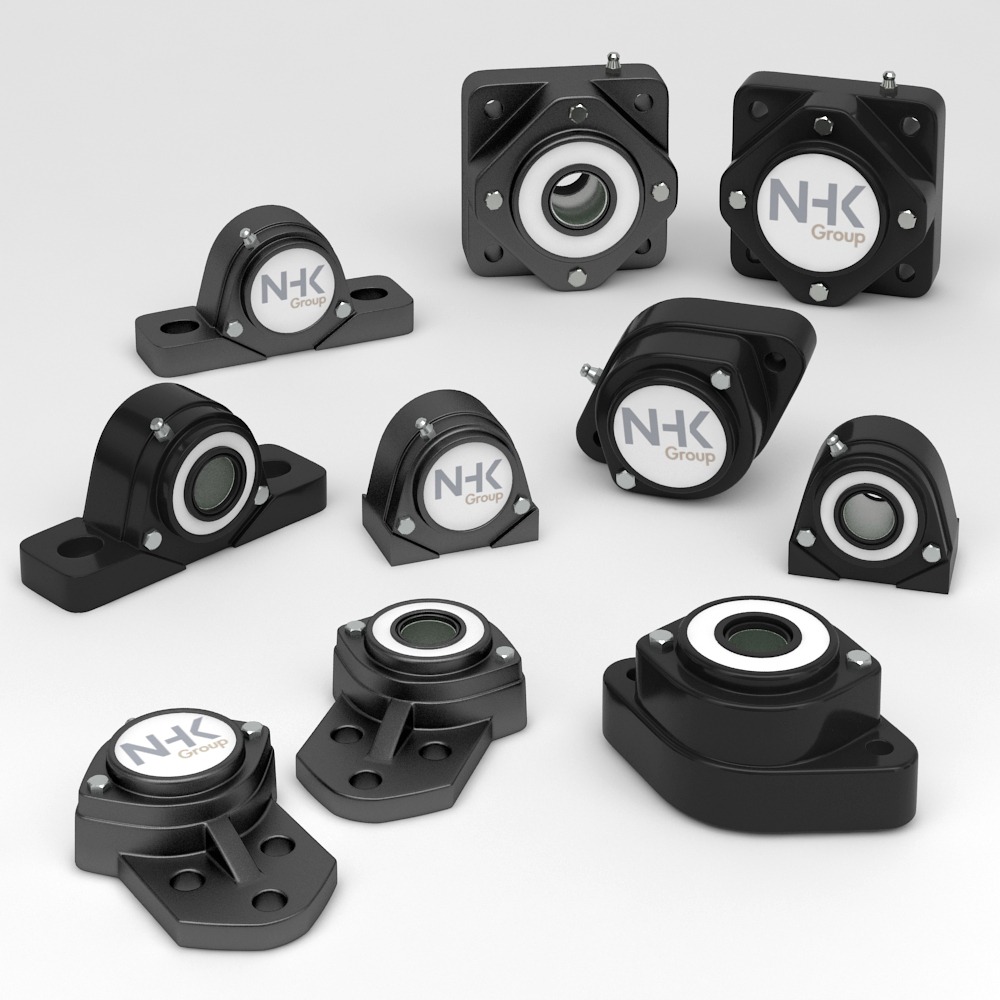
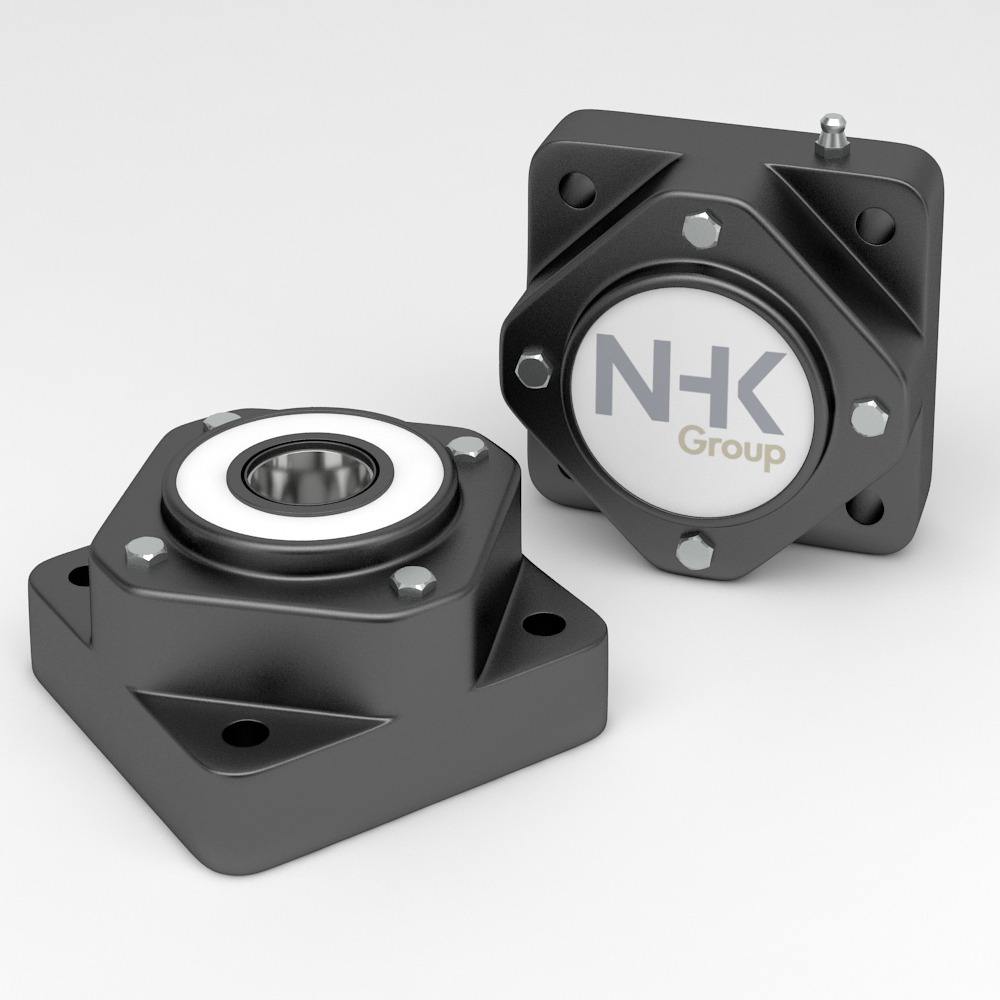
An IP67 waterproof 4-hole square flange bearing unit is a mounted bearing – a self-aligning ball bearing insert with a spherical outer ring in a sealed housing – bolted with four bolts to a wall or frame perpendicular to the shaft. It is used on conveyors and sanitary machinery in food, pharmaceutical and chemical production where water, cleaning agents and product residues are part of daily operation. This guide covers when to choose the square flange bearing format, what IP67 really means, and how to select, mount and inspect these units. For an overview of all flange types – 2-bolt oval, 3-bolt and 4-bolt square – see our guide to choosing a flange bearing.
What a square flange bearing unit is
A square flange bearing unit consists of:
- Housing with a square flange and four bolt holes.
- Spherical insert: a ball bearing whose outer ring is spherical, so it can tilt slightly in the housing.
- Locking to the shaft, typically set screws.
- Seals and covers: a shaft seal on the open side; a closed end cover where the shaft ends in the unit.
- Lubrication: factory grease, often with a grease nipple for relubrication.
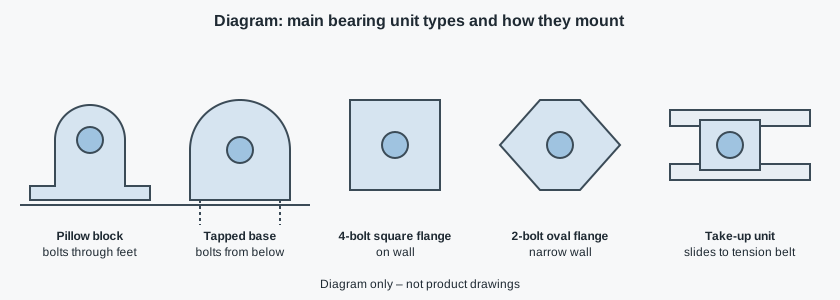
Square flange bearing vs other housings
| Housing | Mounting | Strength | Best for | Trade-off |
|---|---|---|---|---|
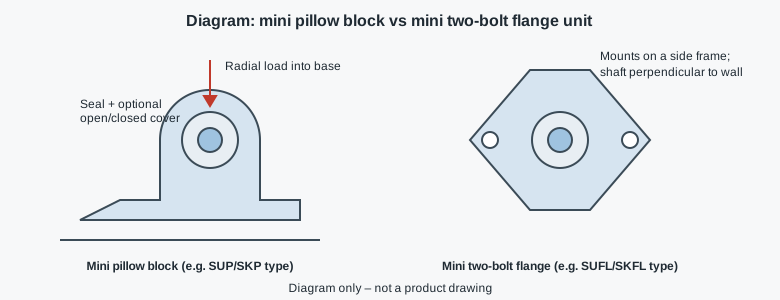
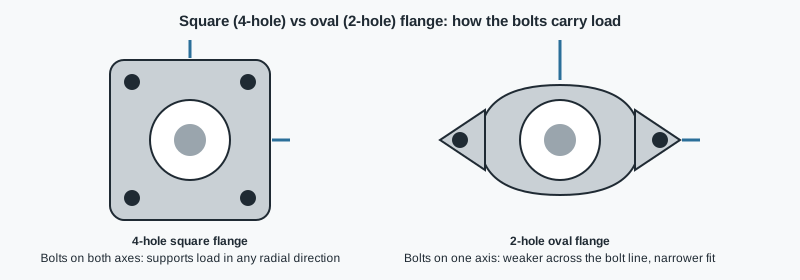
| 4-hole square flange | Wall perpendicular to shaft, 4 bolts | Supports radial load in any direction | Conveyor side frames, drive shafts, changing load direction | Needs a larger flat mounting area; four bolt heads to clean |
| 2-hole oval flange | Wall perpendicular to shaft, 2 bolts | Weaker across the bolt line | Narrow frames, lighter loads | Less stable against loads across the bolt line |
| Pillow block | Surface parallel to shaft | Good for downward loads | Shafts on horizontal frames | Base can trap water if not sealed |
| Round flange | Spigot in a bore | Centred, compact | Precise location in a housing bore | Bore machining required |
The 4-hole square flange gives secure, stable mounting that helps keep alignment and limits movement under load. For the 2-bolt alternative, see industrial oval bearings.
What IP67 means – and does not mean
The IP code (IEC 60529) has two digits:
- 6: dust-tight.
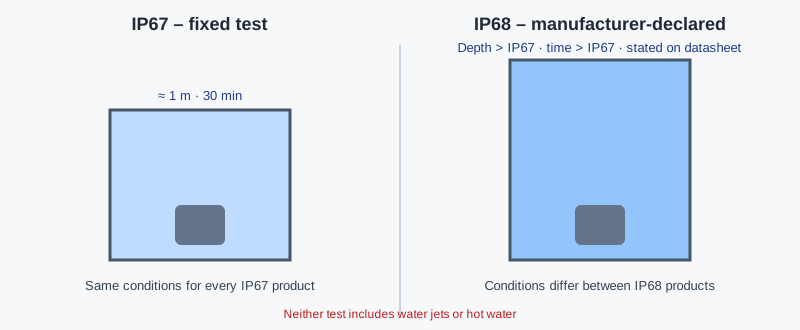
- 7: protected against the effects of temporary immersion in water under defined test conditions.
IP67 therefore shows that the housing and seals keep water out under those conditions. It is not a hygiene certification, and it is not a high-pressure washdown test. High-pressure, high-temperature jets are covered by IP69K (ISO 20653); IP69 also exists in IEC 60529. A waterproof flange bearing with IP67 is well suited to wet areas, splashing and immersion; for daily high-pressure cleaning aimed at the bearing, ask for IP69K evidence or supplier confirmation. More on the differences: waterproof bearing house units.
Spherical inserts and misalignment
The spherical outer ring lets the insert align itself in the housing. That compensates small static misalignment – for example from frame tolerances or two flange units on opposite side frames not being perfectly coaxial – and avoids edge loading that shortens bearing life. It does not compensate continuous shaft deflection or large mounting errors.
Selection method
- Load direction and size: if load direction varies or is significant, prefer 4-hole square over 2-hole oval.
- Shaft diameter and locking: match bore to shaft; set-screw locking suits one rotation direction.
- Cleaning method: dry, foam and rinse, or high-pressure washdown – choose sealing and covers accordingly.
- Shaft end: closed cover where the shaft ends in the unit, open with seal where it passes through.
- Chemicals and temperature: confirm seal and housing materials suit the cleaning agents and temperature range.
- Lubrication: food-grade (NSF H1) grease in food areas; decide whether relubrication is needed.
- Documents: IP test evidence, material and grease data, traceability.
Example – assumptions stated, not a real case. A poultry packing conveyor has side frames 2 m apart, belt tension acting horizontally and daily foam cleaning with a low-pressure rinse. The engineer chooses 4-hole square flange units because the belt pull acts across the frame in a direction a 2-hole oval flange would handle less well, specifies closed covers at the non-drive end, food-grade grease, and instructs cleaning staff not to aim the rinse directly at the shaft seals.
Installation checklist
- Check the mounting surface is flat and rigid; a distorted flange loads the insert unevenly.
- Avoid gaps between flange and frame where water and soil collect – a full-contact surface or a sealed gasket.
- Align both bearings on the shaft before tightening set screws.
- Tighten flange bolts evenly, then set screws, to the supplier's torque.
- Fit covers and check free rotation.
- Use stainless fasteners to avoid corrosion and galvanic corrosion (corrosion when dissimilar metals touch in a wet environment).
Failure modes and prevention
- Water ingress through the shaft seal: caused by jets aimed at the seal or worn lips. Adjust cleaning (see waterproof bearing units designed for easy cleaning), replace seals.
- Grease washout and noise: check covers and relubrication routine.
- Loose set screws: from reversing loads or vibration – check torque.
- Corrosion at bolt heads and gaps: use stainless fasteners and seal the flange contact surface.
- Condensation inside the housing: from temperature cycling; a correctly filled housing limits the space where condensate collects.
NHK's IP67 square flange units
According to NHK's product page, its IP67 4-hole square flange units have an oil seal ring with a stainless steel spring around the shaft, a stainless grease nipple for food-grade grease filling, and a unique batch ID number on each unit for traceability. Related flange versions are listed under IP67 waterproof bearing units with spherical inserts on NHK Machinery Parts.
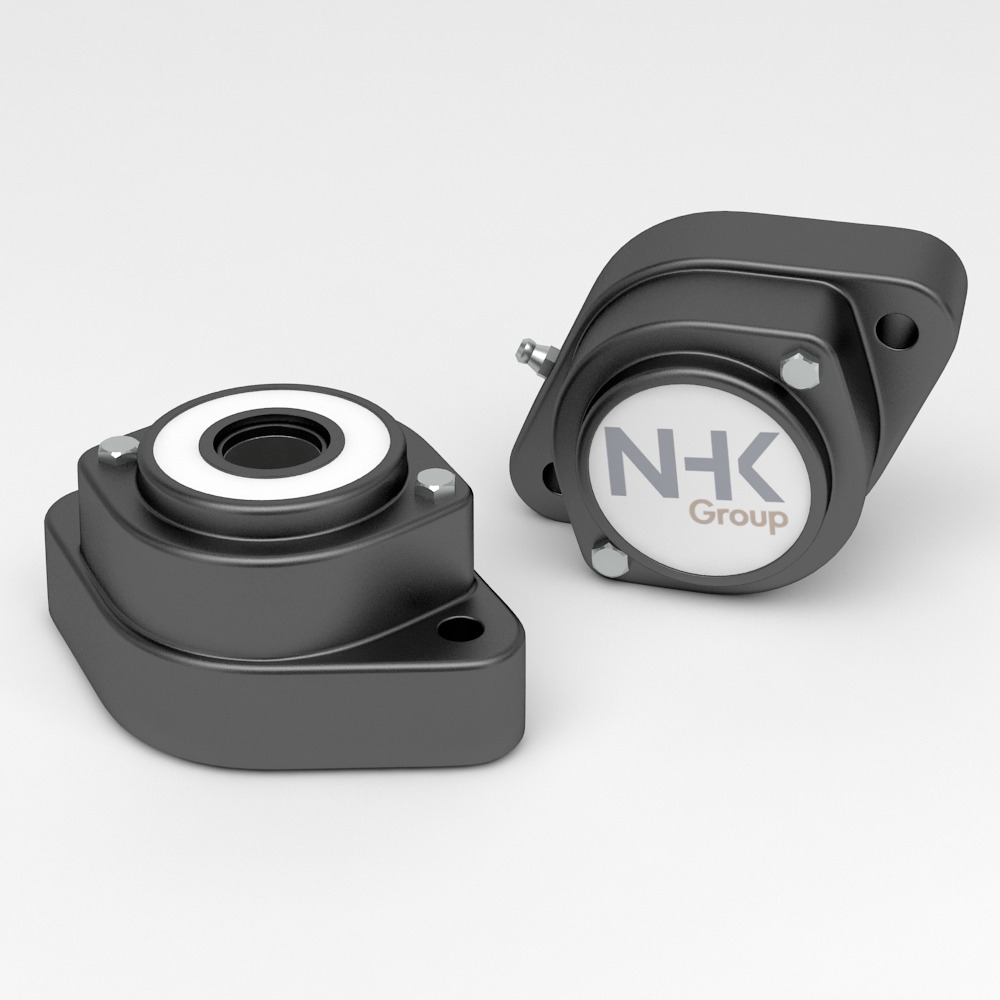
For narrow frames, compare the IP67 waterproof oval bearing 2-hole flange units.