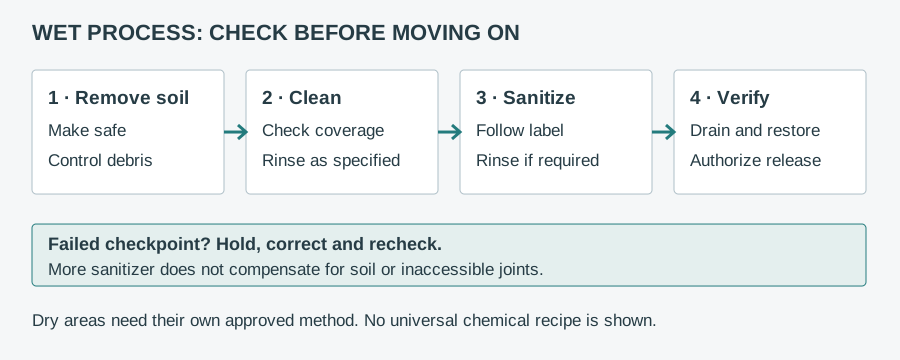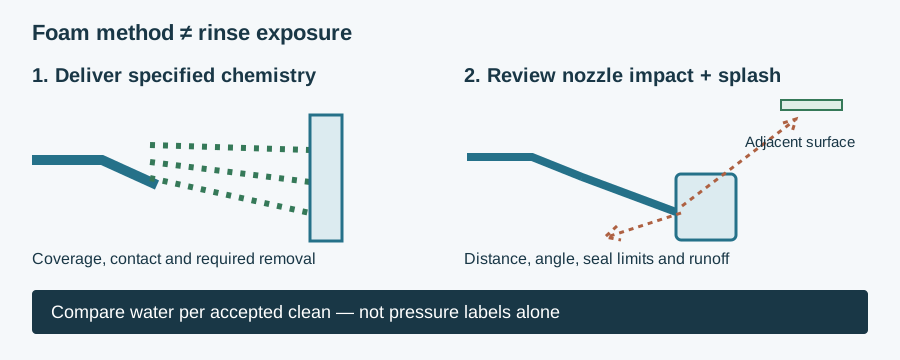
Foam cleaning vs high pressure cleaning compares chemical delivery with a mechanical water-jet method, not two interchangeable sanitation programs. Foam carries an appropriate cleaning chemical onto accessible surfaces; high-pressure water supplies impact during a specified cleaning or rinse stage. A foam process still needs the prescribed removal of detergent and loosened soil, and either method can spread contamination if poorly controlled.
Start with the equipment sanitation sequence and release checks. This guide addresses open-equipment washdown: soil removal, spray behaviour, water measurement and the exposure that bearings, seals and mounting joints must tolerate. It supplies no universal pressure, chemical recipe or sanitiser rinse rule.
Low pressure foam cleaning and high-pressure washdown compared
| Decision | Low-pressure foam application with specified rinse | High-pressure water-jet cleaning or rinse |
|---|---|---|
| Main action | Chemical wetting and contact on accessible surfaces; mechanical action where specified | Local impact plus water transport; chemistry may still be required |
| Good fit | Wet-cleanable equipment with suitable chemistry, access and controlled drainage | A justified task on an assembly explicitly suitable for the defined jet exposure |
| Main limitation | Foam appearance does not prove cleaning beneath covers or inside crevices | Impact cannot compensate for inaccessible geometry or unsuitable seals |
| Spread to assess | Application and rinse overspray, runoff and contaminated droplets | Rebound, splash and airborne droplets from the impact location |
| Component question | Complete chemical exposure and rinse compatibility | Nozzle, distance, angle, time, temperature and exact assembly ingress evidence |
| Water comparison | Measure application, rinse, repeated work and other water use | Measure actual flow and trigger time, including repeated cleaning |
Send your application data and get a component recommendation
“Low pressure” and “high pressure” need defined equipment settings in the site procedure; labels alone do not identify the load on a seal. Foam can be applied at one pressure and rinsed at another. Record the whole process instead of treating a foam label as evidence that the installed components see only gentle water exposure.
When each method is right: make the decision by zone
Choose controlled foam application when the equipment is approved for wet cleaning, the selected chemical can remove the relevant soil, and surfaces can be reached and rinsed as required. The chemical label and site procedure govern concentration and contact conditions. Foam that dries before the prescribed endpoint or hides remaining deposits is not a successful clean.
Use high-pressure washdown only where the task, surrounding hygiene conditions and complete assembly justify it. Review exposed product, neighbouring cleaned equipment, drains, electrical parts and lubricated interfaces before authorising a lance. Stubborn soil may require better removal access, a different approved cleaning process or repair, rather than more jet pressure.
A mixed method can be appropriate: remove gross soil, apply the prescribed detergent, use designated mechanical action, then rinse within the approved envelope. Cleaning removes soil; sanitising is the subsequent approved microbial-control treatment where required. Neither foam nor a pressure washer automatically establishes pathogen control or allergen removal.
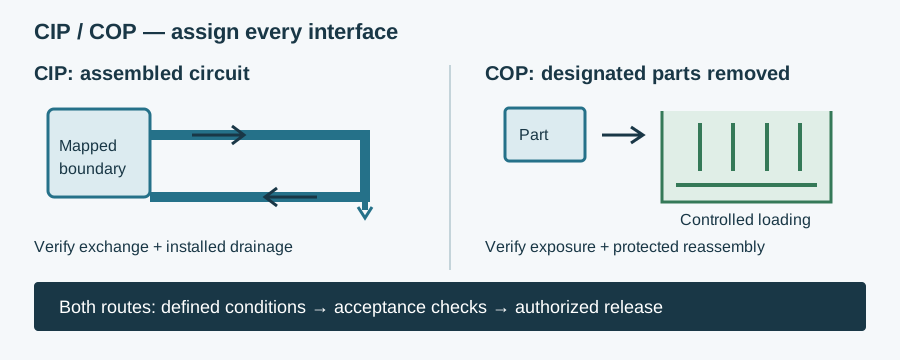
Wet cleaning may be inappropriate in moisture-sensitive production. Containment, drying and release requirements must be established before introducing water. For internal process circuits and detached parts, use the assembled-circuit and removable-part cleaning comparison; external foam is not proof that a closed pipe circuit has been cleaned.
Aerosols, rebound and cross-contamination
Aerosols are airborne particles or droplets; splash and rebound are larger-scale liquid movements from a jet striking a surface. Cleaning can move contamination from the dirty location toward an already cleaned area. The relevant question is where the released material travels, not whether the nozzle produces an impressive visible jet.
Pressure, nozzle pattern, flow, distance, angle, soil and the struck surface all affect spray behaviour. High-pressure impact can disperse contaminated droplets, but a low-pressure application and rinse are not aerosol-free. Do not assign a safe separation distance or droplet reduction percentage without evidence for the actual arrangement.
Keep exposed product and packaging out of the cleaning operation as required by the sanitation plan. Control movement from dirty to clean areas, avoid directing spray from drains toward food-contact surfaces, and assess overheads, neighbouring machines and temporary barriers. Sequence cleaning so runoff and overspray do not undo accepted work.
Check access before attempting to compensate with a lance. A narrow crevice can retain soil while water drives contamination deeper into the interface. Harborage points retain contamination through routine cleaning. The migrated cleaning-shift access and operator-obstacle guide helps identify where a design change is more defensible than a stronger spray.
For recurring findings behind joints, use the controlled niche-removal and redesign checks before increasing impact.
Water use: compare accepted cleans, not pressure labels
Pressure does not determine water consumption on its own. For a steady measured flow, water volume equals flow rate multiplied by actual running time; add all stages and repeated work. A lower-flow nozzle used longer may consume more water than a higher-flow nozzle used briefly. Neither relationship proves equivalent cleaning effectiveness.
- Define the comparison boundary. Use the same machine, zone, representative soil and required cleaning result. Record differences in product, changeover and starting condition.
- Measure the complete cycle. Meter supply water where possible; otherwise use a measured flow for each stage and actual trigger time. Include foam dilution water, rinses and repeated work.
- Pair consumption with acceptance. Record the approved inspections and hazard-appropriate tests, not only the time when the hose stops.
- Investigate failed work. Separate inaccessible residue, damaged joints and process deviations before changing the method.
- Review the change. Retain the method, settings, chemistry, results and corrective actions. A water saving counts only when the required cleaning result remains acceptable.
Example — hypothetical measurement method, not NHK performance data. Let Q₁ be measured application flow and t₁ its running time; let Q₂ and t₂ describe rinse flow and time. Cycle water is Q₁×t₁ + Q₂×t₂ + any other stages or re-cleaning. Use litres/minute and minutes to obtain litres. Replace every input with measured values; the formula predicts volume, not soil removal or safety.
Use the migrated cleaning-resource baseline and measurement guide for a broader consumption investigation. Do not reduce detergent concentration or omit a required rinse simply to improve the total.
Seals, bearings and IP69K: separate three evidence questions
A product-contact surface touches food; a splash zone receives product or cleaning spray without intended direct contact. Bearing covers, shaft interfaces, feet and fasteners can still contaminate nearby food through leakage or retained soil. Evaluate their installed orientation, cleaning access and permitted exposure together.
| Interface | Failure or uncertainty | Check before authorising the method |
|---|---|---|
| Shaft seal and bearing cover | Jet entry, cover displacement, retained liquid or lubricant leakage | Exact cover/shaft configuration, moving or stationary condition and cleaning instructions |
| Frame mounting gasket | Water entering behind the housing; damaged seating | Mounting surface, gasket condition, approved tightening and drainage |
| Elastomer exposed to detergent | Swelling, cracking, extrusion or loss of contact | Exact compound compatibility with chemicals, concentration, temperature and duration |
| Foot, castor or fastener joint | Soil trapped at threads, overlapping faces or pockets | Accessibility, sealing integrity and self-draining installation |
First ask whether the outside can be cleaned. Next ask whether ingress protection matches the actual water exposure. Then ask whether materials, seals and lubricants tolerate the chemistry and repeated duty. One positive answer does not establish the other two.
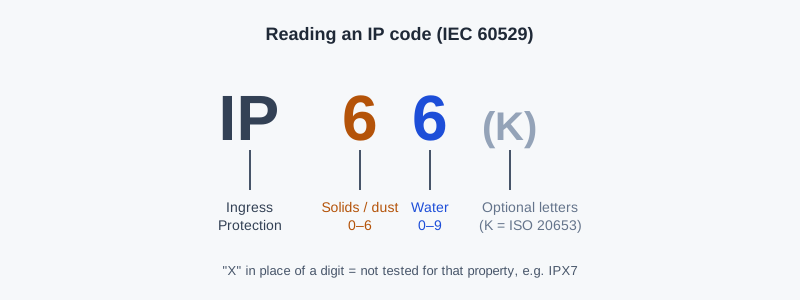
Use the related IP cluster's IP69K test scope and configuration checks for the high-pressure jet evidence. IP69K in ISO 20653 describes defined ingress testing, not hygienic certification, chemical resistance or unrestricted lifetime cleaning. IP67 under IEC 60529 addresses temporary immersion and is not pressure-wash proof. Do not translate either code into permission for any nozzle position or cleaning duration.
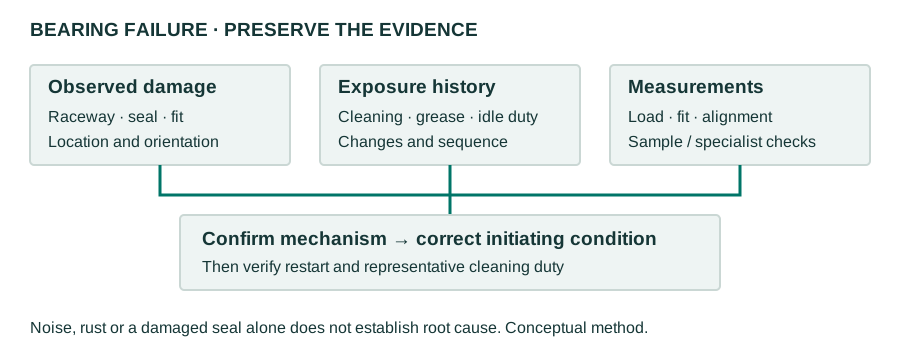
NHK lists sealed stainless bearing configurations for nozzle-exposure review. Confirm the proposed item's documents rather than assuming every configuration tolerates the same washdown. In the related reliability cluster, use the bearing damage diagnosis after cleaning if noise, leakage or corrosion follows washdown; preserve evidence before dismantling.
Inspection and acceptance before restart
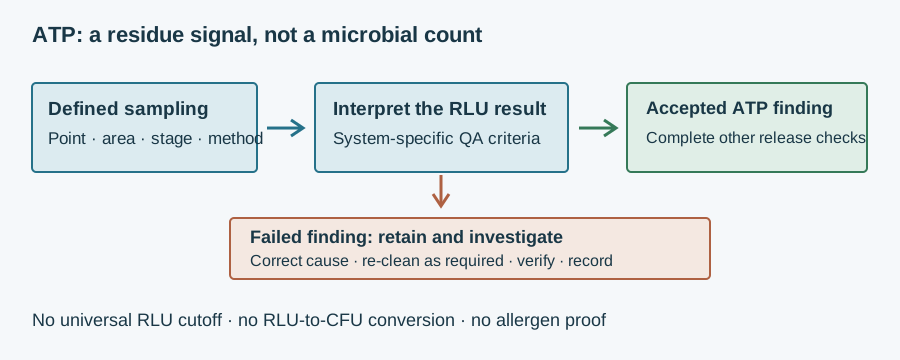
Use the supplier-informed ATP limits and failed-finding response when rapid residue testing forms part of the approved verification procedure.
Make the machine safe under its isolation procedure before inspecting or opening covers. Record remaining soil and the cleaning settings before changing anything. Check the most difficult locations, not only broad visible panels: undersides, joints, seal edges, cover seating and low points where liquid remains.
Reject against the approved criteria if residue persists, seals are damaged, a cover is displaced or required test results are unacceptable. A shiny housing, intact foam blanket or completed cycle checklist is not sufficient release evidence. ATP can indicate residue but does not specifically demonstrate pathogen elimination or allergen removal; select methods suitable for the hazard.
The corrective action should address the cause. Restore approved settings for a process deviation; repair an unsuitable joint or provide access for trapped soil. Re-clean and verify through the authorised procedure. Increasing pressure at a damaged seal may turn an external finding into internal bearing contamination.
Example: foam application followed by a concentrated rinse jet
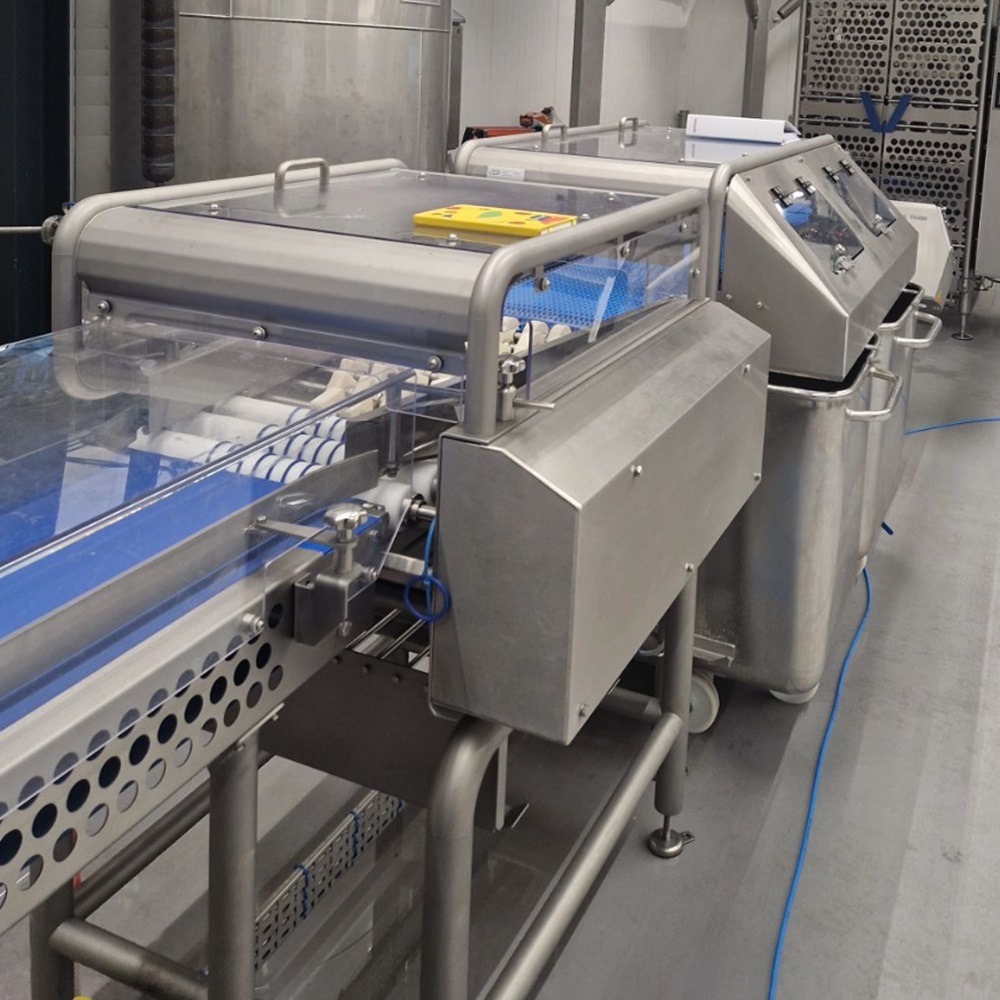
Example — hypothetical assumptions, not an NHK field observation. A conveyor uses approved foam chemistry and a hand-lance rinse. One bearing cover repeatedly retains liquid, and the operator directs a close concentrated jet at its seam. No failure cause or successful repair is assumed.
Map the actual rinse nozzle, distance, angle and duration, then compare them with the exact assembly instructions. Inspect cover seating and the mounting joint; involve QA in the retained-soil or liquid finding. If exposure or access is unsuitable, revise the authorised cleaning arrangement or component design rather than assuming the foam stage protects the seal. Document the change and repeat the relevant acceptance checks.
Specification and enquiry: send the whole exposure envelope
Copy and complete: “Component designation, drawing reference and quantity: __. Product-contact/splash/non-contact zone: __. Soil, product and allergen changeover: __. Foam application and rinse method: __. Nozzle type, pressure at use, flow, distance, angle and duration: __. Chemical identity, concentration, temperature and frequency: __. Seal compound, cover, mounting and drainage: __. Load, speed and duty: __. Required ingress report, materials, certificates and acceptance evidence: __. Measured water per accepted clean: __. Delivery country: __.”
Send these details to NHK
Organise drawings and item-specific evidence with the buyer’s component-document guides. Request applicable food-contact declarations, material identity and exact-design certificates where claimed. EHEDG certification concerns specific equipment designs; 3-A Symbol authorisation follows Third Party Verification. Both are voluntary, and neither establishes your washdown recipe. NHK can recommend components and prepare a quote; QA and the machine builder retain cleaning acceptance and release responsibility.