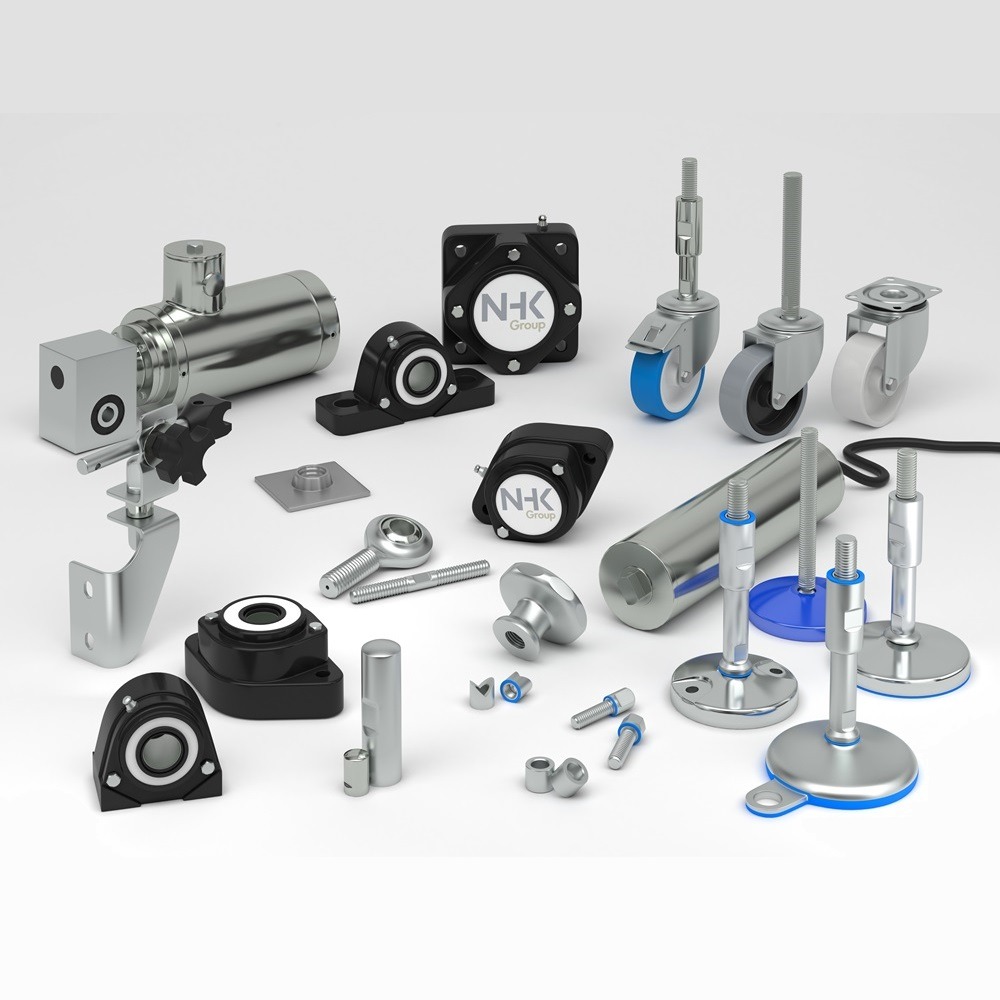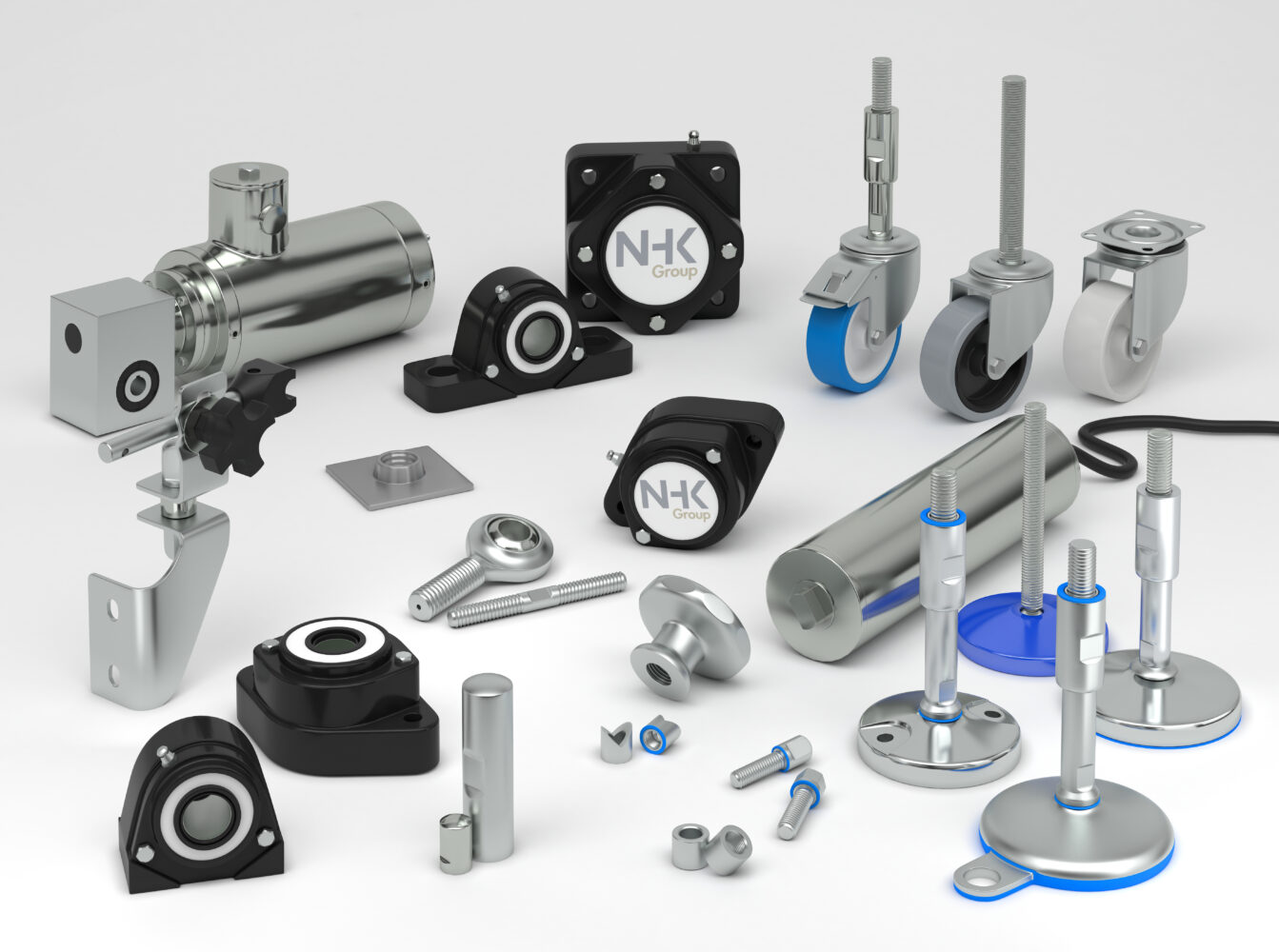
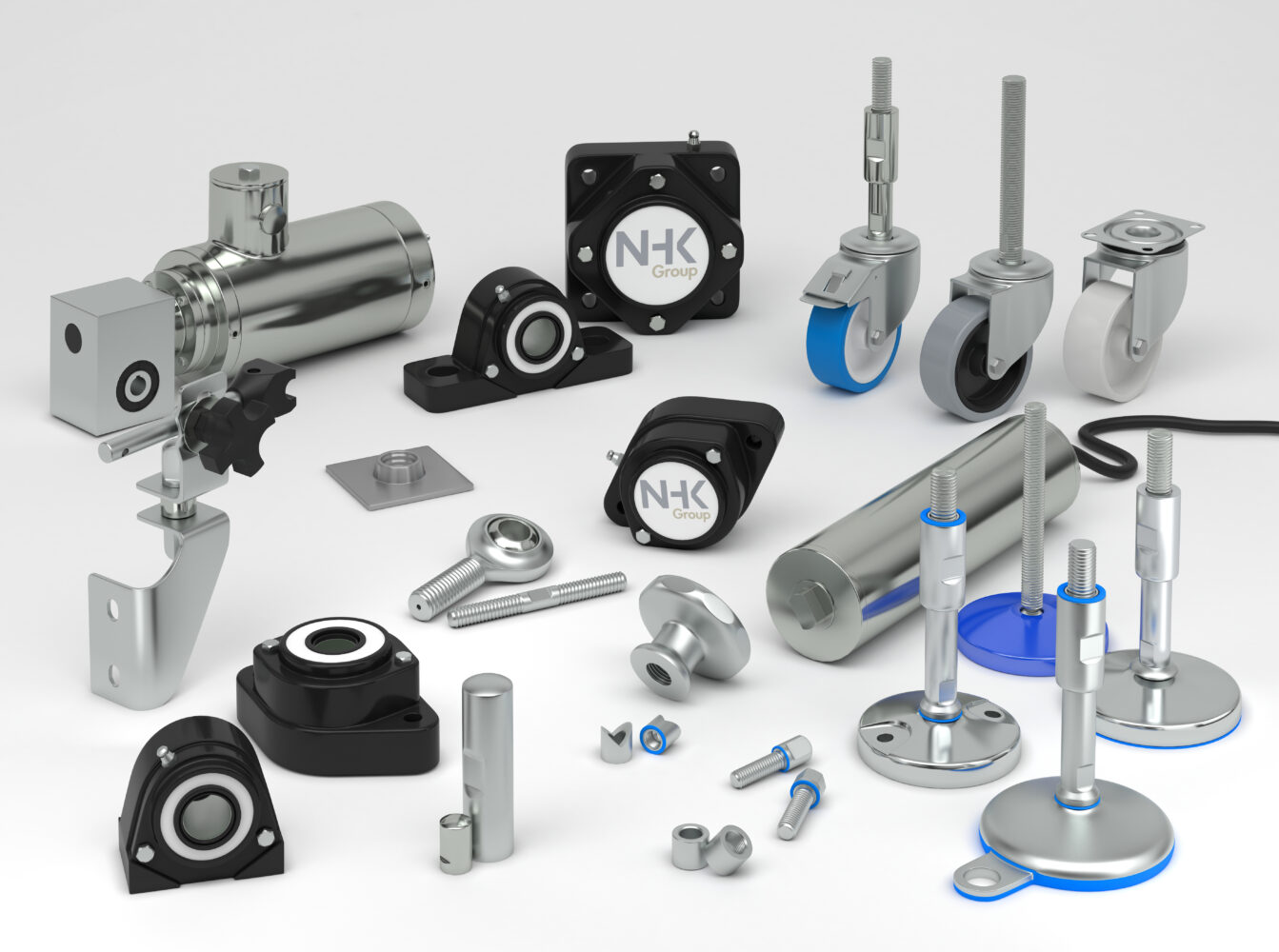
NHK Machinery Parts is the industrial machinery component range of NHK Group ApS, a supplier in Assens, Denmark, that provides bearing units, machine levelling feet, castors, conveyor components and stainless steel hygienic parts for food, dairy, beverage and pharmaceutical machinery. NHK Group also publishes this site.
This page sets out, with verified facts only, what the range covers and which certificates apply. It then gives a practical method that matters regardless of supplier: how to replace or adapt a part on existing equipment so the failure does not return. For the cost side of that decision, see how machinery components drive manufacturing success.
What NHK Machinery Parts supplies
| Product group | Typical application | Where to look |
|---|---|---|
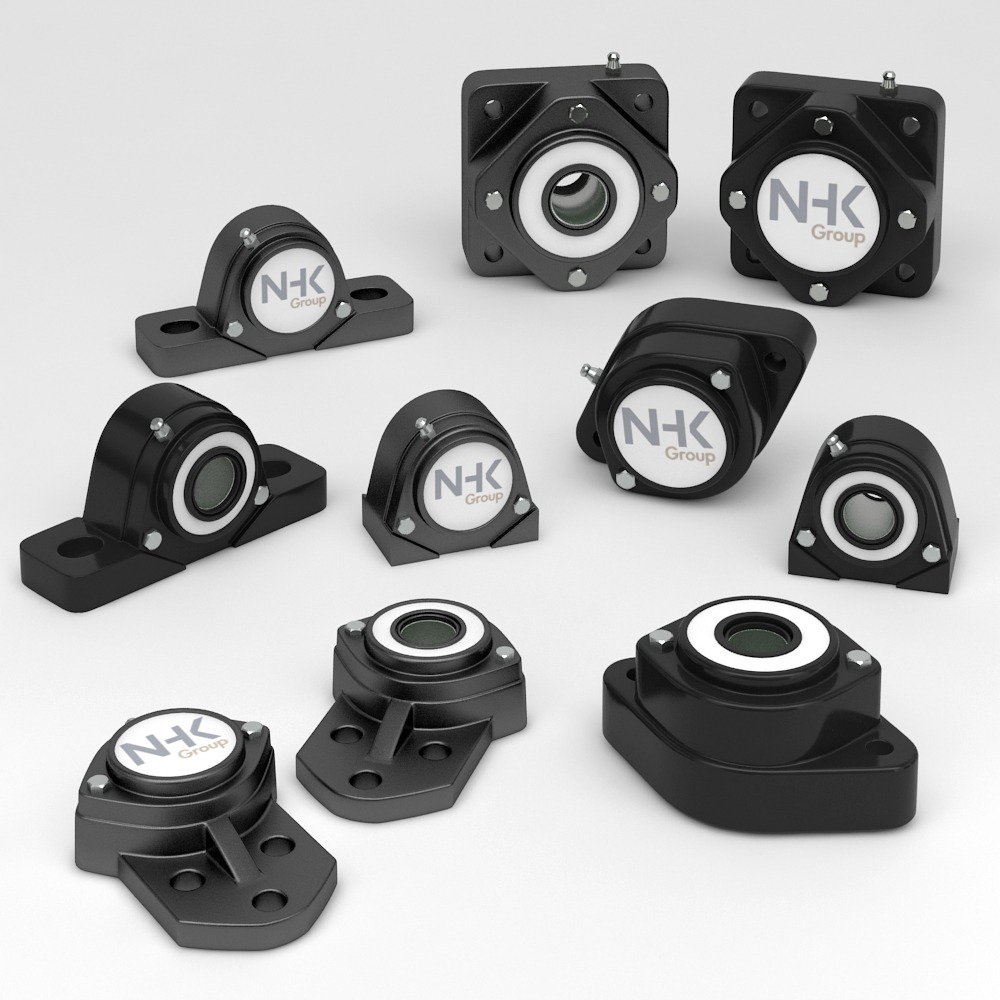
| IP67 waterproof bearing house units | Wet areas where water ingress shortens bearing life | IP67 bearing units |
| Bearing units in IP54 thermoplastic/composite housing | Non-corroding housing for wet or cleaned areas | Thermoplastic bearing units |
| Sealed stainless steel bearing units | Washdown zones, corrosive cleaning agents | Sealed stainless bearing units |
| Mounted ball bearing units and mini stainless bearing units | General and compact shaft support | Product line |
| Stainless steel machine levelling feet | Levelling and supporting machines in hygienic areas | Levelling feet |
| Solid base feet and adjustable feet with composite base plate | Support with different base and floor requirements | Product line |
| Stainless steel and noise-reducing castors | Mobile frames, trolleys, carts | Castors |
| Conveyor components and side guides | Guiding product on conveyor lines | Conveyor components |
| Other hygienic machinery components in stainless steel | Fasteners, handles and machine hardware | Hygienic components |
The full range is in the NHK product line.
A note on ingress ratings: IP67 (IEC 60529) is a temporary immersion test, not a high-pressure washdown test; IP69K (ISO 20653) covers high-pressure, high-temperature water jets. Neither is a hygiene certification.
Which certificates apply – and to what
NHK lists the following, as stated on nhkmachineryparts.com:
- EHEDG-certified bearing – certificate C2400043.
- EHEDG-certified component – certificate C2300067.
- EHEDG-certified levelling feet – certificate C2400039.
- 3-A authorised machine levelling feet and supports, and 3-A authorised parts and system components.
- Component materials intended for food contact comply with FDA regulations, as stated by NHK.
How to read these:
- EHEDG certifies a specific design after review against its hygienic design guidelines. Other NHK products may be hygienically designed, but only these designs are certified.
- 3-A Symbol authorisation follows a Third Party Verification of a specific design against a 3-A Sanitary Standard.
- Both schemes are voluntary. In the EU, legal requirements for food machinery come from machinery law and standards such as EN 1672-2 and EN ISO 14159, and food-contact materials must comply with EC 1935/2004. NHK's stated FDA compliance does not by itself cover EU food-contact rules – ask for the relevant declaration of compliance.
Details: NHK's certifications.
Industries served
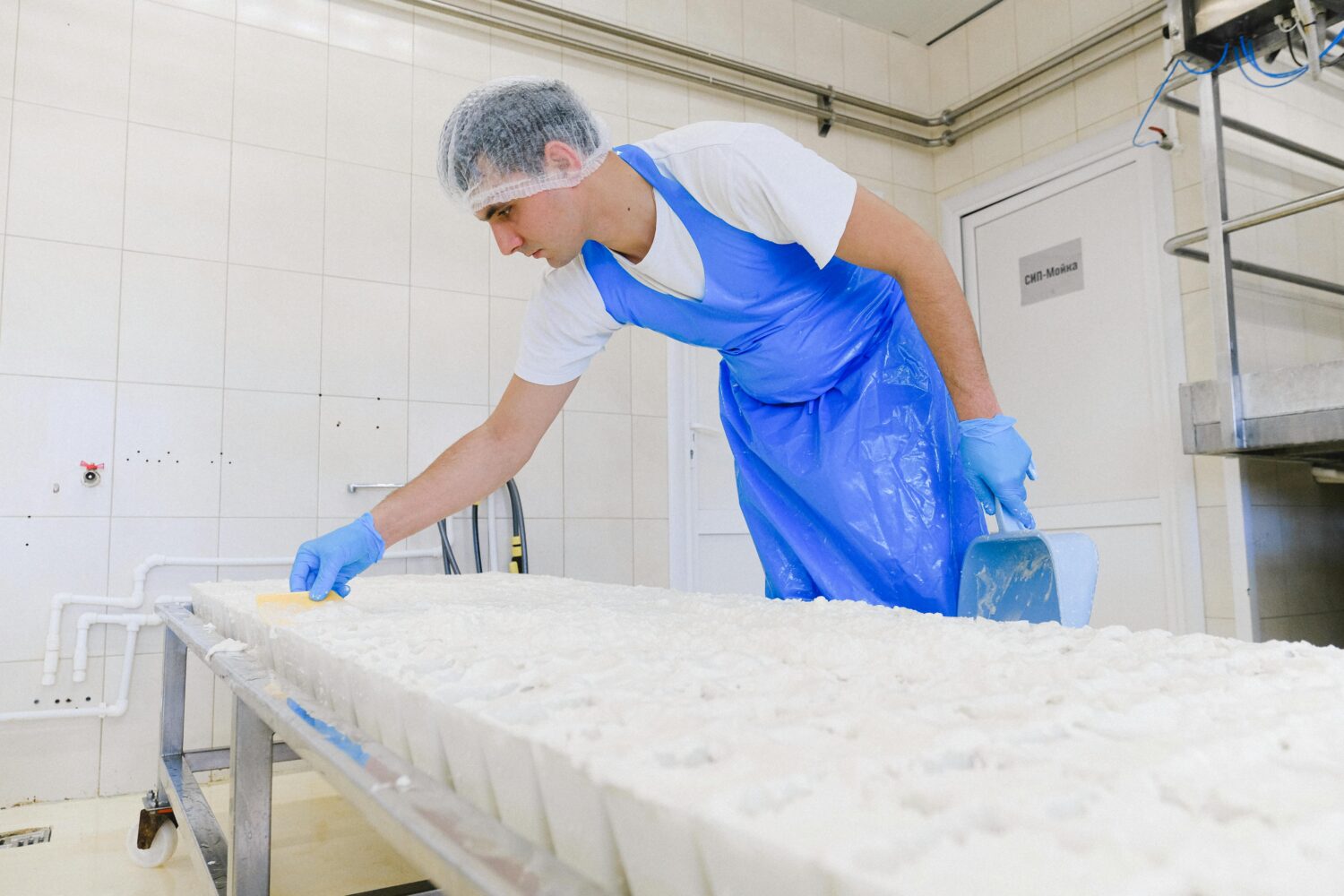
NHK serves food processing, dairy, beverage, pharmaceutical and other hygiene-critical production. These share three requirements for components:
- Cleanability: no exposed threads, crevices or flat surfaces where residue collects. A harbourage point is a place where residue and microorganisms survive cleaning.
- Corrosion resistance: daily cleaning with alkaline detergents and chlorinated or acidic disinfectants. Chloride pitting – local corrosion caused by chlorides – affects AISI 304 more than AISI 316L.
- Documented materials: food-contact compliance for plastics, elastomers and lubricants.
Replacing parts on existing equipment
Much component work is not on new machines but on existing lines: a bearing that fails every few months, a foot that corrodes, a guide that wears. The common mistake is to replace like-for-like and wait for the next failure.
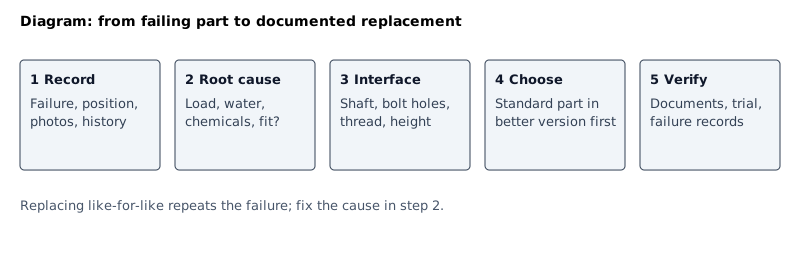
- Record the failure: which part, which position, how often, photos of the failed part, operating and cleaning conditions.
- Find the root cause: water and detergent ingress, corrosion, lubricant washout, overload, misalignment, wrong fit. The failed part usually shows it – rust, washed-out grease, uneven wear.
- Measure the interface: shaft diameter, centre height, bolt pattern and hole size for bearing units; thread size, stem length and load for feet; mounting dimensions for guides.
- Choose a better version with the same interface: a stainless or composite housing instead of painted cast iron, a sealed unit instead of an open one, a foot without exposed thread, AISI 316L instead of 304.
- Verify: check datasheet, certificates and declarations of compliance; trial on one position; compare failure records after a defined period.
Failure causes and typical corrections
| Observed failure | Likely cause | Typical correction |
|---|---|---|
| Rusted bearing housing, rough running | Water ingress, corroding housing | Sealed stainless or thermoplastic housing, closed covers |
| Grease washed out | High-pressure washdown at seal | Better seal, sealed-for-life unit, adjusted cleaning direction |
| Pitting on stainless feet or fasteners | Chlorides from disinfectant or salt | AISI 316L, rinse after disinfection |
| Rocking frame, loose lock nuts | Uneven floor, too few feet carrying load | Re-level, larger load margin, articulating base or anchoring |
| Residue at bolt heads or foot threads | Exposed thread, crevices | Hygienic bolts with sealing washers, sealed feet |
| Worn side guides | Abrasion, wrong material | Wear-resistant engineering plastic, adjustable guides |
Elastomer compatibility decides seal life: EPDM suits hot water and steam but not fats and oils; FKM resists oils and many chemicals; VMQ (silicone) handles wide temperatures but is mechanically weaker.
When a custom part is justified
A custom part makes sense when no standard part fits the interface, load or space, or when a standard series has no suitable material or seal version. It brings longer lead times, harder replacement and more documentation, so exhaust standard versions first.
Example: bearing failures on an older vegetable washer
Assumptions (illustrative): an older vegetable washer with painted cast iron pillow blocks, daily foam cleaning, a bearing replaced every few months.
- Record: failures always on the two bearings nearest the spray bar; housings rusted, grease washed out.
- Root cause: direct spray and water ingress; corroding housing.
- Interface: shaft diameter, centre height and bolt pattern measured and kept unchanged.
- Choice: sealed bearing units in stainless or thermoplastic housing with the same interface; seal material checked against the detergent.
- Verify: fitted on the two worst positions first; failure log compared after a defined period before changing the rest.
What to ask any component supplier
- Datasheets with load ratings, materials and dimensions.
- Certificate numbers for the exact designs claimed as EHEDG-certified or 3-A authorised.
- Declarations of compliance for food-contact materials.
- Technical answers to your load, cleaning and chemical questions.
- Availability of spares, seals and replacement parts.
Contact details
NHK Group ApS, Staermosevej, 5610 Assens, Denmark · phone (+45) 2492 5030 · HMP@nhkgroup.eu. Representative offices: Barcelona, Paris, Milano, Thessaloniki, Stuttgart, Rotterdam, Warszawa, Quebec, Manchester, Mongkok, Milwaukee. More on the company: NHK Machinery Parts.