EHEDG components and parts are machine parts whose specific design has been certified against the hygienic design guidelines of EHEDG, the European Hygienic Engineering & Design Group. Food production is closely regulated, and contamination can occur at any stage – raw material handling, processing or packaging. On machines that look hygienic overall, the weak points are often the small parts: bolts, nuts, handles, knobs and feet.
This page focuses on that hardware level: where standard parts create contamination risks, what hygienic versions change, and how to specify them. For the full picture of what EHEDG certification involves, see EHEDG certified design and energy savings; for the base of the machine, see hygienic levelling feet.
What EHEDG is – and what it certifies
EHEDG is not a standard or a regulation. It is a consortium that publishes guidelines on hygienic design and certifies specific equipment and component designs against them. Important points:
- The certificate applies to a specific design – one bolt type, one handle, one foot – not to a manufacturer, a factory or a material.
- Certification is voluntary. Legal cleanability requirements come from machinery law and standards such as EN 1672-2 and EN ISO 14159; food-contact materials must comply with EC 1935/2004.
- Certified designs are listed in the EHEDG database. Ask for the certificate for the exact part number. How to check one is explained in introducing the EHEDG components.
Products described as "hygienic design" or "designed to EHEDG guidelines" may be well designed, but they are not certified unless a certificate exists. The EHEDG components and parts on this product line show examples of certified hardware.
Why small hardware is a contamination risk
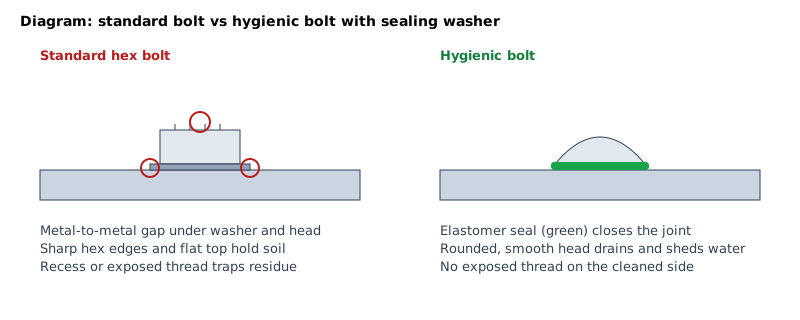
Hygienic design aims to remove harbourage points – places where residue, allergens and microorganisms survive cleaning. Standard hardware creates several:
- Crevices: narrow gaps, such as under a flat washer or between a bolt head and the frame, which cleaning fluid cannot flush.
- Exposed threads: helical grooves that hold soil and are almost impossible to clean by spray or foam.
- Recesses: hex sockets and slots in screw heads fill with residue.
- Flat, horizontal surfaces: hold water and soil instead of draining. Self-draining surfaces slope so liquid runs off.
- Metal-to-metal contact: tight joints where liquid wicks in and dries, also a site for corrosion.
Each fastener is small, but a machine frame can have hundreds. Allergen changeover – cleaning between products with different allergens – exposes them quickly: residue in one bolt recess can be enough to fail a swab test.
Standard vs hygienic hardware
| Part | Standard design – risk | Hygienic design – feature | What to check |
|---|---|---|---|
| Bolts and screws | Hex head, socket recess, crevice under washer | Rounded head without recess, elastomer sealing washer | Seal material, tightening torque, certificate |
| Nuts | Exposed thread end, flat faces | Domed cap nut with integrated seal | Thread fully enclosed, seal seat |
| Handles | Joints, screw holes, recesses | One-piece or sealed joints, smooth radii | Seal at mounting, surface finish |
| Knobs and clamping levers | Threaded insert, gaps between parts | Sealed insert, closed geometry | Disassembly for inspection |
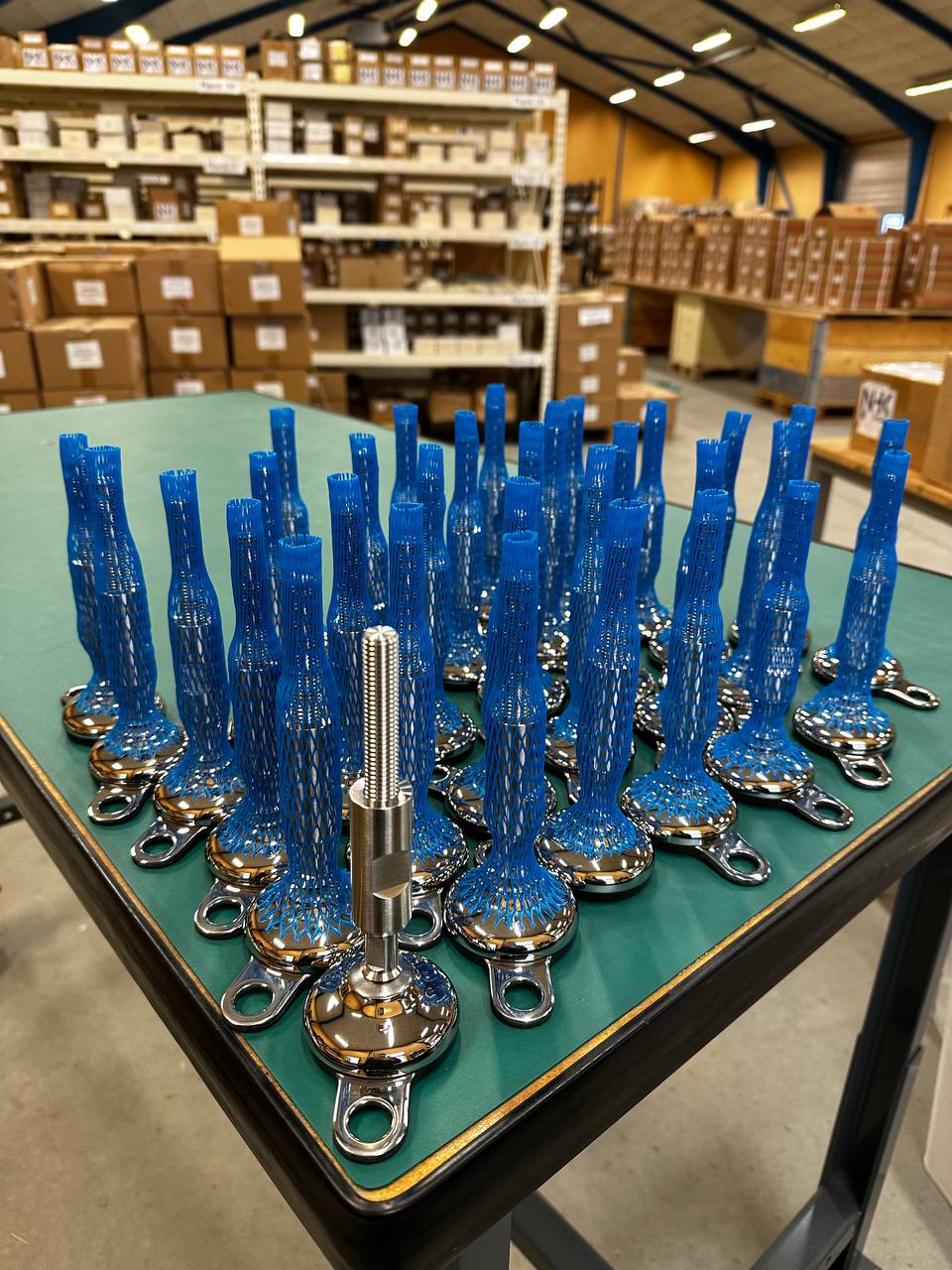
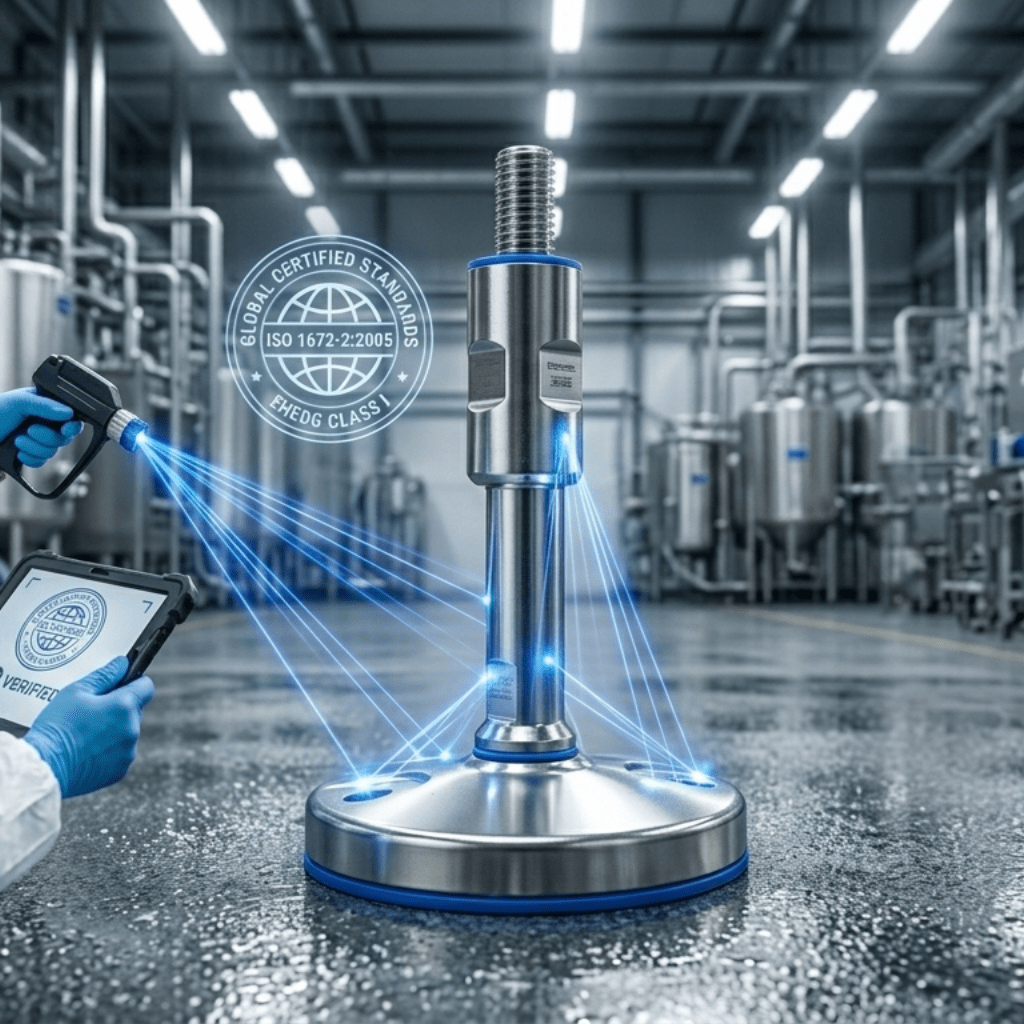
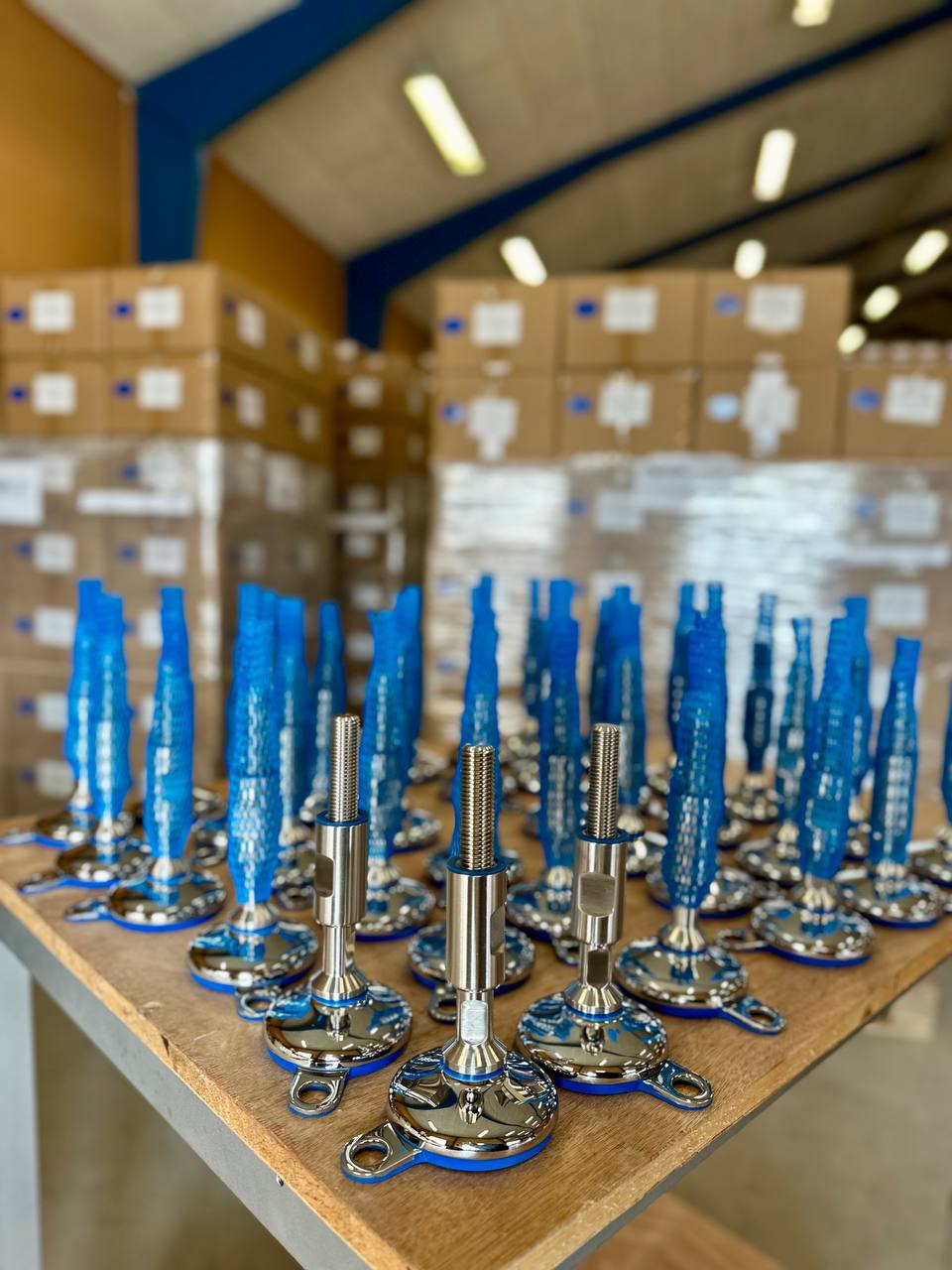
| Levelling feet | Exposed spindle thread, open base | Sealed spindle, smooth base, no exposed thread | Load rating, seal, base material |
| Conveyor parts | Open bearings, hollow rollers, crevices at joints | Sealed bearings, closed profiles, open frames | Cleanability of guides and fixings |
Fasteners: bolts and nuts
Hygienic bolts and nuts provide secure assembly while keeping the joint closed. The key is the elastomer sealing washer under the head: tightened to the right torque, it seals the gap so neither liquid nor soil enters the thread. Over-tightening damages the seal; under-tightening leaves a gap. Domed cap nuts, such as EHEDG-certified nuts, cover the thread end.
Handles and knobs
Handles and knobs are touched by operators and cleaned often. Hygienic versions have smooth surfaces, generous radii and sealed mounting points, so soil does not collect in joints (how to choose hygienic handles and locks) – see the example of EHEDG-certified handles.
Conveyor components
Conveyors carry product through the line and need hygienic belts, rollers, guides and fixings. Hygienic conveyor components are made from materials that do not absorb moisture or degrade under cleaning, and they have no crevices where bacteria can survive. Belts and rollers must withstand the cleaning temperatures and chemicals used.
Materials for EHEDG components
- Stainless steel: the default for fasteners, handles and feet, because of its corrosion resistance and cleanability. AISI 304 suits general use; AISI 316L adds molybdenum for better resistance to chloride pitting (local corrosion caused by chlorides in water, salt and some cleaning agents). Passivation restores the protective chromium oxide layer after machining or welding.
- Food-grade plastics: for some seals, covers and parts in direct food contact; they do not corrode and are easy to clean, but have lower temperature and load limits. In the EU, plastics in food contact also fall under EU 10/2011.
- Elastomers: for sealing washers and gaskets. Elastomer compatibility decides seal life: EPDM suits hot water and steam but not fats and oils; FKM resists oils and many chemicals; VMQ (silicone) handles wide temperature ranges but is mechanically weaker. In the US, rubber food-contact parts are covered by FDA 21 CFR 177.2600.
Avoid mixing dissimilar metals in wet zones: galvanic corrosion occurs when two metals with different electrochemical potentials are in electrical contact through a liquid. For hardware exposed to aggressive chemicals, heat and high-pressure cleaning, see EHEDG-certified components in harsh environments.
Where EHEDG components matter by industry
| Industry | Typical equipment | Main hygiene concern for hardware |
|---|---|---|
| Dairy | Pasteurisers, homogenisers, filling machines | Milk residue and biofilm; daily CIP |
| Meat and poultry | Conveyors, grinders, cutting equipment | Salmonella and E. coli; daily high-pressure and foam washdown |
| Beverage | Valve seals, pumps, fillers | Microorganisms and sugar residues |
| Confectionery and bakery | Mixers, dough sheeters, packaging | Allergens and dry residue; often dry cleaning |
| Pharmaceutical | Processing and packaging equipment | Cross-contamination; validated cleaning and documentation |
How to select and specify hygienic hardware
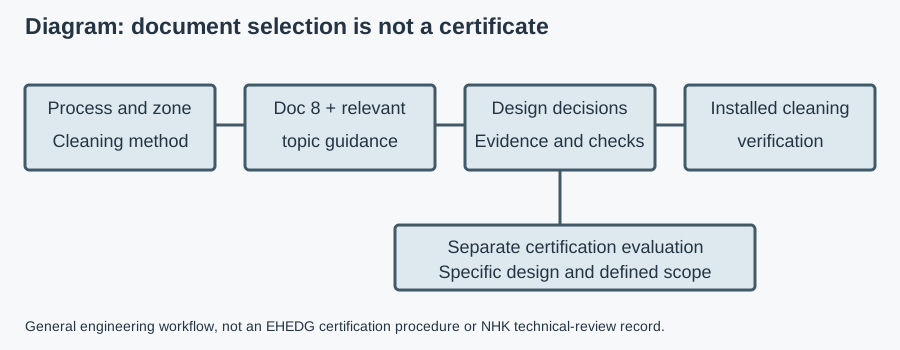
- Define the zone: product-contact, splash zone (where liquid or product can splash and return to the product) or non-contact.
- Define the cleaning method: CIP (cleaning in place), COP (cleaning out of place), foam, high-pressure washdown or dry cleaning, with chemicals and temperatures.
- Choose material: AISI 304 or 316L depending on chlorides and chemicals; plastic where suitable.
- Choose seal elastomer to match chemicals and temperature.
- Check geometry: no exposed thread, no recesses, rounded and self-draining surfaces.
- Request documents: EHEDG certificate for the exact part (if required), material certificate, declaration of compliance for food-contact materials (the supplier's written statement that the material meets applicable regulations).
- Define installation and inspection: tightening torque for sealed fasteners and seal inspection intervals.
Example: replacing hardware on a cutting-line guard
Assumptions (illustrative): a guard on a meat-cutting line held by standard M8 hex bolts with flat washers; daily foam cleaning with chlorinated alkaline detergent; residue found under washers at swab checks.
- Zone: splash zone above the product.
- Choice: hygienic bolts in AISI 316L with EPDM sealing washers – EPDM suits the alkaline detergent and hot water; fats are limited on a guard.
- Installation: tighten to the supplier's specified torque so the seal compresses evenly.
- Inspection: check seals for cracks or extrusion at each planned maintenance stop and replace damaged seals.
- Result to verify: repeat swab tests at the bolt positions after the change.
Inspection and failure modes
- Damaged or extruded seals: from over-tightening or chemical attack – replace and correct the torque or elastomer.
- Missing seals after maintenance: standard washers fitted by mistake – keep hygienic spares at the line and mark them.
- Corrosion at contact points: wrong grade or galvanic contact – change material or isolate metals.
- Loosening from vibration: seal relaxation – check torque at the first maintenance after installation.