EHEDG components are standard machine parts – bolts, nuts, handles, locks, spacers and hygienic feet – designed to the hygienic design guidelines of EHEDG (the European Hygienic Engineering & Design Group) so that they do not trap dirt or bacteria and are easy to clean. They are used where hygiene is critical: food processing, pharmaceuticals and biotechnology.
This page introduces the component family – what each part type does and which hygiene problem it solves – and explains how to verify that a part sold as "EHEDG" really is certified. For the fastener-level details, see safe food production with EHEDG components and parts.
What makes a component an "EHEDG component"?
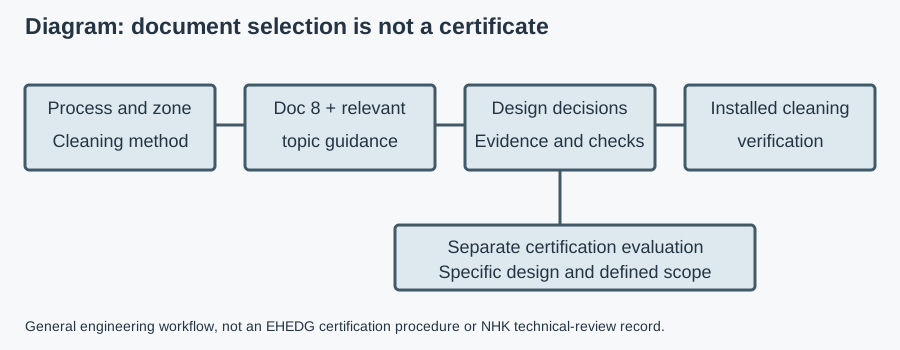
Use the guideline scope and installed-interface review guide to turn a design-basis statement into document references and evidence questions.
EHEDG publishes guidelines for hygienic design and certifies specific designs that meet them. How EHEDG fits with the legal requirements is shown in hygienic machine design standards. The design principles behind all EHEDG components are the same:
- No crevices: narrow gaps that cleaning fluid cannot flush.
- No exposed threads: threads hold soil and are very hard to clean.
- No dead spaces: areas where liquid or product stagnates.
- Self-draining surfaces: sloped or rounded so water and detergent run off.
- Smooth surfaces: EHEDG guidance gives Ra (average surface roughness) ≤ 0.8 µm for product-contact surfaces.
- Suitable materials: corrosion-resistant, typically stainless steel, with food-contact-compliant elastomer seals.
A part that breaks one of these principles creates a harbourage point – a place where residue and microorganisms survive cleaning.
The EHEDG component family
| Component | Function | Hygiene problem solved | Key design features |
|---|---|---|---|
| Bolts | Fasten guards, covers, frames | Recesses in heads, crevice under washer | Rounded head without recess, elastomer sealing washer |
| Nuts | Close bolt and stud ends | Exposed thread end | Domed shape, thread enclosed, sealed seat |
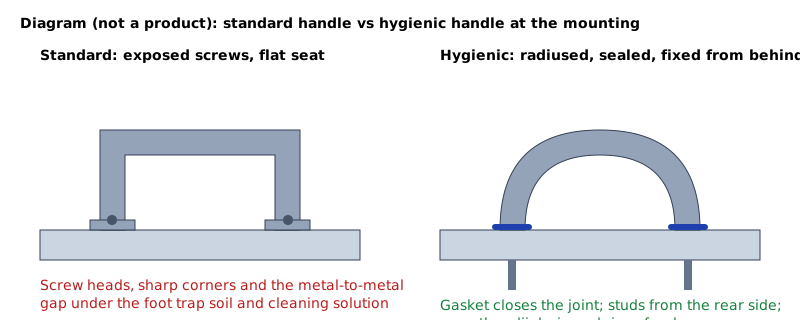
| Handles | Open, lift or hold parts | Joints and screw holes that trap soil | Smooth one-piece or sealed design, generous radii |
| Locks and latches | Secure guards and doors | Moving parts with gaps | Crevice-free, cleanable mechanism |
| Spacers | Keep defined gaps between parts | Metal-to-metal crevices | Rounded edges, polished, sealed ends |
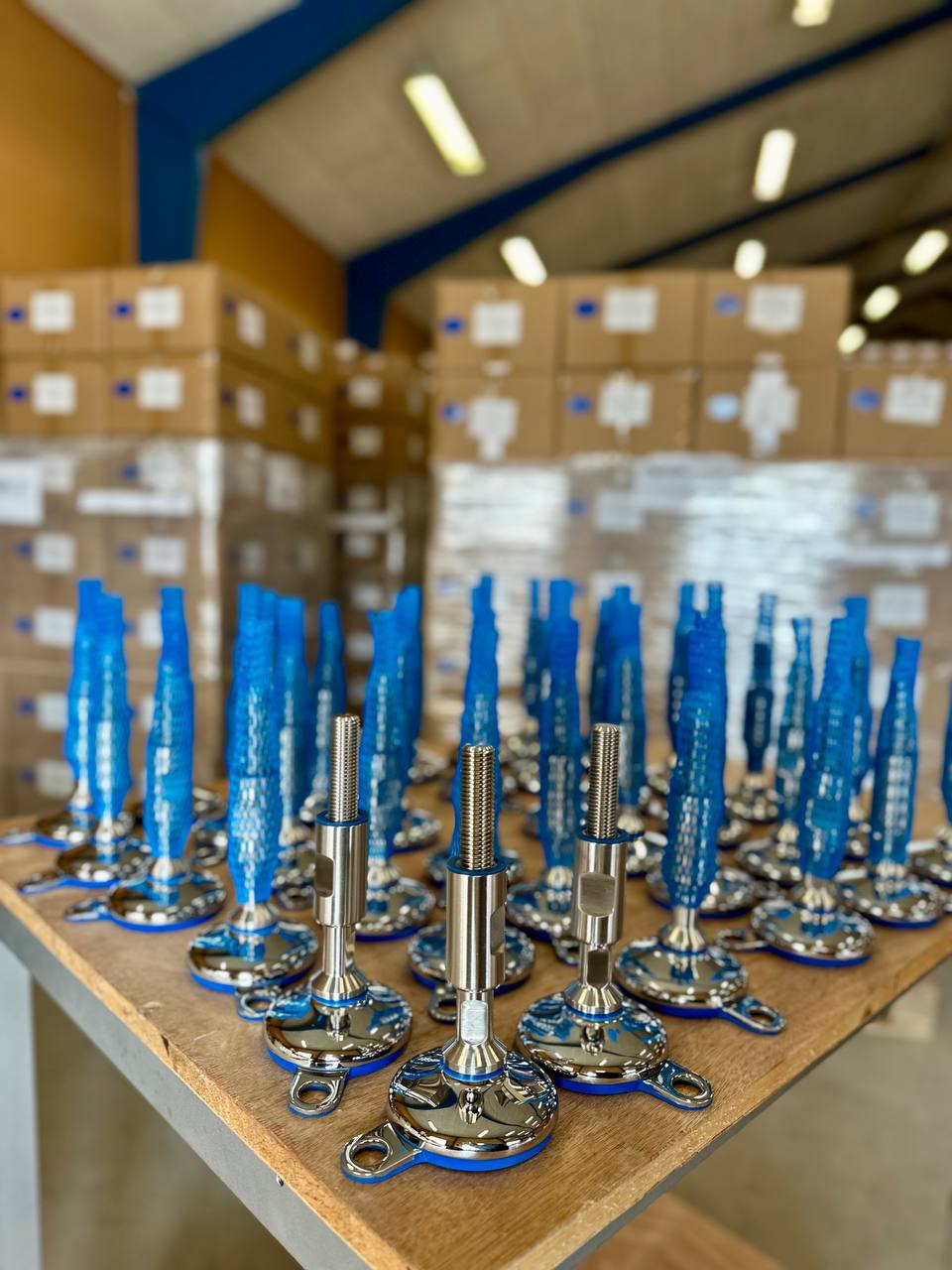
| Hygienic feet | Support and level machines | Exposed spindle thread, flat bases at floor | Sealed spindle, sloped surfaces, smooth base |
Bolts and nuts
Hygienic bolts and nuts are made of stainless steel for corrosion resistance. The decisive feature is the seal: an elastomer washer under a rounded head closes the joint so water and debris cannot enter the thread. Domed nuts enclose the thread end. Correct tightening torque keeps the seal compressed without extruding it.
Handles and locks Selection, sealing and installation are covered in the hygienic bolts guide.
Handles and locks are touched often and cleaned daily. Hygienic versions have no crevices or sharp edges and are mounted with sealed joints. For selection criteria, materials and lock mechanisms, see the guide to hygienic handles and hygiene locks. Ergonomic shapes keep them safe and easy to use with gloves – see the example of EHEDG handles.
Spacers
Spacers keep precise distances between machine parts while allowing cleaning and inspection. A spacer that creates a cleanable gap is better than a tight metal-to-metal joint, which is a crevice. They are made of stainless steel or other suitable materials. Use the standoff sizing and sealed-end selection guide to specify the joint.
Hygienic feet
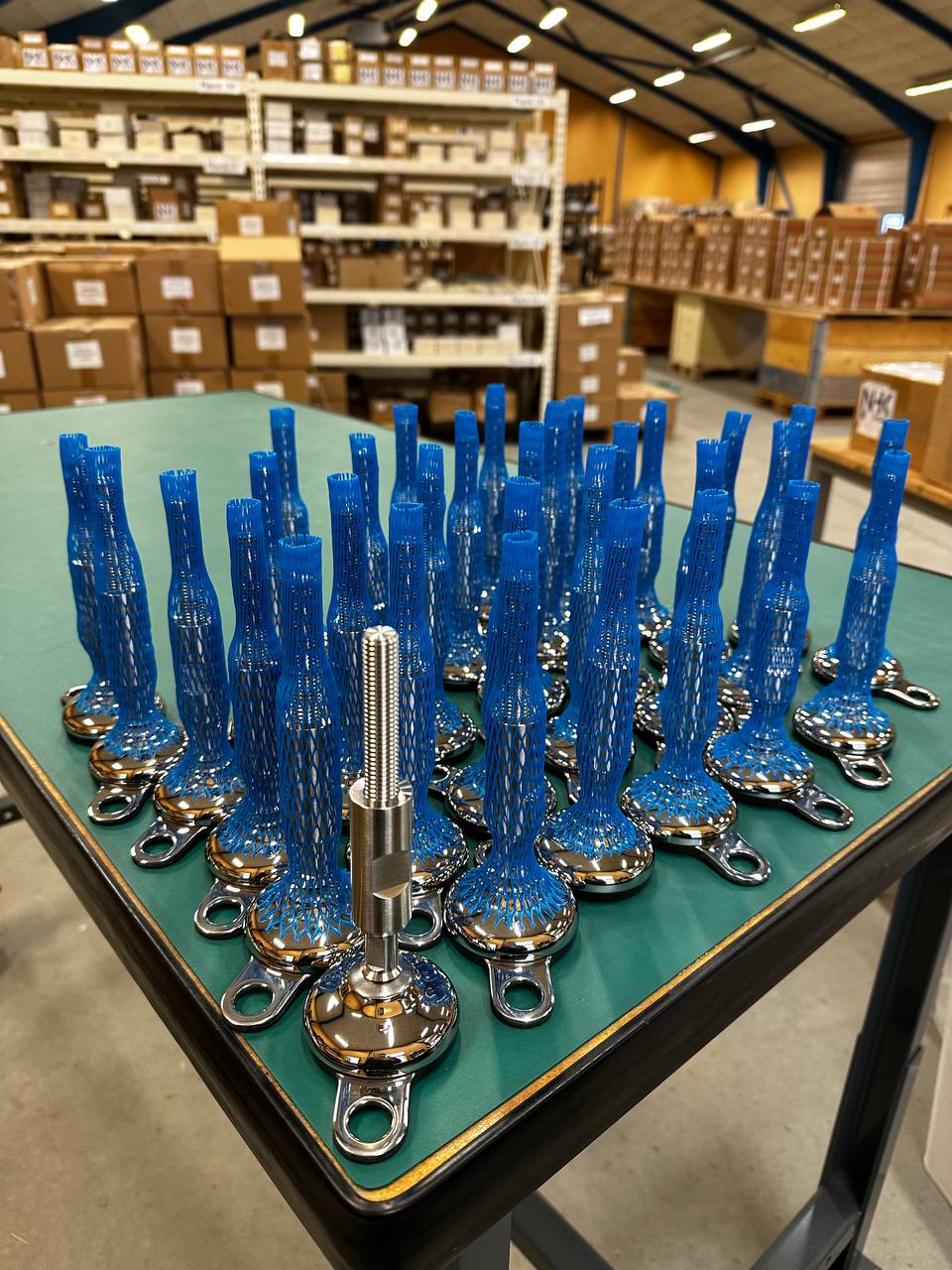
Hygienic feet support heavy machinery and keep it level and stable on uneven floors. Their sloped, smooth surfaces let liquids and cleaning agents drain, and a sealed spindle avoids an exposed thread at floor level, where soil and water collect. For selection, see hygienic levelling feet: clean design from the ground up.
How to verify an EHEDG certificate
What a certificate covers – types, classes and five-year validity – is explained in our guide to EHEDG certification.
Product listings often use "EHEDG" loosely. Before relying on it in a specification:
- Ask for the certificate number for the exact part, not a general statement.
- Look it up in the EHEDG public database of certified equipment.
- Check the holder: the certificate holder should match the manufacturer or supplier.
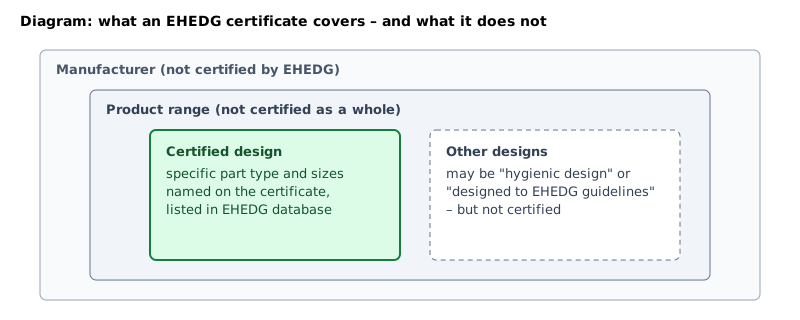
- Check the scope: does the certificate list the part type, sizes and variants you are ordering?
- Check validity: is the certificate current?
- Check the wording: "certified" needs a certificate; "hygienic design" or "designed to EHEDG guidelines" means no certificate.
| Wording on a datasheet | What it means |
|---|---|
| "EHEDG certified" + certificate number | Specific design certified – verify scope and validity |
| "EHEDG certified" without number | Ask for the certificate before relying on it |
| "Designed to EHEDG guidelines" | Manufacturer's own statement; not certified |
| "Hygienic design" | General claim; judge the design yourself |
| "3-A authorised" | Specific design authorised under a 3-A Sanitary Standard after Third Party Verification |
Certification covers the design's cleanability. It does not confirm that the material and seal suit your chemicals and temperatures, and it does not replace legal requirements such as EC 1935/2004 for food-contact materials. More background: everything you want to know about EHEDG certification.
What "EHEDG compliance" claims mean compared with a real certificate, and how 3-A SSI authorisation fits in, is covered in EHEDG and 3-A SSI certified components and parts.
Where EHEDG components are used
Food processing
Hygienic feet keep equipment stable; hygienic bolts and nuts give sanitary assembly; handles, locks and spacers allow operation and maintenance without adding crevices. Daily foam and high-pressure cleaning make sealed joints essential.
Pharmaceuticals
Equipment must support validated cleaning. Hygienic feet and smooth bolts reduce places where residue can remain, and cleanable designs shorten cleaning and maintenance stops. Documentation and material traceability are as important as the part.
Biotechnology
Bolts, nuts and spacers give stability and alignment for sensitive equipment; hygienic feet keep machines level and limit vibration transmission.
How to choose EHEDG components
- Material: stainless steel; AISI 316L where chlorides, salt or chlorinated disinfectants are present, because it resists chloride pitting (local corrosion by chlorides) better than AISI 304.
- Certification: verify the certificate as described above, where certified parts are required.
- Seal elastomer: match to chemicals and temperature – elastomer compatibility varies: EPDM for hot water and alkaline cleaners, FKM for fats and oils, VMQ for wide temperature ranges.
- Compatibility with the machine: thread size, length, load (for feet: load per foot with margin), mounting.
- Cleaning method: foam, high-pressure washdown or CIP (cleaning in place) – sealed joints for high-pressure.
- Documents: certificate, material certificate, declaration of compliance for food-contact materials.
Example: specifying hardware for a new cheese-handling conveyor
Assumptions (illustrative): a conveyor in a dairy, splash zone, daily alkaline foam cleaning and acid rinse, customer requires EHEDG-certified hardware where available.
- Bolts and nuts: hygienic bolts and domed nuts in stainless steel with EPDM seals (no fat-heavy soil; suits alkaline and acid cleaners). Certificate number requested and checked against the database.
- Handles: hygienic handles on removable guards, sealed mounting.
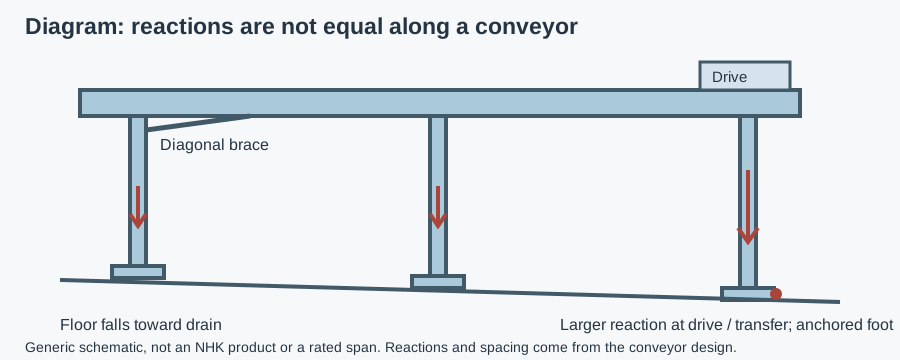
- Feet: hygienic levelling feet with sealed spindle; load per foot calculated with the assumption that not all feet carry load on an uneven floor.
- Documents: certificates, material certificates and declarations of compliance collected in the machine file.
Installation and inspection
- Tighten sealed fasteners to the specified torque.
- Inspect seals for swelling, cracking or extrusion at defined intervals.
- Keep hygienic spares at the line so standard parts are not fitted after maintenance.
- Re-level feet after moving the machine and check all feet carry load.