A belt scraper is a contact device that removes adhered product as the belt leaves discharge or enters its return path. This guide concerns a conveyor scraper for food lines, not a hand tool or a bulk-mineral cleaner. The conveyor and machine components overview covers the surrounding fittings. Start with the belt, residue and cleaning process rather than choosing a blade by width alone.
Carry-back is a residue pathway, not just spillage
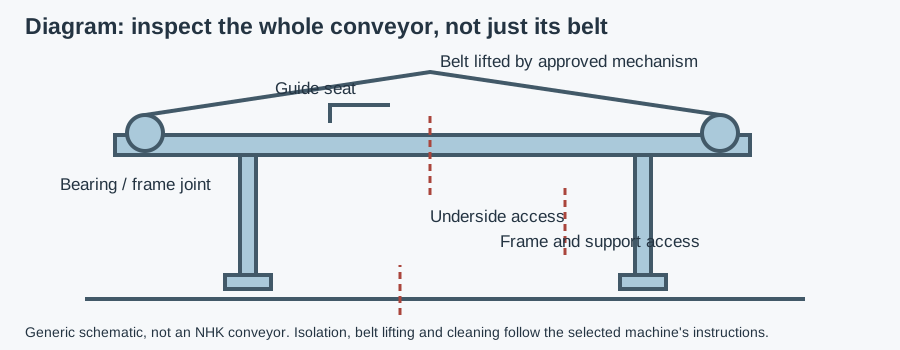
Assess the complete conveyor cleaning path so blade collection and underside access work together.
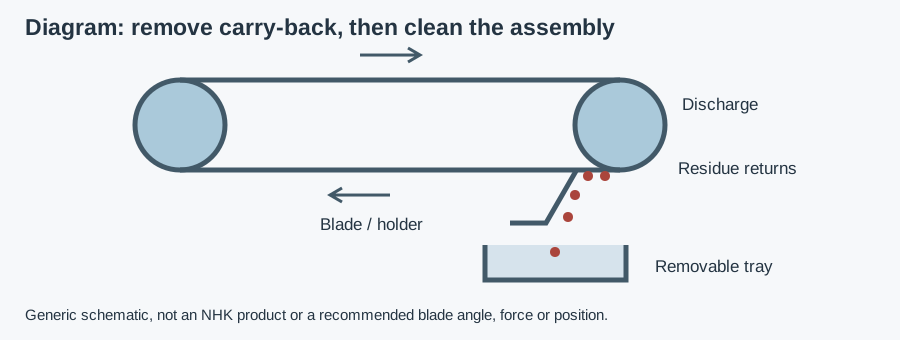
Carry-back is material remaining on the belt after the main product discharges. It can travel around the pulley, drop onto return supports or collect beneath the line. A scraper moves some of that residue to a chosen collection point. The collection path matters: a blade that sheds product onto a hidden cross-member has moved the cleaning problem rather than resolved it.
Assess residue type, where it adheres and where it falls. Sticky product, fine particles and films do not behave identically. Inspect the belt underside and return path through an approved safe procedure. Do not reach near a moving belt or pulley to check contact. Include restart and product changes when assessing whether residue returns to the product path.
Scraping is not sanitizing. A blade can remove visible material while soil remains on the belt or in its mounting. Allergen changeover requires the plant’s defined cleaning and verification process; mechanical removal alone cannot establish that a line is ready for the next product. Plan cleaning of the blade and tray, not merely the belt surface.
Belt scraper and conveyor scraper types: selection table
| Arrangement | Potential purpose | Limits to confirm |
|---|---|---|
| Continuous blade | Contact across a suitable belt surface | Belt profile, splice passage, pressure uniformity and removal |
| Segmented or compliant blade | Accommodate the selected belt geometry | Actual design approval, gaps, wear and segment retention |
| Spring or other tensioned holder | Maintain specified contact as wear occurs | Force-setting method, movement and cleanability of mechanism |
| Fixed adjustable holder | Set documented position and contact | Retensioning requirement and safe adjustment access |
| Removable holder/blade | Expose parts for cleaning | Safe removal, retention and repeatable reinstallation |
| Separate collection tray | Capture removed residue | Access, drainage, emptying and prevention of return to belt |
Send belt, splice and cleaning details for a scraper recommendation
Blade materials: compatibility before a generic label
Common scraper designs use polymer or metal contact parts, but suitability belongs to the complete blade/belt pairing. Polyurethane is used in some scraper products; its exact compound, hardness, wear and cleaning limits must be obtained from the supplier. Do not transfer wheel-material behavior or another blade’s documentation to a food-contact scraper.
Other plastics can provide particular stiffness or sliding properties. Metal blades may be appropriate in some approved arrangements but can damage an incompatible belt or splice. A stiffer edge is not automatically a better cleaner. Establish product adhesion, belt surface and the permitted contact method before comparing material options.
Request the exact blade identity and food-contact declaration for the intended food types, temperatures and contact times. The food-contact component materials guide explains why “food grade” is incomplete evidence. EC 1935/2004 covers materials and articles within its food-contact scope; EU 10/2011 concerns plastics. FDA 21 CFR 177.2600 concerns applicable repeated-use rubber articles, not every polymer or assembled scraper.
Include bushes, seals and any lubricant where they can contact food or foreseeably transfer substances. Color does not establish compound identity, compliance or reliable fragment detection. If detectability is required, request evidence for the exact material and the plant’s detection method; no detectability performance is assumed here.
Belt surface and splice: check the moving interface
Identify belt construction: homogeneous, fabric-reinforced or modular. Record texture, profiles, cleats and the actual splice, including mechanical fasteners or a welded joint. These can interrupt the contact edge. A design approved for one smooth belt is not automatically appropriate for modular links, raised features or a mechanical splice.
Compare the belt-family cleaning and drive trade-offs before specifying the scraper's moving interface.
State belt speed, direction, reversals, pulley geometry and any permitted test operation. Request approved blade position, contact angle and clearance from the belt and scraper suppliers. No general distance, angle or force is prescribed. A tensioned holder can still be wrongly positioned or incompatible with a splice.
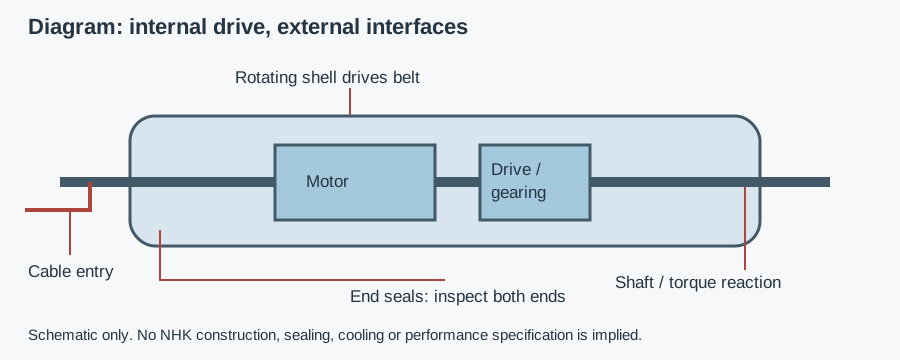
The drum motor and drive-duty selection guide provides context for belt pull and operating conditions. Added scraper drag belongs in the conveyor assessment, but do not estimate it from an invented friction value. Check whether contact changes with belt tracking, startup or wear and whether the tensioner has sufficient approved travel.
Hygienic mounting and controlled collection
The blade may be readily visible while its holder hides a soil trap. A harborage point is a location where residue survives cleaning; a crevice is a narrow interface that cannot be reached effectively. Inspect clamps, adjuster recesses, springs, cross-shafts and holder undersides. A stainless exterior does not establish accessibility inside the mechanism.
Use the migrated side-guide and conveyor mounting guide for related clamp-interface principles. Specify smooth accessible joints or designed seals, drainage and a clear removal path. Avoid opening a hollow frame cavity with an unsealed fixing. Sealed bolts cannot compensate for an inaccessible holder cavity.
Arrange the tray so removed residue can be collected without reaching into hazards or allowing it back onto the return belt. Check fill behavior, emptying access and cleaning. Self-draining surfaces shed liquid rather than retain it, but drainage must lead to an appropriate collection point, not onto adjacent equipment. Verify the installed orientation instead of relying on an isolated drawing.
Contact adjustment and commissioning
Follow the selected assembly’s force-setting and alignment procedure. Excess force may increase drag, wear or splice damage; insufficient force or uneven contact can leave streaks. Do not tighten repeatedly to compensate for a worn blade, belt distortion or poor mounting. Find the cause against the approved geometry and maintenance instructions.
- Identify and isolate. Confirm belt, blade and splice compatibility, then isolate hazardous energy and provide the access required by the equipment instructions.
- Set the documented geometry. Check holder alignment, fasteners, blade retention and adjustment range. Record the approved settings.
- Verify safely under operation. Use a guarded, controlled commissioning procedure; do not touch or manually adjust a moving belt unless the design provides a documented safe method.
- Inspect collection and wear. Check carry-back location, streaking, belt/splice condition and residue in the holder after isolation.
- Accept the cleaning state separately. Demonstrate removal, cleaning and correct reinstallation against the plant’s acceptance procedure.
A scraper does not guard a pulley nip or replace conveyor safety measures. Any new access opening, holder or collection arrangement must preserve the guarding system. Include blade replacement and tray removal in the risk assessment, not just normal running.
Example: a sticky-product discharge
Assumptions: a food belt carries sticky product, residue remains after discharge, and the line undergoes an allergen changeover. The belt construction, splice and supplier limits must be established. This is a hypothetical selection exercise; no product capacity, efficiency percentage or cleaning interval is claimed.
The engineer maps residue on the return belt and chooses a candidate only after both suppliers confirm the blade/belt interface. QA checks the blade, holder and tray removal route. Maintenance verifies safe access and repeatable contact adjustment. The commissioning record separates carry-back removal from sanitation acceptance.
If residue collects behind the holder, the mounting or cleaning access is changed rather than merely increasing blade force. If the splice catches, operation is stopped for compatibility review. The example yields an interface and cleaning specification, not a universal blade material recommendation.
Fault checks: do not solve every symptom with pressure
| Symptom | Check after safe isolation | Corrective direction |
|---|---|---|
| Residue streaks across belt | Uneven contact, damaged edge or belt profile | Restore approved alignment or replace worn blade |
| Splice catches or belt marks | Blade/belt compatibility and geometry | Stop and obtain approved arrangement |
| Excess drag or heat | Contact setting, wear and duty | Investigate against supplier limits |
| Soil behind holder | Removal access, drainage and cleaning procedure | Improve approved access or redesign mounting |
| Fragments or loose segments | Wear, retention and material damage | Follow plant product-control procedure and replace parts |
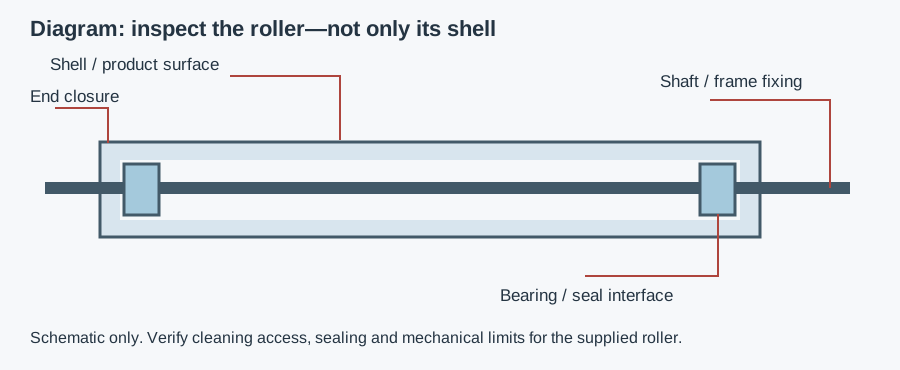
The conveyor roller and return-support guide helps assess where carry-back may reach the return equipment. Do not assume a cleaner belt means bearings or frame undersides are clean. Inspect the whole path and investigate material damage under the plant’s foreign-body control procedure. Use the related food-processing equipment and zone guide to place the cleaning assessment in its process context.
RFQ and cleaning handover
Copyable RFQ: “Assess a scraper for the attached belt/discharge drawing. Belt construction, width, surface and splice: … Product and operating direction/speed: … Confirm approved blade compound, contact geometry, setting method, retention and wear limits. Provide food-contact documentation for intended use, safe removal instructions and cleaning limits. Collection path, quantity and delivery country: …”
Use the component buyer’s documentation guides for the purchasing handover. Include spare blade identity and a repeatable reinstallation check. Cleaning staff need access and acceptance criteria, while maintenance needs isolation, adjustment and replacement instructions; neither can be replaced by a material certificate alone.
NHK’s conveyor-component category for belt-cleaning enquiries is the approved product enquiry path. It does not establish a specific scraper assembly, blade compound, contact force or certificate. Send the application details for NHK to confirm availability and documentation, recommend suitable components where available and prepare a quote.