Conveyor rollers are rotating supports, not interchangeable tubes. Start by identifying what touches the roller: a sealed carton, a reusable crate, unpackaged food or a belt underside. This guide covers stainless steel conveyor rollers and hygienic conveyor rollers. The Conveyor and machine components overview provides the wider assembly context.
For the surrounding frame and cleaning sequence, use the stainless steel conveyors selection guide.
Stainless vs plastic conveyor rollers: selection criteria
Compare the actual roller construction, not a material label. Stainless shells can contain polymer end caps, different bearing steels and elastomer seals. Plastic rollers may contain metal shafts or bearings. No material family supplies one universal load, chemical or temperature rating.
| Criterion | Stainless shell: check | Plastic shell: check | Decision evidence |
|---|---|---|---|
| Product contact | Alloy, surface condition, joints and finish | Exact resin and finished-article compliance | Intended food, contact time and cleaning conditions |
| Load and span | Tube wall, shaft, bearing and deflection limits | Stiffness, sustained loading and temperature effects | Rating for the supplied face length and support arrangement |
| Cleaning chemicals | Grade and corrosion exposure at shell and ends | Compound compatibility, swelling and surface damage | Named chemicals, concentrations, temperatures and exposure |
| Handling | Surface friction, marking and impact on the item | Surface friction, wear and deformation | Trial with the actual package and transfer geometry |
| Bearings and ends | Protection is independent of shell alloy | Protection is independent of resin identity | Seal details, end-cap joint and maintenance instructions |
| Hygiene | Closure integrity and accessible shaft interfaces | Closure integrity, damage and accessible interfaces | Cleaning procedure and acceptance inspection |
Send your roller layout and cleaning cycle for a component recommendation
Choose stainless where the documented assembly meets the required rigidity, exposure and surface requirements. Consider plastic where its actual grade and construction support the contact, handling and cleaning duty. Exclude either option when the supplier cannot substantiate a critical limit. A smooth-looking sample cannot resolve missing chemical data or an unsupported shaft span.
For stainless shells, request the actual alloy rather than prescribing 304 or 316L from the word “food.” Cleaning chemistry and corrosion exposure must be assessed alongside welds, finish and end construction. For plastic shells, request the exact resin and grade: color and a generic polymer name do not establish compliance or dimensional stability under sustained load.
Define the roller's job before specifying dimensions
Product-carrying rollers support the package directly. Belt-support rollers carry a belt, so belt tension, tracking and contact differ from those of a carton conveyor. A driven roller transmits torque; a gravity roller depends on the item, slope and rolling resistance. A motorized roller adds electrical and drive limits that a passive roller does not have.
Describe starts, stops, accumulation and impacts at transfers. During accumulation, rollers may continue moving beneath a stopped item; check abrasion, heat and package damage for that operating mode. Do not assume a roller's rotating-load rating also describes a stalled drive or long-term static support. The belt and conveyor-family selection by product and zone helps decide whether a roller conveyor is appropriate at all.
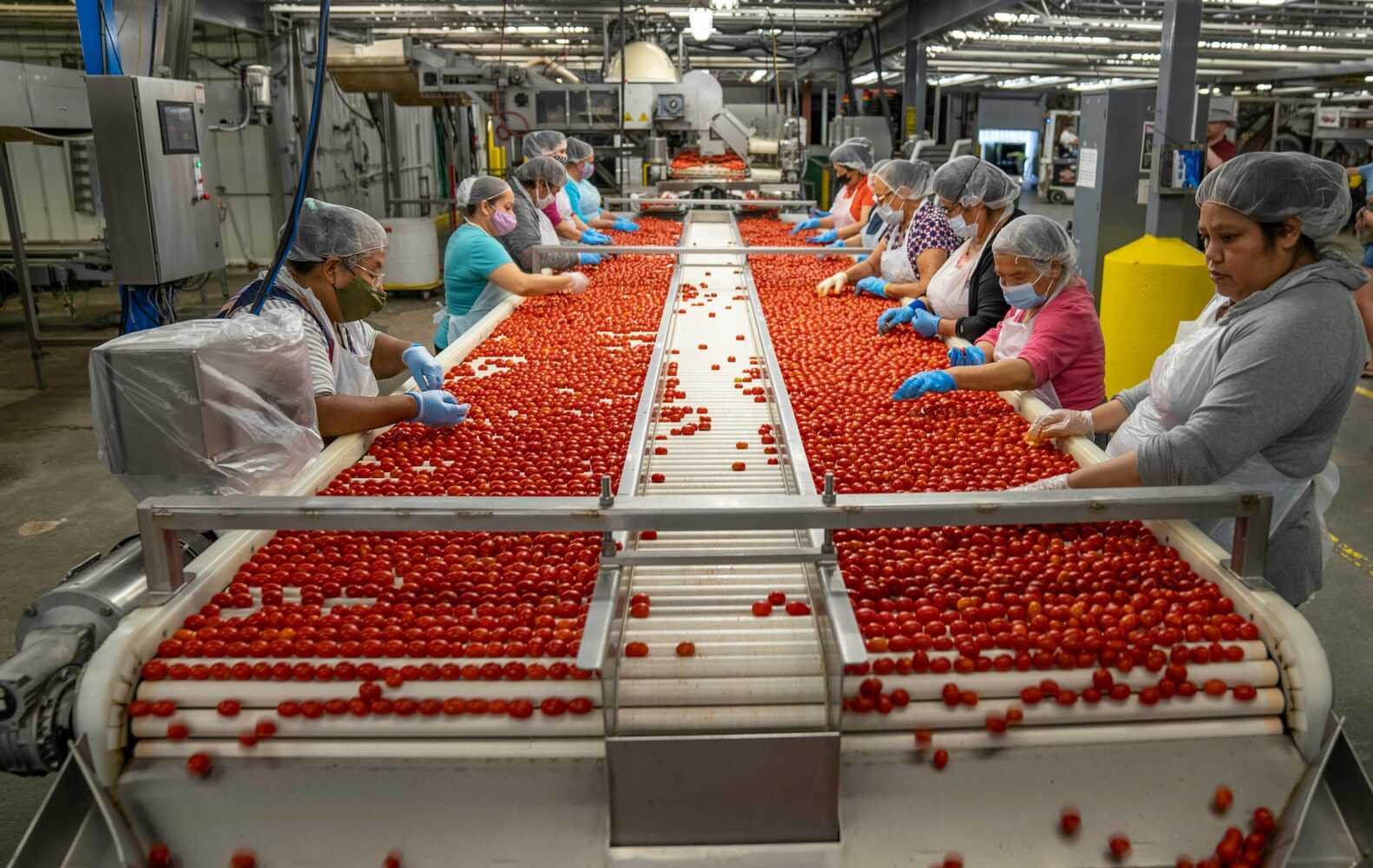
Flat-bottomed rigid containers are easier to support consistently than flexible bags or packages with recessed feet. Small unpackaged pieces may fall between rollers; fragile surfaces may be marked. Change the conveyor concept when product support cannot be made reliable, rather than solving every transport problem with a larger roller.
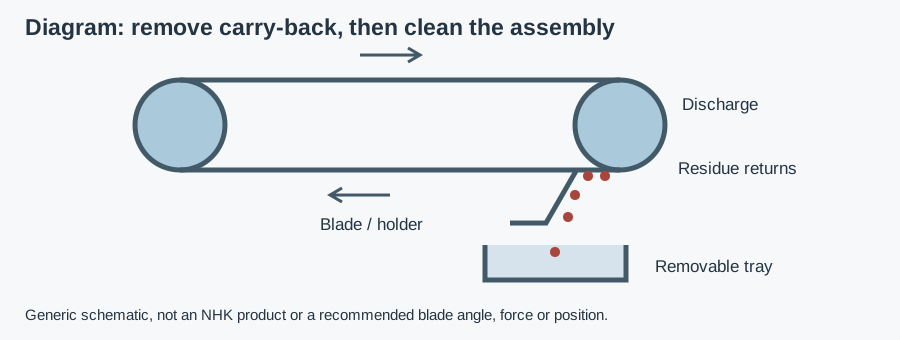
The food-processing equipment and zone guide helps relate transport requirements to the surrounding process, rather than treating every packing line as a direct-food-contact application. The frame under the rollers needs its own check; sizing and bracing the stands beneath a conveyor covers leg reactions and feet. On belt-return supports, use the carry-back and scraper-interface checks to assess residue removal and collection.
Pitch, load, shaft span and transfer checks
Pitch is the center-to-center distance between adjacent rollers. Establish the item's effective supporting length along travel, including feet, recesses and deformable packaging. Check its worst position between rollers and while crossing the entry or exit transfer. A long package can still bridge poorly if only a small part of its underside carries load.
Request capacity at the intended roller face length, shaft support span, speed and mounting. Wider span can change shaft deflection; a tube capacity without bearing and shaft conditions is incomplete. State whether loads are distributed across the shell or concentrated near an edge. Confirm the conveyor designer's support and load-sharing method before selecting a capacity.
Measure face length, overall length, diameter, shaft projection and fixing interface from a drawing. Spring-loaded shafts, threaded ends and other mountings are not automatically interchangeable. Check removal clearance and whether the frame can accept replacement without forcing the shaft out of alignment. Do not copy an old roller's dimensions without checking why it failed.
Bearings, seals and end closures: separate the interfaces
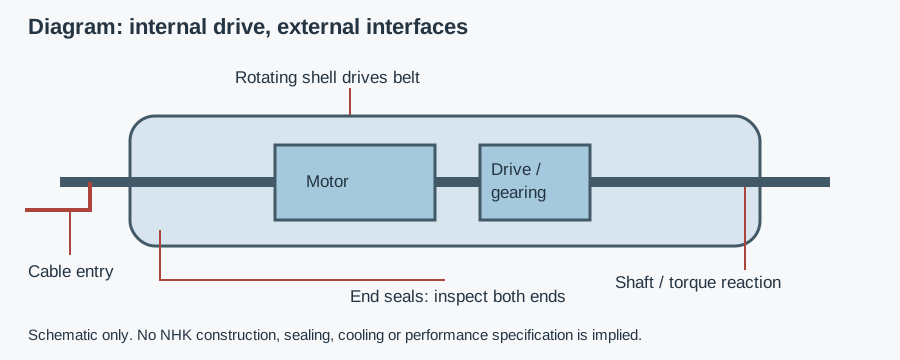
For a belt-end drive rather than a passive support, use the drum motor belt-pull and thermal-duty guide to assess the different selection requirements.
The roller may rotate around a stationary shaft with bearings inside its ends, or use another arrangement. External housed bearing units supporting a conveyor drive shaft are a different assembly; the bearing unit types guide helps distinguish them. A housing selection rule should not be applied uncritically to an internal roller bearing.
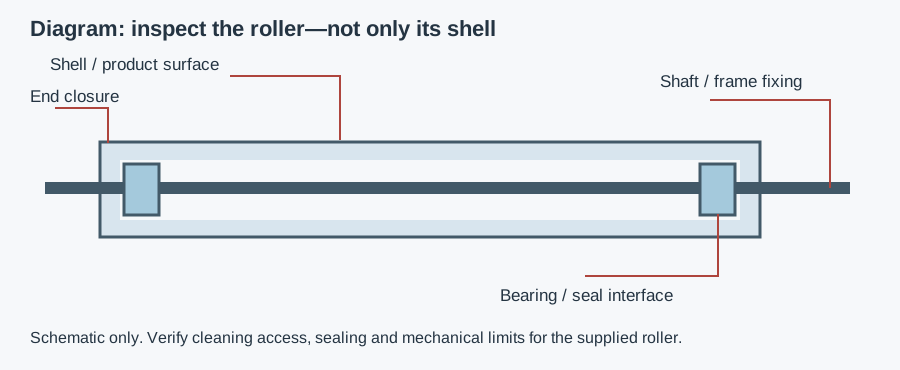
Ask how the shell-to-end-cap joint is closed, how the bearing is protected and whether the internal cavity can admit water. A closed tube with a leaking end can hide contamination. An external recess beside a sealed bearing can retain residue even when the bearing itself remains protected. Inspect the entire end, not just the seal designation.
Seal compounds must match the cleaning chemistry and movement. EPDM, FKM and VMQ identify elastomer families, not universal compatibility. Lubrication likewise needs the specified bearing and operating conditions; incidental-food-contact suitability does not make grease edible or establish that it will resist jet washing. Use documented maintenance instructions and avoid adding grease to a nominally sealed-for-life design without approval.
Hygienic conveyor rollers: access, zones and cleaning
A product-contact zone touches food; a splash zone receives product or cleaning spray. A non-contact location is not automatically dry or free of transfer risk. Map the actual roller, frame and drive exposure, including water draining from upper surfaces. Harborage points are gaps where residue survives cleaning; roller ends and shaft slots are priority checks.
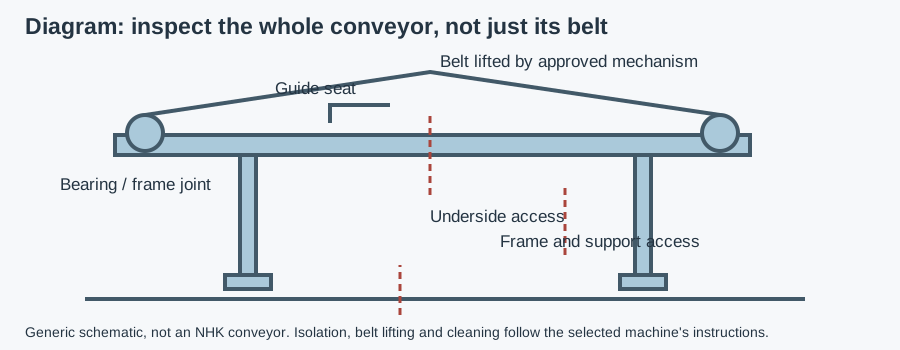
Look for accessible end faces, cleanable fixing slots and a frame that allows inspection beneath the rollers. Self-draining surfaces shed liquid rather than retain it. Cleaning access must coexist with guarding: rotating nips can injure, so do not remove guards permanently to make washing easier. Review removable parts and safe access with the machine designer.
Define dry cleaning, foam and rinse, or removal for cleaning out of place—COP. An open roller conveyor is not automatically cleaned by CIP, or cleaning in place. Record chemicals, concentration, temperature, contact time and pressure exposure at the roller. IP67 under IEC 60529 is an immersion test, not a washdown rating; IP69K in ISO 20653 is a different ingress test. Neither proves external cleanability or detergent compatibility.
During allergen changeover, verify residue removal at roller ends and underneath the frame, not only on visible shells. Our side-guide cleaning and adjustment guide covers neighboring interfaces; the harsh-environment component checklist adds the combined water, chemical and temperature assessment.
Installation and inspection: six acceptance checkpoints
- Isolate safely. Follow the machine's energy-isolation procedure, including stored energy and unexpected movement. Never inspect rotating nips by hand while running.
- Verify the supplied part. Match shell, shaft, ends and bearings to the drawing and code. Check visible shipping damage and closure condition before installation.
- Check mounting alignment. Seat shaft ends correctly, use the stated fastener method and torque, and avoid clamping that distorts or binds the roller.
- Check movement safely. With guarding and the approved procedure, verify free rotation, tracking and transfer behavior using the intended load. Investigate drag before increasing drive force.
- Check cleaning access. Inspect shell ends, slots and the underside after the specified cleaning procedure. Reject persistent residue or damage that prevents the agreed cleaning standard.
- Record a baseline. Note play, rotation, visible condition and fixing position. Set inspection intervals from duty and instructions rather than inventing a weekly rule.
For the frame connection, use the hygienic fastener design and specification guide to assess exposed threads and head interfaces without assuming every roller needs a certified bolt.
Example: short crates crossing a roller transfer
Assumptions: reusable rigid crates move by gravity into a wet-cleaned packing area. Their underside includes recessed sections. Existing roller dimensions and ratings are unknown. This is an illustrative assessment, not an NHK case or test.
The engineer measures the shortest effective bearing surface and checks the crate in its least-supported position at the transfer. Roller pitch and layout are then reviewed with the conveyor designer. Stainless and documented plastic shells remain candidates; bearing and end-cap details are checked against the cleaning cycle before either is accepted. A package-handling trial confirms support and movement without inventing a capacity or declaring a material winner.
RFQ checklist and food-contact documents
Send product and zone; package underside and dimensions; item mass and loading pattern; speed, drive and accumulation; roller pitch, face length and shaft span; mounting drawing; required shell and end materials; cleaning cycle; documents, quantities and delivery country. Include photographs of the installation only when they clarify access or failure symptoms.
Copyable specification: “Confirm the complete roller's capacity and rating conditions for the attached support layout. Identify shell, shaft, end-cap, bearing and seal materials; state cleaning and maintenance limits. Provide mounting drawings and instructions. Where food contact or certification is claimed, provide documentation covering the supplied variant and intended use.”
EC 1935/2004 concerns food-contact materials within its scope; EU 10/2011 concerns plastic food-contact materials. FDA 21 CFR 177.2600 addresses rubber articles for repeated use, not every plastic. Request finished-article evidence for intended conditions rather than accepting “food grade” or color as proof. EHEDG certifies specific equipment designs; 3-A Symbol authorization follows Third Party Verification. Both are voluntary and do not certify generic steel or plastics.
The buyer's guides for component enquiries provide the wider purchasing context. NHK's approved conveyor component and mounting category describes side-guide and mounting components; it does not verify a specific roller assortment. Send the layout so NHK can confirm availability, recommend appropriate components and prepare a quote. No roller material, load rating, certification or delivery promise is inferred from that category.