Stainless steel conveyors use stainless structural or conveying parts to move products through a process. For food plants, select the transport method first, then assess how the complete installed assembly handles product contact, cleaning and maintenance. Stainless material does not make inaccessible joints cleanable. The Conveyor and machine components overview connects this guide to the wider component range.
Stainless steel conveyor selection: start with the process
Define the product, its condition and the transfer points. Unpackaged food on a belt creates a product-contact surface; sealed cartons on rollers usually present a different contact assessment. A splash zone receives spills or cleaning liquid without intended direct product contact. A non-contact zone still needs assessment where residue or lubricant could reach food. Record these zones on a drawing, rather than labeling an entire machine “food grade.”
State normal operation and the difficult changeover: sticky residue, fragments, allergens, pooling liquid or fragile packs. Identify whether the line uses manual cleaning, foam and rinse, or a documented cleaning-in-place system (CIP: cleaning without dismantling). An open conveyor is not automatically CIP-capable because someone sprays it. Cleaning-out-of-place (COP) means removing parts for cleaning elsewhere; include safe handling and storage of those parts.
| Decision | Specify | Acceptance evidence |
|---|---|---|
| Product and transfer | Contact surfaces, package underside, spillage and shortest item | Trials at transfers and worst item orientation |
| Frame | Span, stiffness, connection detail and cleaning access | Drawing, structural check and installed inspection |
| Metal selection | Actual grades and fabrication treatment | Material evidence and chemical compatibility |
| Belt or rollers | Load, speed, tension and contact conditions | Supplier limits and relevant contact documents |
| Drive and bearings | Operating duty, reaction loads and cleaning exposure | Assembly instructions and applicable test conditions |
| Guides and scrapers | Adjustment, belt compatibility and residue collection | Cleaning procedure and safe removal route |
| Supports | Reactions, adjustment, restraint and floor access | Support/anchor design and installation limits |
| Cleaning | Chemicals, concentration, temperature and access sequence | Validated plant procedure and supplier restrictions |
Send conveyor and cleaning data for a component recommendation
Which conveyor and component guide do I need?
Use this route map before selecting individual parts. A conveyor family, its support frame and its fitted components answer different questions; a component specification cannot substitute for the machine builder's assembly design.
| Question | Next guide | What it resolves |
|---|---|---|
| Which belt construction or transport principle fits my product? | Belt construction and product-form selection | Modular, solid and mesh cleaning interfaces, plus conveyor-family alternatives |
| How do I detail the belt and side guides? | Hygienic conveyor interfaces and guide details | Contact path, guide brackets and cleaning access |
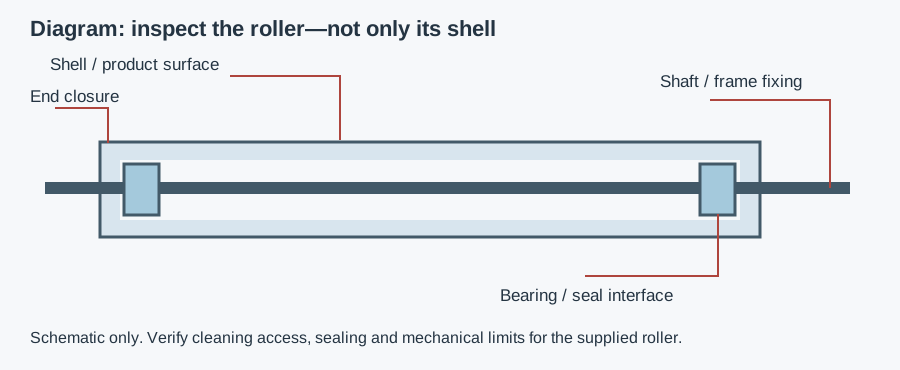
| Which rollers and support pitch fit? | Roller support, materials and end seals | Item support, span and end interfaces |
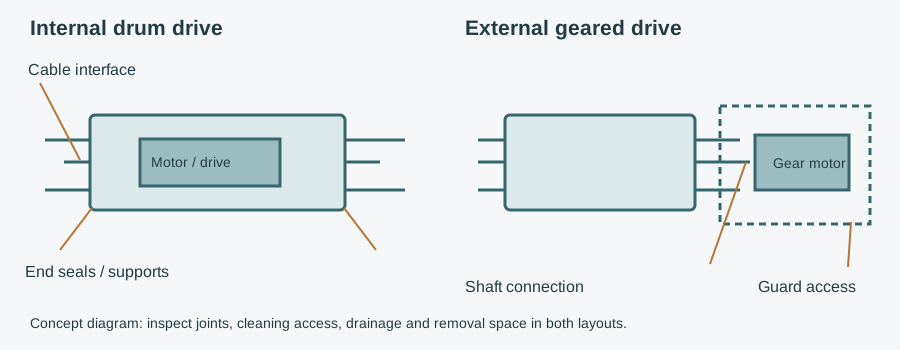
| How do I specify an integrated drive? | Drum drive duty and cleaning checks | Belt pull, thermal duty and installation limits |
| Which drive layout fits the cleaning and service plan? | Enclosed drum versus external geared-drive decision | Lubrication boundaries, washdown access and replacement strategy |
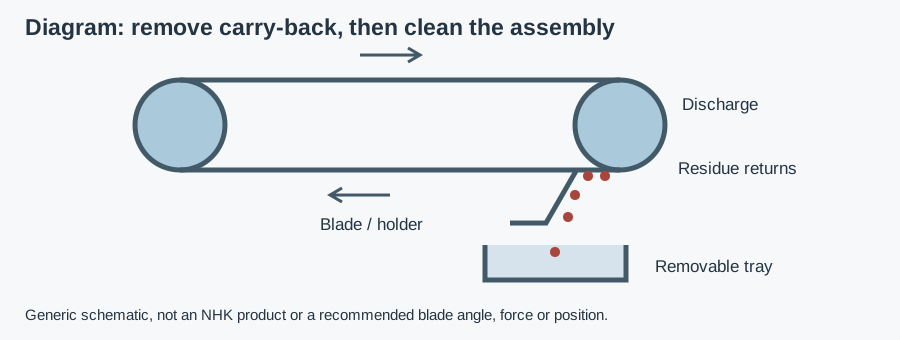
| How do I manage adhered residue? | Scraper selection and carry-back collection | Blade compatibility, mounting and collection path |
| How do operating stresses affect parts? | Conveyor-component stresses in service | Exposure and component maintenance context |
| What does a component certificate establish? | Certified-part scope in a conveyor assembly | Evidence for parts versus the installed machine |
Frame profiles, welds and hidden cavities
An open profile can provide visible surfaces and cleaning access, but its orientation can still create a ledge. A hollow section can provide a compact structural member, but penetrations and imperfect closures may admit liquid into an inaccessible cavity. Select the detail from structural need and a documented hygiene assessment, not a blanket rule that all open or all closed sections are preferable.
A self-draining surface releases liquid rather than retaining a pool. Check drainage with the machine installed at its operating height and adjustment; a slope on a loose component can disappear in the assembly. Avoid depositing drain water on another conveyor, a bearing seat or the food path. A crevice is a narrow gap that can retain contamination beyond effective cleaning. A harborage point is a place where residue survives the procedure; it may occur under a bracket even when its visible face is polished.
For a welded closure, inspect continuity, surface discontinuities and distortion against the fabrication specification. For a bolted removable connection, confirm access, seating surfaces and any intended seal compression. Do not seal over an unresolved cavity and call it hygienic. Provide an inspection or replacement strategy for a closure whose integrity cannot be checked in normal service. Grinding a visible weld does not prove the rear surface or cavity is acceptable.
For removable frame connections, use the sealed fastener-interface selection guide.
Stainless grades and surface evidence
AISI 304 and 316L are common stainless choices, not universal food-plant prescriptions. 316L generally offers greater chloride-pitting resistance than 304, but neither is immune. Chloride pitting is localized attack that can penetrate a surface without widespread rust. Assess actual chemicals, concentrations, temperature, contact time and rinsing with the supplier; a nominal grade cannot compensate for persistent retained liquid or unsuitable cleaning chemistry.
Specify the grades of frame, shaft, fasteners and other exposed parts separately. Mixed metals in an electrolyte may create galvanic corrosion; isolation and compatibility require consideration at the actual connection. Passivation is a treatment used to support a clean passive stainless surface, not a coating that guarantees chemical resistance. Welding heat tint and contamination need an appropriate fabrication and surface-treatment procedure before commissioning.
Surface roughness Ra describes averaged profile variation, not all surface defects. A low Ra result alone does not prove a weld, scratch, bracket seat or joint is cleanable. Define the areas to measure, the acceptance basis and the relevant documentation rather than assigning one roughness number to the whole conveyor. No universal conveyor finish or NHK frame grade is established by this guide.
Belts, guides, bearings and drives as one assembly
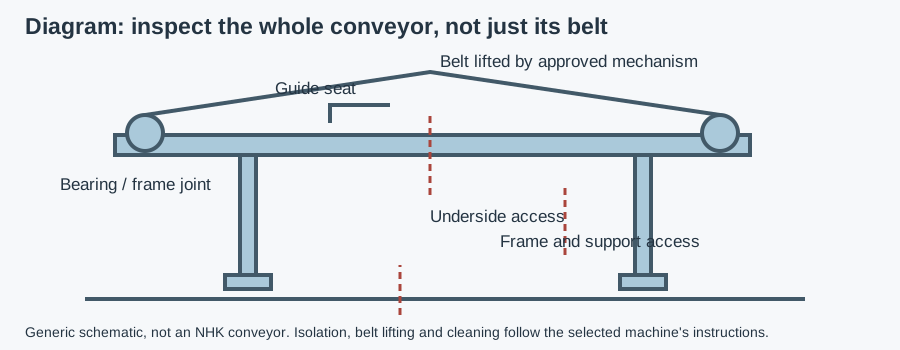
A smooth belt may simplify inspection, while modular belt hinges introduce additional interfaces. Evaluate the exact belt, splice, edges and sprocket engagement. Confirm whether lifting or tension release exposes both underside and supports, and whether the safe procedure needs tools or mechanical assistance. A removable part is useful only if workers can remove, clean, inspect and refit it correctly without creating another contamination route.
Guides need adjustment without hidden residue traps at rods, clamps and mounting seats. Record permissible settings and the cleaning position, particularly after a product change. A scraper removes carry-back but does not sanitize a belt; its collected material needs a controlled destination. Avoid returning waste or cleaning runoff into the product path.
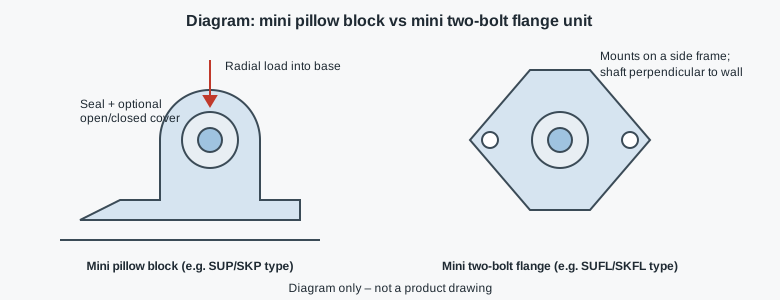
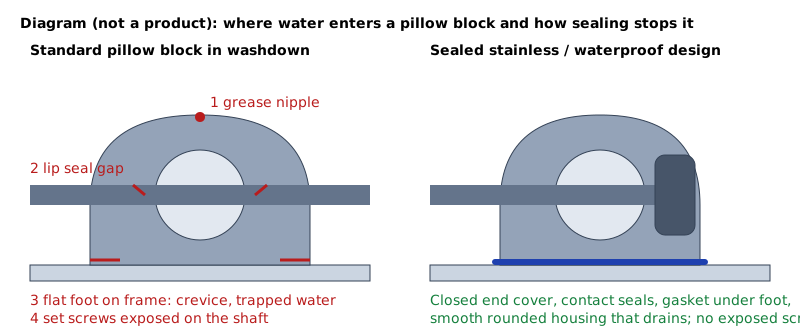
Bearings carry shaft reactions as well as conveying loads. Belt tension, overhung drives and misalignment can matter more than product weight alone. Compare stainless pillow-block selection for washdown when choosing shaft supports. Check cover interfaces, lubricant control and replacement access together with the mounting surface. A sealed insert does not make the entire bearing seat hygienic.
An IP rating describes ingress protection under stated test conditions, not hygiene certification or detergent resistance. IP67 covers an immersion test, not high-pressure washdown. Where hot pressure cleaning is proposed, request the applicable test standard, exact configuration and installation conditions; do not infer washdown suitability from stainless housing or an immersion rating. An EHEDG certificate concerns a specific equipment design, not the factory or every component installed beside it.
Support reactions and cleaning below the line
Support selection must include the frame, bracing, feet, floor and any anchoring. Load divided by foot count is not enough when load positions, belt forces and unequal contact change reactions. Establish the governing operating and maintenance cases and confirm allowable extension and articulation for the selected foot. The conveyor-leg reaction and anchoring guide explains the support system in detail. Leveling feet (levelling feet in British English) adjust height; they do not correct excessive frame deflection.
Provide clearance for the intended cleaning equipment and inspection method underneath the actual line, including adjacent machines. There is no universal clearance value here. Confirm access with trays, cable supports and utilities installed. Bracing can improve stiffness while blocking cleaning, so resolve its connection and position before ordering. Anchors may be needed for restraint; friction and machine weight alone do not establish protection against lateral movement or uplift.
Example: selecting a wet packing-line configuration
Example — hypothetical assumptions, not NHK field data. A plant plans a conveyor for sealed packs downstream of a wet filling area. Assume regular external foam cleaning, variable pack positions, an adjustable discharge height and a short unpackaged inspection transfer upstream. The task is to specify component interfaces, not calculate a certified machine capacity.
- Mark the upstream contact transfer separately from the packaged-product section. Specify contact evidence for the actual transfer belt and foreseeable product-contact fittings rather than requesting a generic machine declaration.
- Obtain the frame drawing with belt-lifting positions, guide settings and support layout. Inspect underside access at both discharge-height extremes; reject a layout that exposes the belt but leaves a concealed shelf underneath it.
- Ask the designer for support and shaft reactions at the governing product positions and drive conditions. Select feet and bearing units from those reactions, not a count-based share of total pack mass.
- Check cleaning limits for the belt, motor ends, bearing covers and mounting seals as an assembly. Do not select an immersion-rated part on the assumption that it withstands the specified pressure-cleaning cycle.
- Agree an acceptance demonstration with guards, utilities and collection trays installed. Record the safe cleaning sequence and inspection locations before approving the purchase.
The result is an auditable configuration and document request. It is not a claim that a particular metal grade, belt family or supplier product passes this application's cleaning validation.
Installation and acceptance checklist
Before commissioning, safely isolate the machine and follow the approved support and dismantling procedure. Inspect the installed condition, not only drawings or catalog photographs.
- Check belt tracking and guide position throughout the permitted adjustment range; investigate rubbing rather than masking it with higher tension.
- Inspect welds, section closures, bracket seats and bolt interfaces for discontinuities, retained liquid and inaccessible residue.
- Demonstrate belt lifting or removal and safe access to return rollers, scrapers and trays; confirm reassembly checks and tension settings.
- Confirm lubricant and collected product cannot migrate into the food path. Check electrical cables and utilities do not create new shelves.
- Verify floor contact, restraint and support extension against the installed design, then repeat access checks after height adjustment.
- Validate the cleaning procedure for the product and allergen changeover; visual cleanliness alone does not establish microbial or allergen acceptance.
Symptoms after cleaning: check the interface first
| Symptom | Check before replacing parts | Corrective direction |
|---|---|---|
| Residue returns beneath the belt | Return path, lifting access and scraper collection | Remove the inaccessible retention route and revise the procedure |
| Liquid appears from a frame section | Closures, penetrations and connection integrity | Isolate the affected area and assess cavity contamination and repair |
| Bearing noise or leakage changes | Alignment, tension, covers and cleaning exposure | Correct the load or ingress pathway; confirm replacement specification |
| Local corrosion at a seat | Chemistry, trapped liquid and fabrication contamination | Address exposure and surface condition, not just visible staining |
| Transfer alignment changes | Supports, floor contact, frame movement and adjustment | Correct structural or restraint causes before resetting guides |
Record where and when a symptom occurs. Repeated part replacement without checking the surrounding interface can leave the same failure pathway in place. Do not change seal material, lubricant or cleaning chemistry without confirming compatibility and the machine's operating requirements.
RFQ wording: send the component interfaces, not just “stainless”
Copy and complete: “Conveyor application and product condition: __. Contact/splash zones and transfer drawing: __. Speed, load positions, belt tensions and designer's reactions: __. Frame, mounting, support extension and restraint: __. Cleaning chemicals, concentrations, temperatures and procedure: __. Proposed belt, bearing, guide and drive interfaces: __. Required material/contact documents and exact certificate scope: __. Part numbers if known, quantity and delivery country: __.”
Use the machine-builder component enquiry preparation guide to organize the assembly drawing and supplier evidence before requesting parts.
Ask for documentation identifying the actual supplied parts and use conditions. Regulation (EC) No 1935/2004 concerns food-contact materials and articles; Regulation (EU) No 10/2011 is specific to plastics, not all metals or elastomers. Certificate scope and material evidence answer different questions. Do not accept an unrelated certificate as approval of a complete conveyor.
NHK's conveyor fittings and side-guide category lists guide rods, clamps and mounting fittings. It does not establish a complete conveyor range, frame specification or capacities. Use NHK's food-grade conveyor design reference for additional context, and send the application to confirm available components and documents. This enquiry is for component assessment and quotation, not machine-level certification or an assumed delivery commitment.