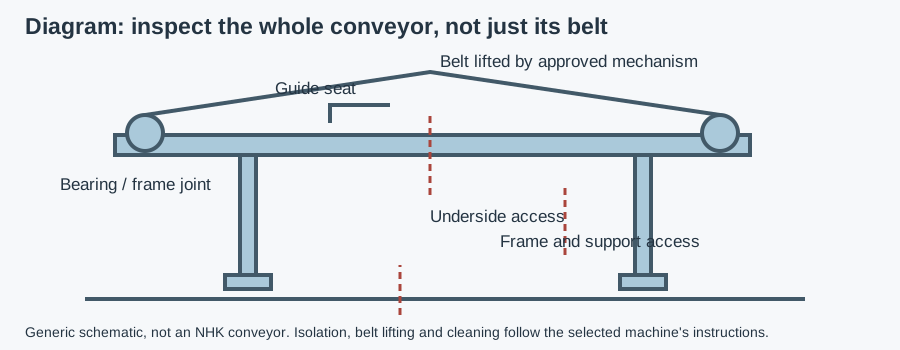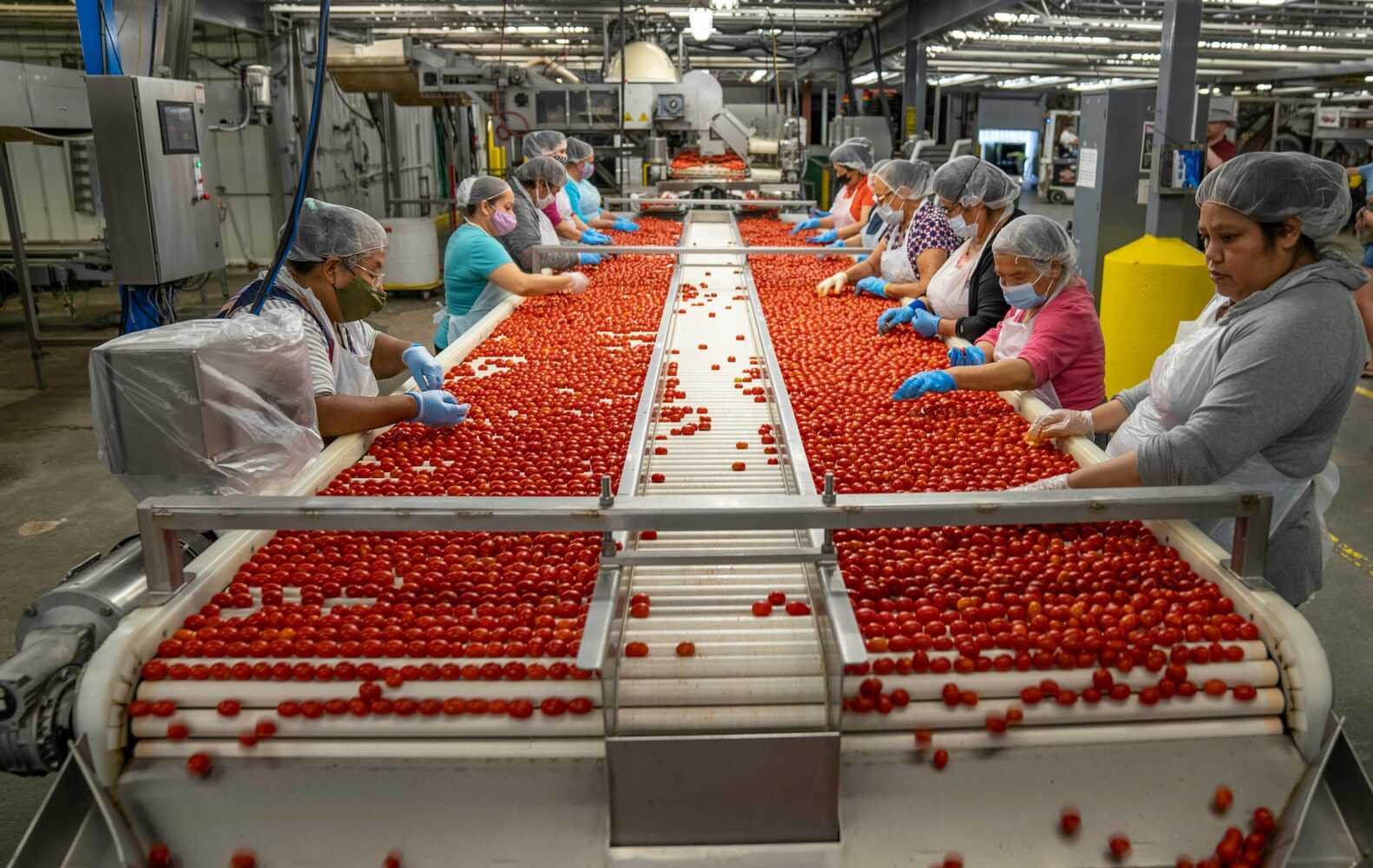
Hygienic conveyor belts are conveying surfaces selected and installed so the intended cleaning procedure can reach and remove product residue. Belt construction matters, but so do the return supports, drive, guides and collection trays. Start with the installed conveyor frame and component checklist; a clean top surface does not establish a clean conveyor.
This guide retains the original conveyor-family overview below, then compares food-belt construction. HMP does not sell belts. Use the belt supplier for belt selection and limits; NHK enquiries here concern surrounding conveyor components, with availability confirmed for the proposed configuration.
Hygienic conveyor belts: selection table by product and zone
A product-contact zone touches food. A splash zone receives product or cleaning spray; other locations still require assessment where contamination could transfer to food. Mark the actual interfaces rather than calling the entire conveyor “food grade.”
| Product and zone | Belt candidates to assess | Hygiene trade-off | Evidence that decides |
|---|---|---|---|
| Unpackaged wet or sticky food, direct contact | Solid homogeneous PU/TPU; suitable modular designs | Closed surfaces avoid hinge joints; modular hinges add cleaning interfaces | Residue removal at underside, joints and drive supports under the approved cycle |
| Fragile pieces needing stable support, direct contact | Solid belt or suitable closed-top modular belt | Surface support and transfer geometry may decide before drainage | Trials with smallest pieces, transfer gap and permitted belt curvature |
| Washing or draining product, direct contact | Open modular or wire mesh | Openings release liquid but expose wires, hinges and lower supports to soil | Product retention, cleanable openings and a controlled drainage destination |
| Baking, frying or cooling, direct contact | Documented wire mesh or another process-rated belt | Airflow or fluid passage may matter; thermal duty cannot be inferred from appearance | Exact alloy/construction, component temperatures and process limits |
| Dry bakery or confectionery, exposed finished product | Solid, modular or mesh according to process | Crumbs, fat films and allergens need different removal; uncontrolled water may be unsuitable | Zone-specific cleaning, dismantling and release evidence |
| Sealed packages, mainly non-contact or splash exposure | Suitable belt or roller conveyor | Product support, leakage and external cleaning still matter | Pack stability, spillage paths and access beneath supports |
Send zone and cleaning data for a conveyor-component recommendation
These are candidates, not approvals. Narrow the choice using product support, cleaning access and supplier limits together. Where the process cannot tolerate wet intervention, a belt advertised as washable does not justify changing the sanitation method. Reject a candidate if its critical material, operating or cleaning evidence is missing.
Modular plastic vs solid belt hygiene
Modular plastic belts consist of linked modules with hinge pins. Many use sprockets for positive drive: teeth engage the belt rather than relying only on friction. Replaceable modules can support localised repairs, but replacement also introduces pin-retention and reassembly checks. Hinge openings, pin bores and underside features can retain soil; evaluate the exact geometry rather than labelling all modular belts unhygienic.
Inspect hinges in the cleaning configuration specified by the supplier, including how articulation exposes contact faces. Confirm that supports and sprockets do not shield the surfaces being cleaned. Check pins for movement, damage and retention; a missing pin or broken module belongs in the plant's foreign-body procedure. A closed top does not eliminate the interfaces underneath it.
Solid homogeneous belts have a continuous polymer body without a fabric carcass or modular hinges. PU means polyurethane; TPU is thermoplastic polyurethane. Suppliers use these terms for particular constructions, so obtain the actual compound and finished-belt identity. Solid belts can have friction or positive drive; “solid” does not specify their transmission principle.
Removing hinges can simplify access, but welded splices, edge damage, profiles, cleats and underside drive features remain inspection points. Distinguish homogeneous construction from a fabric-reinforced belt with a smooth coating. Damage that exposes reinforcement changes the contamination assessment. Do not claim that every solid belt is seamless, nonabsorbent in every condition or compatible with every detergent.
Wire mesh: drainage and airflow versus retained residue
Wire mesh is a metal-wire construction with openings between wires. Particular designs can suit drainage, cooling, baking or frying, but mesh is not one universal specification. Confirm opening size against the smallest product, transfer geometry, wire joints, edge finish, drive and support arrangement. Obtain the exact alloy and operating envelope instead of assigning a temperature or load from the word “metal.”
Open area permits passage through the belt, which also means product fragments and wash liquid can reach supports below. Thin wires and cross-connections may retain sticky material even when the top looks clear. Inspect the return path and collection trays; check for broken wires or distorted edges under a safe procedure. Drainage must not discharge onto another food path.
For dry coatings and baked products, use the related bakery and confectionery cleaning-boundary checks before selecting an aqueous cleaning method. Alloy and finish do not compensate for inaccessible supports or uncontrolled moisture.
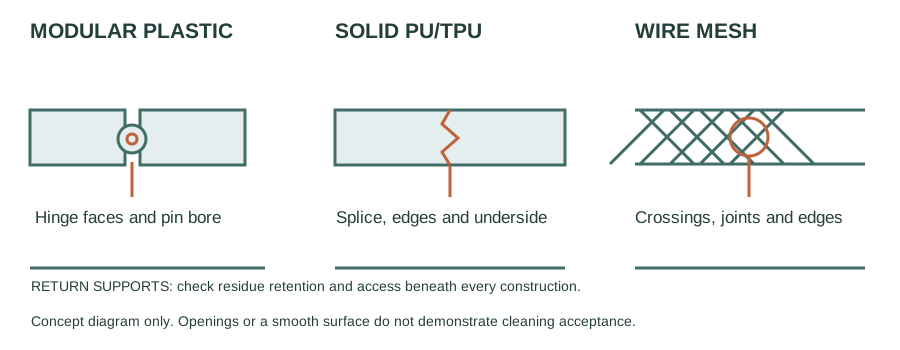
Diagram: compare hidden contact interfaces, not only the carrying surface; schematic, not an NHK product drawing or approved belt design.
Drive, tracking and return supports
Select belt and drive as a matched system. A friction-drive belt requires its documented tension and pulley interface; a positive-drive belt requires matching teeth or sprockets, engagement and permitted slack. Neither arrangement removes tracking checks. Tracking means keeping the belt in its intended lateral path; product side guides are not a substitute for the belt's tracking system.
Before a retrofit, record pulley or sprocket geometry, shaft alignment, supports, transfer positions and removal access. Confirm the replacement belt's minimum bending requirements and permitted operating conditions with its supplier; no universal diameter or tension is prescribed here. Do not reuse an existing drive merely because the belt width matches.
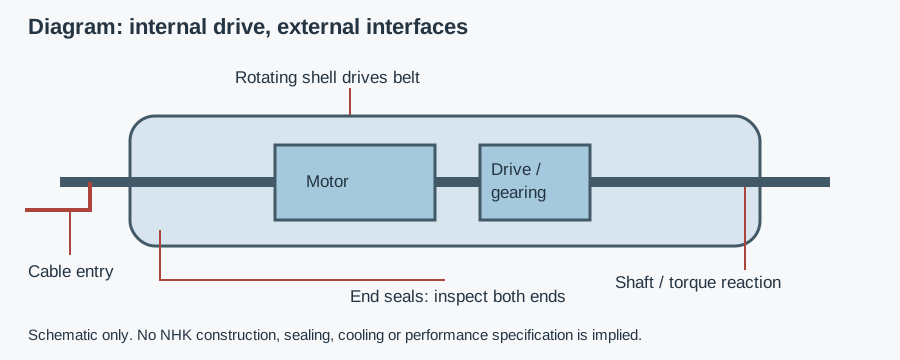
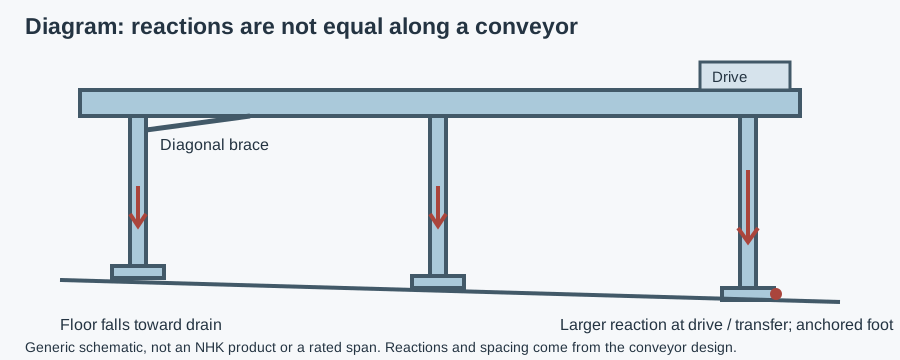
Compare the enclosed and external conveyor-drive layouts before using the drum-drive sizing and thermal-duty guide for the drive assessment. Scraper drag, starts, product loading and belt tension affect the required duty and shaft reactions. Ask the designer for those reactions before selecting bearing supports; the related bearing-unit arrangement guide distinguishes housed supports from bearings inside rollers.
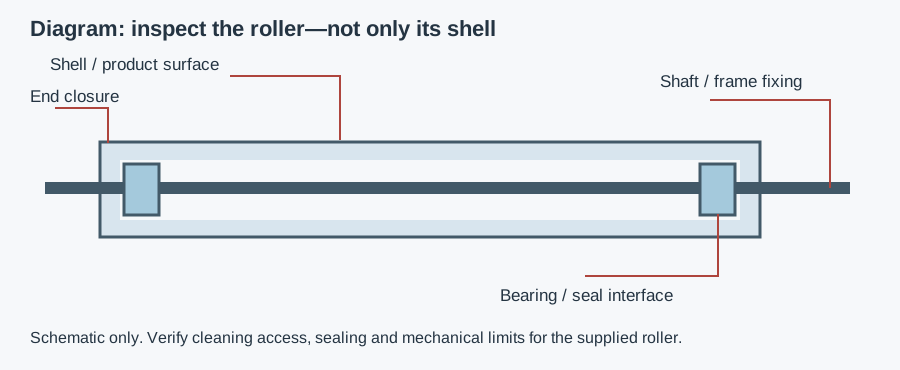
For the return path, assess roller ends, support spacing and cleaning access. After safe isolation, inspect rubbing, accumulated residue and uneven support. During guarded commissioning, verify tracking with representative product and operating changes. Increasing tension to hide an alignment problem can change loads without resolving its cause.
Scrapers and side guides: do not create new traps
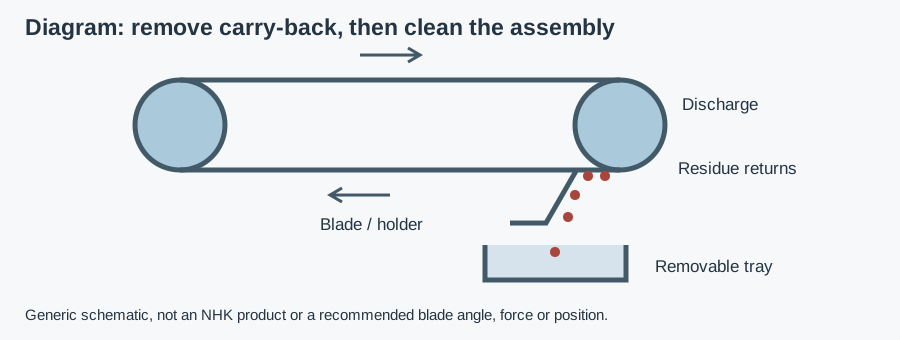
A scraper removes carry-back: product that remains attached after discharge and returns beneath the conveyor. It does not sanitise the belt. Blade construction, contact force, splice passage and reverse operation require approval for the actual belt. A continuous blade suited to a smooth surface cannot automatically scrape modular openings or wire mesh.
Use the blade compatibility and carry-back collection checklist to assess the holder and tray as well as contact. Increasing force can damage an incompatible belt or joint. Make removed residue accessible for controlled disposal rather than shedding it onto a concealed frame member.
Side guides position the product, not the belt. Check wear-profile backs, rod clamps, adjustment seats and the access left after a format change. Tight gaps can become harborage points, where residue survives cleaning; stainless mounting parts do not prevent that by themselves. The migrated side-guide mounting and cleaning-access guide covers these neighbouring interfaces. Record approved running and cleaning positions so reassembly is repeatable.
Cleaning and inspection: six acceptance steps
- Define the hardest soil and changeover. Identify fat, protein, crumbs, adhesive deposits and actual allergens. Choose the plant-approved dry or wet method; do not assume one cycle suits every zone.
- Make safe and expose the planned surfaces. Follow isolation and stored-energy procedures. Demonstrate approved belt lifting or removal, scraper removal and access to hinges, splices, mesh crossings and supports. Never inspect moving nips by hand.
- Apply the documented cleaning envelope. Confirm chemicals, concentrations, temperature, exposure and mechanical action against belt and component instructions. Cleaning in place (CIP) is an engineered method, not a synonym for exterior spraying; cleaning out of place (COP) involves removed parts.
- Inspect retention and damage. Check belt underside, joints, pins, edges, guide backs and trays. Investigate recurring residue before extending cleaning or using stronger chemicals. Replace damaged parts against supplier limits and plant product-control procedures.
- Verify the required outcome. Visual cleanliness is useful but not proof of microbial or allergen acceptance. QA sets appropriate validation and routine verification evidence for the actual hazard and hard-to-clean locations.
- Restore and record. Account for parts, verify pins, splice condition, settings, tension, tracking and guards. Confirm drainage or drying where required before authorised release. Reassess after changes to belt, product, accessories or cleaning.
Conveyor families in food, cosmetic and chemical industries
Choose the transport principle before the belt. The original cross-industry comparison remains relevant where the product is a powder, a package or an unpackaged piece rather than a belt-selection problem.
For enclosed powders, review the grain-line dust and transfer checks. For filling and packing, use the beverage-line wet-area component assessment to distinguish the closed process from exposed transfers.
| Conveyor family | Typical task across food, pharma, cosmetic or chemical plants | Hygiene checkpoint |
|---|---|---|
| Belt | Pieces, open products or packages | Construction, contact evidence and underside access |
| Roller | Suitable packages or containers | Item support and roller-end interfaces |
| Screw/auger | Powders or suitable bulk material | Trough, seals and dismantling |
| Pneumatic | Suitable powders moved through pipes | Filters, bends and internal cleaning |
| Chain | Crates, pallets or containers | Lubrication and retained residue |
| Bucket elevator | Grains or granules lifted vertically | Buckets, boot section and retained material |
| Vibratory | Suitable pieces conveyed or sorted | Tray joints and supports |
| Flexible screw | Suitable powders on a routed transfer | Tube access and removable spiral |
| Drag chain | Enclosed bulk transfer | Corners, casing and return path |
| Magnetic | Suitable ferrous items or containers | Product suitability and accessible conveying surfaces |
Enclosure can contain dust while hiding soil. Open transport exposes surfaces but does not ensure they are reachable. The actual material, hazards and approved cleaning method decide which family is suitable; this table assigns no throughput, containment performance or cleaning result.
Specification and component-enquiry handover
Copy and complete: “Product, smallest pieces or package underside, allergens and zone: __. Belt supplier, construction, compound/alloy, splice and profiles: __. Speed, loading, starts, direction and drive interface: __. Shaft/support reactions and drawing revision: __. Cleaning method, chemicals, concentrations, temperatures and exposure: __. Scraper, guide and return-support access: __. Contact documents, operating limits, acceptance checks and replacement criteria: __. Surrounding component request, quantities and delivery country: __.”
Use the buyer's component specification guides to organise these details before completing the enquiry form below.
Request evidence identifying the exact food grade conveyor belt and intended use. Regulation (EC) No 1935/2004 provides the food-contact framework; Regulation (EU) No 10/2011 applies to plastics within scope, not metal mesh. Food-contact evidence does not prove cleanability. Any hygiene certificate must cover the specific design, not a material family or the complete conveyor by association.
NHK's conveyor guide rods, clamps and mounting fittings provide the secondary component-browsing path. The listing does not establish a belt range or specific roller, drum-motor or scraper availability. Send the completed interface and cleaning requirements through the existing form so NHK can confirm available components and documents before a recommendation or quote; obtain belt approval from the belt supplier.