Food processing equipment is the machinery that turns raw materials into safe, packaged food: intake and storage systems, preparation machines, processing and forming equipment, heat treatment, cooling and freezing, and packaging lines. This guide sorts food production equipment by process step, explains the hygiene risk at each step and shows what that risk means for the components, materials and documents you specify. It is the overview page of our industries and applications section.
For freezers and cold zones, see frozen food processing equipment and its components.
For washing, peeling and cutting produce, see fruit, vegetable and potato processing components.
For juice and soft drink lines, see beverage processing components.
Types of food processing equipment by process step
For dairy specifically – CIP regimes, cheese and packaging lines, and seal choices – see dairy processing equipment and hygiene.
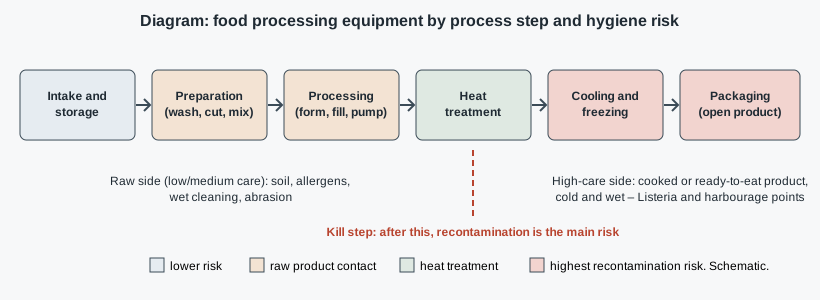 a food processing line by process step with the hygiene risk level of each step. Schematic, not a product test report.
The most useful way to group industrial food processing equipment is not by machine name but by where it sits relative to the kill step – the heat treatment or other process that reduces microbes to a safe level. Before it, equipment must cope with soil, raw product and allergens. After it, the main risk is recontamination of finished product, so the design and cleaning demands are highest.
| Process step | Typical equipment | Main hygiene risk | What it means for components |
|---|---|---|---|
| Intake and storage | Silos, tanks, tippers, intake conveyors, chill stores | Dust, pests, condensation | Closed housings, drainable surfaces, corrosion-resistant feet and supports |
| Preparation | Washers, peelers, cutters, grinders, mixers | Raw soil, water, abrasion, allergens | Stainless frames, sealed bearings, components that dismantle for allergen changeover |
| Processing and forming | Pumps, fillers, formers, extruders, depositors | Product build-up in dead spaces | Product-contact parts with low Ra, no crevices, elastomers with food-contact declarations |
| Heat treatment | Ovens, fryers, cookers, pasteurisers, retorts | Heat, steam, fat | Temperature-rated seals and greases, materials that tolerate thermal cycling |
| Cooling and freezing | Spiral freezers, tunnels, chillers | Cold, wet, ready-to-eat product | Washdown-proof bearings, self-draining surfaces, no harbourage points |
| Packaging | Slicers, weighers, form-fill-seal machines, conveyors | Open product after the kill step | Hygienic design in the splash zone, sealed fasteners, cleanable feet and castors |
Some terms used above:
- Product-contact zone: surfaces the food touches. Splash zone: surfaces reached by product or cleaning water that can drain back. Non-contact zone: everything else.
- Dead space: a volume where product or cleaning fluid stands still and is not flushed.
- Harbourage point: a gap, thread or crevice where residues and microbes survive cleaning.
- Surface roughness Ra: the average height of surface peaks. EHEDG guidance gives Ra ≤ 0.8 µm for product-contact surfaces; NHK's article on surface roughness for food contact explains how it is measured.
For the design rules behind these requirements, see the core of hygienic design in food processing machinery.
Before requesting bearings, review the bearing selection and RFQ checklist.
Food industry equipment by sector
How the machines themselves are built – frames, drives, bearings, fasteners and feet – is covered in food processing machinery, part by part.
The same process steps appear in every sector, but the dominant risk differs. That changes which components need the most attention.
| Sector | Typical equipment | Dominant risk | Component focus |
|---|---|---|---|
| Dairy | Tanks, pumps, valves, separators, fillers | Milk residues, CIP chemicals | CIP-able closed systems, 3-A or EHEDG designs in product contact |
| Meat and poultry | Cutting, deboning, conveying, chilling | Fat, blood, daily high-pressure washdown | Washdown-proof bearings, stainless feet, open frames |
| Seafood | Filleting, brining, freezing | Salt and chlorides | 316L or higher grades, chloride-resistant fasteners |
| Bakery and grain | Mixers, dividers, ovens, cooling spirals | Dry dust, allergens, heat | Dry cleaning access, temperature-rated parts |
| Fruit and vegetables | Washers, peelers, sorters | Water, soil, acids | Corrosion-resistant frames, sealed bearings |
| Beverage | Tanks, fillers, cappers | Sugar, CIP, wet floors | Hygienic feet, sealed units in the filler area |
| Convenience food | Assembly lines, slicers, packaging | Ready-to-eat, many allergens | High-care hygienic design, fast changeover |
Sector guides on this site go deeper: designing adaptable machinery for poultry processing, seafood processing equipment and sustainability and conveyors in food, cosmetic and chemical plants.
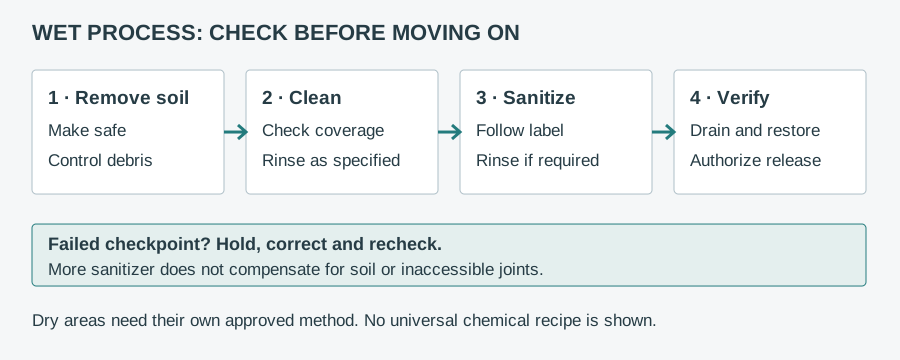
How cleaning regimes decide component choice
Dry plants follow different rules; grain processing equipment covers dust, ATEX awareness and allergen changeover in cereal plants.
Use bakery and confectionery production equipment checks for flour, dough, sticky sugar/fat and heat-exposed components on baking and chocolate lines.
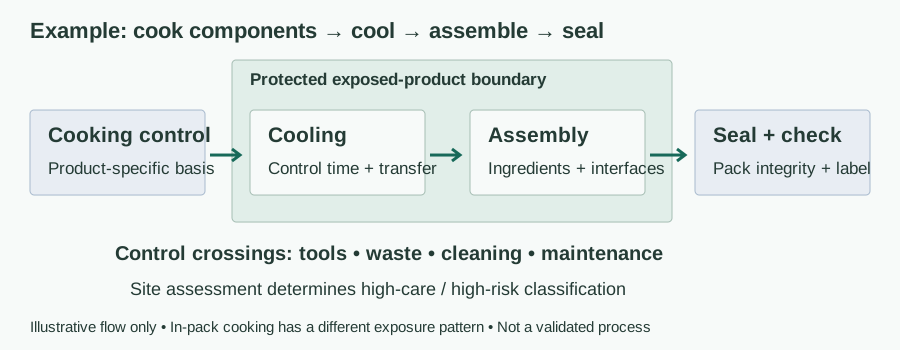
Use the convenience food processing and ready-meal component guide to map exposed assembly, hygiene boundaries and chilled handling before specifying parts.
The cleaning method stresses components more than the product does. Choose parts for the regime actually used on the line, not the one in the manual.
- CIP (cleaning in place): detergent and rinse circulate through closed equipment without dismantling. Components must be drainable and free of dead legs.
- COP (cleaning out of place): parts are removed and washed in a tank or cabinet. Components must dismantle without tools where possible.
- Foam and low-pressure rinse: common for open equipment. Needs smooth, self-draining surfaces – surfaces sloped so water runs off.
- High-pressure washdown: drives water past seals and into threads. Bearings, feet and fasteners need seals designed for it; an IP67 rating alone is an immersion test, not proof of washdown resistance.
Cleaning chemicals and chlorides cause chloride pitting (local corrosion of stainless steel) and attack elastomers. Check elastomer compatibility – EPDM, FKM or VMQ (silicone) – against the actual chemicals and temperatures. Our guide to reducing water and cleaning detergent usage shows how component design affects cleaning time.
Materials and documents for food production equipment
| Item | What to specify | Document to request |
|---|---|---|
| Stainless steel | AISI 304 for dry or mild zones; 316L where chlorides, salt or aggressive cleaning are present | Material certificate (EN 10204 3.1) |
| Plastics in food contact | Grade and colour, temperature range | Declaration of compliance to EC 1935/2004 and EU 10/2011 |
| Elastomers (seals, gaskets) | EPDM, FKM or VMQ by chemical and temperature | EC 1935/2004 declaration; FDA 21 CFR 177.2600 for US markets |
| Lubricants | Food-grade grease for incidental contact | NSF H1 registration |
| Hygienic design claim | Specific component or design | EHEDG certificate or 3-A authorisation for that design, if claimed |
| Surface finish | Ra for product-contact surfaces | Measurement or drawing value |
| Passivation | After welding or machining stainless parts | Process confirmation |
EC 1935/2004 covers all food-contact materials; EU 10/2011 covers plastics only. EHEDG certifies specific equipment designs, not a supplier or a factory, and 3-A authorisation follows a Third Party Verification. Both are voluntary. Avoid mixing stainless steel with carbon steel or aluminium in wet zones: galvanic corrosion attacks the less noble metal.
Common equipment hygiene failures on site
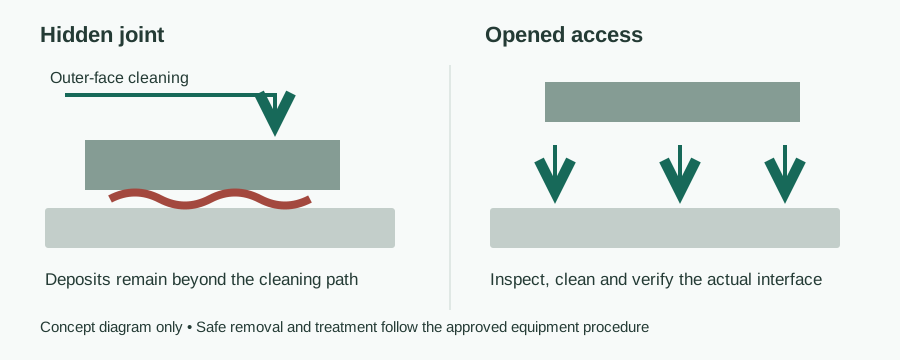
- Exposed threads on feet and fasteners – residues collect in the thread; replace with sealed, crevice-free designs.
- Water in bearing units after washdown – grease washes out and bearings fail; use washdown-proof units and avoid aiming jets at seals.
- Hollow frame tubes without sealed ends – water enters and leaks back as contaminated liquid.
- Flat horizontal surfaces – water and product stand; slope or round them.
- Unlisted elastomers – seals swell or crack under detergents; check compatibility and declarations.
- Floor-level harbourage – feet bolted without sealing, frames too close to the floor for cleaning access.
Specifying components for food processing equipment: RFQ checklist
Before asking for certification evidence, use the checking supplier certificates against the quoted parts.
Send the same details the enquiry form asks for, and an NHK technician can recommend a component instead of sending a catalogue:
- Equipment type and process step
- Zone: product-contact, splash or non-contact
- Cleaning method, chemicals and temperature
- Load, speed or dimensions of the part
- Material grade and any food-contact requirement
- Certificate needed (EHEDG, 3-A) and documents (material certificate, declaration of compliance)
- Quantity and delivery country
After the enquiry, an NHK technician suggests the right component and sends a quote. For a broader reference, NHK's article on food processing equipment covers the topic from the manufacturer's side.