Beverage processing covers the preparation, treatment, filling and packing of drinks – juice, nectars, soft drinks, water and ready-to-drink teas – and splits into a closed, CIP-cleaned process section and an open, permanently wet filling and packaging hall. Each part sets different requirements for machine components. This guide explains those requirements for hygienic equipment in juice and soft drink processing facilities, and what to specify when ordering manufactured parts for food and beverage processing. It sits under food processing equipment by process step.
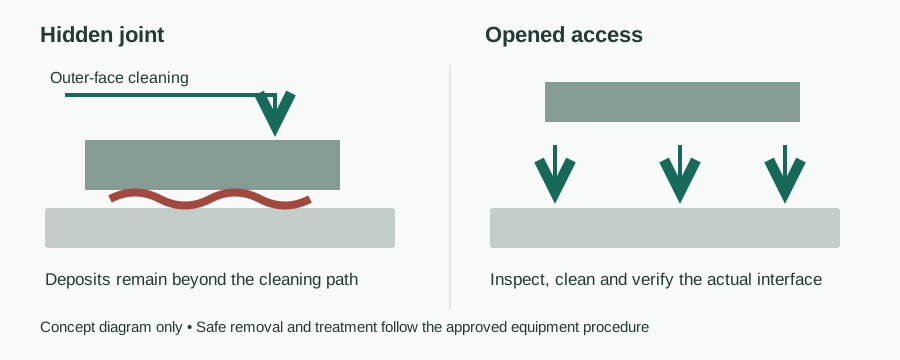
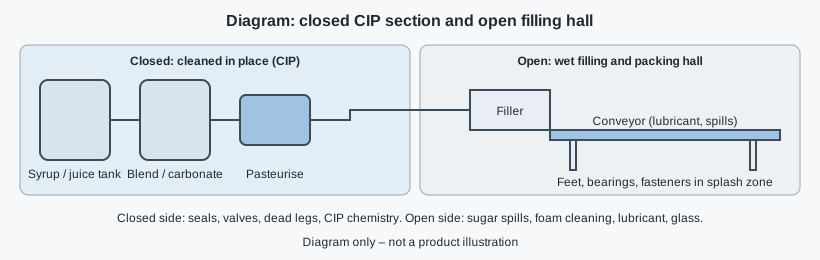 the closed CIP section and open filling hall in beverage processing. Schematic, not a product test report.
Process steps, risks and component requirements
| Stage | Hygiene and technical risks | Component requirements |
|---|---|---|
| Raw material intake (fruit, concentrate, sugar, water treatment) | Dust from sugar, fruit residues, spills | Cleanable supports and feet; stainless fasteners |
| Syrup room, blending, carbonation (closed) | Sugar residues, dead legs, seal condition | Drainable pipework, seals compatible with product and CIP, no dead legs |
| Juice extraction and finishing | Acids, pulp, essential oils from citrus peel | 316/316L in product contact; seal grades checked against oils |
| Pasteurisation / heat treatment (closed) | Heat, CIP chemicals, gasket ageing | Temperature-rated elastomers, inspection access |
| Bottle or can washing, rinsing | Hot caustic, water spray | Stainless parts, sealed bearings, drainage |
| Filling and capping (open) | Product splash, sugar, foam cleaning, aseptic or clean-room zones on some lines | Crevice-free design, sealed bearings with covers, hygienic feet and bolts |
| Conveying, labelling, packing | Conveyor lubricant, spills, glass breakage, wet floors | Stainless conveyor parts, bearings protected from lubricant spray, feet with enclosed threads |
CIP (cleaning in place) circulates cleaning solutions through closed tanks and pipes without dismantling them. The splash zone is everything reached by product splash or cleaning water but not in direct product contact – in a filling hall that includes most conveyor frames, feet and bearings.
Send your application data and get a component recommendation for your beverage line
The closed section: CIP and what it demands
Tanks, pipes, heat exchangers and fillers' product paths are cleaned in place, typically with alkaline and acid steps at controlled concentration, temperature, flow and time. Component points:
- Dead legs – branches where cleaning flow does not reach – trap sugar and allow microbial growth. Remove unused branches and sensor ports.
- Seals and gaskets must suit the product, CIP chemicals and temperature. Elastomer compatibility matters: EPDM is widely used for hot water and CIP but can swell with citrus oils and fats; FKM resists oils better. Check grades with the seal supplier for the actual product.
- Drainability: pipes and tanks must drain fully between CIP steps and production runs.
- Surfaces: EHEDG guidance gives Ra ≤ 0.8 µm for product-contact surfaces as a common reference; the finish must be consistent, including welds.
The difference between enclosed and exposed sections is explained in open vs closed processing systems.
The open section: the wet filling hall
Filling halls are wet for most of the shift. Sugar spills, conveyor lubricant, rinse water and foam cleaning all reach machine frames and their components:
- Sugary residues dry into sticky deposits that bind dirt and support yeasts and moulds – common spoilage organisms in soft drinks and juices.
- Conveyor lubricants (soap-based or dry) and spray reach bearings on conveyor shafts; grease washout follows.
- Glass breakage on bottle lines means machines must be inspectable underneath.
- Floors are wet and sloped to drains, so machine feet sit in water.
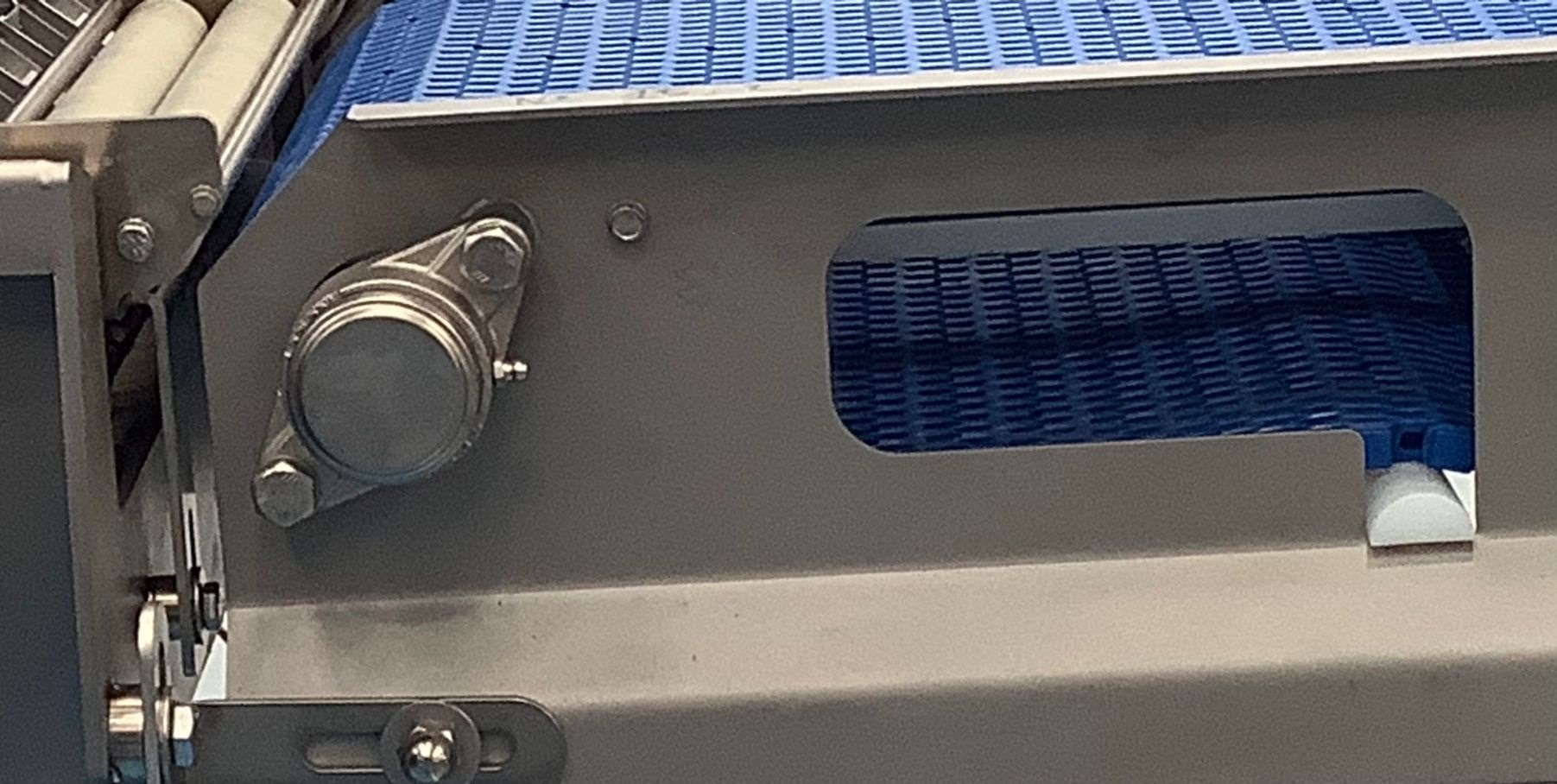
Components that work here: sealed stainless bearing units with closed covers, hygienic bolts without recesses, levelling feet with enclosed threads and sealed bases, and frames without horizontal ledges. See sealed stainless bearing units for hygienic industries and hygienic levelling feet design.
Materials
- AISI 304 is common for frames, guards and conveyor structures.
- AISI 316/316L for product contact with acidic juices, and where chlorinated water or acidic CIP steps are frequent – molybdenum improves resistance to chloride pitting.
- Avoid zinc-plated or painted mild-steel parts in the filling hall; they corrode and flake.
- Avoid mixing metals in wet areas to prevent galvanic corrosion.
- Plastics and elastomers in product contact need a declaration of compliance under EC 1935/2004 (and EU 10/2011 for plastics).
Example
Assumed situation, for method only: a juice and soft drink plant with a closed blending and pasteurising section and a PET filling line. Findings: a capped sensor branch forms a dead leg in the syrup line; EPDM gaskets on the juice side swell after citrus runs; conveyor bearings beside the filler fail repeatedly from lubricant and rinse spray; exposed-thread feet under the filler show sugar deposits. Changes: remove the branch, review gasket grade with the seal supplier, fit sealed stainless bearing units with covers on conveyor shafts, replace feet with enclosed-thread hygienic feet sized for operating load, and clean spills before they dry.
Common mistakes
- Treating the filling hall as "outside" the hygiene scope because product is in closed bottles after capping.
- One gasket material for every product, regardless of oils and temperature.
- Open bearings on conveyors next to fillers.
- Leaving sugar deposits until end-of-shift cleaning.
- Mild-steel brackets added during retrofits.
What to send for a recommendation
- Line section (closed process or open filling/packing) and product types
- Cleaning method: CIP chemistry, foam, high-pressure
- Components: bearings (shaft size, load), feet (operating load), fasteners, conveyor parts
- Material grade, documents (material certificates, EC 1935/2004 declarations, EHEDG certificate where required)
- Quantities and delivery country
An NHK technician suggests components and sends a quote. Browse NHK's hygienic machinery components in stainless steel. For related lines see dairy processing equipment and fruit processing.