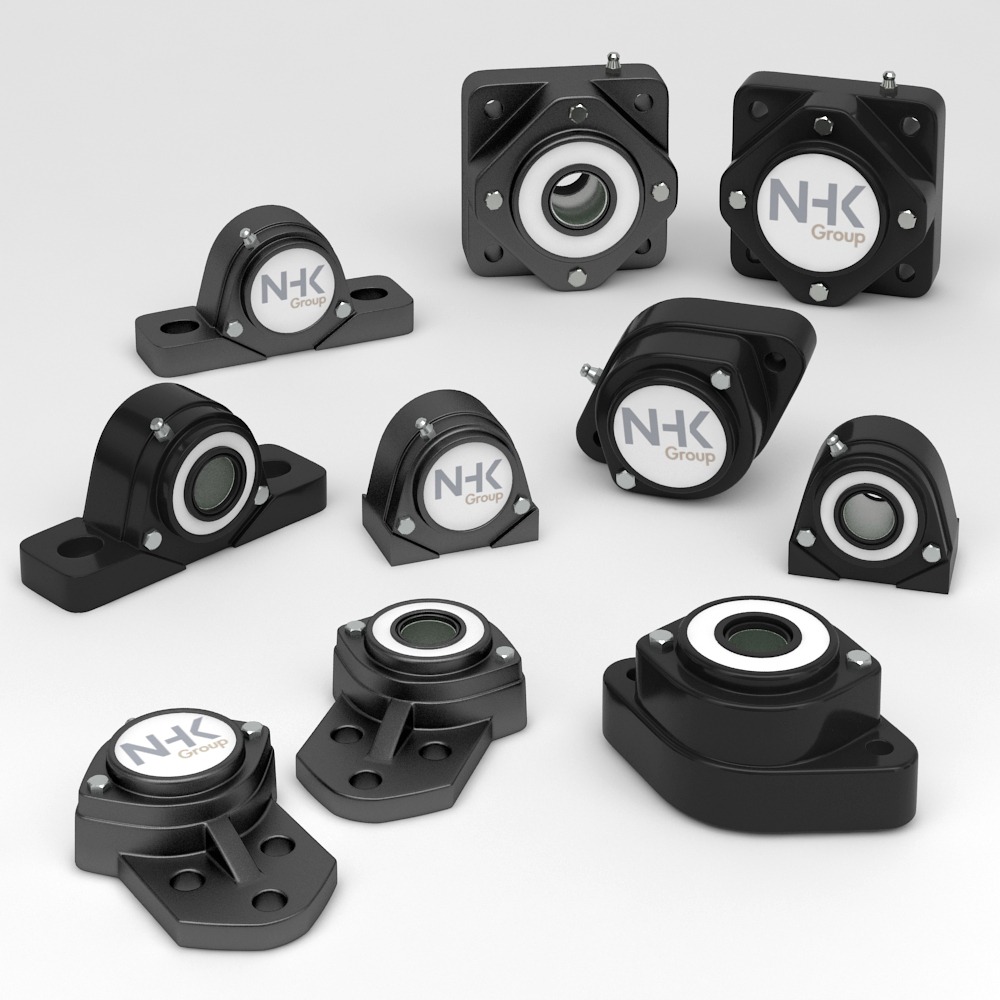
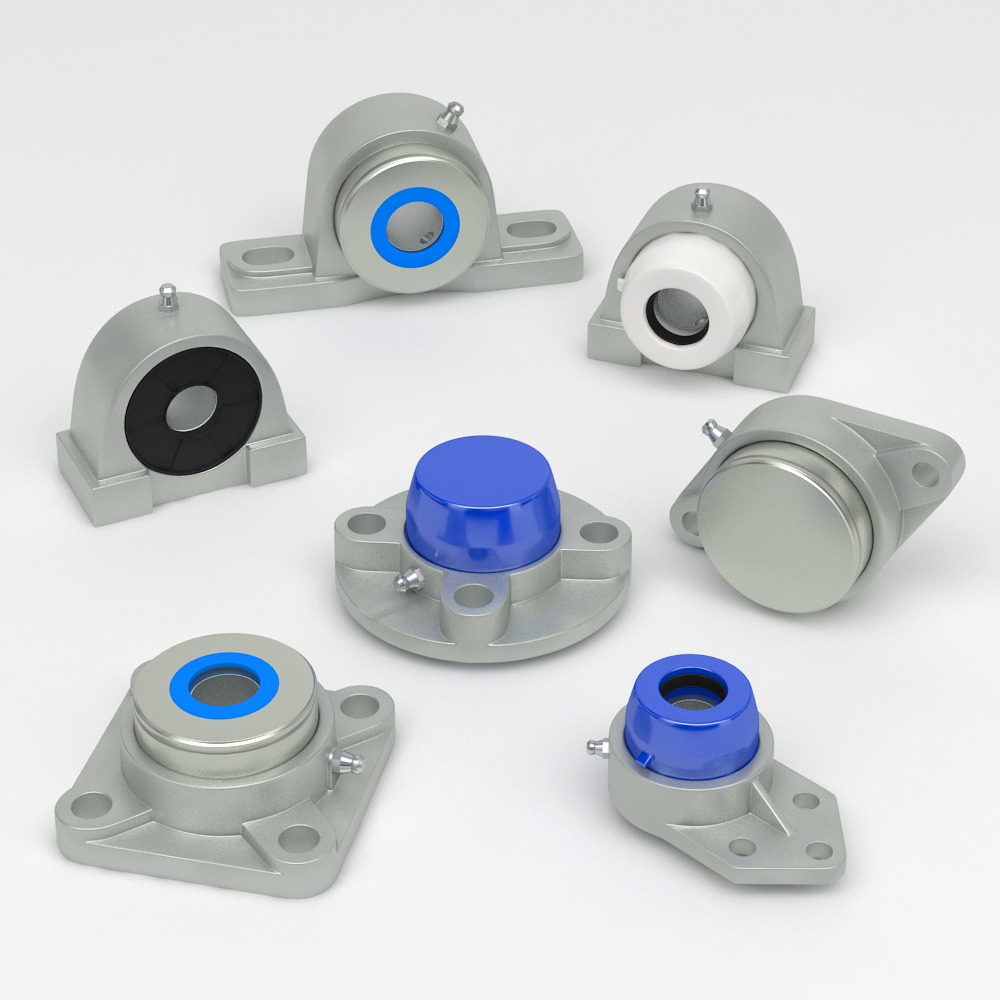
Sealed stainless bearing units are mounted bearings – pillow block, flange and take-up housings with a self-aligning Y-insert – built from stainless steel and sealed so that cleaning water, soil and lubricant stay where they belong. In food processing, pharmaceuticals, cosmetics, dairy, butchery and the chemical industry they replace grey cast-iron units that rust and shed coating. This guide explains what makes such hygienic bearing units suitable, and how requirements differ by industry.
For housing types, insert locking and life calculation, see mounted ball bearing units in stainless steel. To identify an existing SP or SF marking before selecting a replacement, use the stainless-family naming and replacement checks.
For open vs closed end caps and their materials, see open and closed bearing covers.
What makes a bearing unit hygienic
Stainless steel alone does not make a bearing hygienic. Four features matter:
- Corrosion-resistant materials throughout the housing, insert, seals and cover.
- Sealing: contact seals on the insert and, in wet areas, closed end covers or shaft-side seals that keep water out of the bearing.
- Geometry: smooth, rounded, self-draining surfaces (they shed liquid instead of pooling it) and no crevices (narrow gaps) or dead spaces where soil collects and microorganisms survive cleaning – so-called harbourage points.
- Food-grade lubrication, so incidental contact with product does not create a chemical hazard.
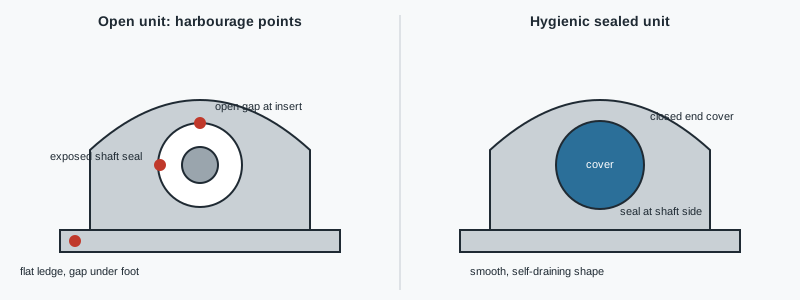
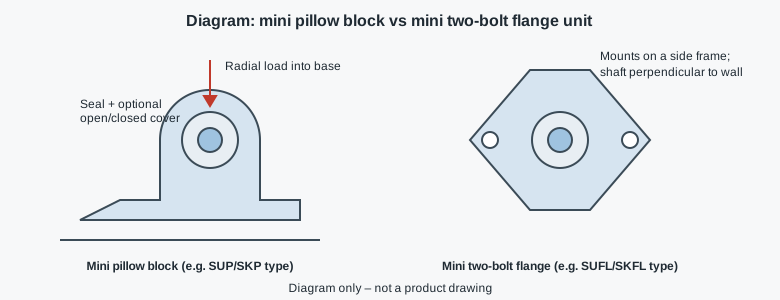
The diagram shows the typical difference: an open unit leaves gaps at the insert, an exposed shaft seal and ledges at the base; a sealed unit with a closed end cover presents a smooth, drainable outer shape.
Materials: 304 housings and 440C inserts
The units described on NHK's sealed stainless bearing units page combine housings in stainless steel 304 with bearing inserts in 440C. The two grades do different jobs:
| Part | Grade | Why | Limitation |
|---|---|---|---|
| Housing | AISI 304 (austenitic) | Good corrosion resistance and strength for frequent cleaning | Can suffer chloride pitting (local pits started by chlorides) with chlorinated cleaners or brine; 316 is more resistant |
| Insert rings and balls | AISI 440C (martensitic) | Hardenable to the hardness and wear resistance raceways need | Less corrosion-resistant than 304; depends on seals and grease |
| Seals | Elastomers such as NBR, EPDM or FKM | Keep water out and grease in | Must suit temperature and cleaning chemicals |
| Covers | Stainless steel or plastic | Close the end of the unit, protect the shaft end | Plastic covers need chemical compatibility |
Two consequences follow. First, 440C inserts carry lower load ratings than chrome-steel inserts of the same size, so check the bearing life calculation instead of copying a cast-iron unit's size. Second, 440C can stain or corrode if seals fail, so seal condition is part of the maintenance routine. Avoid mixing stainless and carbon-steel parts in wet areas, which invites galvanic corrosion.
Lubrication: food-grade and "lifetime"
NHK describes the units as having FDA-certified lifetime lubrication. In regulatory terms, the FDA does not certify greases; lubricants for incidental food contact are formulated to FDA 21 CFR 178.3570 and are normally registered as NSF H1. Ask for that registration or a declaration for the actual grease.
Lifetime lubrication means no regreasing under the intended conditions. It reduces maintenance and removes the risk of over-greasing, where excess grease is pushed out onto the machine. Grease life is shortened by high temperature, high speed, water ingress and aggressive cleaning. Units with a grease nipple allow relubrication and flushing of contaminated grease, but the nipple is one more feature to clean. Decide based on the cleaning severity and the accessibility of the unit. For produce applications, see bearing requirements on fruit and vegetable lines.
Use the factory-fill versus permitted relubrication decision to check the actual unit's instructions before selecting a servicing routine or purge method.
Requirements by industry
| Industry | Typical exposure | What to prioritise |
|---|---|---|
| Food processing | Foam and rinse, product splash | Closed covers, food-grade grease, smooth housing |
| Dairy | Hot water, alkaline and acid cleaners, moisture | Seals for hot water and chemicals; consider 316 housings where chlorides are present |
| Butchery and meat | Daily high-pressure washdown, fat and blood | Sealed covers, seals resistant to fat; ingress protection for jets (IP69K) where specified |
| Pharmaceuticals | Strong cleaning and disinfection agents, documentation | Chemical compatibility, traceable materials, document file |
| Cosmetics | Sensitive ingredients, oils | Seal compatibility with oils, closed design |
| Chemical industry | Aggressive substances | Housing and seal materials checked against the actual chemicals |
An IP rating (IEC 60529; IP69K in ISO 20653) describes resistance to water and dust ingress, not cleanability. For sealing details and IP ratings, see sealed waterproof stainless steel bearing units.
How to select hygienic bearing units
- Define the zone: product-contact zone, splash zone (wetted by product or cleaning spray) or non-contact zone.
- Record cleaning: dry, foam, high-pressure washdown, or CIP/COP (cleaning in place, or out of place after dismantling), with pressure, temperature and chemicals.
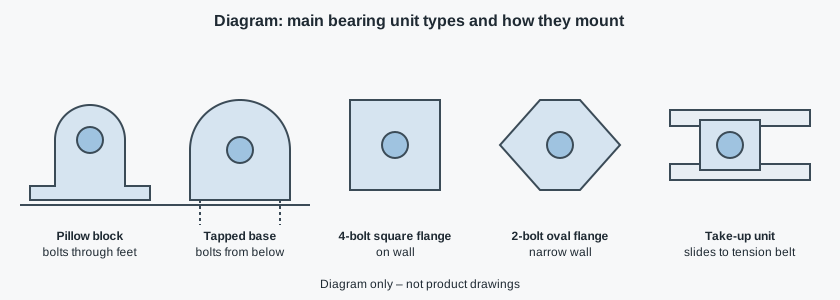
- Choose the housing type: pillow block, square or oval flange, take-up – see pillow block bearings: the complete guide.
- Check the load: calculate bearing life with the stainless insert's ratings, not chrome-steel figures.
- Choose sealing and cover: open cover only in dry areas; closed or sealed covers in wet areas; shaft-side seal where washdown hits the unit.
- Choose lubrication: lifetime-lubricated or relubricatable, with food-grade grease documented.
- Request documents (below).
Example – assumptions stated, not a real application. A conveyor in a poultry plant runs at moderate speed and is cleaned daily with alkaline foam and a high-pressure rinse. The specifier picks sealed stainless flange units with closed covers on the non-drive side and a shaft-side seal on the drive side, lifetime-lubricated with NSF H1 grease. Because a chlorinated sanitiser is used weekly, the specifier asks whether 316 housings are available and checks the seal elastomer against the sanitiser. Bearing life is recalculated with the stainless insert's dynamic load rating.
What to write in the RFQ
- Housing type and shaft diameter; load and speed.
- Housing and insert grades (e.g. 304/440C, or 316 where chlorides are present).
- Seal type and elastomer, cover type (open, closed, sealed).
- Lubricant: food-grade, with NSF H1 registration or declaration.
- Cleaning method, chemicals and temperatures.
- Ingress rating with test standard, if required, and any hygienic design certificate for the exact design.
Failure modes to avoid
- Sizing from a cast-iron unit – stainless inserts may be overloaded.
- Open covers in washdown zones – water and soil enter the shaft end.
- Seals not matched to chemicals – swelling or cracking lets water in and the 440C insert corrodes.
- Over-greasing relubricatable units – grease is pushed onto the machine.
- Treating IP ratings or "FDA" wording as proof of hygiene – ask for the specific documents.
Conclusion
Sealed stainless bearing units with 304 housings and 440C inserts are a sound basis for hygienic bearing applications, provided seals, covers, grease and load are chosen for the industry and cleaning method in question – and documented.