Communication in cleaning practices is the exchange of instructions, findings and feedback between cleaners, supervisors, hygiene managers and engineering, so that cleaning is done correctly and problems get fixed. Effective cleaning needs more than good tools and procedures: it needs a continuous dialogue between cleaners and management.
This page covers the barriers, practical communication methods, what inspection tools such as UV lights can and cannot show – and how cleaner feedback can improve the equipment itself. For the broader management system, see effective hygiene management.
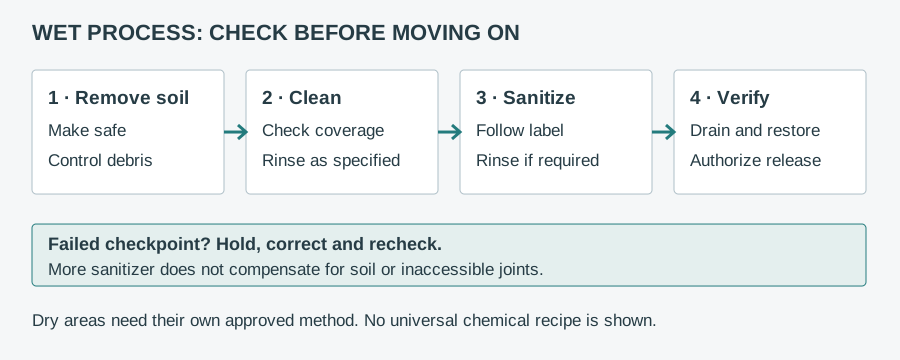
Use the cleaning checkpoints and audit-record guide to connect team handovers with documented execution and corrective action.
Why communication in cleaning teams breaks down
- Language barriers: cleaning staff often come from diverse backgrounds. Misunderstood instructions lead to wrong procedures or incomplete tasks.
- Shift patterns: cleaning teams typically work at night or between production runs, with little overlap with management.
- Hierarchy: cleaners may feel undervalued or hesitant to raise concerns, expecting not to be taken seriously.
- No route to engineering: even when supervisors hear about a problem, there is often no clear way to pass a design or wear issue to maintenance or the machine builder.
Practical communication methods
| Barrier | Method | What it looks like |
|---|---|---|
| Language | Visual, multilingual instructions | Photo-based SSOPs (sanitation standard operating procedures) at each machine |
| Shift gaps | Handover log | Short written or digital record of issues, read at shift start |
| Hierarchy | Anonymous or easy reporting | Feedback form, app or board; issues answered visibly |
| Coordination | Liaison role | Team leader who relays feedback in both directions |
| Shared priorities | Regular briefings | Short shift briefings plus a weekly or bi-weekly review |
Digital platforms – apps or dashboards for task tracking, messaging and reporting – make communication possible across shifts. They work only if they are quick to use with wet gloves and if reports get answered.
The feedback loop to maintenance and engineering
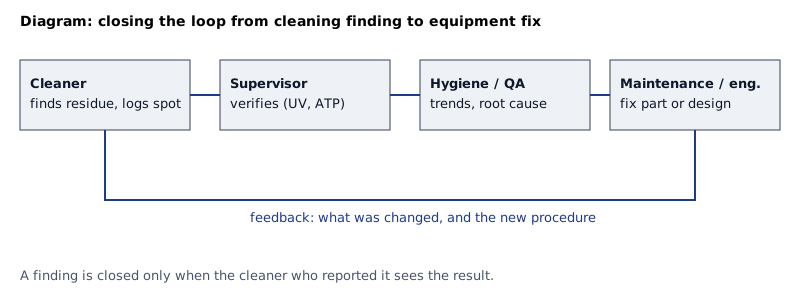
Cleaners handle every surface of every machine, so they see equipment problems first: a seal that has started to leak, a foot that has corroded, a corner that never comes clean. A structured feedback loop turns that knowledge into fixes:
Typical findings and what they usually mean:
| Cleaner finding | Likely cause | Who acts |
|---|---|---|
| Residue always at the same machine feet | Exposed thread, worn or missing seal | Maintenance: replace with sealed hygienic feet |
| Water or soil behind bearing covers | Unsuitable housing or worn seals for washdown | Maintenance: seal replacement or washdown-suited bearing units |
| Rust spots on frames or fasteners | Chlorides, unsuitable grade, damaged surface | Engineering: material and chemical review |
| Corner that cannot be reached | Design: dead space, tool-bound disassembly | Engineering or machine builder |
| Chemical damage to seals | Elastomer not compatible with cleaner | QA and maintenance: seal material review (EPDM, FKM, VMQ) |
Dead spaces are areas where liquid stagnates. Elastomer compatibility describes whether a seal material resists a specific chemical; EPDM, FKM and VMQ each suit different media. Replacement options include hygienic levelling feet and sealed stainless bearing units. The cleaner's side of these problems is covered in challenges faced by cleaners in food production.
Inspection tools: what UV lights can and cannot show
New inspection tools give cleaners and management shared, visible evidence of results. UV inspection lights are among the simplest.
How UV inspection works
A UV light makes certain residues fluoresce – glow – so they become visible. Some organic soils fluoresce on their own; fluorescent marker gels can be applied before cleaning to test whether a surface was cleaned.
Uses:
- Visualising residue invisible in normal light, so cleaners can target specific areas.
- Immediate feedback: supervisors and cleaners check surfaces right after cleaning.
- Documentation: photos of inspections record results.
- Training: before-and-after views show why thorough cleaning matters.
Limits: UV light does not detect bacteria directly, not all residues fluoresce, and results depend on the surface and light conditions.
Comparing verification methods
| Method | What it shows | Speed | Best use |
|---|---|---|---|
| Visual inspection | Visible soil | Immediate | Every clean |
| UV light / fluorescent markers | Fluorescent residue, cleaning coverage | Immediate | Training, coverage checks |
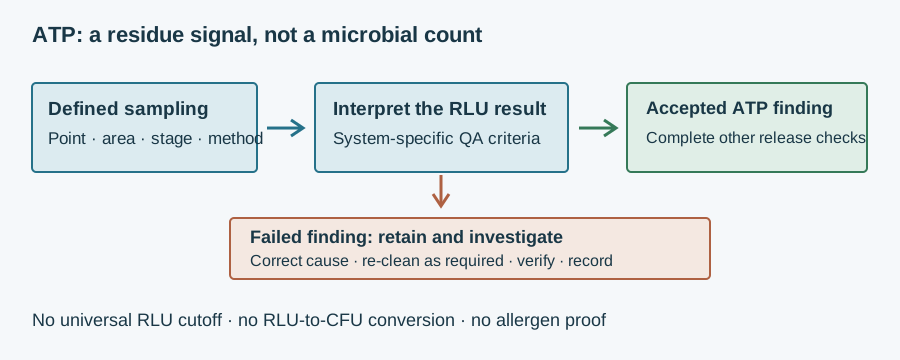
| ATP test | Organic residue (adenosine triphosphate), numerical result | Minutes | Routine verification at defined points |
| Microbiological swab | Specific microorganisms | Days (lab) | Validation, environmental monitoring |
| Allergen swab | Specific allergen residue | Minutes to days | Allergen changeover verification |
Combining communication and inspection
- Joint inspections: cleaners and supervisors inspect together, using UV lights and ATP, and agree on findings.
- Location-based reports: record results by machine and spot, not just by shift.
- Recognition: acknowledge good results based on inspection data.
- Continuous improvement: combine feedback with inspection data to refine procedures and identify equipment changes. Turning this data into targets is covered in setting and achieving cleaning goals.
How to set up a cleaning feedback loop
- Define reporting: a simple form or app with machine, location, problem and photo.
- Assign a liaison per shift to collect reports.
- Verify: supervisor checks the finding with visual, UV or ATP inspection.
- Trend: QA reviews findings weekly by location.
- Act: procedure change, maintenance task or engineering change.
- Close: tell the reporting cleaner what was done.
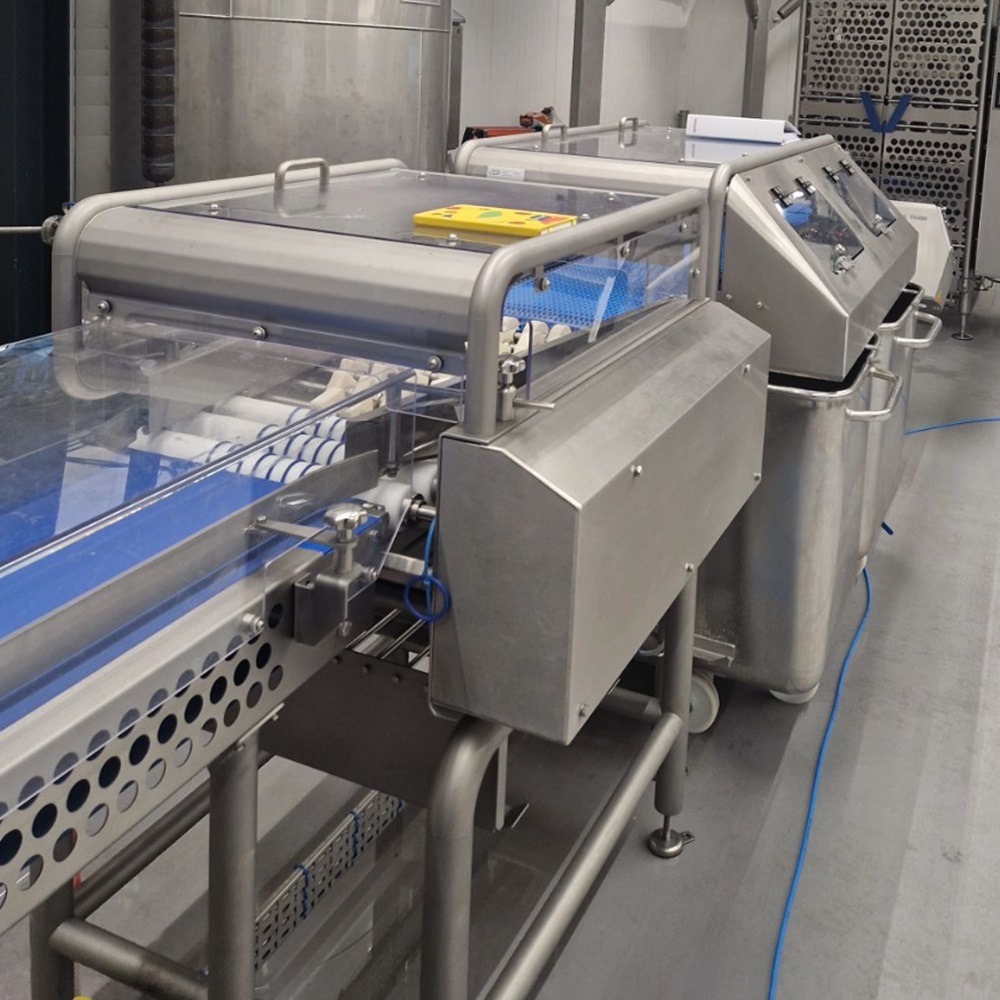
Example: night-shift reports on a slicing line
Assumptions (illustrative): night-shift cleaners repeatedly write in the handover log that the base of a slicing line takes extra time and still shows residue.
- Verify: the supervisor applies fluorescent marker before the clean; UV inspection afterwards shows residue around the feet and frame fasteners.
- Trend: ATP results at the same points fail more often than elsewhere on the line.
- Act: maintenance replaces the feet with sealed hygienic feet and splash-zone fasteners with hygienic bolts.
- Close: the change is explained at the next briefing; ATP checks continue at the same points.
What better communication delivers
- More consistent cleaning, because procedures are understood and followed.
- Higher morale, when cleaners see that reports lead to changes.
- Fewer repeat problems, because root causes reach the people who can fix them.
- Trust, based on shared evidence rather than opinion.