Cleaning in food production is the removal of soil, allergens and microorganisms from equipment and facilities so that products are safe – and the people who do it face some of the hardest working conditions in the plant. Their work protects food safety, regulatory compliance and the brand; when it fails, the result can be health hazards, recalls and lasting damage to reputation.
This page looks at the challenges from the cleaner's side and asks what machine builders and engineers can change. For the management system around cleaning, see effective hygiene management.
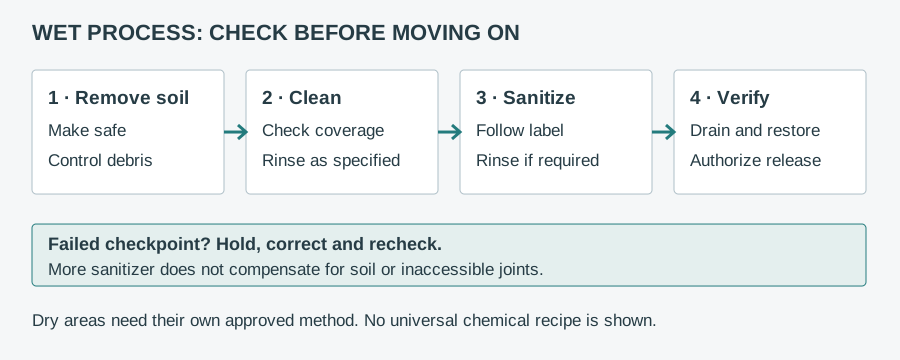
The dry and wet cleaning decision route connects method choice, access and chemical exposure with a controlled sanitation sequence.
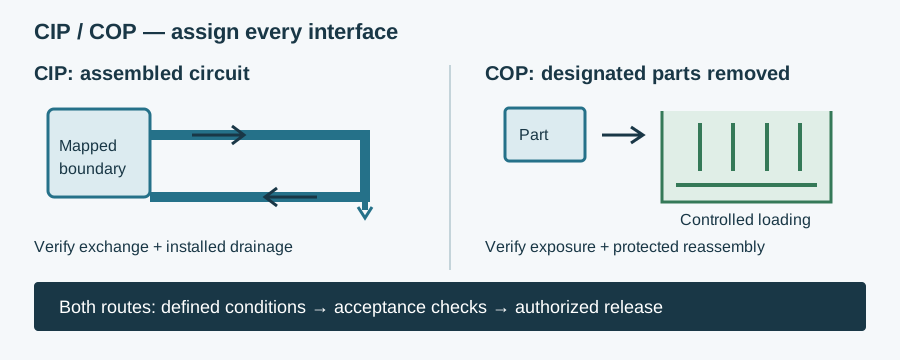
For dismantling and restoration tasks, the removed-part handling and reassembly checklist helps specify what the cleaning procedure must cover.
Use the spray-path and component-exposure comparison when assessing foam application and hand-lance rinsing.
Why cleaning matters in food production
Compliance
Food plants work under HACCP-based food safety systems, often certified to schemes based on ISO 22000, and local food safety law. Cleaning is a prerequisite programme for all of them: every surface, machine and area must meet defined hygiene levels, and that has to be verified.
Preventing cross-contamination
The main purpose of cleaning is to stop cross-contamination: removing allergens, pathogens and residues so they do not carry from one product, batch or area to the next. Allergen changeovers – cleaning between products with different allergens – are among the most demanding cleans, because residue limits are strict and verification is required.
The challenges cleaners face
| Challenge | What cleaners experience | Root cause they cannot fix themselves |
|---|---|---|
| Labour-intensive cleaning | Scrubbing, kneeling, reaching under frames | Hard-to-access equipment design |
| Long cleaning cycles | Clean runs into production time | Tool-bound disassembly, many crevices |
| Wet, cold or hot conditions | Fatigue, slips, discomfort | Plant layout, temperature of process areas |
| Chemical exposure | Skin and respiratory risk, uncomfortable PPE | Soil that only strong chemicals remove |
| Time pressure | Speed versus thoroughness | Short sanitation windows |
| Zero tolerance | Pressure of audits and swab results | Recurring failures at the same design features |
Labour-intensive processes and complex equipment
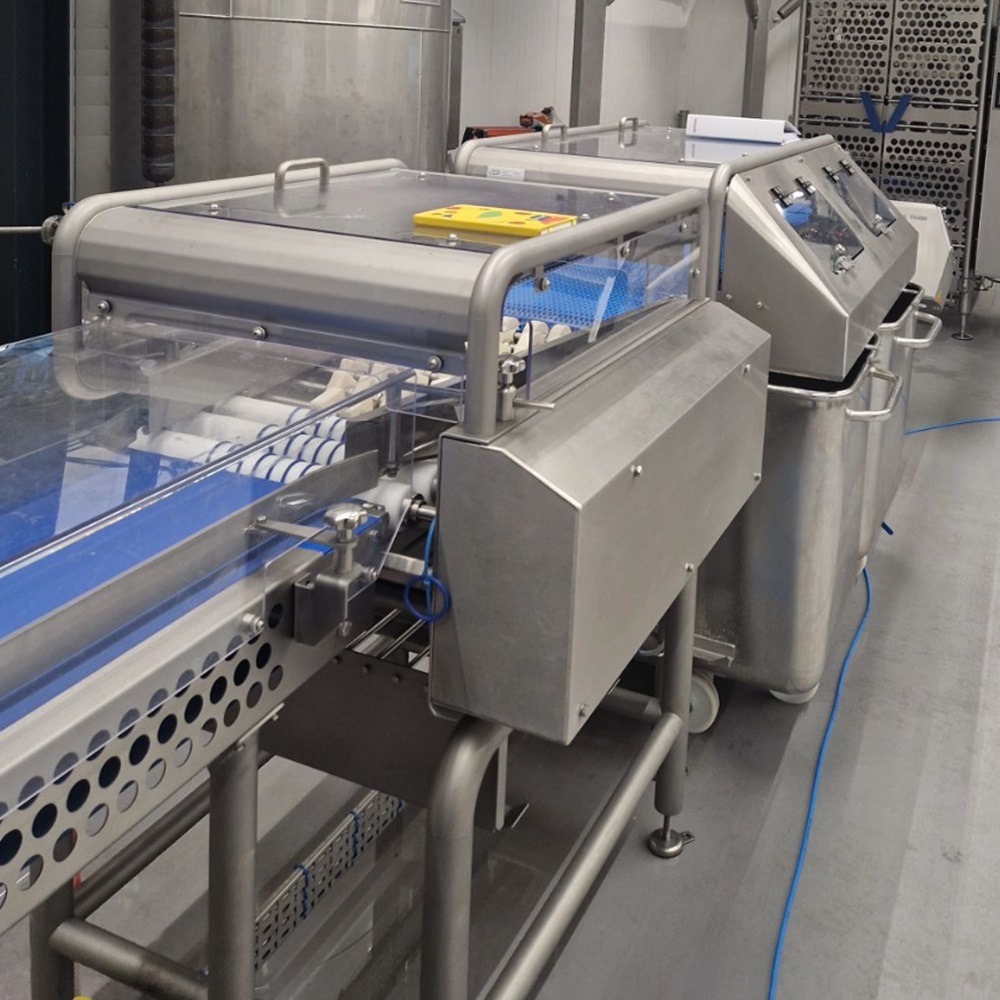
Cleaning means handling heavy parts, reaching awkward areas and following precise protocols. Many machines are not designed with cleaning in mind: intricate components, hollow sections and closely packed parts are hard to access. Manual cleaning of such equipment takes long and delays the restart of production.
Harsh environmental conditions
Cleaners work in wet, humid areas, in cold rooms or near hot equipment. Floor slopes, drains and space around machines are set by the hygienic factory layout. Wet floors and cleaning agents make surfaces slippery; temperature extremes add to fatigue and the risk of accidents.
Chemical exposure
Disinfectants and detergents can cause skin irritation and respiratory problems if handled incorrectly. PPE (personal protective equipment) is essential but restrictive during long shifts. Incorrect mixing or misuse of chemicals reduces effectiveness and can cause harmful reactions. Strong chemicals also attack equipment: chlorinated cleaners can cause chloride pitting (local corrosion) on stainless steel and degrade unsuitable seals.
Time constraints and high standards
Production schedules leave limited windows for sanitation. Cleaners must balance thoroughness with speed, knowing that small lapses can lead to contamination, penalties or recalls.
Where cleaners lose time on a machine
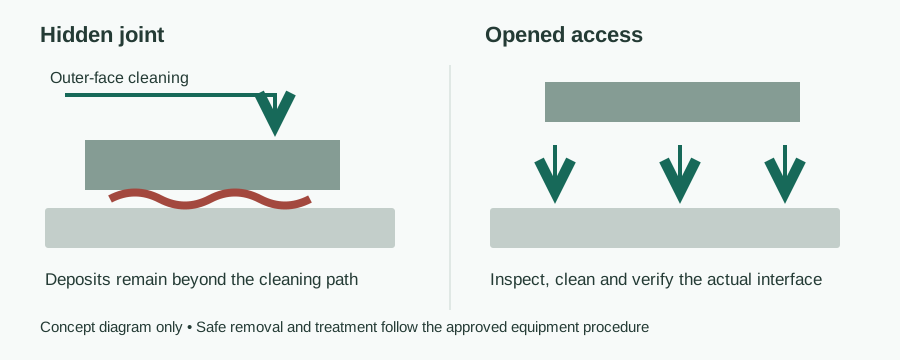
Most of the extra effort concentrates at a few design features – harbourage points, places where soil and microorganisms survive normal cleaning:
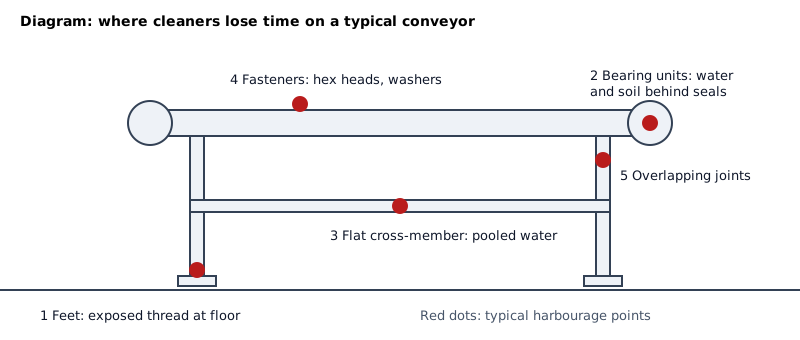
- Machine feet with exposed adjustment threads and lock nuts at floor level, where water and soil collect.
- Bearing units where high-pressure water drives soil past seals or collects in housing recesses.
- Flat horizontal surfaces and closed profiles that hold water – dead spaces where liquid stagnates.
- Fasteners: hex heads, washers and exposed thread form crevices, narrow gaps cleaning fluid cannot flush.
- Overlapping joints and metal-to-metal contact surfaces.
Design solutions that remove the cause
| Problem spot | Design solution | Effect for cleaners |
|---|---|---|
| Feet | Sealed hygienic feet, no exposed thread, self-draining shape | No scrubbing of threads at floor level |
| Fasteners | Hygienic bolts and domed nuts with integrated seals | Smooth surfaces foam and rinse can reach |
| Bearing units | Housings suited to washdown, closed covers, correct seals | Less soil and water ingress, fewer replacements |
| Frames | Sloped surfaces, open or sealed profiles, continuous welds | Water drains instead of pooling |
| Removable parts | Tool-free disassembly, parts that cannot be refitted wrongly | Faster COP and changeovers |
| Product-contact surfaces | Smooth finish; EHEDG guidance of Ra ≤ 0.8 µm | Soil releases with less chemical action |
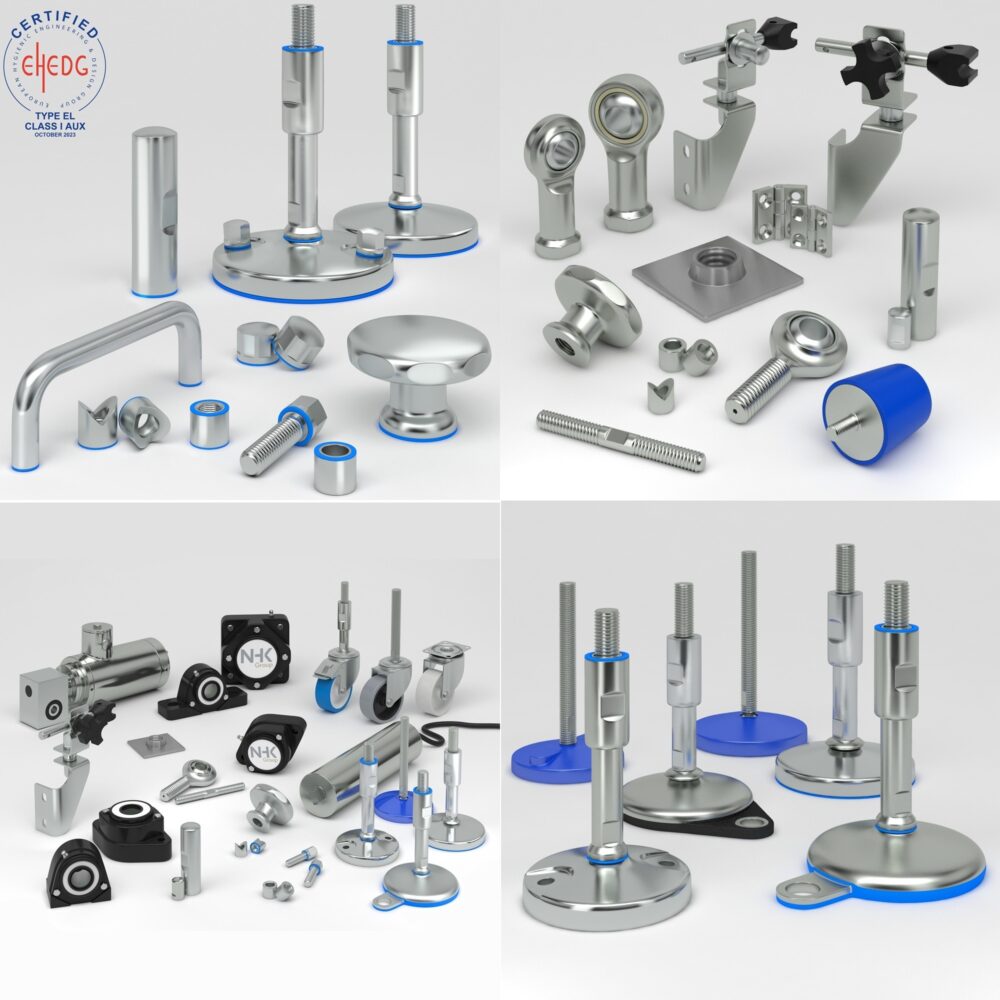
Self-draining surfaces are shaped so water runs off. Ra is average surface roughness. COP (cleaning out of place) means removing parts to clean them separately. Hygienic design is set out in EN 1672-2 and EHEDG guidelines – see hygienic machine design standards. Components to look at include hygienic levelling feet and hygienic bolts.
Automation
CIP (cleaning in place) cleans closed systems such as pipes and tanks without disassembly, saving labour and downtime and making cleaning repeatable. Robotic floor scrubbers automate floor cleaning. Automation reduces exposure to hazardous conditions, but open equipment such as conveyors still depends on manual and foam cleaning – and on its design.
Milder chemistry
Less aggressive, biodegradable cleaning agents can reduce exposure risks where they achieve the required hygiene level. Easy-to-clean equipment makes that possible, because soil that is not trapped needs less chemical action. Always check that the chemistry is validated for the soil and compatible with the equipment's materials and seals (elastomer compatibility: EPDM, FKM and VMQ each resist different chemicals).
Training
Training should cover chemical handling, ergonomics, time management and the specific machines: which parts to remove, where residue hides, and why high-pressure water should not be aimed at bearing seals.
How to run a cleanability walk-down
Engineers can learn more in one cleaning shift than from drawings. A simple method:
- Join a cleaning shift on the machine in question and note each step and its time.
- Mark where time goes: parts that need tools, areas reached only by kneeling, spots scrubbed repeatedly.
- Check results: after cleaning, inspect and swab the marked spots.
- Classify each spot: design feature, worn part, or procedure issue.
- Prioritise changes: replace components with hygienic designs at the next planned stop; change procedures where design is not the cause.
- Repeat after changes to confirm the improvement.
Example: conveyor in a ready-meal plant
Assumptions (illustrative): cleaners report that a conveyor takes noticeably longer to clean than similar lines, with repeated swab failures at the base.
- Walk-down finding: most time spent on feet with exposed threads and on hex fasteners on the side frames; water pools on a flat cross-member.
- Action: feet replaced with sealed hygienic feet, splash-zone fasteners replaced with hygienic bolts, cross-member drilled for drainage at the next redesign.
- Verification: swabs continued at the same points; cleaning time recorded before and after.
Best practices for cleaners and supervisors
- Regular schedules: consistent cleaning prevents build-up.
- Focus on high-risk areas: equipment interfaces, conveyors and drains.
- Collaboration: cleaners, supervisors, maintenance and production should share findings – cleaners know where machines are hardest to clean. How to set up that dialogue is covered in communication and innovation in cleaning practices.
- Report damage: worn seals, loose parts and corrosion create new harbourage points.
What changes next
Smart monitoring, stricter hygiene expectations and sustainability goals will continue to shape cleaning. The most direct improvement, though, is equipment that is easier to clean: it makes the cleaner's work safer, shorter and more reliable.
How component failures turn into recalls is covered in safeguarding against contamination and product recalls.
To turn cleaning problems like these into a decision management will fund, see the value in technical challenges.