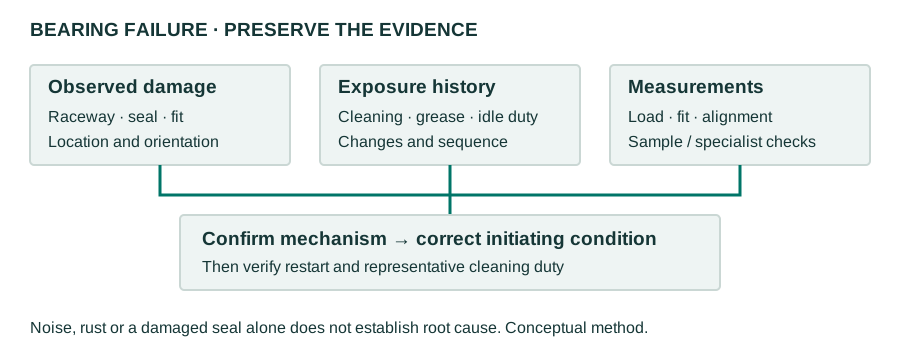
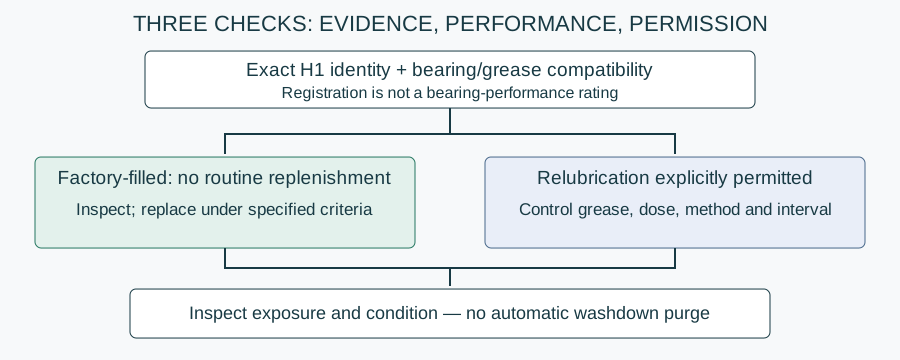
An NSF H1 lubricant is registered for use where incidental food contact may occur; that registration does not approve deliberate addition to food or prove a grease will perform in a particular bearing. Treat food-contact suitability, mechanical lubrication and the permitted maintenance strategy as separate checks. For existing damage, start with the bearing failure and exposure investigation rather than assuming fresh grease will repair the unit.
What NSF H1 registration means—and does not mean
NSF reviews lubricants within its nonfood compounds registration programme. H1 identifies lubricants intended for locations where incidental contact with food is possible. Check the actual product name and current registration, not just a supplier's general “food grade” label. An H1 oil and an H1 grease are not interchangeable merely because both share a category.
| Evidence or term | What it addresses | What it does not establish | Buyer check |
|---|---|---|---|
| NSF H1 registration | Lubricant suitability for incidental food contact within registration conditions | Deliberate food contact, bearing life or washdown endurance | Match exact product identity and registration category |
| 21 CFR 178.3570 | US requirements for lubricants with incidental food contact, including applicable formulation and use conditions | FDA certification of a grease or a complete bearing | Obtain the formulation/use compliance basis for the actual lubricant |
| ISO 21469 certification, where held | Hygiene requirements covering formulation, manufacture and use of lubricants with incidental product contact | Universal bearing performance or interchangeability | Check the certified lubricant and certificate scope |
| Bearing manufacturer's lubrication specification | Mechanical requirements and permitted servicing for the unit | Food-contact compliance by itself | Confirm grease identity, method, amount and interval separately |
Send your application data and get a component recommendation
Do not use “FDA-certified grease” as the evidence request: the FDA regulation is not a grease certification scheme. H1 registration and ISO 21469 certification are distinct forms of evidence; one should not be presented as automatic proof of the other. Neither permits disregarding the plant's contamination controls or the conditions of use.
H2 is a lubricant category for locations where there is no possibility of food contact; H3 concerns soluble oils in a separate registration category with its own conditions. They are not alternative bearing-grease grades to substitute wherever H1 is specified. Ask QA to confirm the application zone and documentation before accepting a change.
Food grade bearing grease: choose the formulation, not the label
Bearing grease combines base oil, thickener and additives. These influence lubricant film, consistency, delivery and compatibility. Select for the actual bearing type, speed, load, operating temperature, sealing and exposure using the manufacturer's data. H1 status does not establish the required viscosity, consistency, corrosion protection or resistance to water washout.
Compare the grease's technical data with the unit instructions and the plant's food-contact requirements. Do not infer that all products labelled “food grade” are H1 registered, or that a registered oil is suitable for a grease-filled insert. Request an exact designation and supporting document, not an unspecified “equivalent” product.
Before changing grease, confirm compatibility with the existing fill, seals and delivery system. Similar colour, thickener family or H1 status is not proof that two complete formulations can be mixed. A change may require a manufacturer-approved cleaning or replacement procedure; adding a different grease on top is not a compatibility test. Record the approved change and identify containers and tools to prevent accidental mixing.
For the related corrosion cluster, use the cleaner exposure and corrosion identification guide if moisture or chemicals have attacked the unit. Grease selection can be part of protection, but adding grease does not reverse pitted raceways or identify the entry path.
Lubricated for life vs relubricable bearing units
“Lubricated for life” means the intended grease fill serves the unit under its specified conditions without routine replenishment. It does not mean infinite life, immunity to ingress or no inspection. Confirm the intended duty and replacement criteria. A sealed housing is not, by itself, proof that the insert must never be relubricated—or that it can be.
| Strategy | Appropriate selection question | Maintenance obligation | Limit |
|---|---|---|---|
| Factory-filled, not intended for relubrication | Can the approved fill and seals serve the specified duty? | Inspect seals, covers, running condition and exposure; replace as required | Do not open seals or add fittings to inject grease without approval |
| Relubricable unit | Can lubrication be delivered safely, cleanly and in controlled quantities? | Follow specified lubricant, method, amount and interval; inspect condition | Extra grease can increase heat, displace seals or escape toward product |
| Changed cleaning or operating duty | Is the existing lubrication strategy still applicable? | Review exposure, load, speed and observed condition with supplier and QA | Do not invent a shorter interval or purge procedure from cleaning frequency alone |
Choose a replenishable arrangement when the unit requires and permits servicing and access allows controlled intervention. Choose a factory-filled arrangement when its intended service conditions fit the application and routine greasing is not required. Neither is always better: accessibility, contamination control, duty and the actual unit instructions decide.
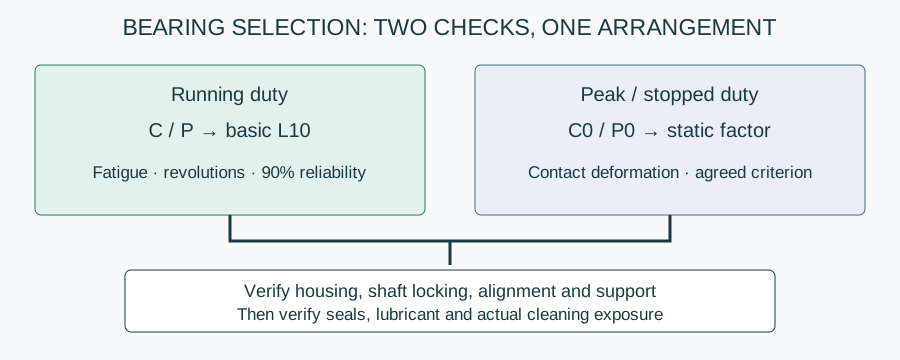
The migrated sealed stainless units by industry guide adds housing and application context. Check the proposed item rather than transferring a lifetime-lubrication claim from a category page. For running-load assessment, use the basic fatigue-life method and its limits; an L10 result is not a grease-life or replacement-interval calculation.
When to relubricate after washdown
Relubricate after washdown only when the unit permits it and the approved procedure calls for that intervention. Cleaning frequency is an input to the maintenance review, not a universal trigger. Record nozzle exposure, cleaner concentration, temperature, dwell and rinse, then inspect the sealing path and lubricant evidence.
Water-contaminated, depleted and displaced grease are different findings. Fresh grease may be part of a permitted maintenance action, but cannot prove that water is absent or the ingress route is closed. Do not prescribe pumping until fresh grease appears for every unit: a controlled purge may be appropriate for a particular design only when its manufacturer specifies the path and quantity.
If noise, heat, leakage or damaged seals appear after cleaning, investigate before adding more grease. Preserve useful observations and lubricant samples where needed. Involve QA where lubricant or fragments could reach food and follow the plant's hold/disposition procedure. Neither H1 registration nor a fresh fill authorizes releasing contaminated product.
For the related cleaning cluster, use the installed cleaning-access and residue checks. The migrated waterproof-unit cleaning inspection route supports exposure assessment, but the exact unit's servicing instructions take precedence over a generic regreasing routine. IP67 under IEC 60529 documents temporary immersion, not high-pressure jet resistance or chemical compatibility.
Relubrication of bearing units: a controlled procedure
- Identify the unit and permission. Confirm the designated lubrication point, whether relubrication is permitted and the approved working state. Isolate machinery unless an engineered safe servicing procedure requires otherwise; never improvise access to a moving shaft.
- Verify the lubricant. Match product identity, H1 registration where required, mechanical specification and existing-fill compatibility. Hold the task if the fill is unknown or documentation conflicts.
- Control cleanliness. Clean the lubrication point using the approved method. Protect containers, couplings and delivery tools from food residue, dirt and water; use identified equipment to prevent cross-use.
- Control delivery. Apply the specified amount and method with equipment suited to the unit. Where dose is stated by mass, establish the gun's delivery rather than assuming every stroke is identical. No universal stroke count or pressure is prescribed here.
- Monitor and stop. Follow the designated discharge/vent path where one exists. Stop and investigate abnormal resistance, seal displacement or uncontrolled leakage; do not overcome resistance by increasing pressure blindly.
- Record and inspect. Record lubricant, dose, time, unit and observations. Remove escaped material using the hygiene procedure and check running condition after the approved restart; retain the inspection baseline and follow-up plan.
Ask the manufacturer for a defined dose and interval at the actual duty. Do not substitute a generic bearing-diameter formula for the mounted unit's instructions without approval. Over-greasing can cause churning and heat or force lubricant beyond seals. Under-lubrication, incompatible lubricant and contaminated delivery can also damage the unit.
Use the washdown inspection and monitoring framework to separate lubrication tasks from running-condition checks.
Symptoms and checks before adding more grease
| Observation | Possible explanation | Check before intervention | Decision |
|---|---|---|---|
| Heat rises after greasing | Excess fill, unsuitable lubricant or another mechanical fault | Delivered amount, grease identity, operating baseline and load | Stop/dispose under approved procedure; do not infer the cause from heat alone |
| Grease escapes toward product | Excess pressure/fill, seal damage or unsuitable discharge path | Seals, delivery method and contamination risk | Contain and involve QA; correct the demonstrated cause |
| Water traces or milky grease | Possible contamination through a sealing path | Samples, cover/seal condition and cleaning exposure | Investigate; regreasing does not repair corrosion |
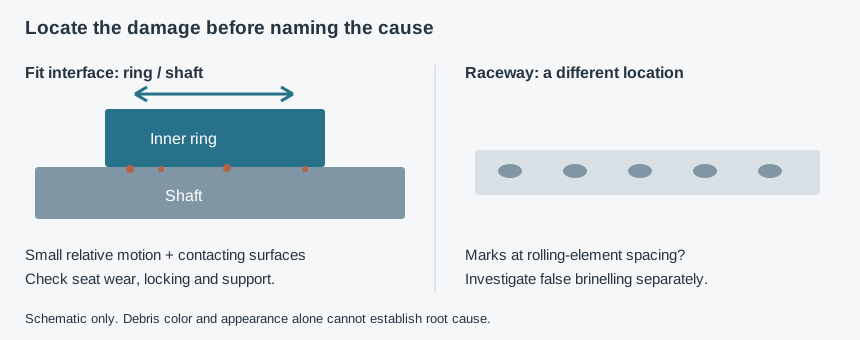
| Vibration or debris beneath ring | Fit movement may coexist with lubrication problems | Seat condition, locking and support | Use the fit-interface diagnostic route rather than treating all noise as dry running |
Example: grease leakage after a cleaning change
Example — hypothetical assumptions, not NHK field data. A conveyor has a relubricable insert and begins leaking grease after a change in cleaning and servicing. The actual fill, approved dose and ingress evidence are unknown. No cause or successful repair is assumed.
Record the delivered lubricant and quantity, inspect seals and review cleaning exposure. Excess delivery would require correcting the method; confirmed moisture would require correcting its entry route; an incompatible fill would require the supplier's disposition. Do not respond by increasing frequency automatically. A factory-filled unit in the same situation must not be treated as relubricable merely because a grease gun is available.
Specification and enquiry: send the lubrication record
Copy and complete: “Unit designation, shaft drawing and quantity: __. Factory-filled or relubricable, and source instructions: __. Current lubricant identity, H1 registration and compatibility basis: __. Load, speed, temperature and duty: __. Zone and incidental-contact risk: __. Washdown method, chemicals, concentration, temperature, dwell and rinse: __. Permitted dose, interval, method, access and discharge path: __. Leakage, heat, noise, seal condition and maintenance record: __. Material, lubricant and applicable exact-design documents required: __. Delivery country: __.”
Send these details to NHK
NHK lists sealed stainless units for lubrication-strategy enquiries. Send the record through this site's existing form so NHK can suggest a component and prepare a quote. Use the supplier evidence and configuration checklist for any claimed component-design certificate. Ask for the proposed item's actual grease identity and permitted maintenance conditions; this guide asserts no NHK H1 registration, grease quantity, service interval, temperature limit or maintenance-free guarantee.