Galvanic corrosion is an electrochemical coupling problem, not a synonym for every rusty mixed-metal joint. This guide evaluates stainless-to-aluminium, plated-steel and carbon-steel connections, then explains how to choose a practical remedy. For pits, cracks or damage not clearly associated with a metal pair, start with the corrosion identification field guide.
Dissimilar metal corrosion: the three conditions to check
A galvanic cell needs metals with different electrochemical behaviour, an electronic connection between them and an ionic path through electrolyte. The anode is the member that undergoes dissolution; the cathode supports the associated reduction reaction. Washdown water with dissolved salts, product residues or cleaning chemicals can supply the electrolyte. A nearby metal with no electrical connection does not automatically form a galvanic couple.
Inspect the assembly, not only the contact line. A bolt, mounting plate, shaft or remote metal strap may connect parts that appear separated locally. Water bridges and damp deposits supply the ionic path. Drying can interrupt that path, while a retained film inside a joint may remain active after the exposed face looks dry.
Metal-pair screening: stainless steel and aluminium or plated steel
| Pair on machinery | Member potentially at risk | What makes the joint demanding | Selection direction |
|---|---|---|---|
| Passive stainless with aluminium | Aluminium is generally the anodic member | Persistent wetting, coating defects and a small exposed aluminium area | Evaluate compatible metals, drainage and complete local isolation where permissible |
| Passive stainless with zinc-plated steel | Zinc may be consumed preferentially; exposed steel also needs assessment | Thin or damaged coating, cut edges and wet fastener seats | Confirm coating condition and exposure; do not treat plating as permanent isolation |
| Passive stainless with carbon steel | Carbon steel may suffer accelerated attack | Small steel fastener or shim connected to a larger wetted stainless surface | Reassess both mating parts and mechanically suitable replacement materials |
| Stainless with stainless | Depends on actual grades and surface states | Passive-film breakdown or different local environments | Do not presume that every stainless pair is either hazardous or immune |
Send your application data and get a component recommendation
The table is qualitative screening, not approval or a service-life ranking. Alloy, coatings and actual chemistry matter. Replacing a plated bolt with stainless may protect the bolt but leave an aluminium bracket as the vulnerable member.
For fabricated stainless alternatives, use the stainless grade and supplied-condition guide. Choosing 316L instead of 304 does not remove a galvanic circuit involving a different mating metal. Assess the interface and exposure as well as the replacement part.
Galvanic series: a relative ranking, not a voltage limit
A galvanic series orders materials according to observed corrosion potentials in a stated environment. ASTM G82 addresses development and use of such series. A seawater chart is not an interchangeable table for alkaline foam, food brine or an intermittently wet machine frame. Stainless steel may have different active and passive behaviour; its surface condition affects the comparison.
Use a relevant ranking to screen which member could become anodic, then evaluate environment, polarisation behaviour and geometry. Do not assign an allowable potential difference, fixed safety distance in a chart or predicted corrosion rate without applicable evidence. A small apparent separation does not establish that a particular installed joint will survive its cleaning regime.
Washdown electrolyte and the effective area ratio
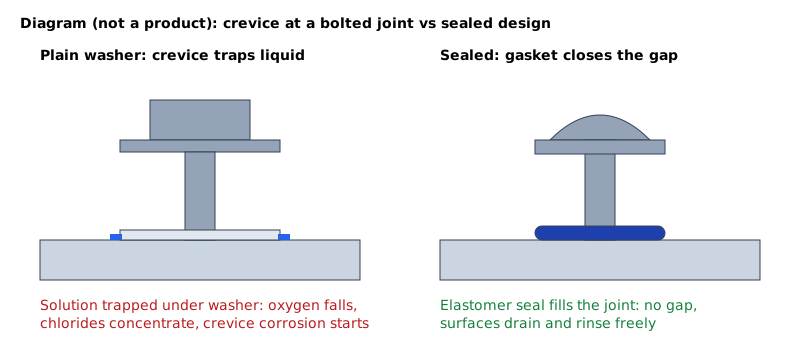
Identify where the same electrolyte contacts both connected metals. A product-contact zone touches food directly; a splash zone receives product or cleaning liquid without intended direct contact. In either, crevices—narrow sheltered gaps—can retain solution. Chloride residues, evaporation and poor rinsing can change the chemistry compared with freshly supplied water.
The screening ratio is effective wetted cathodic area divided by effective wetted anodic area. A large passive-stainless cathode paired with a small exposed aluminium, zinc or steel anode is generally unfavourable, all else equal. Do not count an entire dry frame simply because it is electrically continuous: current distribution and the shared electrolyte determine the participating areas.
Coating damage can expose a small anodic patch while neighbouring cathodic surfaces remain wetted. Conversely, limiting cathodic exposure can reduce the participating area. Neither observation supplies a corrosion rate. Record retained liquid, damage location and wet/dry cycles instead of calculating lifetime from nominal surface dimensions.
Isolation methods: washers, sleeves and bypass paths
Electrical isolation must interrupt the metallic path without compromising the joint's function. Depending on the design, this may require insulating washers beneath head and nut, a sleeve around the bolt shank, and separation of mating faces. A washer under the head does not prevent shank contact in the hole, a metal spacer bridging the faces or another bolt reconnecting the parts.
Check compressed insulators for load capacity, creep, extrusion and chemical compatibility. They must maintain alignment and clamp function through operating and cleaning conditions. Tightening instructions must come from the engineered assembly; no universal torque makes an improvised isolation stack reliable. The spacer joint and end-face selection guide explains the mechanical and cleanability requirements of that surrounding connection.
Inspect remote electronic paths through frames, shafts, piping and bonding conductors. Conductive liquid is an ionic path, not a replacement for identifying the electronic connection. Local isolation may be ineffective if another metallic route reconnects the metals. Verification must consider the full assembled machine, not only loose parts tested on a bench.
Do not disconnect protective bonding to prevent corrosion. Required bonding supports electrical safety. Have the machine's electrical designer assess modifications against applicable requirements such as IEC 60204-1. Where a protective bond must connect the metals, use another corrosion-control approach with an approved bonding design; do not hide or remove the conductor to obtain a favorable continuity reading.
Coatings and sealing: barriers with maintenance requirements
A sound barrier can limit electrolyte contact, but paint, plating or anodising is not guaranteed electrical isolation after assembly. Scratched holes, compressed contact faces and damaged edges can reconnect metal or expose a small anodic patch. Coating only the vulnerable member can leave unfavourable localised attack at defects if a large cathode remains exposed.
A seal can exclude liquid when correctly selected and installed. A damaged seal can instead retain it, creating both corrosion risk and a harborage point where residue survives cleaning. Specify chemical compatibility, fit, drainage and inspection. Use the installed cleaning-access checklist before adding washers, sealant or inaccessible insulating layers.
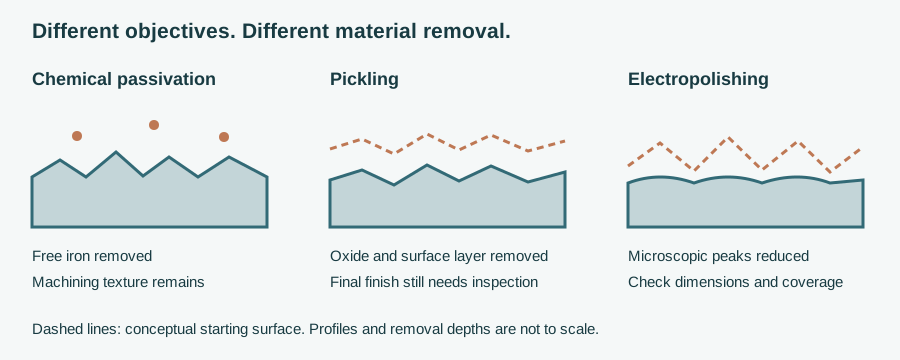
For a separate surface-treatment decision, compare decontamination, oxide removal and smoothing outcomes; these treatments do not interrupt the mixed-metal circuit.
Do not select an insulating polymer solely because it is nonconductive. Assess its mechanical duty, cleaning exposure and relevant intended-food-contact evidence. A stainless component certificate does not automatically cover an added gasket, sleeve or changed joint configuration.
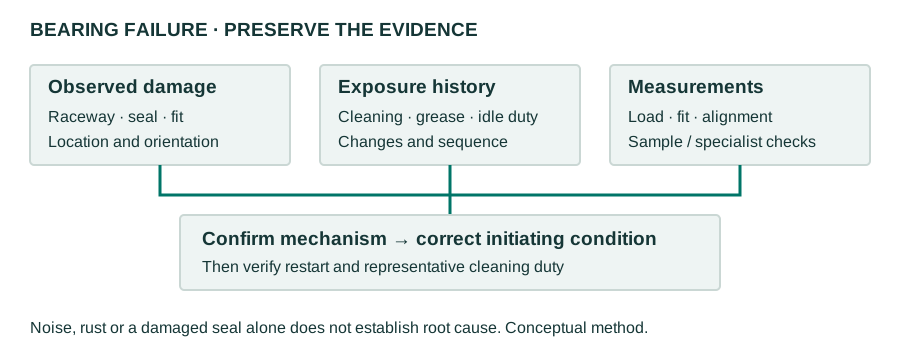
Diagnose contact corrosion before changing the metal pair
- Make inspection safe. Isolate energy and support loads through the approved procedure. Involve QA where corrosion debris or damaged surfaces could affect food.
- Document the pattern. Photograph deposits before cleaning; record which member lost material, coating damage and whether attack follows the joint or occurs across exposed faces.
- Identify both materials. Obtain alloy and coating records rather than relying on appearance. Record repairs, substitutions and installation changes.
- Trace both circuit paths. Assess metallic continuity and shared wetting. Electrical testing must follow the machine designer's safe procedure and preserve required bonding.
- Review chemistry and alternatives. Compare cleaner instructions with actual concentration, temperature, dwell and rinse. Aluminium may suffer direct alkaline attack without galvanic coupling; crevice attack and transferred iron stains may coexist.
- Agree the remedy and acceptance. Set criteria for remaining section, coating condition, fastening integrity and cleanability. Recheck after representative operation and sanitation rather than assuming a brighter joint proves success.
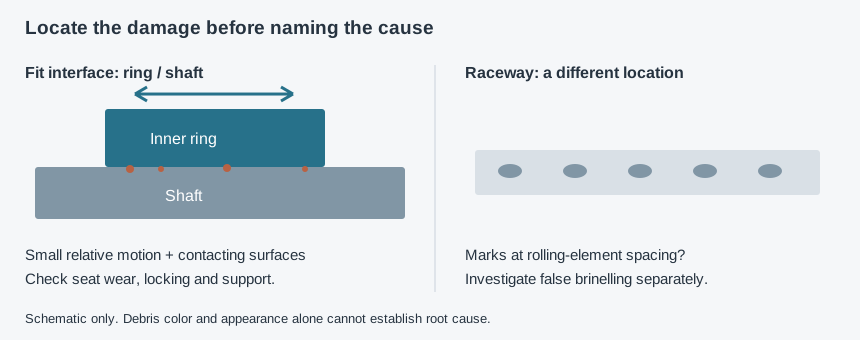
Widespread etching of aluminium away from the connection suggests investigating chemical compatibility, but appearance alone cannot establish the cause. Isolation does not stop direct chemical attack. Similarly, rust deposited onto stainless from an adjacent steel part does not prove the stainless itself has dissolved.
Example: a stainless attachment on an aluminium bracket
Example — hypothetical assumptions, not NHK field data. A washed machine has a stainless attachment bolted to an aluminium bracket. Deposits remain at the fixing, but cleaner concentration, wetted area and remaining bracket section have not been measured. A protective bonding connection may also link the assembly.
Photograph and inspect the aluminium, verify the metal identities and review cleaning records. Map the retained water and electronic paths. A small wetted stainless fastener on a large aluminium bracket differs from a large wetted stainless plate connected to a small exposed aluminium patch; neither geometry alone confirms an acceptable life.
If bonding must remain, local insulating washers may not eliminate the coupling. The team must evaluate alternative materials, drainage, compatible surface protection and an approved bonding arrangement. If the cleaner attacks aluminium directly, that exposure needs correction regardless of isolation. No outcome or recommended part number is assumed.
Specification and enquiry checklist for mixed-metal joints
Copy and complete: “Component/drawing and quantity: __. Both metals and coatings: __. Damage photographs and location: __. Product-contact/splash zone: __. Cleaner, concentration, temperature, dwell and rinse: __. Retained liquid and effective wetted surfaces: __. Fasteners, isolation and alternative electrical paths: __. Required protective bonding: __. Loads, acceptance criteria, documents and delivery country: __.”
Request item-specific material evidence and relevant food-contact documentation. For a claimed hygiene certificate, use the certificate scope and configuration checks. EHEDG certifies specific designs; 3-A Symbol authorization follows Third Party Verification. Both are voluntary and neither supplies a galvanic service-life rating. IP tests likewise address ingress, not chemical compatibility or exterior cleanability.
NHK's stainless machinery component browsing range provides the secondary product path. No isolation kit, aluminium range or galvanic performance is claimed for an unspecified NHK part. Send the completed details through the site's enquiry form so NHK can suggest a component and quote; electrical modifications or damaged structural joints also need the responsible machine designer's assessment.