A stainless steel spacer is a machined sleeve, standoff or spacer nut that keeps two parts of a machine at a defined distance – a guard off a frame, a bearing unit above a cross-member, a sensor bracket clear of a conveyor belt. Spacers look like the simplest part on the drawing, yet in food and pharma machinery they are a frequent source of dirt traps, corrosion and loose joints. This page explains how to choose the type and grade and how to mount metal spacers so they can be cleaned.
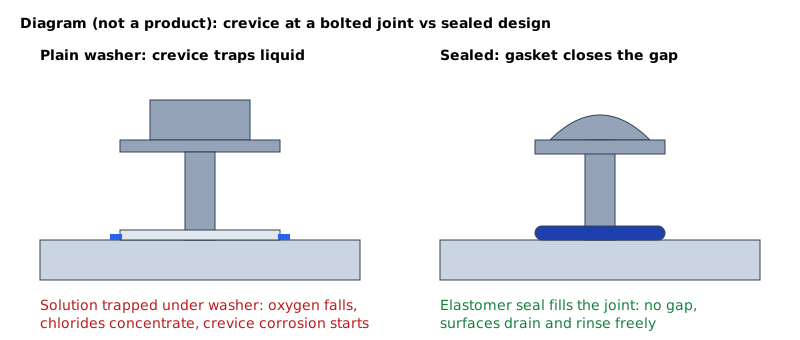
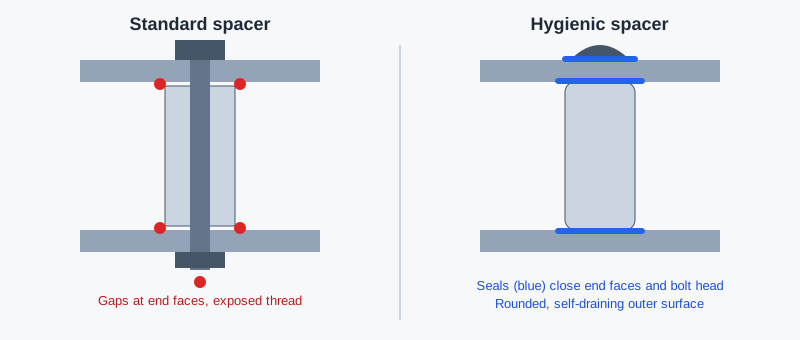 a standard spacer joint with gaps and exposed thread to a sealed hygienic spacer joint. Schematic, not a product test report.
Spacers belong to the hygienic fasteners family; the bolts that clamp them are covered in the hygienic bolts guide.
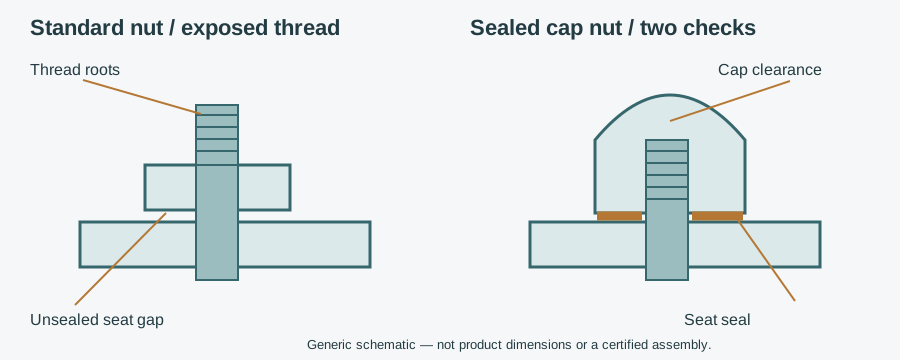
For the opposite end of a through-bolt, check cap depth and sealing at the nut seat alongside the spacer stack.
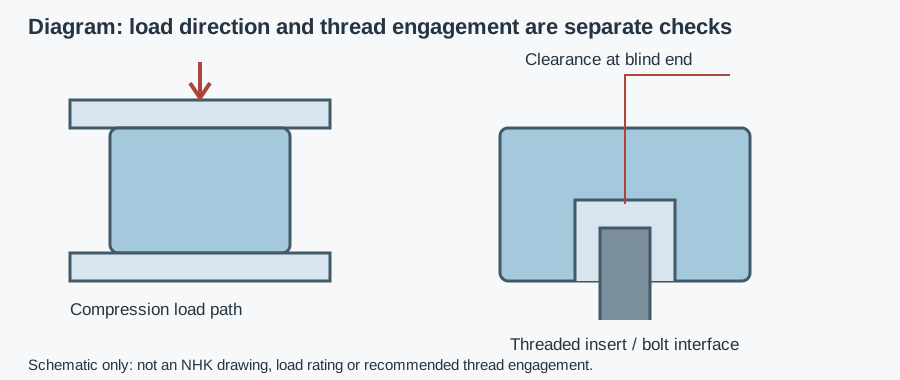
For a threaded connection seated inside a frame tube, use the tube-profile fit and thread-load guide rather than treating the fitting as a spacer.
Types of steel spacers and spacer nuts
| Type | How it works | Typical use | Hygiene notes |
|---|---|---|---|
| Plain spacer (sleeve) | Unthreaded tube; a through-bolt clamps the stack | Guards, brackets, frame offsets | Two open end faces; bore hidden from cleaning |
| Female-female standoff | Internal thread at both ends | Panels, covers removable from one side | Screw heads at both ends; thread under heads |
| Male-female standoff | External thread one end, internal the other | Stacking, sensor mounts | Exposed male thread if over-length |
| Spacer nut (coupling nut) | Long nut joining two threaded rods or studs | Extending studs, adjustable offsets | Thread visible at joints if not fully engaged |
| Hygienic spacer | Rounded body with sealed end faces | Product and splash zones | Designed for cleaning; check for a certificate |
"Metal spacer" in purchasing often includes aluminum and zinc-plated carbon steel. On food machinery, plated steel spacers flake and rust in washdown, and aluminum is attacked by alkaline cleaners. Stainless steel is the normal choice anywhere wet cleaning reaches.
Send your application data and get a spacer recommendation
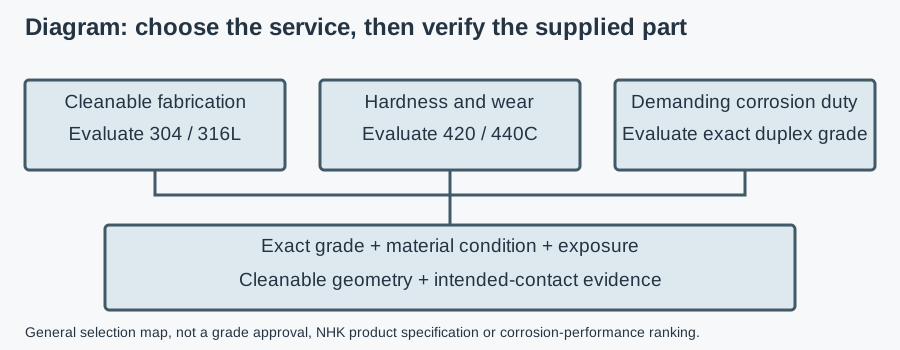
Choosing the grade: 304 or 316L
| Condition | Grade | Why |
|---|---|---|
| Dry area, inside cabinets, non-contact zone | 304 (1.4301) | Adequate corrosion resistance, widely available |
| Daily water washdown with neutral or alkaline cleaners | 304 or 316L | Depends on chloride content and drying |
| Chlorinated sanitizers, salt, brine, acidic products | 316L (1.4404) | Molybdenum improves resistance to chloride pitting (local attack by chloride ions) |
| Load-bearing or wear joints needing hardness | Hardened martensitic grade by agreement | Lower corrosion resistance – keep out of wet zones |
Match the spacer grade to the bolt and nut. A 304 spacer under a 316L bolt is not usually a galvanic problem, but mixing stainless with carbon steel or aluminum in a wet joint is: galvanic corrosion attacks the less noble metal. Check the complete electrical path through a spacer joint before relying on an insulating washer. A detailed grade comparison is in AISI 316L vs AISI 304.
Sizing a spacer: what actually matters
A spacer in a bolted joint is in compression: the bolt preload pushes through it. Check four points:
- Length and tolerance. In a stack, tolerances add up. Several spacers in series can move a bearing or guard out of line. Give a tolerance on the drawing for spacers that set alignment.
- Cross-section. The wall must carry the bolt preload without yielding. Thin-walled tubes cut from stock are the usual weak point – the spacer shortens and the joint loosens.
- End-face contact. Square, flat end faces spread the load. Chamfers that are too large reduce contact area and leave a ring-shaped gap that traps dirt.
- Bore clearance. Too much clearance between bolt and bore lets the parts shift sideways and creates a narrow annular gap that is impossible to clean.
Example (assumptions, for method only): a guard is held 40 mm off a frame by plain 304 spacers on M8 bolts. The guard rattles after some months. Inspection shows the spacer ends have indented (thin wall) and the bolts have lost preload. Options: a spacer with a thicker wall or larger outside diameter, a flat washer under the bolt head, and checking the tightening torque recommended by the bolt supplier. No figure for preload or torque is given here – take it from the bolt and spacer supplier's data.
Hygienic mounting in washdown zones
In the product-contact zone (surfaces that touch product or drain onto it) and the splash zone (surfaces reached by spray or product splash), a plain spacer creates three harborage points – places where product residues and microorganisms survive cleaning:
- the gap at each end face, where metal meets metal without a seal;
- the bore around the bolt, a crevice that water enters and cleaning cannot reach;
- the exposed bolt thread and the hex head.
A hygienic spacer joint closes those gaps:
- Seal both end faces with an elastomer seal designed for the purpose, so there is no metal-to-metal crevice.
- Use a sealed bolt head – a rounded head with an integrated seal instead of a hex head and washer.
- Keep the outer surface rounded and self-draining, so water runs off instead of standing on flat tops.
- Avoid blind holes and exposed threads; cut bolts to length so no thread protrudes.
- Choose seal material for the cleaning chemicals – EPDM, FKM or VMQ (silicone) differ in resistance to oils, steam and chlorine.
Surfaces in product contact should be smooth; EHEDG guidance of Ra ≤ 0.8 µm for product-contact surfaces is the usual reference. Where possible, the better hygienic solution is to avoid the spacer altogether: weld a boss or a threaded welding plate to the frame, or design the bracket so it sits directly on the surface with a seal.
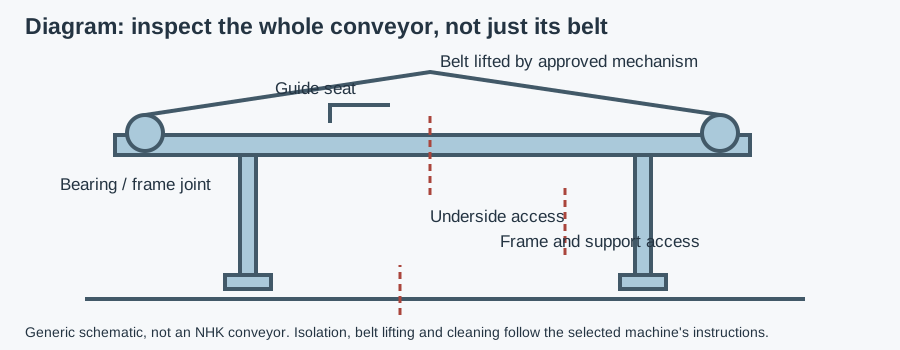
The same principle applies to handles and locks on guards – see hygienic handles and locks. An overview of the certified component family, including spacers, nuts and feet, is given in introducing the EHEDG components. On conveyors, spacers often set side-guide and sensor distances; see the role of high-quality conveyor components.
Failure modes seen on site
| Problem | Cause | Prevention |
|---|---|---|
| Black residue or biofilm at spacer ends | Unsealed end faces | Sealed hygienic spacers; remove spacer by design |
| Rust stains on stainless spacers | Wrong grade, embedded iron from tools, plated washers | 316L in chloride zones; passivation; all-stainless fasteners |
| Seized threaded standoffs | Galling of stainless threads | Clean threads, slow tightening, suitable anti-seize |
| Joint loosens | Spacer compresses; tolerance stack | Adequate wall, flat ends, defined length tolerance |
| Seal extrudes or cracks | Over-tightening; wrong elastomer | Tighten to supplier data; elastomer matched to chemicals |
Passivation – an acid treatment that removes free iron and restores the passive surface – is worth specifying on spacers machined from bar, especially if they were cut with tools also used on carbon steel.
What to write in the RFQ
For any claimed hygienic certification, use the certificate checks for the selected standoff design before relying on it in the specification.
Where the connection must deform rather than hold a fixed gap, use the buffer load-direction and thread checks instead of treating a compliant mount as a rigid spacer.
- Type: plain spacer, female-female or male-female standoff, spacer nut, or hygienic sealed spacer
- Thread size, length and tolerance, outside diameter and bore
- Grade: 304 (1.4301) or 316L (1.4404); material certificate EN 10204 3.1 if traceability is needed
- Surface finish (Ra) on exposed surfaces; passivation
- Seal material, if sealed; zone and cleaning method
- Declaration of compliance with EC 1935/2004 if the part can contact food
- Certificate for the specific design, if a certified hygienic component is required
- Quantities and delivery country
NHK holds EHEDG certificate C2300067 for its listed component designs; ask whether the proposed spacer is explicitly within that scope, without assuming any spacer variant is covered. An NHK technician reviews your joint and sends a recommendation and quote. To browse, see NHK's EHEDG and 3-A standard components and the hygienic-bolt listing. See NHK's certifications.