Passivation vs electropolishing is a choice between chemical surface decontamination and electrochemical metal removal, not two interchangeable labels for a shiny part. This comparison includes pickling because weld oxide changes the preparation route. For unexplained pits or cracking, first use the corrosion mechanism and inspection field guide; finishing must not erase evidence before damage is assessed.
Passivation vs electropolishing: comparison and deciding criteria
| Process | What it does to the surface | Choose it when | What it does not establish |
|---|---|---|---|
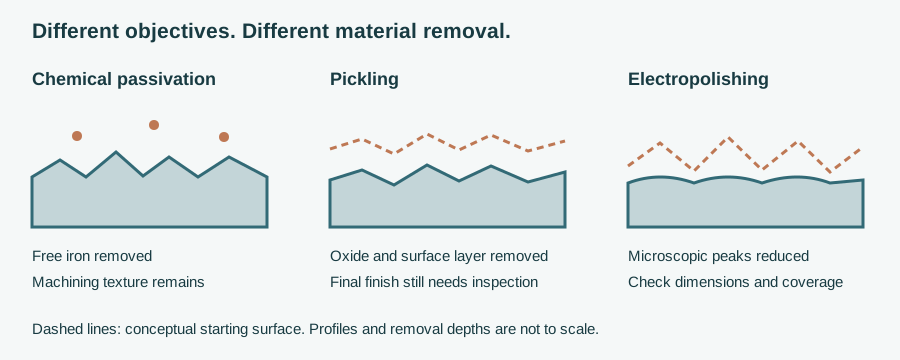
| Chemical passivation | Removes contaminant free iron from suitably cleaned stainless and supports passive-film formation | Machined or handled parts have acceptable geometry and finish but need documented surface decontamination | Removal of weld scale, smoothing of tool marks or service-corrosion immunity |
| Pickling | Chemically removes oxide scale and a layer of underlying metal | Weld heat tint or scale requires removal through an approved preparation procedure | A specified final roughness, repaired weld defects or an automatically acceptable final appearance |
| Electropolishing | Dissolves surface metal electrochemically, preferentially levelling microscopic high points; can also passivate | A controlled surface-finish change is required and material removal is acceptable | Elimination of deep scratches, cleanability of hidden joints or preserved dimensions without verification |
Send your application data and get a component recommendation
Start with the defect or required outcome. Select chemical passivation when the surface already meets finish and geometry requirements. Select pickling or another qualified oxide-removal route when heat tint is present. Consider electropolishing when a finish change and passive condition are both required, after confirming access, alloy suitability and tolerances. These operations may be stages in one route rather than competing complete solutions.
Do not order treatment from appearance alone. A bright electropolished face may conceal a poor weld; a chemically passivated face may retain its machining texture. Ask which surfaces are treated, which are excluded and how the finished part will be accepted.
Stainless steel passivation after machining: remove contamination
Stainless steel's chromium-rich passive film forms naturally on a suitable clean surface exposed to an appropriate oxidising environment. Chemical passivation removes surface contamination, especially free iron transferred during fabrication, and promotes a suitable passive condition. It is not a deposited protective coating and does not change a 304 part into a more corrosion-resistant alloy.
After machining, check cutting-fluid removal, burrs, tool marks and iron transfer from tooling or handling. Degreasing precedes treatment where oils could shield the surface. A component sharing a workbench with carbon-steel grinding debris needs contamination control, not simply a treatment certificate obtained before that handling occurred.
ASTM A967/A967M addresses chemical passivation treatments and alternative qualitative verification tests. Select an applicable treatment and test with the processor for the actual alloy and condition. Do not prescribe acid concentration, temperature or immersion time from a generic article. Treatments suitable for one stainless family cannot be assumed suitable for every hardened or assembled part.
Treatment does not remove unacceptable pits or restore lost section. Agree whether discoloured deposits are contamination or corrosion before cleaning them away. Use the grade and supplied-condition selection guide when material identity or compatibility is uncertain.
Pickling and passivation after welding: separate the tasks
Welding can leave heat tint and oxide scale. The affected surface may include chromium depletion beneath the oxide, so removing only visible colour is not sufficient evidence that preparation is complete. Pickling removes oxide and underlying surface metal; chemical passivation alone is not a substitute for that removal.
Inspect the weld before choosing the finishing route. Undercut, porosity, cracks and an inaccessible overlap require fabrication assessment, not a brighter surface. Mechanical finishing may be part of an approved alternative preparation sequence, but tools must avoid introducing iron or leaving an unacceptable texture. For attachment details, use the welded fixing-point preparation checks.
ASTM A380/A380M distinguishes cleaning, descaling, pickling and passivation and addresses precautions for parts, equipment and systems. Specify the sequence and final condition instead of writing “pickled and passivated” without acceptance requirements. Pickling can alter appearance and dimensions; protect critical features through an agreed process, not improvised masking.
Acid treatments require trained personnel, compatible equipment, exposure controls and lawful waste handling. This is a purchasing and inspection guide, not an on-machine chemical recipe. Trapped treatment solution in tubes, blind holes or assembled joints can create a new contamination or corrosion problem.
Electropolishing stainless steel: smoothing with metal removal
Electropolishing makes the workpiece the anode in an electrolytic process. Controlled dissolution can preferentially reduce microscopic peaks and leave a smoother, passivated surface under suitable conditions. ASTM B912 concerns passivation using electropolishing; ISO 15730 concerns electropolishing as a means of smoothing and passivating stainless steel.
The outcome depends on starting texture, alloy, process conditions and geometry. Deep scratches, weld undercut and existing pits may remain. Current distribution, access and fixture contact can create differences between exposed faces and recessed areas. Ask the processor how holes, internal passages and contact marks will be addressed and inspected.
Because metal is removed, check threads, seal grooves, shaft fits, thin edges and drawing tolerances. Specify finished dimensions and any required before-and-after measurements. Do not assume a uniform removal allowance across every surface or claim a fixed percentage reduction in roughness.
For the refitted joint, use the compound, cleaning and seal-reassembly checks alongside the finished groove dimensions.
Electropolishing can support a finish objective, but it is not automatically necessary for every washed frame component. Chemical passivation may be sufficient where the supplied surface is already acceptable. Conversely, passivation cannot deliver a smoothing objective simply because it is less disruptive to geometry. Neither route supplies a corrosion lifetime under an unspecified cleaner.
Cleanability and corrosion resistance: specify separate evidence
A product-contact surface touches the product; a splash zone receives product or cleaning liquid without intended direct contact. Define these zones on the drawing so the processor knows where finish, residue control and inspection are required. Non-contact surfaces still matter if runoff or corrosion debris can reach the food path.
Surface roughness Ra is an average profile deviation. It does not describe every scratch, pit or discontinuity, and different textures can share the same Ra. Specify the measurement method, direction, locations and agreed evaluation settings alongside the acceptance limit. NHK's surface-profile interpretation for food-contact finish gives the secondary reference path; no universal numeric limit is imposed here.
Use the surface roughness Ra for food-contact specification guide to turn the finish objective into drawing instructions and a traceable acceptance record.
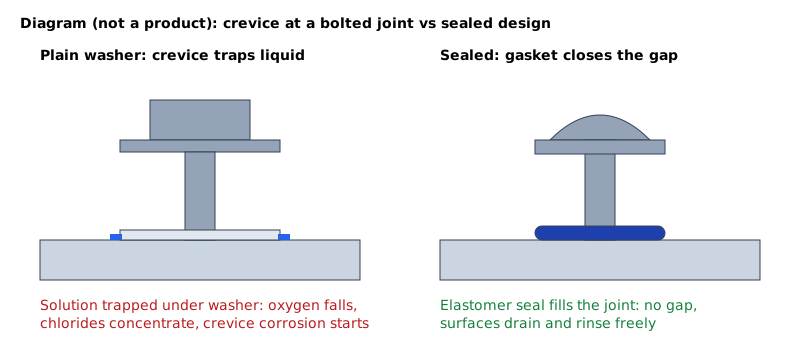
Cleanability also requires accessible, self-draining geometry and sound joints. A polished overlap remains a crevice—a sheltered gap that can retain liquid. Use the installed cleaning-access assessment to check those features. Cleaning-in-place (CIP) cleans without dismantling; cleaning-out-of-place (COP) cleans removed parts separately. Neither process name validates an uninspectable joint.
Passivation and electropolishing do not interrupt electrical coupling between dissimilar metals. Use the mixed-metal wetting and isolation checks for stainless against aluminium or plated steel. Likewise, finishing cannot make an incompatible cleaner acceptable; record actual concentration, temperature, dwell time and rinsing rather than “daily washdown.”
Acceptance checklist: inspect the part and its records
- Identify the item. Match drawing revision, quantity, exact alloy and material condition to the treatment batch. Identify assembled seals, lubricated bearings and other components that may need removal or exclusion.
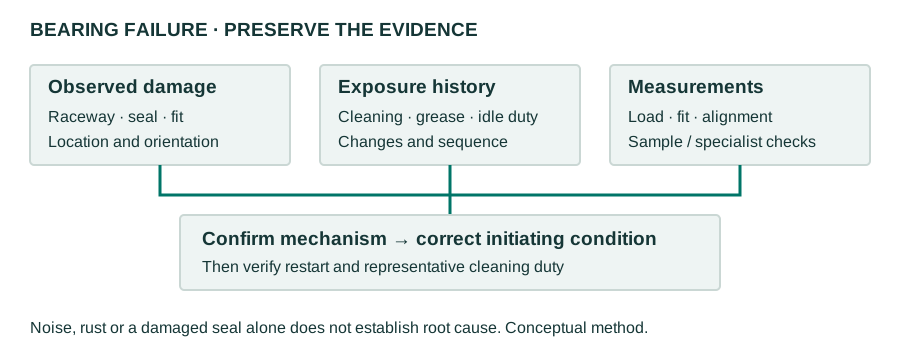
- Record the starting condition. Inspect welds, scale, contamination and machining damage before treatment. Resolve structural defects and agree preparation; retain relevant photographs where a failure is being investigated.
- Agree treatment coverage. Mark treated surfaces, inaccessible regions, masking and fixture contacts. Check drainage and how chemistry is removed from blind holes, tubes and joints.
- Define verification. Select the applicable standard, treatment designation, test, sampling basis and acceptance criteria. A qualitative free-iron test does not prove resistance to the plant's chemicals or validate cleaning.
- Inspect the finished result. Check specified visual condition, dimensional features, roughness locations and residue requirements. Compare results with the drawing, not a photograph of another component.
- Protect the accepted surface. Specify final rinsing, drying, clean handling and packaging. Recheck after subsequent machining, welding or contaminated handling; an earlier batch record does not cover later rework.
Reject documentation that cannot be matched to the delivered lot or names only a process without the agreed result. Ask whether the report records measured outcomes, qualitative pass/fail results or merely confirms processing. Those are different kinds of evidence.
Example: choose a route for a welded and machined bracket
Example — hypothetical assumptions, not NHK field data. A stainless bracket has a welded attachment, machined holes and a splash-zone face. Assume the drawing specifies finished fits and a surface acceptance requirement, but no treatment has been selected. Heat tint remains near the weld; no pit-depth or crack assessment has established damage.
First inspect the weld and resolve unacceptable defects. Arrange degreasing and a qualified heat-tint removal route; chemical passivation alone does not address the starting condition. Then assess the prepared face against its finish requirement. If the texture is acceptable, chemical passivation with agreed verification may meet the surface-decontamination objective.
If a smoothing objective remains, ask whether electropolishing can achieve it while preserving finished hole sizes, edges and thread engagement. Require inspection at the actual critical locations. The decision remains conditional on measured starting and final condition; no successful result, removal thickness or NHK finishing service is assumed.
Specification and enquiry: send the same fields to NHK
Copy and complete: “Component/drawing revision and quantity: __. Exact alloy and condition: __. Product-contact/splash/non-contact zone: __. Machining, weld and heat-tint condition: __. Product and cleaning chemistry, concentration, temperature, dwell and rinse: __. Proposed preparation and finishing objective: __. Critical dimensions and finish measurement locations: __. Agreed standard, treatment, sampling, test and acceptance criteria: __. Required material, treatment and intended-contact documents: __. Delivery country: __.”
Request traceable material identification, a treatment record linked to the batch, applicable inspection results and relevant food-contact evidence for the finished article. Regulation (EC) No 1935/2004 concerns intended food-contact use; a passivation report is not that evidence by itself. For a claimed hygiene certificate, apply the certificate scope and supplied-configuration checklist. Neither EHEDG design certification nor 3-A Symbol authorization is conferred by surface treatment alone.
Send these details to NHK
Send the completed fields through this site's enquiry form so NHK can suggest a component and quote, with treatment availability and item-specific documentation confirmed separately. NHK's stainless component category for application selection is the secondary browsing route. No electropolishing service, default treatment or final roughness is asserted for an unspecified NHK part.