GFSI schemes compared is a comparison of food-safety certification programs and their implications for a site, not a competition between component badges. For an OEM or technical buyer, the useful result is a purchase specification that connects the plant’s certification scope to equipment hazards, cleaning access and traceable supplier documents.
Use the contact-zone and material evidence framework alongside this comparison. Scheme certification does not replace the legal assessment of food-contact materials. This guide addresses food-manufacturing programs; packaging, storage, primary production and other activities can require different scopes or codes. It is not a pharmaceutical qualification guide.
BRCGS vs IFS vs FSSC 22000 vs SQF: comparison
The table compares programme architecture and a practical equipment-review approach. It is not a clause-by-clause mandatory checklist: the site must map its actual requirements to the current normative documents and applicable interpretations.
| Programme | Main architecture | Equipment review emphasis | Evidence to organise | Selection criterion |
|---|---|---|---|---|
| BRCGS Food Safety | Defined food-manufacturing safety, quality and operational requirements | Demonstrate that premises, equipment and operating controls meet the applicable standard | Equipment specification, installed inspection and operating records linked to relevant requirements | Customer acceptance, food-manufacturing scope and ability to implement the standard |
| IFS Food | Product and process compliance in food safety and quality | Connect equipment condition and controls to the actual product and process risks | Product/process risk assessment, supplier evidence and implemented control records | Customer acceptance and alignment with the site’s products and processes |
| FSSC 22000 | ISO 22000 plus applicable sector prerequisite programs and additional scheme requirements | Integrate equipment procurement and change management into the food-safety management system | Purchase specification, risk-based change review and supporting equipment information | Appropriate food-chain category and fit with the site’s ISO-based management system |
| SQF | Food Safety Codes and applicable sector requirements | Select the right code and evaluate equipment hygiene within its scope | Applicable-code mapping, equipment suitability and cleaning/maintenance records | Accepted code, sector coverage and implementation capability |
Send your application data and get a component recommendation
Prerequisite programs, or PRPs, are foundational conditions and activities that support food safety, such as cleaning, maintenance and supplier controls. HACCP, Hazard Analysis and Critical Control Points, is the structured approach to identifying and controlling food-safety hazards. Neither term describes an approved bearing or a food-contact material certificate.
What is GFSI, and what does GFSI certification mean?
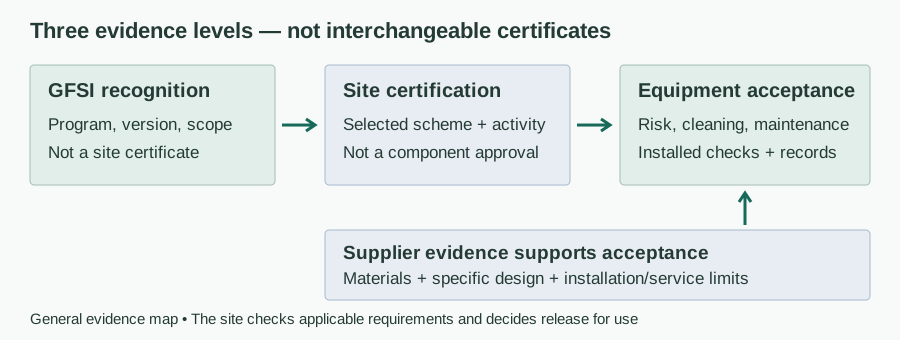
The Global Food Safety Initiative benchmarks and recognises certification programs. GFSI does not certify businesses itself, and its Benchmarking Requirements are not a standard against which a plant receives a GFSI audit certificate. Certification bodies audit a business under a selected programme and issue the corresponding certificate where requirements are met.
“GFSI certification” is therefore shorthand that needs clarification. Ask for the scheme name, edition, site identity, activities and products within scope, certificate status and issuing body. A certificate covering one site or activity does not automatically cover another facility, an equipment supplier or every component bought by the plant.
The programs share a basis in food-safety management and hazard control, with traceability, supplier management and evidence of implementation. Recognition helps harmonise expectations; it does not make every programme’s audit grading, frequency, scope or customer acceptance interchangeable. Do not rank them as different levels of stainless-steel quality.
Choose the scheme before specifying the component
- Obtain customer requirements in writing. Confirm the accepted programme and scope rather than choosing from a regional stereotype. A customer can have requirements beyond recognition, including a particular programme or additional assessment.
- Map the site’s activities. Record manufacturing processes, outsourced steps and relevant products. Check which programme or sector code covers them; the same brand can offer several different standards.
- Review management-system fit. FSSC’s ISO-based structure can suit a site already managing integrated systems, but an existing ISO certificate does not prove readiness. BRCGS, IFS and SQF also require implemented systems and effective controls.
- Confirm edition and transition rules. Agree the audit basis with the certification body before assigning requirements to purchasing. Maintain applicable doctrine, position statements and scheme decisions alongside the standard.
- Issue equipment acceptance criteria. Convert relevant hazards into design, access, document and operational checks, with an owner for each unresolved item.
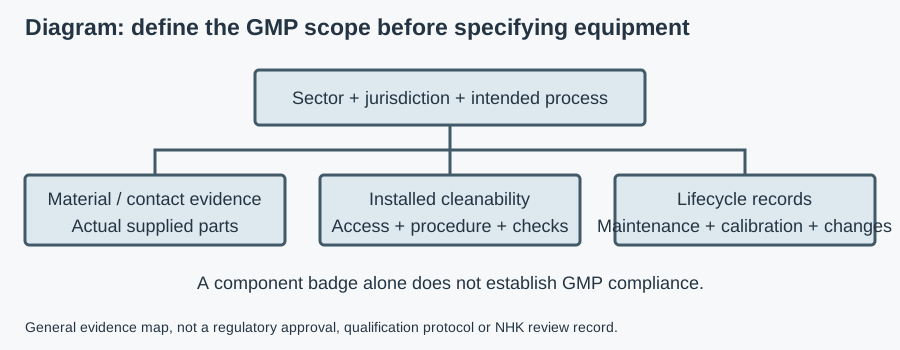
Do not choose the apparently easiest certificate and then assume cleaning limitations will be accepted. Equally, do not demand every possible design mark without identifying its purpose. A narrowly scoped part certificate may help one acceptance check while leaving the installed joint or cleaning procedure unresolved.
Editions and recognition: check the audit basis
At this guide’s November 7, 2026 source check, official material identifies BRCGS Food Safety Issue 9 and IFS Food 8, with applicable position statements and doctrine. Published changes to interpretation can affect the audit basis without a new standard edition. Check their effective dates rather than relying on an old downloaded checklist.
FSSC 22000 Version 7 is published, but the official upgrade process permits Version 6 audits through April 30, 2027. Version 7 upgrade audits run from May 1, 2027 through April 30, 2028. Publication of Version 7 is not the same as the start of its upgrade-audit window.
SQFI states that Edition 10 audits are expected no earlier than January 2, 2027, dependent on GFSI benchmarking; Edition 9 remains the audit basis before the applicable transition. Do not treat that expected date as an unconditional completed transition. Check the official recognition listing: an application undergoing benchmarking is not completed recognition of the new version.
What each programme means for equipment and hygienic design
All four comparisons ultimately need evidence that the installed equipment supports the site’s controls. This does not mean that each programme mandates an identical supplier file. FSSC Version 6’s equipment-management requirement and guidance explicitly address purchase specifications and risk-based change management. Its FAQ distinguishes unchanged existing equipment from new equipment or significant changes; existing hazards still belong in the hazard analysis.
For BRCGS, IFS and SQF, identify the applicable equipment, cleaning, maintenance and supplier requirements rather than borrowing a FSSC clause number. IFS checklist guidance explains implementation but is not a substitute for the normative standard and doctrine. SQFI’s hygienic-design guidance supports evaluating new or used equipment and modifications before purchasing; the selected code determines the actual obligation.
Inspect the product-contact zone, where the component touches food, the splash zone, reached by product or cleaning spray, and possible transfer from nominally non-contact parts. A housing above exposed food can create a contamination path through lubricant, fragments or retained liquid. A floor support may instead need accessible external cleaning and corrosion resistance.
Look for harborage points, places where residue and microorganisms can persist: exposed threads, overlapping brackets, damaged seals and hollow sections. Crevices are narrow gaps that trap soil; dead spaces do not receive the intended cleaning action or cannot empty. Self-draining geometry helps only if the installed orientation and surrounding structure allow drainage.
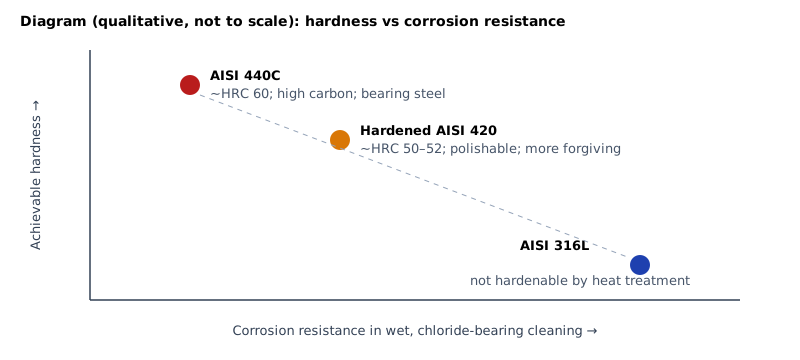
Do not equate a specified surface roughness Ra, the arithmetic average roughness, with a cleanable assembly. Smooth parts can form an inaccessible interface after mounting. The related seal-family and joint screening guide separates elastomer compatibility from the geometry of that interface. For metal exposure, use the related finished stainless-part suitability checks rather than assigning a grade from the scheme name.
Supplier documents: separate three kinds of evidence
| Evidence level | What it answers | What it does not answer |
|---|---|---|
| Site scheme certificate | Named site, activities and certification scope | Whether every delivered component has suitable materials or cleanable installation |
| Material and contact-use evidence | Identity, applicable legal basis and intended-use restrictions | Whether an assembled housing drains or a cleaning procedure reaches behind it |
| Specific-design and installation evidence | Relevant certificate scope, design information, mounting conditions and service limits | Whether the whole plant passes its scheme audit |
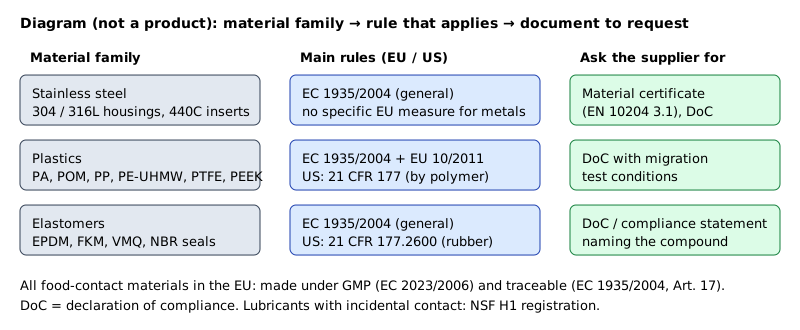
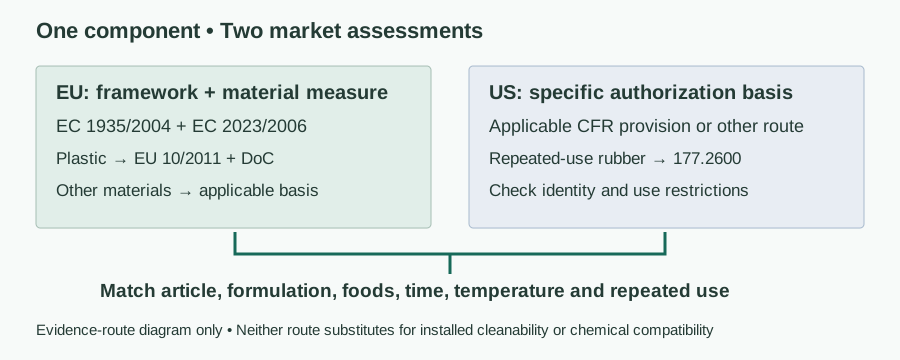
Use the sibling EU and US supplier-document comparison for declarations of compliance and supporting evidence. EC 1935/2004 is the EU food-contact framework; EU 10/2011 adds plastics requirements, while FDA 21 CFR 177.2600 concerns repeated-use rubber. A generic “GFSI-approved material” statement cannot replace the applicable basis and intended-use assessment.
EHEDG certifies specific equipment designs; 3-A Symbol authorisation follows Third Party Verification. Both are voluntary. Do not infer that a GFSI-recognised programme requires every part to carry either mark. If a customer or site specification requires one, match the actual model and covered configuration using the certificate-identity and installation checklist. The migrated guide to decoding component certification labels explains why a management-system badge cannot answer a component-design question.
Installed inspection and change-control checklist
- Compare drawing and delivered assembly. Record component identity, revision, sealing arrangement and materials; investigate substitutions before release.
- Check cleaning access. Remove guards using the agreed safe procedure and inspect mounting faces, seal undersides and support interfaces. Reject an inaccessible retained-soil location until the design or cleaning method is resolved.
- Check exposure limits. Compare cleaner chemistry, temperature, spray conditions and frequency with the actual supplier limits. An ingress rating does not certify hygiene or cleaning effectiveness.
- Check operating contamination paths. Inspect loose fasteners, wear, lubricant discharge and drainage. Connect findings to the site’s hazard assessment and the sibling component contamination-pathway inspection guide.
- Record cleaning and maintenance acceptance. Agree visual, residue, allergen or microbiological checks appropriate to the risk. Document the method and responsible decision maker; no universal swab limit or inspection interval is assigned here.
- Control changes. Reassess replacement seals, altered mounting, new product or cleaning conditions. Keep approved configurations, change decisions and current instructions traceable to the machine.
Use the sibling GMP equipment and operating-record distinction when legal manufacturing controls also need assessment. A food scheme certificate does not establish pharmaceutical GMP qualification. Similarly, a factory acceptance inspection is not proof of cleaning effectiveness under the plant’s installed production conditions.
Example: a conveyor retrofit at a certified food site
Example — hypothetical assumptions, not an NHK case or audit result. A food plant replaces conveyor guides and support brackets on a line serving different allergens. The site’s chosen scheme stays unchanged; the equipment layout and cleaning access change. No material grade, load rating, test result or certification outcome is assumed.
The OEM marks product-contact guide surfaces, bracket interfaces and potential drip paths. The supplier provides item-specific contact evidence and cleaning instructions; the plant reviews whether removed guides expose all retained-residue locations. Reassembly checks confirm that the new mounting arrangement does not create an inaccessible gap.
QA then assesses the changed allergen-cleaning procedure and appropriate verification evidence before release. Purchasing files the revised drawing and replacement-part identity. The scheme certificate remains site-level evidence; it does not decide whether this retrofit is acceptable. The useful result is a closed change review, or a documented unresolved item—not a new badge on the bracket.
Copyable specification and enquiry fields
Copy and complete: “Site scheme, edition, scope and customer requirement: __. Component/part number, drawing revision and quantity: __. Zone and contamination paths: __. Product and destination market: __. Cleaning method, chemicals, temperature and frequency: __. Load, material, sealing and maintenance access: __. Required contact documents and exact-design certificate if specified: __. Acceptance checks, evidence gaps and change notification: __. Delivery country: __.”
Send these details to NHK
NHK can review the component application, clarify available supporting documents, suggest a suitable part and prepare a quote. The site’s responsible team determines scheme acceptance; no audit pass or document availability is guaranteed. Direct contact is HMP@nhkgroup.eu and (+45) 2492 5030. Browse stainless hygienic component families for an application-specific enquiry as the secondary path; category identity is not a certificate for every part.