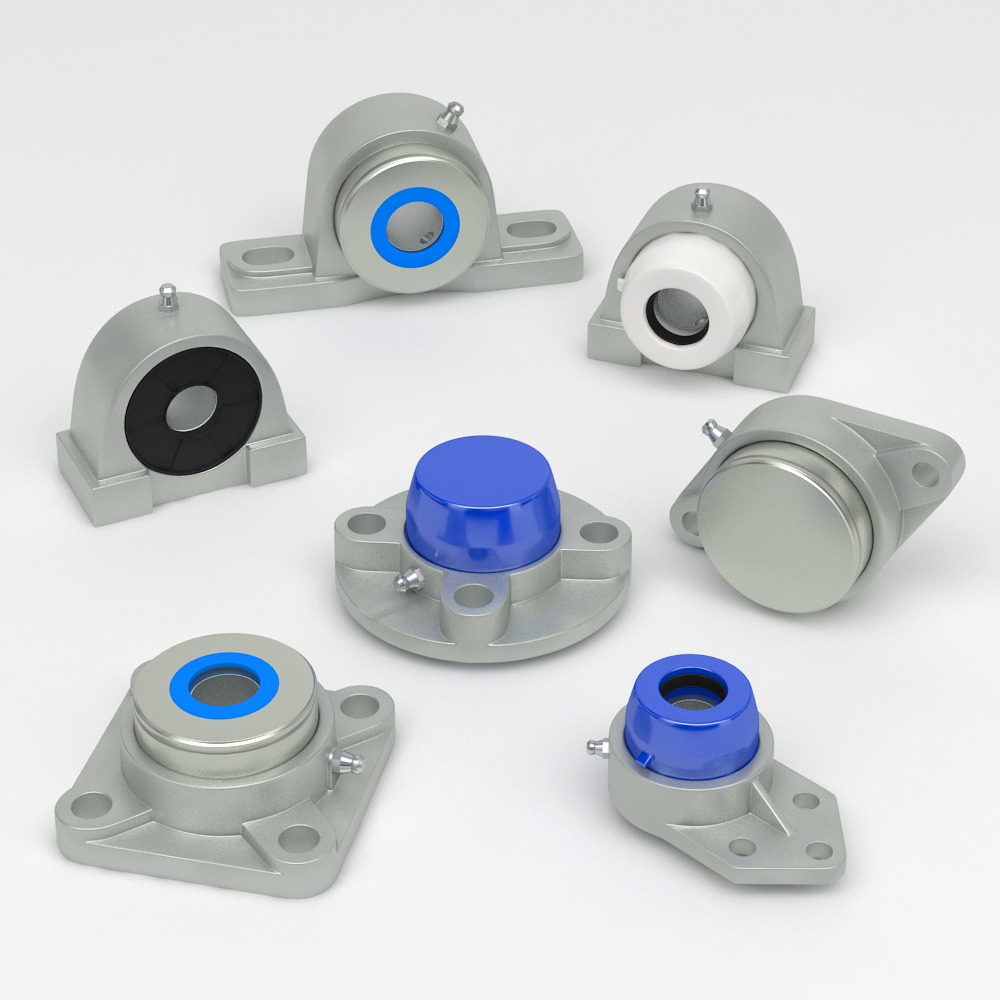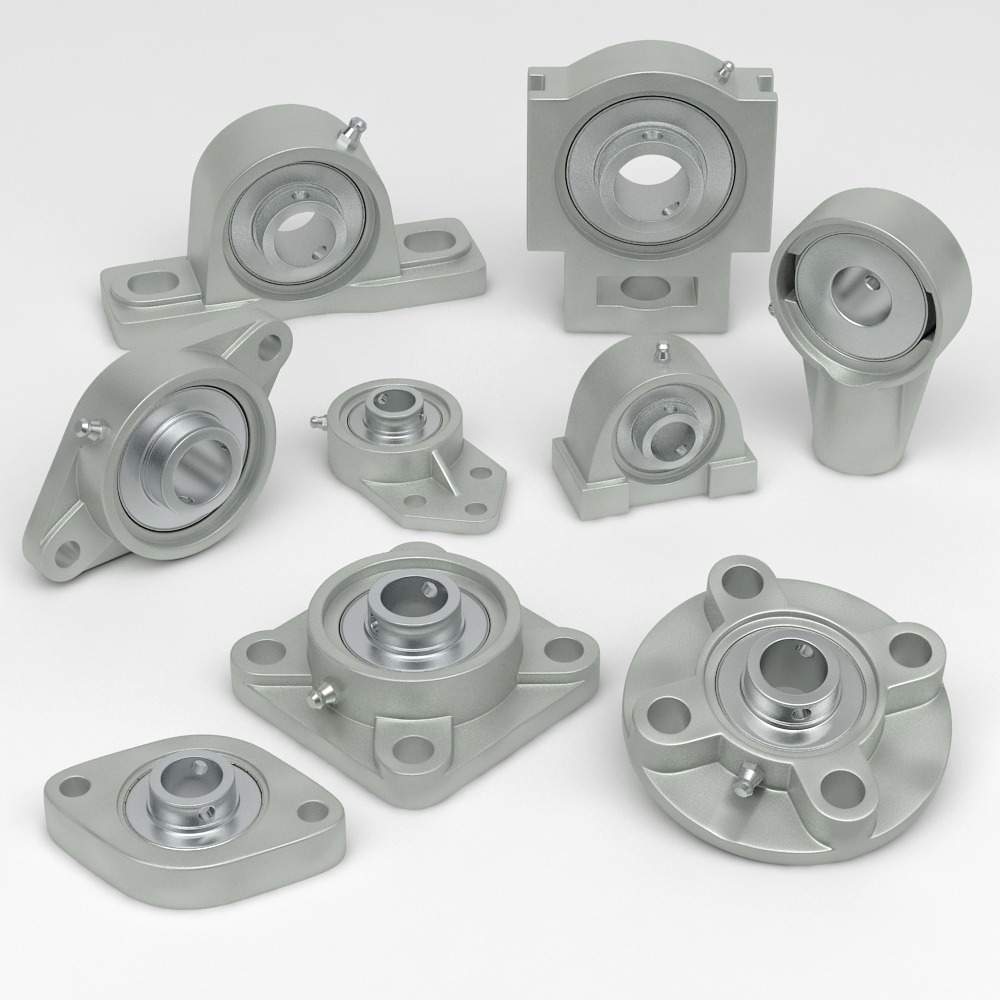
Mounted ball bearing units in stainless steel are ready-to-install assemblies of a stainless ball bearing insert and a housing made from stainless steel or another corrosion-resistant material, bolted to a machine frame to support a rotating shaft. They are used where corrosion resistance and hygiene matter – food, medical and pharmaceutical equipment, and also chemical and marine applications. This guide focuses on the engineering choices: housing type, insert locking, sizing and installation.
For small shafts on light conveyors and packaging machines, see mini bearing units in stainless steel.
What a mounted ball bearing unit consists of
- Insert: a deep-groove ball bearing with a spherical outer ring (often called a Y-bearing), so it can align itself in the housing and compensate small mounting errors. In stainless units the rings and balls are typically 440C, a hardenable martensitic stainless steel.
- Housing: typically austenitic stainless steel such as AISI 304, or a corrosion-resistant plastic or composite.
- Locking: set screws or an eccentric collar fix the inner ring to the shaft.
- Seals and covers: contact seals on the insert; optional open, closed or sealed end covers.
- Lubrication: factory-filled grease, sometimes with a grease nipple for relubrication.
Why choose stainless steel bearing units
- Corrosion resistance: no rust or flaking paint in wet areas or with many cleaning agents. Austenitic 304 housings resist general corrosion well; with chlorinated cleaners or brine, chloride pitting (local pits started by chlorides) can occur, and 316 is more resistant.
- Hygiene: smooth surfaces and few crevices (narrow gaps where soil collects) reduce places for bacteria to survive cleaning. Hygiene still depends on seals, covers and housing geometry, not on the steel alone.
- Maintenance: no coating to repair, and lifetime-lubricated inserts need no regreasing under suitable conditions.
The trade-offs are cost and load capacity. Stainless units cost more than cast-iron units, and stainless inserts carry lower load ratings than chrome-steel inserts of the same size. The source article's claims of handling "high loads, shocks and vibrations" therefore need checking against data for each case.
Mounted ball bearing units: housing types
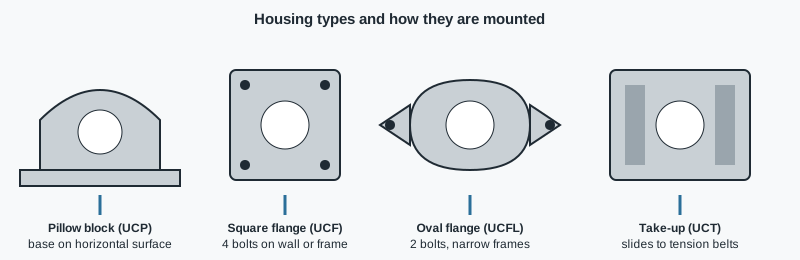
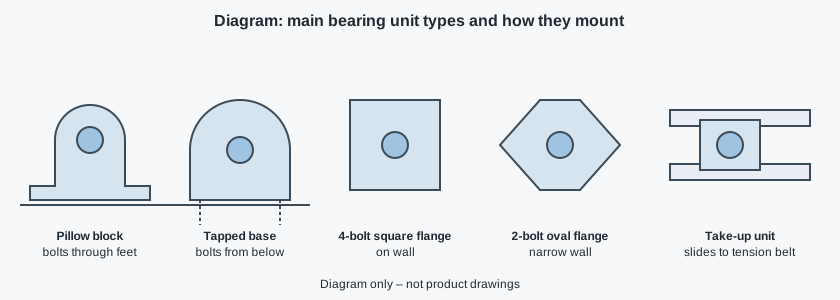
| Housing type | Common series designation | Mounting | Typical use | Watch for |
|---|---|---|---|---|
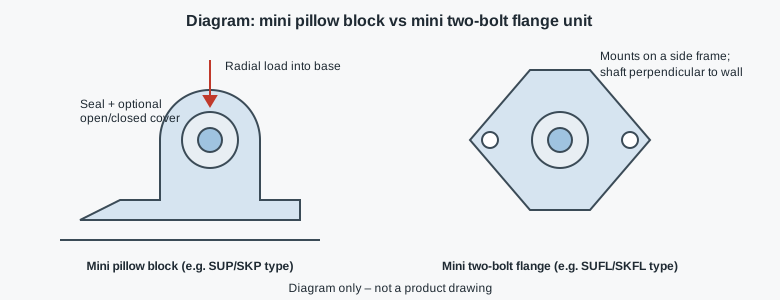
| Pillow block | UCP | Base bolted to a surface parallel to the shaft | Conveyor shafts on horizontal frames | Ledges and gaps under the base in wet areas |
| Square flange | UCF | Four bolts on a wall perpendicular to the shaft | Side frames, drive shafts | Four bolt heads to clean |
| Oval flange | UCFL | Two bolts | Narrow frames, lighter loads | Lower moment capacity than four-bolt flanges |
| Round flange | UCFC | Spigot and bolts | Centred mounting in a bore | Spigot fit tolerance |
| Take-up | UCT | Slides in a frame slot | Tensioning belts and chains | Slot must not trap soil |
| Hanger / other | various | Special brackets | Specific machine layouts | Check load direction |
For a fuller comparison of pillow blocks and flanges, see pillow block bearings: the complete guide.
Insert locking: set screw or eccentric collar
- Set screws (two screws at 120° in an extended inner ring) are simple and common. They suit one rotation direction and moderate loads. With frequent reversals, shock or vibration, set screws can loosen and mark the shaft.
- Eccentric collar locking tightens in the direction of rotation and suits constant direction; it can loosen with reversing rotation.
- In both cases, a ground shaft within the supplier's tolerance and correct tightening torque are essential.
Use the h7/h9 notation and shaft-fit acceptance guide to translate the actual manufacturer's recommendation into an inspection record rather than choosing a universal tolerance class.
Sizing: calculating bearing life with stainless ratings
Mounted units are often chosen by shaft diameter alone. That works for cast-iron units with chrome-steel inserts at light loads, but it can undersize a stainless unit.
The basic rating life of a ball bearing (ISO 281) is:
- L10 (millions of revolutions) = (C ÷ P)^3
- L10h (hours) = 10^6 ÷ (60 × n) × (C ÷ P)^3
where C is the dynamic load rating of the insert (from the supplier's stainless data), P the equivalent dynamic load on the bearing and n the speed in rpm. L10 is the life that 90% of a group of identical bearings reaches or exceeds.
Use the C and C0 comparison with calculation assumptions to keep fatigue-life inputs separate from the static equivalent load and peak-load acceptance check.
Steps:
- Determine radial and axial loads on each bearing from belt tension, product weight and drive forces.
- Calculate the equivalent load P (for small axial loads, P ≈ radial load).
- Take C for the stainless insert of the intended size from the supplier.
- Calculate L10h and compare with the required service life.
- If too short, choose a larger size or reduce the load.
- Check the static load rating C0 against shock loads and the housing's own load limits.
Example – a calculation illustration with assumed numbers, not product data. A conveyor shaft runs at 100 rpm. The supplier's stainless insert has a ratio C ÷ P of 5 for the calculated load. L10 = 5^3 = 125 million revolutions; L10h = 10^6 ÷ (60 × 100) × 125 ≈ 20,800 hours. If the plant requires 30,000 hours, the specifier must choose a size whose C ÷ P is at least about 5.65, because (30,000 × 60 × 100 ÷ 10^6)^(1/3) ≈ 5.65. Contamination and water ingress reduce real life below L10, which is why sealing matters as much as size.
Seals, covers and lubrication
Choose sealing for the cleaning method at the bearing position:
- Dry or wiped areas: standard insert seals, open cover.
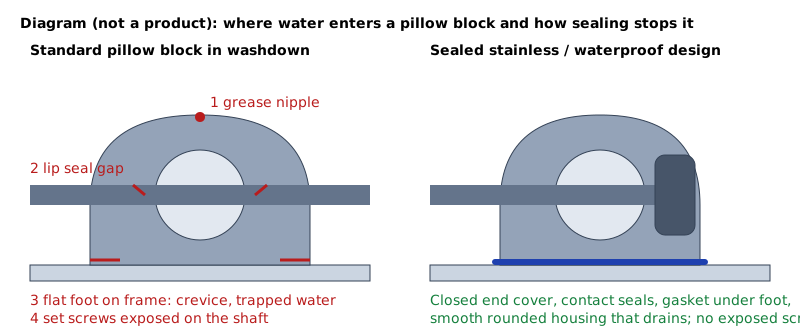
- Foam and rinse: closed end cover on the free shaft end.
- High-pressure washdown: sealed covers on both sides where possible; consider units with an ingress test for jets.
Food plants normally use food-grade grease registered as NSF H1 for incidental contact. Hygiene-focused selection – covers, grease and industry requirements – is covered in sealed stainless bearing units for hygienic industries.
Installation checklist
- Check shaft diameter and tolerance; clean and deburr the shaft.
- Mount the housing on a flat, rigid surface; shim if needed, without leaving gaps where soil collects.
- Slide the insert on without hammering on the outer ring.
- Align the shaft; do not use up the insert's self-alignment on installation error.
- Tighten housing bolts, then set screws or collar, to the supplier's torque.
- Fit covers, check free rotation and running noise.
- Use stainless fasteners; mixing stainless and carbon steel in wet areas invites galvanic corrosion.
Failure modes to avoid
- Undersizing from using chrome-steel ratings for a stainless insert.
- Set screws loosening under reversing loads or vibration.
- Water ingress through open covers in washdown areas, washing out grease.
- Over-greasing relubricatable units, pushing grease onto the machine.
- Misalignment that overloads the insert edge.
Use the damage-location and operating-history investigation to distinguish load, mounting and ingress explanations before repeating the installation.
Conclusion
NHK's mounted ball bearing units in stainless steel are one example of this product family. Such units give corrosion resistance and a cleaner machine than cast-iron units, but only when the housing type, locking, size and sealing are chosen for the actual load and cleaning conditions.