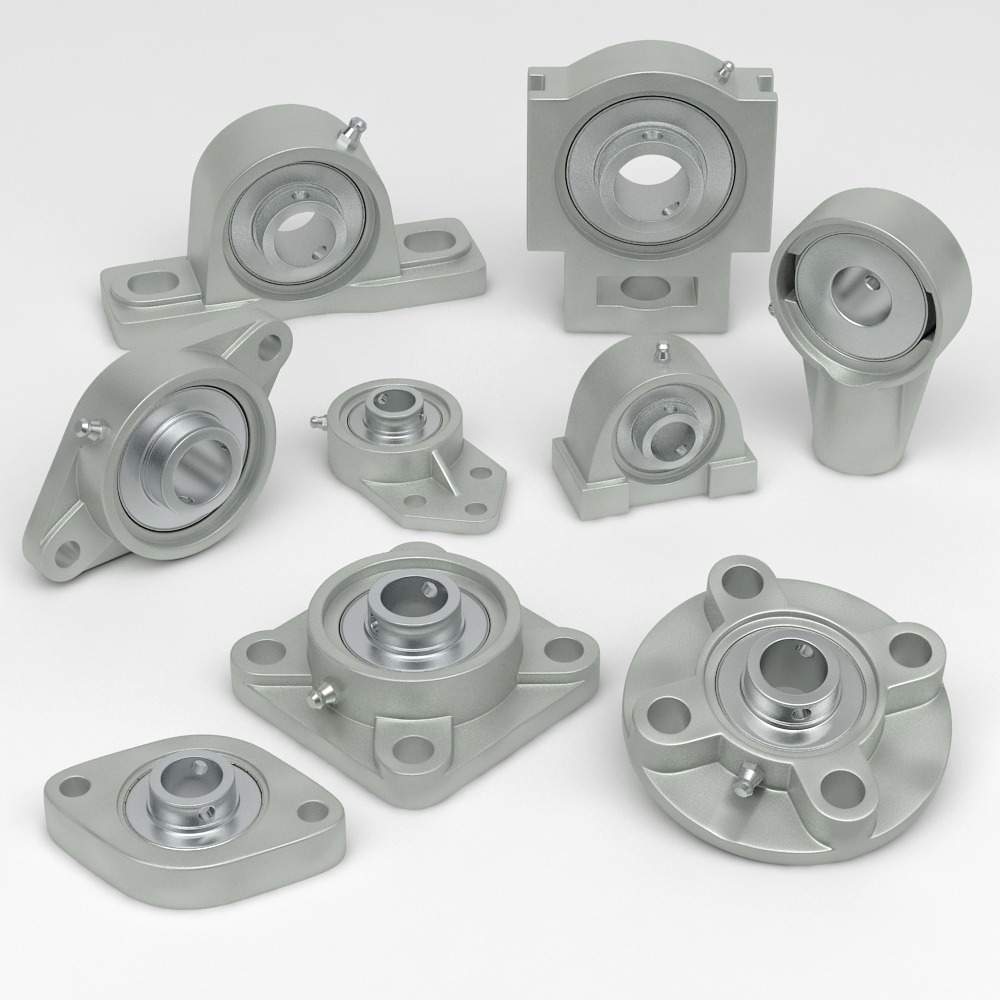
Mini bearing units are small housed bearings – an insert ball bearing in a compact pillow block or two-bolt flange housing – for small shafts and light loads on conveyors, packaging machines, dosing units and inspection equipment. In food and pharma machines they are usually specified in stainless steel because they sit close to product and are cleaned wet. This guide covers where miniature flange bearing units and small stainless bearing units fit, how to size them, sealing and washdown, and what to specify. It belongs to the Bearing units hub. For the full range of mounting formats, compare the bearing housing families and selection criteria.
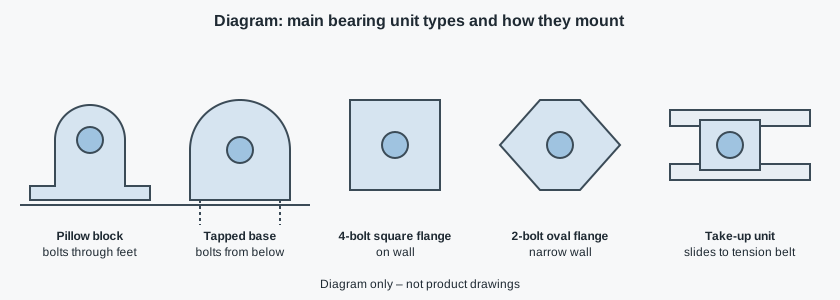
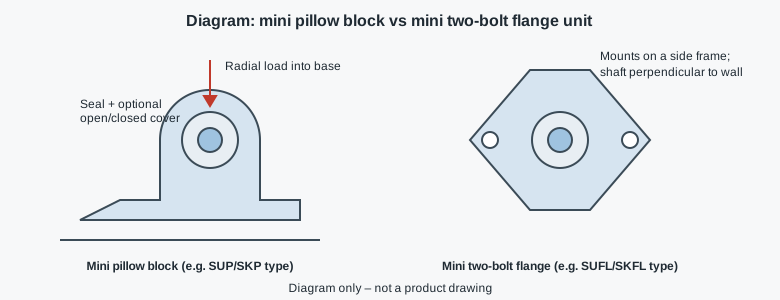 mini pillow block vs mini two-bolt flange unit. Schematic, not a product test report.
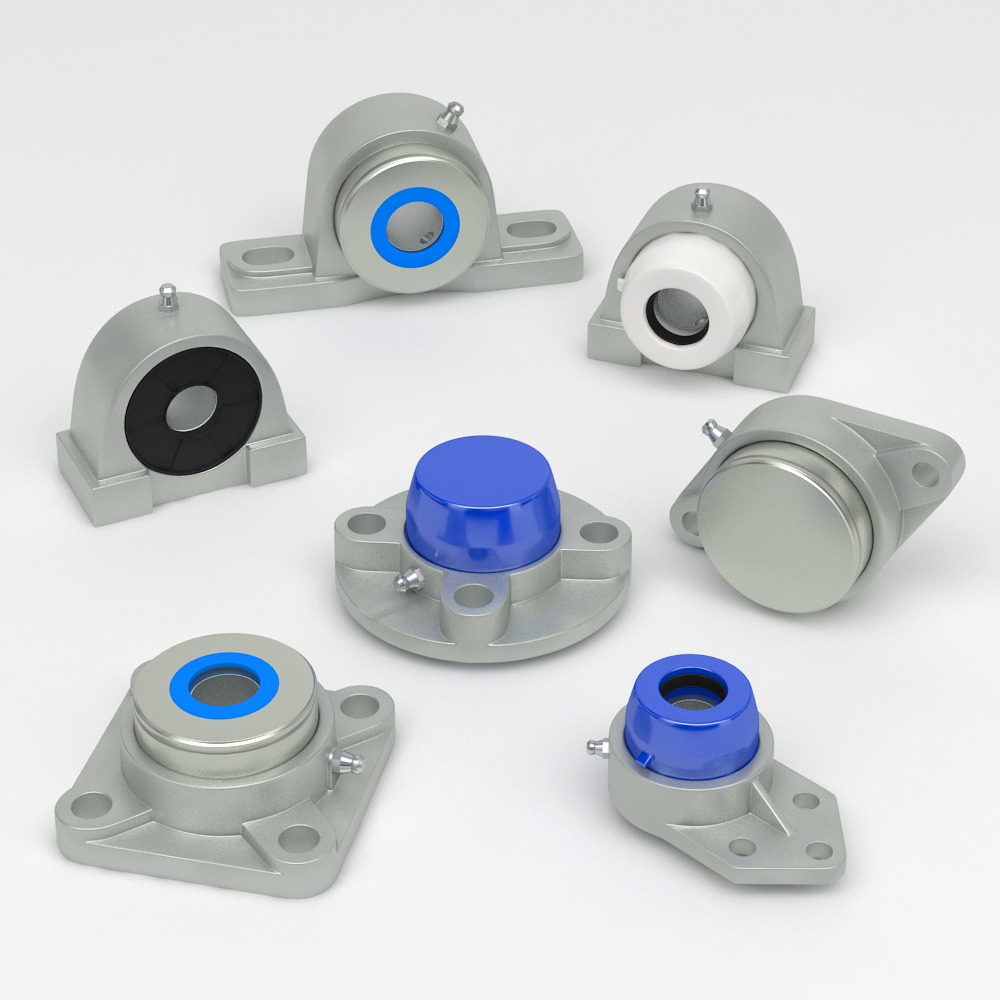
How to choose and fit end caps is covered in the bearing cover guide.
Where mini bearing units are used
| Application | Typical duty | What matters most |
|---|---|---|
| Light belt and modular conveyors (idler and tail shafts) | Low radial load, moderate speed | Corrosion resistance, sealing, compact side-frame mounting |
| Packaging machines (film rollers, guides, dancers) | Low load, frequent starts | Low friction, alignment, space |
| Dosing, filling and labelling units | Low load, close to product | Cleanability, closed covers, food-grade grease |
| Inspection and checkweigher conveyors | Very low load, smooth running | Low vibration, precise alignment |
| Laboratory and pharma equipment | Low load, frequent cleaning | Stainless, chemical resistance of seals |
Mini units are not a cheap substitute for standard-size units. Where shafts carry chain or belt drive tension, or where impact from product is possible, check whether a standard-size unit is needed; the mounted ball bearing units guide covers the larger range and the life calculation.
Housing types: pillow block or two-bolt flange
- Mini pillow block – the housing mounts on a surface parallel to the shaft; radial load goes into the base. Suits shafts carried on a horizontal crossmember.
- Mini two-bolt flange – the housing bolts to a wall perpendicular to the shaft; common on narrow side frames of light conveyors with hygienically optimised components and packaging modules.
The choice is set by the frame, not the load, at this size. See pillow block bearings and the flange bearing guide for housing comparisons at standard sizes.
Selection criteria
| Criterion | What to decide | Notes |
|---|---|---|
| Bore | Shaft diameter | Check the supplier's bore table per series; mini series cover small shafts only |
| Load | Radial and axial load per unit | Include belt tension and product weight; add a factor for shocks |
| Speed | Shaft rpm | Seal friction matters more on small bearings |
| Housing material | Stainless steel (304-type) vs 316 | 316 near chlorides, brine or chlorinated cleaners |
| Bearing insert | Stainless insert, set-screw locking | Retighten set screws after run-in |
| Seals | Contact seals; elastomer type | Check compatibility with cleaning chemicals and temperature |
| Covers | Open (shaft passes through) or closed (shaft end) | Covers keep spray off seals and remove a harbourage point at the shaft end |
| Grease | Food-grade (NSF H1) where incidental contact is possible | Confirm temperature range |
| Cleaning | Foam and rinse, high-pressure washdown | Avoid aiming jets at seals; IP ratings are ingress tests, not hygiene ratings |
| Documents | Material certificates; declaration for grease | EHEDG certificate only if the specific unit has one |
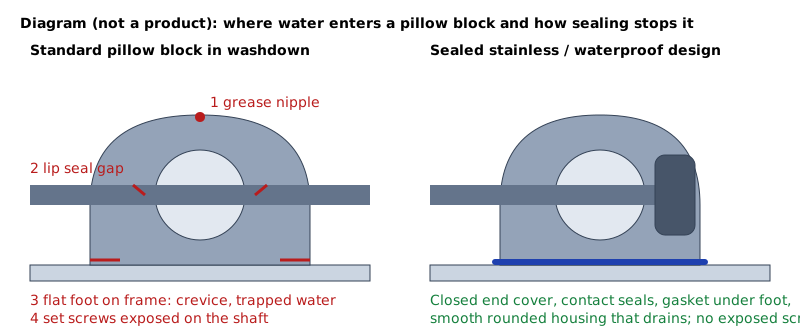
Harbourage points on small units are the gap between housing and frame, the set screws, the open shaft end and the seal lip. Chloride pitting is local corrosion caused by salt or chlorine.
Use the RFQ checklist below to prepare the data for a mini bearing recommendation.
Sizing method
- Work out the radial load per bearing: belt tension or roller weight plus product load, split between the two bearings on the shaft.
- Multiply by a duty factor for starts, shocks and misalignment.
- Compare with the insert's dynamic load rating and calculate rated life with the ISO 281 basic formula, L10 = (C/P)³ million revolutions for ball bearings, converting to hours at the shaft speed.
- Check the static rating where the shaft stands loaded or receives impacts.
- Check the shaft: small shafts deflect, and deflection misaligns bearings.
Example (assumptions, for method only): a tail shaft on a light conveyor carries 300 N belt tension and 100 N roller and product weight, split over two bearings: 200 N per bearing. With a duty factor of 1.5, P = 300 N. If the chosen insert's dynamic rating C were 5,000 N, L10 = (5,000/300)³ ≈ 4,630 million revolutions, about 257,000 hours at 300 rpm. Here, life is not the limit – corrosion, seals and washdown are. That is typical for mini units, and why selection focuses on sealing and covers. Use the real C value from the supplier's table.
Sealing and washdown
Small bearings carry little grease, so a small amount of water ingress has a large effect. In practice: Check ingress tests against the cleaning regime before specifying seals and covers.
- Fit closed covers on shaft ends and open covers where the shaft passes through.
- Mount units so water drains away from seals; avoid pockets above the housing.
- Do not point high-pressure jets at seals at close range.
- Use stainless fasteners in the same grade to avoid galvanic corrosion.
- Consider a spacer or stand-off so the housing does not sit flat on the frame, where residues collect – see sealed stainless bearing units for hygienic industries.
Common failure modes
- Rough running after a few weeks: water ingress and grease washout from jet cleaning at the seals.
- Shaft fretting: set screws not retightened after run-in.
- Early failure on drive shafts: mini units used where belt or chain tension needed standard size.
- Corrosion under the housing: housing bolted flat on the frame without sealing.
- Noise and heat: misalignment from shaft deflection or uneven frame faces.
What to specify in an RFQ
Before asking for certification evidence, use the certificate scope checks for a compact unit.
- Housing type (mini pillow block or two-bolt flange), bore
- Radial/axial load, speed
- Zone and cleaning method, chemicals
- Housing material, cover type (open/closed)
- Grease requirement, temperature range
- Documents, quantities, delivery country
An NHK technician suggests the unit and sends a quote. NHK lists sealed stainless bearing units; ask about miniature configurations and request dimensions, mounting details, materials and covers for the proposed unit rather than assuming availability or specification.