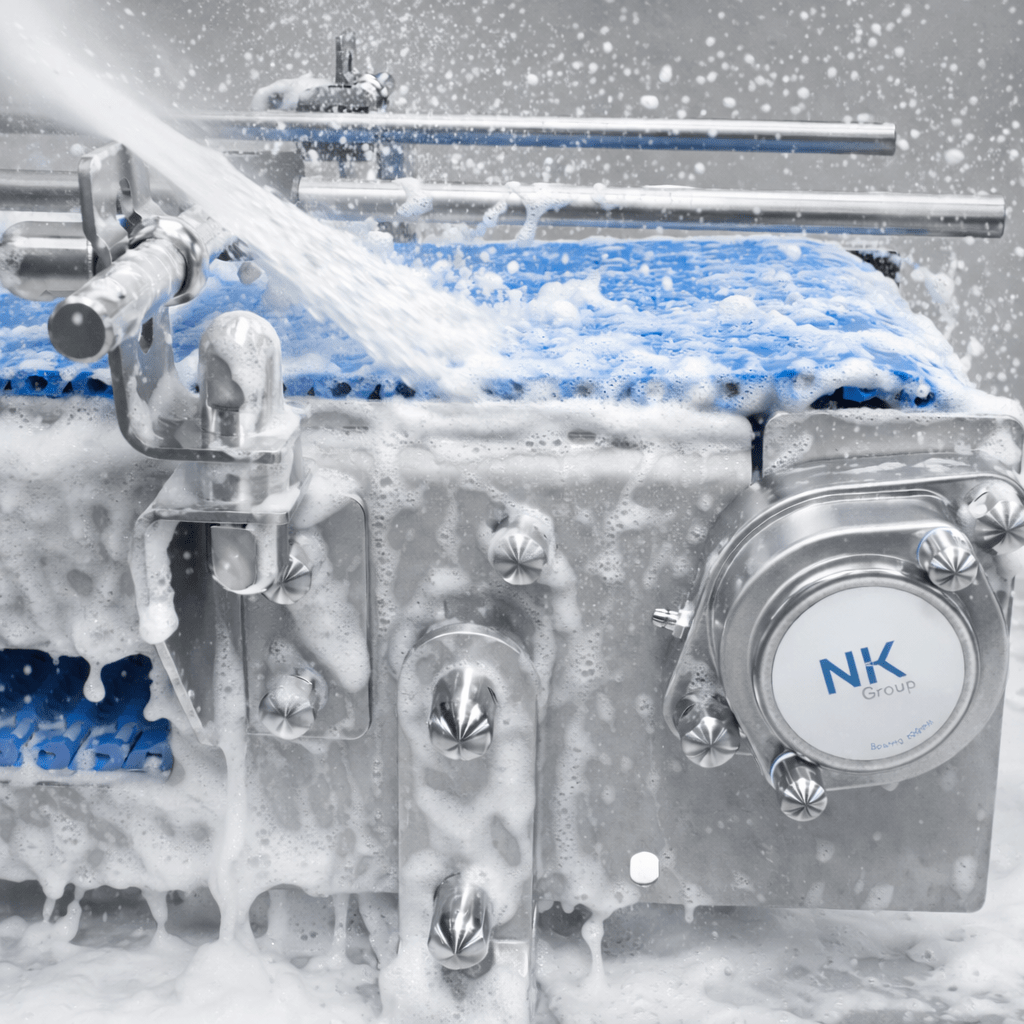
Sanitary machinery components are parts – feet, castors, bearing units, guides, conveyor parts and drives – designed so that soil and microorganisms cannot collect on them and cleaning reaches every surface. Food and beverage, pharmaceutical and biotechnology plants use them to protect product safety and meet hygiene regulations. The advantages are not uniform: each component solves a specific problem at a specific position on the line. This guide goes through them part by part.
Where sanitary components sit on a line
For a zone-by-zone rule on which standard components can stay, see standard parts in hygienic design.
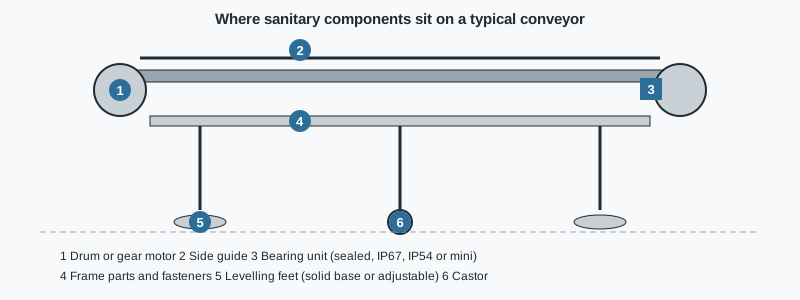
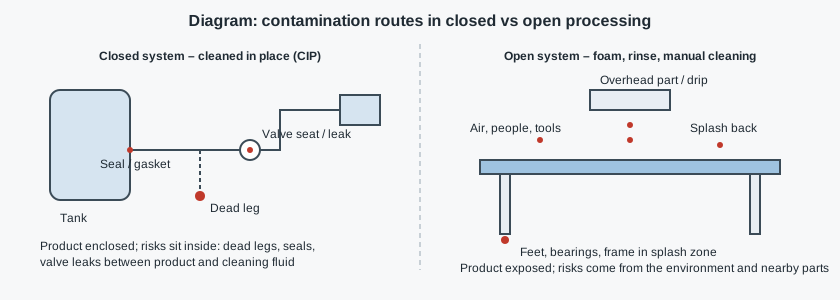
Hygiene requirements depend on the zone:
- Product-contact zone: surfaces that touch food. Highest requirements, including food-contact materials (EC 1935/2004) and smooth finish – EHEDG guidance is Ra ≤ 0.8 µm.
- Splash zone: parts reached by product or cleaning spray, which can drip back onto the product – bearings and frames above the belt.
- Non-contact zone: areas such as the floor and the underside of the frame. Lower requirements, but often the wettest and dirtiest area.
Advantages and limits by component
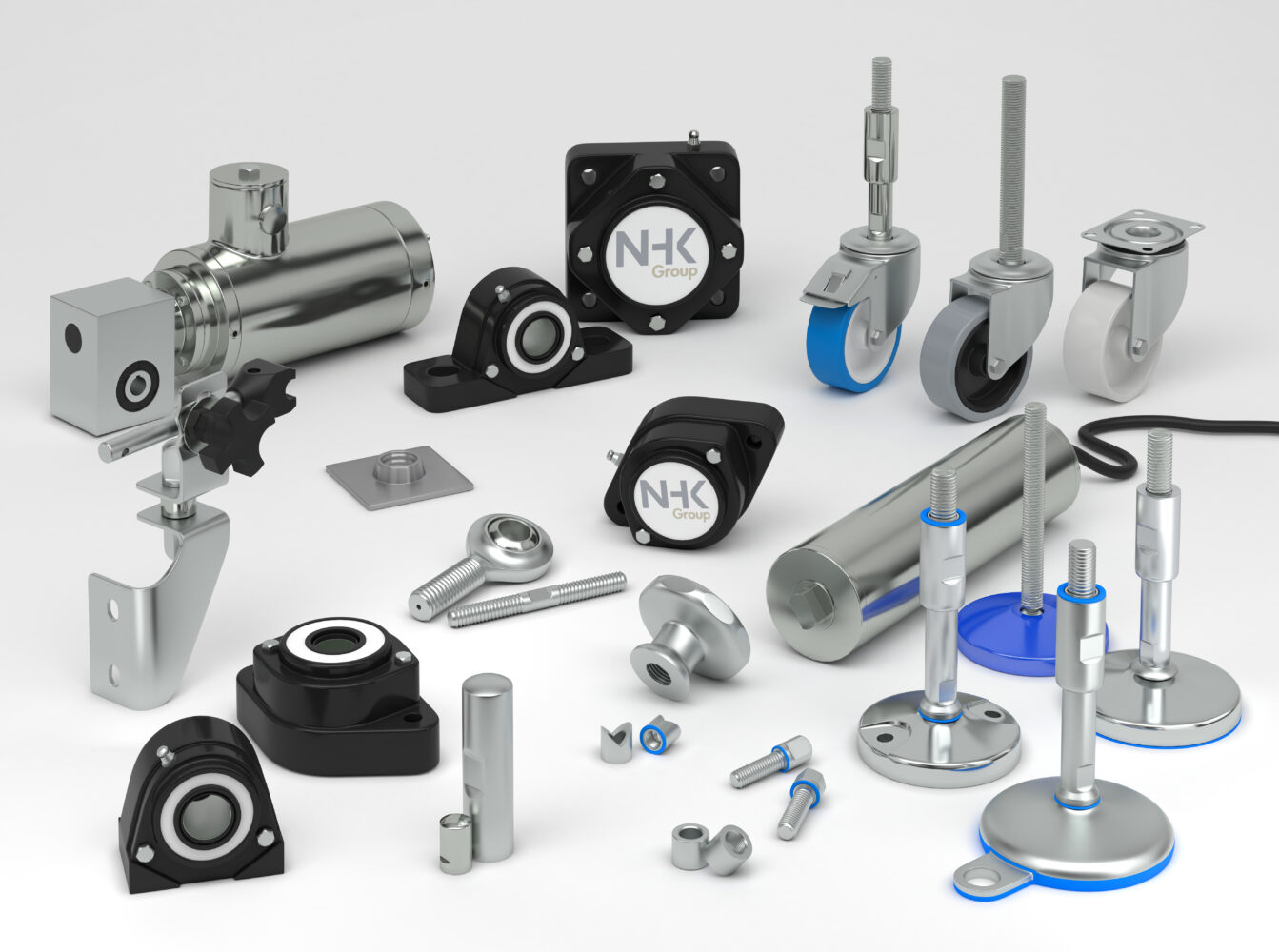
| Component | Main advantage | Limit / what to check | Typical zone |
|---|---|---|---|
| Solid base levelling feet | No hollow base to trap soil; easy to clean around | Thread above the base must be covered or sealed | Floor, non-contact |
| Adjustable hygienic levelling feet | Levelling without exposed thread or open joints | Seal material; load rating per foot | Floor, non-contact |
| Hygienic castors | Mobility for cleaning and changeovers | Wheel and bearing sealing; brake design | Floor, non-contact |
| IP67 bearing housing | Tight against dust and temporary immersion | Not a jet-washdown rating | Splash zone |
| Sealed stainless bearing units | Corrosion resistance plus sealed grease | Cover type; food-grade grease | Splash zone |
| IP54 thermoplastic bearing units | No corrosion, cost-effective | Splash only – not for jets | Dry or lightly cleaned areas |
| Mounted stainless ball bearing units | Corrosion-resistant, wide housing choice | Lower load ratings than chrome steel | Splash zone |
| Mini stainless bearing units | Same principle for small shafts | Small seals – check cleaning access | Compact machines |
| Stainless conveyor parts | Corrosion resistance, washable | Joints and fasteners must be crevice-free | All zones |
| Stainless side guides | Smooth guide surface along product | Mounting brackets and rod ends | Product contact |
| Stainless gear and drum motors | Enclosed drive with no external chains or gears to clean | Seal life; motor heat in wet areas | Product contact / splash |
Levelling feet and castors
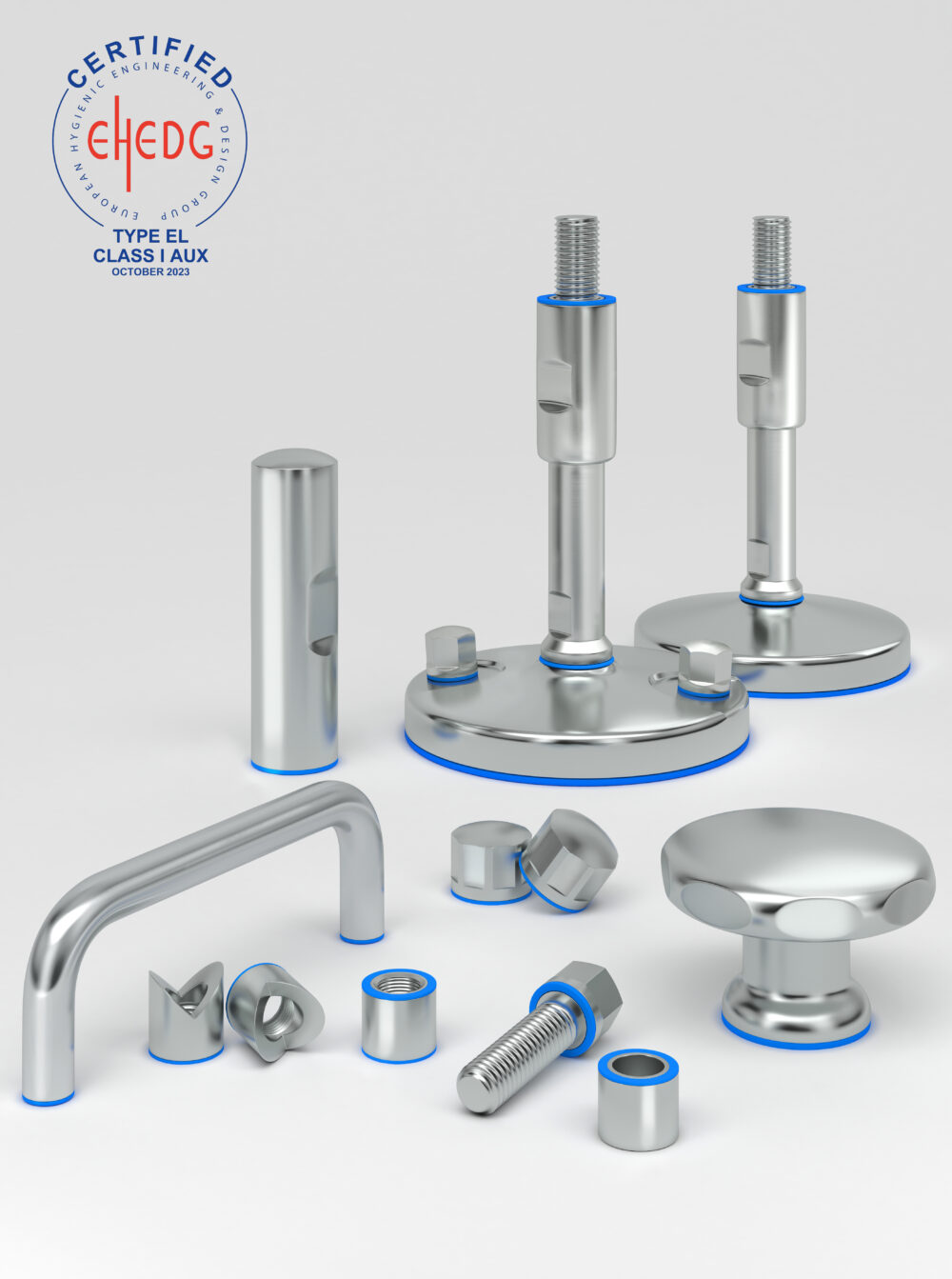
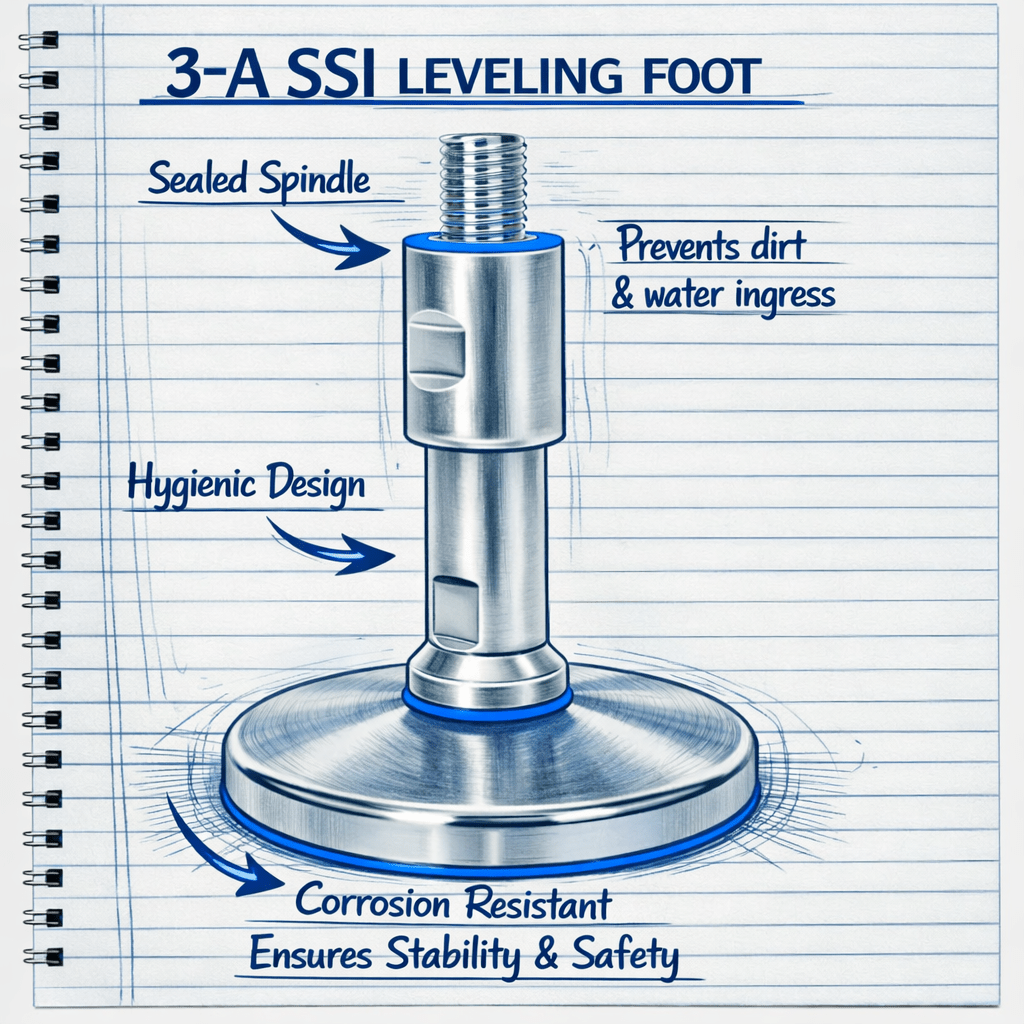
Solid base machine levelling feet in stainless steel have a closed, solid base, so dirt and bacteria cannot collect inside it; they resist corrosion and cleaning agents. Adjustable hygienic levelling feet add sealed joints and covered threads, so the machine can be levelled without creating harbourage points (places where microorganisms survive cleaning). A level machine also drains correctly and runs with less vibration. See hygienic machine feet for selection details.
Hygienic castors give mobility for cleaning behind equipment and for changeovers. Smooth, non-porous surfaces resist contamination; check that wheel bearings are sealed and the brake has no open cavities.
Bearing units: choosing by cleaning method
Bearing units are where the choice depends most on cleaning:
- IP54 thermoplastic housing: protected against dust and water splashes; suits areas with regular but not intense cleaning. The housing does not corrode. See an economical and reliable solution.
- IP67 waterproof bearing house: dust-tight and protected against temporary immersion. IP67 is an immersion test, not a washdown rating; check suitability for jets separately.
- Sealed stainless bearing units: corrosion-resistant housing and sealed insert, suited to wet, hygienic environments.
- Mounted ball bearing units in stainless steel: corrosion-resistant units in pillow block, flange and take-up housings; see mounted ball bearing units in stainless steel for sizing.
- Mini bearing units in stainless steel: the same benefits for compact machinery with small shafts.
Conveyor parts and side guides
Stainless conveyor parts – rollers, frames, brackets – withstand frequent washdown and cleaning agents. The hygiene weak points are usually joints, fasteners and brackets, not the profiles themselves. Side guides sit in or next to the product path; smooth, corrosion-resistant guides that do not harbour soil, mounted on brackets that can be cleaned, are the goal.
Gear and drum motors
Use the internal conveyor drive selection checklist for belt compatibility, startup duty, cooling and cleaning evidence.
For the alternative arrangement, assess internal and external conveyor-drive tradeoffs against the installed cleaning and service plan.
A drum motor places the motor and gearbox inside the conveyor drum, sealed and in stainless steel. Advantage: no external chain, sprocket or gearbox in the product area to clean. Check seal life and the supplier's documented suitability for the cleaning method and chemicals.
What "certified" adds
Certified hygienic components carry a certificate for a specific design, for example EHEDG certification or 3-A Symbol authorisation after Third Party Verification. Both are voluntary. A certificate gives independent evidence that the design can be cleaned; it does not make a whole machine compliant. Ask for the certificate for the exact part number.
How to prioritise upgrades
- Map zones on the line: product contact, splash, non-contact.
- Inspect after cleaning: where do residues, rust or grease remain?
- Start with product-contact and splash parts: side guides, drives, bearing units above the belt.
- Match bearing units to cleaning method using the list above.
- Upgrade floor-level parts: feet and castors in wet areas.
- Request documents: material certificates, declarations of compliance, IP test reports, hygiene certificates where claimed.
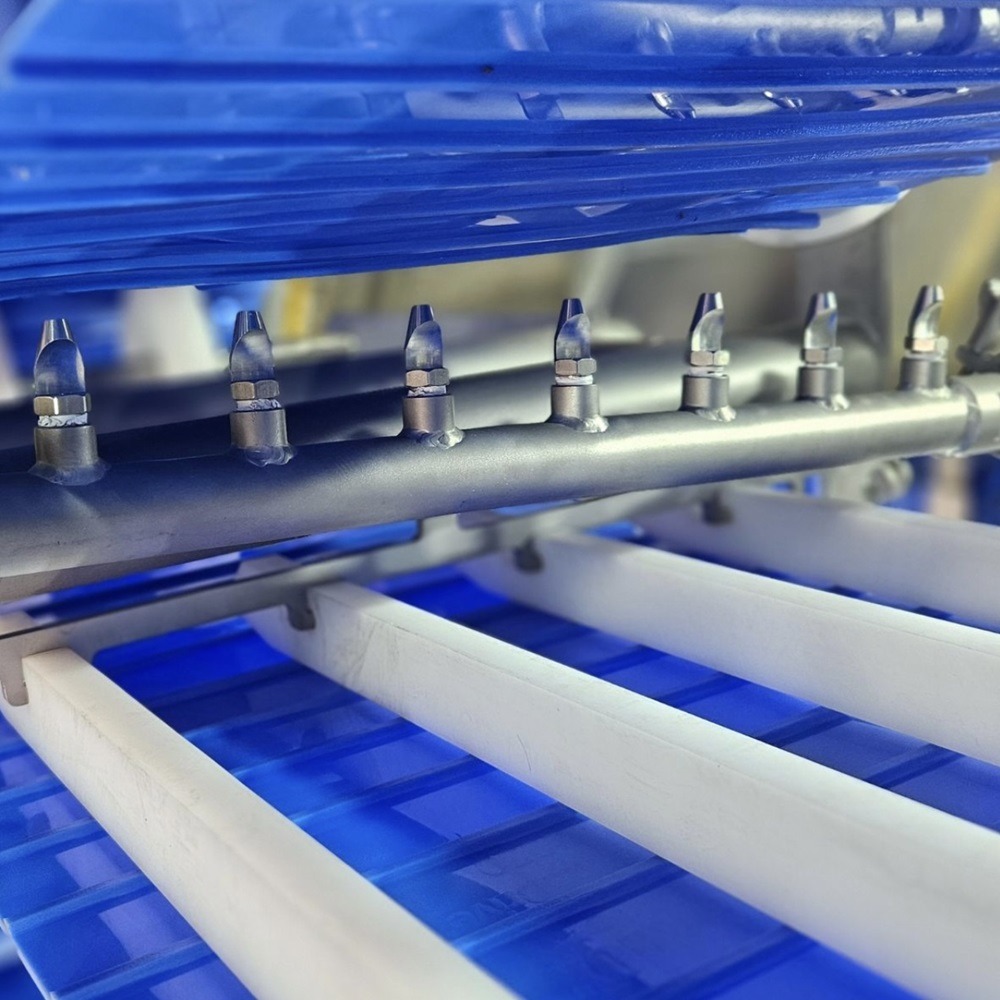
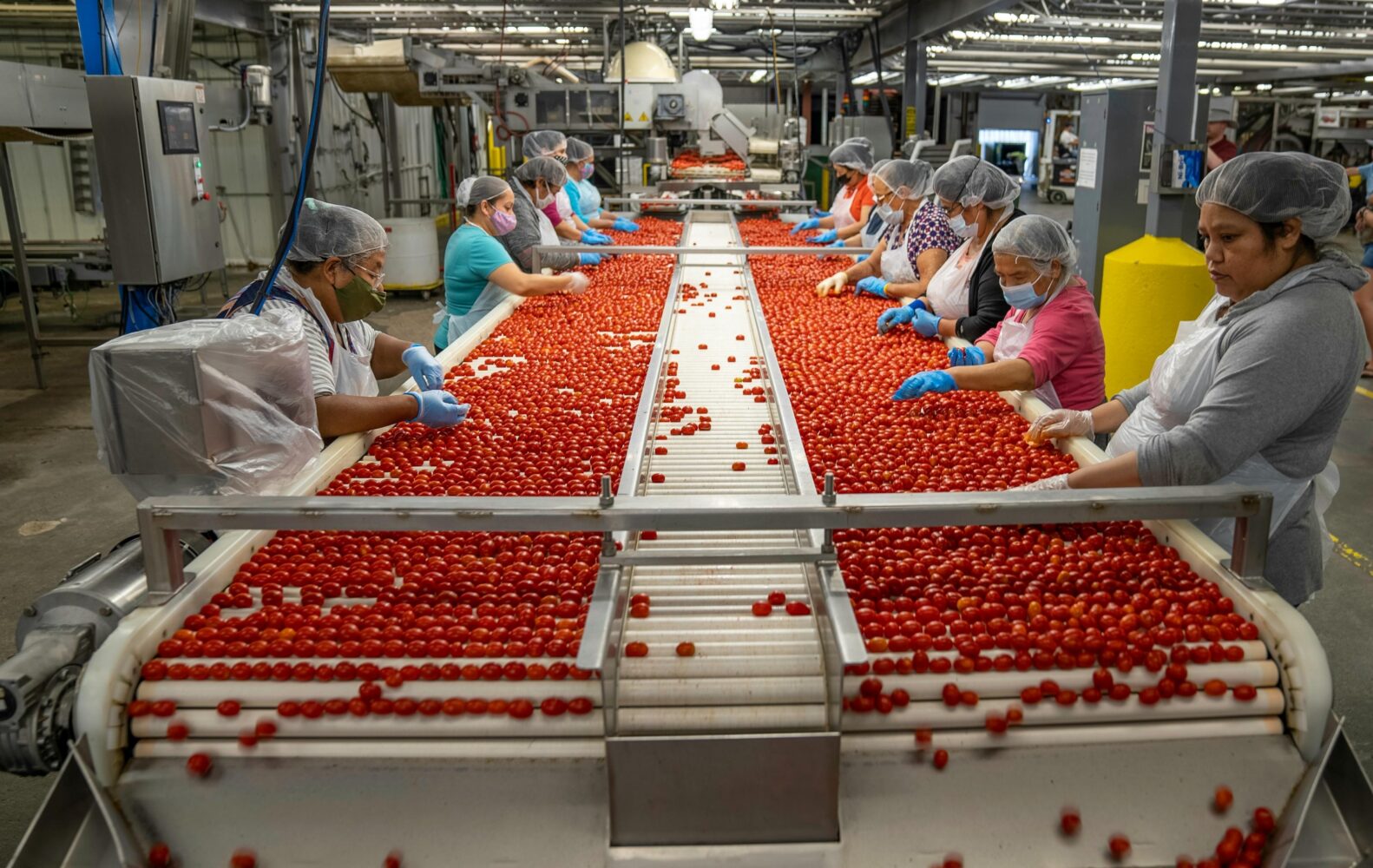
Example – assumptions stated, not a real case. A vegetable-sorting line like the one in the photo is foamed and rinsed daily. Inspection finds grease below open bearing covers and soil around exposed feet threads. Priority: sealed stainless bearing units with closed covers above the belt; hygienic adjustable feet at the floor; side guide brackets checked for crevices. IP54 thermoplastic units stay in the dry packing area at the end of the line.
Conclusion
The advantages of using sanitary machinery components come part by part, at the positions where soil, water and product meet. For how requirements differ between industries, see sanitary optimized parts and components. NHK's range is listed at NHK Machinery Parts.