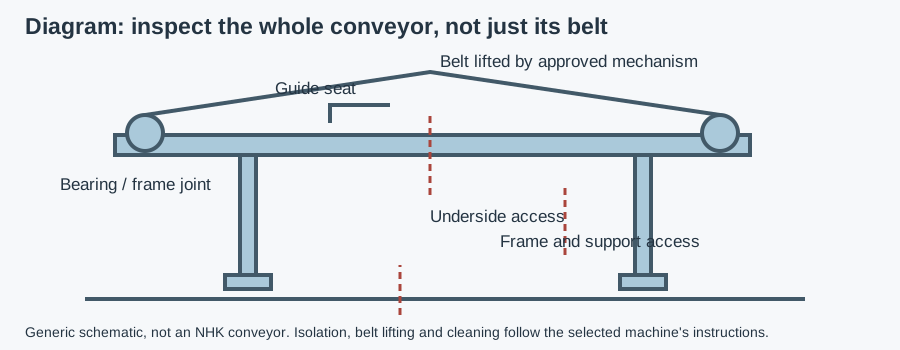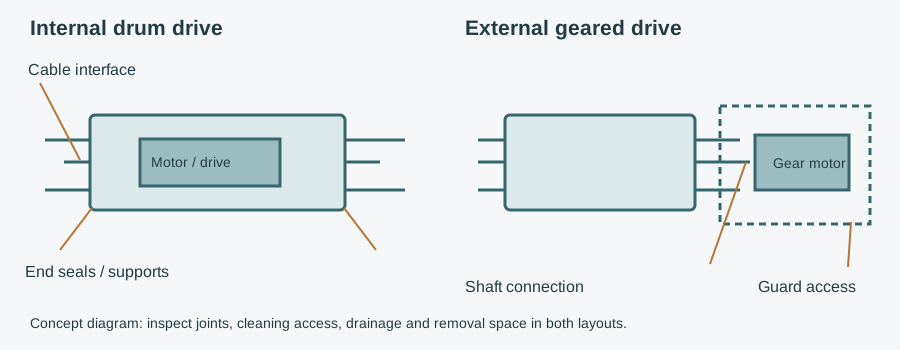
Drum motor vs gear motor is an architecture decision before it is a motor selection. This comparison addresses cleaning boundaries, lubrication and serviceability; the existing drive guide handles detailed sizing. Start with the installed conveyor frame and component interfaces so a compact motor does not hide an inaccessible mounting joint.
Drum motor vs gear motor: decision table
Here, gear motor means an external motor with reduction gearing driving a separate pulley. A drum motor may also contain gearing; the terms are not opposites at the transmission level. An external drive can be directly shaft-mounted and does not always require a chain.
| Decision criterion | Enclosed drum drive | External gear motor | Evidence that decides |
|---|---|---|---|
| Cleaning footprint | Removes an external motor/gearbox from the belt-end space | Location can put the drive outside the cleaning or product zone | Installed drawing with guards, supports and drainage |
| Residue access | Inspect drum ends, supports and cable entry | Inspect gearbox mounts, shaft, coupling and any guard interior | Safe cleaning demonstration on the assembled conveyor |
| Lubricant containment | Internal fluid or grease may remain behind seals | Gearbox and bearing lubricants remain possible sources | Lubricant inventory, leakage paths and inspection procedure |
| Thermal duty | Heat must leave the enclosed assembly | Separate motor and gearbox need their own heat-removal path | Approved operating envelope at actual load and speed |
| Mechanical duty | Match shell/belt interface and available drive duty | Match reduction, pulley connection and support reactions | Operating and startup cases, not nominal power alone |
| Maintenance | Drum removal may disturb belt tension and tracking | Motor or gearbox may be replaceable independently | Access, lifting method, spares and reassembly plan |
| Retrofit | Existing belt and frame must accept the drum | Existing pulley may be retained if connections suit | Verified interfaces and revised safety assessment |
Send your application data for a conveyor-component recommendation
Compare the two proposed assemblies with identical process requirements. A smooth internal drum and an exposed conventional chain are not a fair comparison if the external-drive proposal actually uses a direct shaft connection and a cleanable motor outside the splash zone. Conversely, relocating the motor is not enough if its shaft penetration leaves a concealed product trap.
Hygiene: inspect the ends, guards and contamination paths
The product-contact zone touches food; the splash zone receives product or cleaning spray. Mark both on the installed drawing. Include surfaces from which lubricant or retained liquid could transfer to the food path, even when they do not normally touch product. Enclosing a transmission can reduce exposed parts but does not remove these transfer routes.
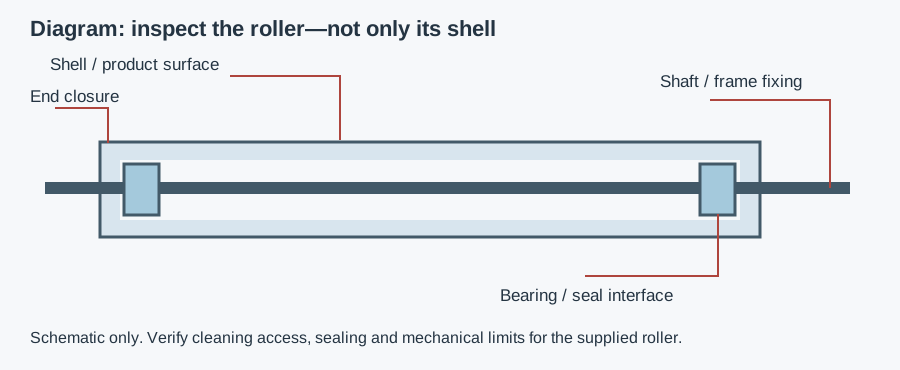
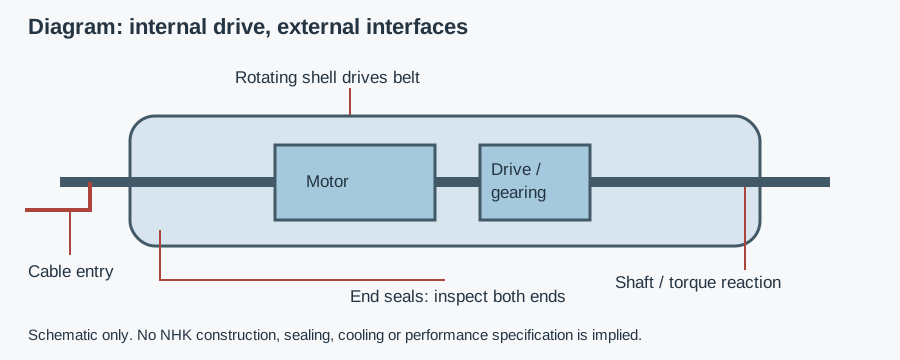
For a drum drive, inspect both end seals, stationary supports, bracket seats and cable exit. A crevice is a narrow gap that can retain residue beyond cleaning access. Harborage points are locations where contamination survives the cleaning procedure. Reject an arrangement that looks smooth from above but leaves an uninspectable underside against the frame.
For an external drive, inspect shaft extensions, torque arms, fasteners and any coupling or chain enclosure. Guards are needed for safety; their interior surfaces, fixings and removal procedure belong in the hygiene assessment. Do not operate without required guards merely to improve cleaning access. Resolve safe access through the machine's approved isolation and dismantling procedure.
Check neighbouring side-guide seats and adjustable brackets at the same time. A clean drive cannot compensate for residue dropping from an overhanging clamp. Self-draining means liquid can leave the surface in its installed orientation; verify that drainage does not land on food or another retention point.
Cleaning and washdown: separate three acceptance questions
First, can the exterior be cleaned? Second, can the assembly resist the proposed water exposure? Third, are its materials compatible with the cleaning chemistry? Neither architecture answers all three. Record detergent and disinfectant, concentration, temperature, contact time, rinse practice and drying, including the worst permitted procedure rather than the usual quick rinse.
IP ratings describe ingress tests. IP67 under IEC 60529 is temporary immersion, not a high-pressure washdown rating. IP69K under ISO 20653 concerns hot high-pressure jets under defined conditions. Request the tested configuration, cable connections and installation restrictions. Chemical compatibility and aged-seal behaviour remain separate from the ingress classification.
Use the IP exposure selector and test-scope checks to frame the ingress-evidence request before comparing supplier proposals.
Inspect after the approved cleaning cycle with guards and utilities in place. Look for residue behind supports, liquid beneath guard edges, seal damage and cable-gland movement. Use the plant's validated cleaning and verification criteria; visual inspection does not establish microbiological acceptance. The migrated conveyor exposure guide connects water, chemistry and operating stresses across the assembly.
Oil-filled vs oil-free drum motor: ask what is actually inside
An oil-filled drum motor may use internal oil for transmission lubrication and heat transfer to the shell. Its suitability depends on containment, lubricant specification, seal condition, cooling and the actual operating envelope. Oil inside an enclosure is not automatically a contamination event; a leakage path into the food area is the issue to control.
An oil-free drum motor describes a design without an oil system as specified by its supplier. It does not prove there is no grease in bearings or other lubricated interfaces. Ask what the claim excludes, whether a transmission remains, how bearings are lubricated and how heat is removed. Do not silently turn “no oil bath” into “no lubricant.”
Request a lubricant inventory for both candidate drives: type, location, containment boundary, service requirement and plausible leakage destination. Where incidental food contact is possible, ask for appropriate lubricant evidence and the plant's acceptance basis. Such evidence does not authorise deliberate food contact or replace a leakage-control plan.
Specify inspection actions for unexpected liquid at drum ends, gearbox seals or collection trays. Safely stop and isolate as the site procedure requires; identify the fluid and contamination route before restarting. Follow the supplier's service instructions rather than topping up, mixing lubricants or increasing seal compression without approval.
Synchronous vs asynchronous: motor principle is not a hygiene rating
A synchronous motor's rotor follows the rotating magnetic field at synchronous speed in normal operation. An asynchronous induction motor develops torque with a speed difference, called slip, between that field and the rotor. Both principles can be used in conveyor drives; neither identifies the exterior geometry or lubricant arrangement.
Permanent-magnet synchronous designs are one implementation, not the definition of every synchronous motor. Control requirements, starting behaviour, torque-speed limits and protective settings depend on the particular motor and drive system. Confirm the controller, feedback requirements where applicable, electrical supply and permitted operating modes together.
Do not publish a universal efficiency advantage from the motor label. Compare measured electrical input at the same delivered belt pull, belt speed and duty, including controller and transmission losses. A peak-efficiency point does not describe a line that accumulates product, starts repeatedly or spends much of its shift at reduced speed.
Cooling also needs a separate check. Some drum designs transfer heat through fluid and shell with belt contact contributing to heat removal; other designs differ. An external motor may also have low-speed cooling restrictions. Require written approval for the actual continuous, intermittent and unloaded conditions rather than assuming a variable-speed controller makes every speed acceptable.
When to choose a drum motor — and when not to
Choose a drum layout when it reduces hard-to-clean external parts and the supplier confirms belt compatibility, thermal duty, mounting and removal access. Compactness is useful where the external drive would obstruct cleaning, an aisle or neighbouring equipment. It is not useful if drum removal needs dismantling that the maintenance plan cannot support.
Choose an external gear motor when the required torque/speed duty, cooling, independent service access or retained pulley makes it the better engineered arrangement. Locating it outside the splash zone can reduce exposure, provided the connecting shaft, supports and guards remain cleanable and safely accessible. Confirm actual replacement availability instead of assuming standard appearance means interchangeability.
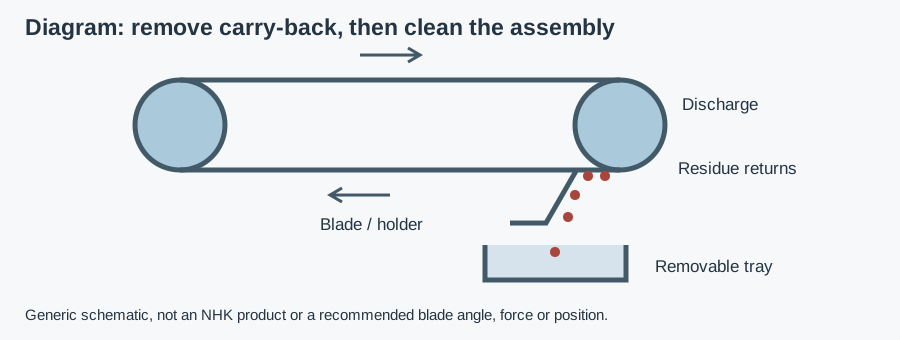
Do not choose either from motor power alone. Include startup, incline, acceleration and accumulation where applicable. Check external pulley supports through the bearing-unit type and mounting guide, and include scraper drag and collection through the belt-cleaning blade and holder checklist. These are assembly constraints, not reasons to invent a drive rating.
Example: two layouts for a chilled-food transfer
Example — hypothetical assumptions, not NHK field data. An OEM is comparing a compact drum and an external shaft-mounted gear motor for an unpackaged-food transfer. The line uses foam and rinse, has intermittent starts and offers restricted belt-end access. No pull, speed, temperature limit or performance measurement has been supplied.
- Mark splash, food-contact and potential drip routes for both layouts. Include the drum end brackets and the external drive's shaft connection, not just the visible motor bodies.
- Have maintenance demonstrate the isolated removal sequence. Record which belt settings are disturbed, lifting access and how tracking will be restored.
- Ask both suppliers to confirm the same startup and thermal duty. Reject a proposal whose required cooling or permitted operating mode conflicts with the process.
- Have QA assess cleanability and lubricant containment against the proposed procedure. Oil-free wording is insufficient until its scope and remaining lubrication are documented.
The decision remains open until those checks are resolved. If the drum's cooling and removal constraints are acceptable, its smaller external footprint may favour it. If independent motor replacement and positioning outside spray give the external drive better access, that layout may prevail. Neither outcome implies measured savings or machine certification.
Copyable specification and supplier acceptance checklist
“Assess an enclosed drum drive and an external geared-drive alternative for the attached food-conveyor layout. Confirm belt interface, required pull and speed range, startup/accumulation duty and thermal limits. Identify all lubricants and containment boundaries, cleaning restrictions, materials, cable interfaces and service access. State the proposed controls, mounting procedure, spare strategy and documents for the exact supplied configuration.”
Attach the application and zones, belt/layout drawing, load cases, cleaning cycle, oil-free requirement and reason, supply/control requirements, removal-space constraints, requested documents, quantities and delivery country. Compare equipment requirements for food-processing zones before finalising the request, and use the component purchasing guides to organise supplier evidence. There is no dedicated conveyor-drive calculator on this site; a supplier selection must confirm the mechanical and thermal limits.
For acceptance, check the following before purchase:
- The supplier identifies the actual architecture and lubricant inventory rather than a generic family description.
- Operating and startup cases are covered at the specified speeds; exclusions and cooling restrictions are explicit.
- Safe cleaning and replacement access can be demonstrated with the installed guarding and utilities.
- Material/contact evidence matches intended use; ingress reports and any design certificates identify the exact configuration.
- Inspection, service and replacement instructions support the plant's maintenance and contamination-control procedures.
Use the migrated sanitary-component priorities across a conveyor to keep the drive decision in context. For detailed belt-pull, tension, mounting and electrical checks after selecting an architecture, continue with the conveyor drum-drive selection guide.
NHK's approved conveyor mounting fittings and component category is the secondary browsing path. It does not establish a specific drum-motor or oil-free drive range. Send these application details through the existing enquiry form so NHK can confirm availability, recommend appropriate components and discuss quotation; no delivery commitment or drive rating is assumed.