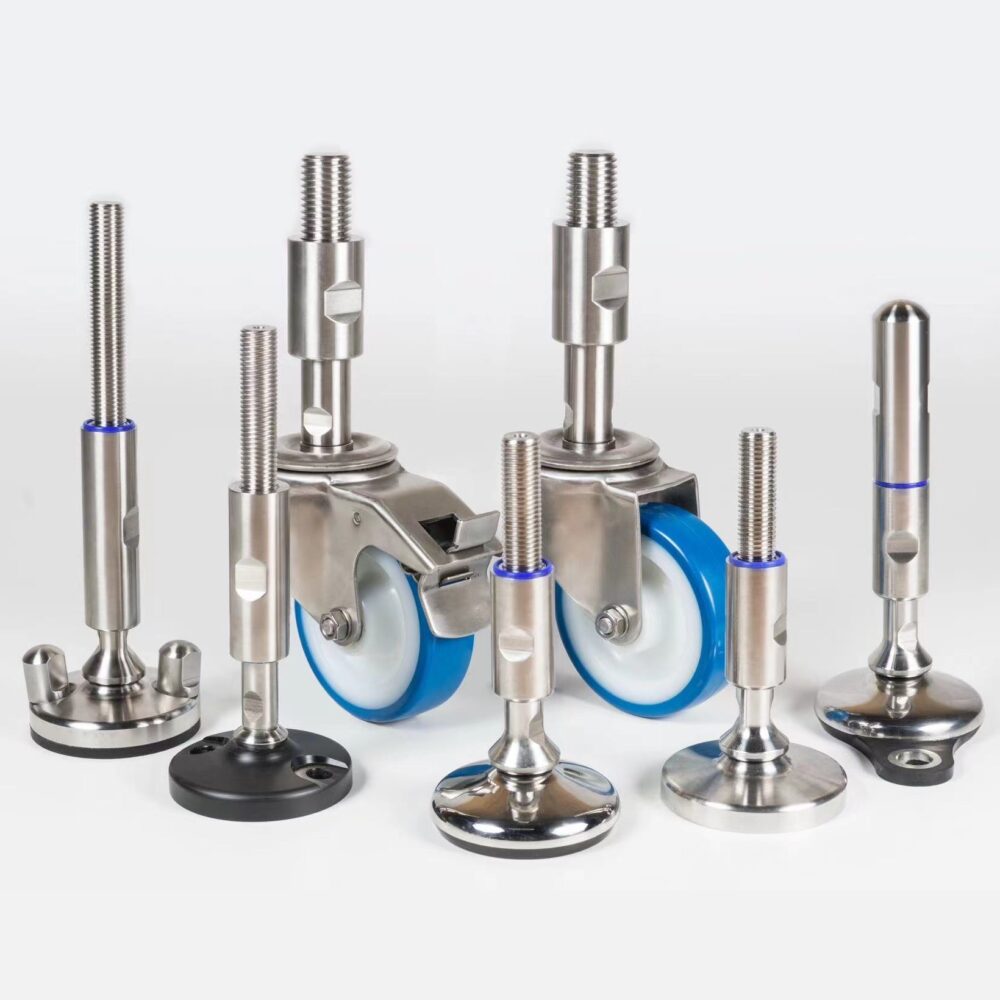
Rubber leveling feet support and adjust a machine through a foot with an elastomer contact base. The British spelling is rubber levelling feet. This guide focuses on pad function and limitations; the industrial foot load and anchoring guide covers the wider support selection. Do not buy an isolation solution from a rubber-base label alone.
Anti-slip leveling feet versus anti-vibration leveling feet
For a measured support load, assess the weighing support path and cable forces before choosing a compliant base.
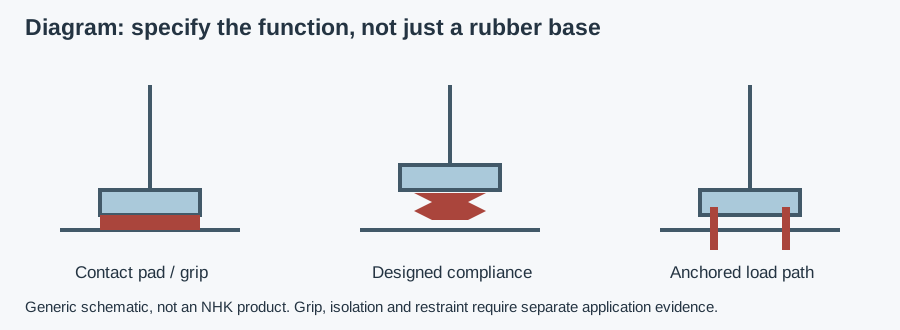
Anti-slip describes resistance to sliding at the floor interface. Vibration isolation describes reducing transmission between a machine and its surroundings. Damping dissipates vibration energy, while compliance is deformation under force. These are related but different properties. A rubber pad may deform and dissipate energy without producing useful isolation at the machine’s operating frequencies.
Anchoring provides another function: a designed connection to resist specified loads and preserve position. It is not supplied merely by a pad touching the floor. Determine the required function before comparing feet, pads or mounts. Precise transfers and machines with lateral or uplift forces may require a restrained support even if the floor pad appears to grip.
Selection table: evidence by requirement
| Requirement | Establish | Ask for |
|---|---|---|
| Vertical support | Maximum reaction and installed geometry | Complete-foot rating, extension and tilt limits |
| Floor protection | Floor finish and pad contact | Compound and deformation/marking limitations |
| Grip | Wet/dry surface, residue and lateral forces | Relevant friction or application evidence, not color |
| Isolation | Operating forces, frequencies and support loads | Stiffness, damping and appropriate dynamic assessment |
| Position/restraint | Lateral load, uplift and transfer alignment | Approved anchoring or restraint design |
| Chemical resistance | Actual cleaners, concentration and temperature | Compound-specific compatibility |
| Hygiene | Pad edge, attachment, joint and drainage | Cleaning method and inspection access |
| Compliance | Intended contact and foreseeable transfer | Applicable declaration for the actual material |
Send load, floor and cleaning data for a support recommendation
Base materials: specify the actual compound
Rubber is a family description, not a complete material specification. Formulation, hardness, geometry and attachment change the pad’s behavior. EPDM, FKM and VMQ/silicone are examples of elastomer families; none establishes cleaning compatibility, grip or food-contact suitability without data for the exact compound and conditions.
Ask whether the pad is bonded, molded, mechanically retained or replaceable, and obtain the approved replacement identity. A loose insert, bonded layer and thick compliant mount have different interfaces. Adding an aftermarket pad to a rated metal foot changes contact and deformation; it does not inherit the original assembly’s load or hygiene evidence.
The food-contact material and declaration guide explains the evidence needed for intended contact. EC 1935/2004 concerns all food-contact material categories within scope; EU 10/2011 concerns plastics and FDA 21 CFR 177.2600 concerns applicable repeated-use rubber articles. “FDA rubber” in a product label is not a universal approval of the foot or its installed cleaning performance.
Load, contact and adjustment
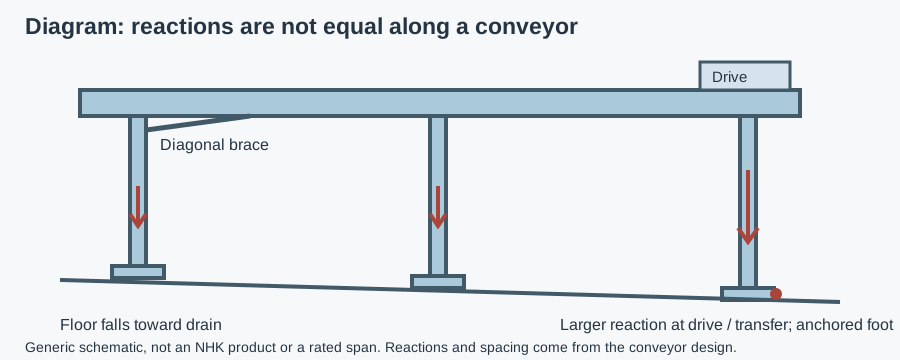
Establish the loaded machine, payload, center of gravity and support positions. Reactions need not be equal. Uneven floors, frame stiffness and adjustment can concentrate load at individual feet. Check the foot’s complete rating at the proposed stem extension and articulation, and the pad’s intended contact rather than assuming a larger base solves every load problem.
A screening average is total load divided by the number of supports assumed to carry it, with a justified application factor where appropriate. The designer must validate that assumption and include operating load cases. Do not prescribe a universal factor or infer a pad rating from stem size. Floor strength, contact geometry and frame attachment also belong in the support assessment.
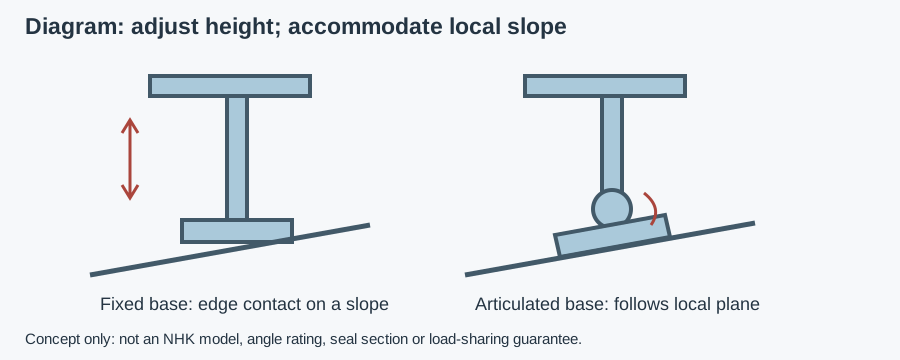
The swivel-foot slope and articulation guide covers joint geometry on uneven floors. Rubber compression cannot automatically accommodate a sloped contact plane without edge loading or distortion. Confirm permitted tilt, extension and pad seating from the actual design. Keep adjustment within instructions and lock it as specified.
Wet-floor grip: why an anti-slip label is insufficient
Frictional holding depends on pad, floor finish, normal reaction, water, cleaner and product residue. A tread that grips a dry test surface can behave differently on greasy tile or cleaning foam. Normal load also changes as the machine rocks or a foot loses contact. Do not invent a coefficient of friction or use a dry result to claim wet-floor holding.
Specify actual floor conditions and lateral forces, and ask for relevant application evidence. Use a controlled acceptance method devised for the machine, never an uncontrolled slope or push test with people exposed. A support that appears stationary during an unloaded check may not remain stable during operation or cleaning.
Where movement is unacceptable, use the floor anchoring and fixing-hole guide to develop the support detail. Anchors need their own floor and load assessment. The related brake and floor-lock distinction explains why frictional contact is not equivalent to anchoring, leveling or a safety-rated restraint.
Vibration damping is not guaranteed isolation
An isolator must be selected for the supported mass, stiffness, damping and excitation. Natural frequency is the frequency at which the supported system tends to oscillate. Excitation near that frequency can increase motion rather than reduce it. Useful isolation depends on the relation between excitation and the system’s dynamic behavior; no NHK isolation curve is asserted here.
Obtain load-deflection and dynamic data for the actual support where isolation matters. Include startup, shutdown and multiple operating speeds, not just steady running. A thicker or softer pad can increase motion and disturb alignment. Greater damping is not automatically the best answer for every frequency or precision requirement.
Pipes, guards, cables and rigid anchors can create parallel transmission paths. Anchoring a nominal isolator may bypass or change its intended compliance; the restraint and isolation must be designed together. The migrated machine-support contact and vibration guide provides broader support-system context. Investigate machine imbalance or looseness rather than treating a pad as a cure for every vibration fault.
Hygiene at the rubber-to-metal and floor interfaces
A harborage point is a location where residue survives cleaning. Inspect the pad edge, underside recess, bond line and joint enclosure. A rubber layer that looks continuous can still hide a debonded cavity. Assess the installed design in its actual orientation and cleaning cycle; material compliance cannot establish cleanability.
In a splash zone, product or cleaning spray reaches the support. Confirm drainage, accessible surfaces and compatibility with chemicals and temperature. A cleaner that the metal tolerates can still damage the pad or attachment. Swelling, cracking, softening or a changed surface can affect both hygiene and support performance.
Do not lift or tilt loaded equipment just to rinse underneath a foot. Follow the machine’s approved isolation, temporary support and cleaning method. If cleaning requires movement, the wheels versus fixed-support comparison helps assess the overall arrangement rather than adding improvised sliding pads.
Creep, compression and maintenance
Creep is time-dependent deformation under sustained load. Compression set describes residual deformation after compression under stated conditions. Both can affect level and contact. Obtain relevant supplier limits and check whether the pad needs scheduled inspection or replacement; no generic service life or replacement interval is claimed.
Record initial support height and contact after installation. Recheck after operating or cleaning changes using a safe procedure. Investigate drift, cracking, debonding and uneven contact before simply readjusting the stem. A changed height may indicate damaged material, altered load sharing or a machine-frame issue.
Example: a wet-cleaned packing machine
Assumptions: a stationary packing machine stands on a tiled floor, is foam-cleaned and needs repeatable alignment. Its loaded reactions, operating frequencies and lateral forces will be established. This is a hypothetical selection exercise, not a field case; no compound, coefficient, capacity or vibration-reduction percentage is invented.
The engineer first checks support capacity and pad compatibility. QA reviews the pad edge and cleaning access. If grip is the only requirement, the supplier is asked for evidence relevant to the wet floor. If isolation is required, dynamic data and the connected services are assessed separately. If positional restraint governs, an engineered anchor arrangement is considered.
The team rejects the shortcut “rubber means anti-vibration.” Acceptance records contact, level, cleaning condition and the verified restraint or isolation requirement. A candidate without the needed evidence is not credited with performance merely because its base is described as anti-slip.
Inspection checklist and copyable RFQ
- Confirm pad identity, attachment and rated support geometry before installation.
- Set and lock the support through the approved procedure; do not loosen loaded feet as a contact test.
- Inspect pad edges, joint and drainage after cleaning for residue and damage.
- Investigate height drift, loss of contact, swelling or debonding before return to service.
- Reassess grip, restraint and isolation after changes to loads, floor or cleaning chemicals.
Copyable RFQ: “Assess rubber-base feet for the attached support layout. Maximum reactions and operating forces: … Floor and wet residues: … State the compound, complete-foot capacity and installation limits. Confirm cleaning compatibility and applicable material declarations. Provide relevant grip evidence or isolation data only for the requested function. Anchoring, quantity and delivery country: …”
Use the component buyer’s documentation guides to organize documents and replacement identity. Ask NHK to distinguish a rubber contact pad from a rated isolator and to confirm which function the proposed variant supports.
NHK’s machine-foot category is an enquiry starting point; rubber-base availability requires confirmation. No exact compound, grip value, damping curve or universal food-contact declaration is inferred. Send application data for NHK to confirm the appropriate variant, its limits and documents and prepare a quote.