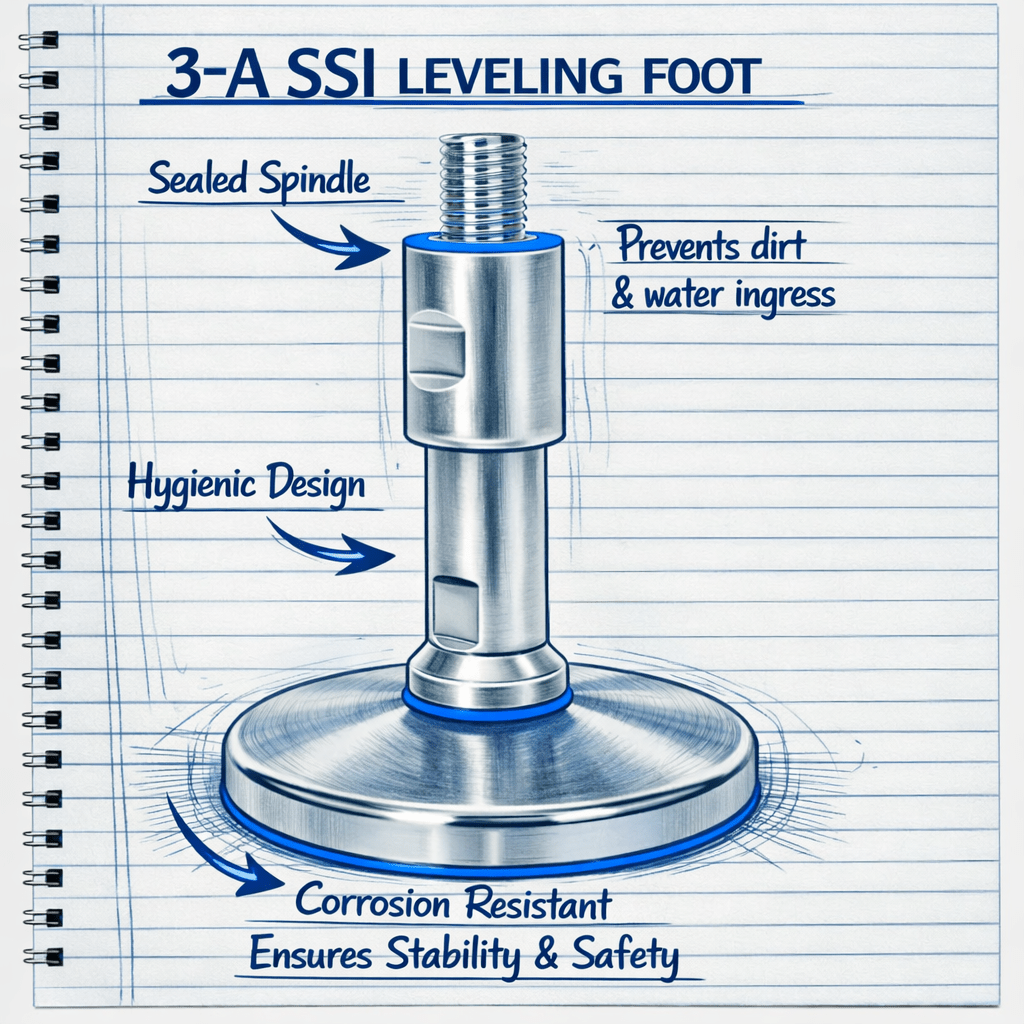
Hygienic bolts are fasteners whose head, seat and seal are designed so that product residue and microorganisms cannot collect on or under them. A hygienic screw and a sanitary bolt are the same thing under other names. The difference from a standard bolt is not the steel – both can be stainless – but the geometry: a smooth, rounded head with no socket or slot, and an elastomer seal under the head that closes the joint to the surface it clamps.
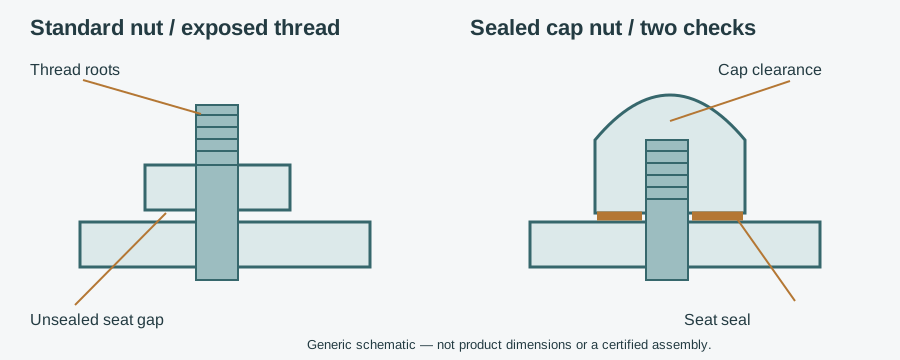
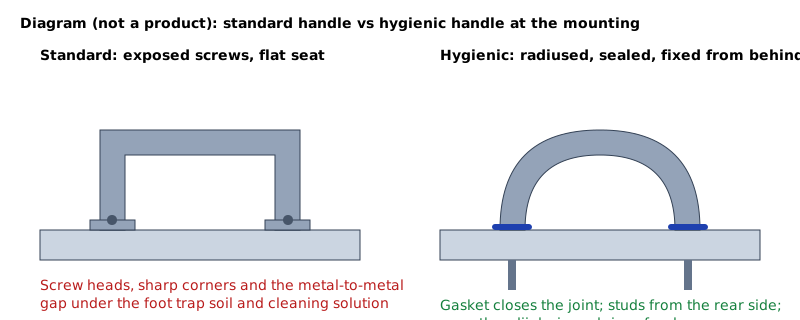
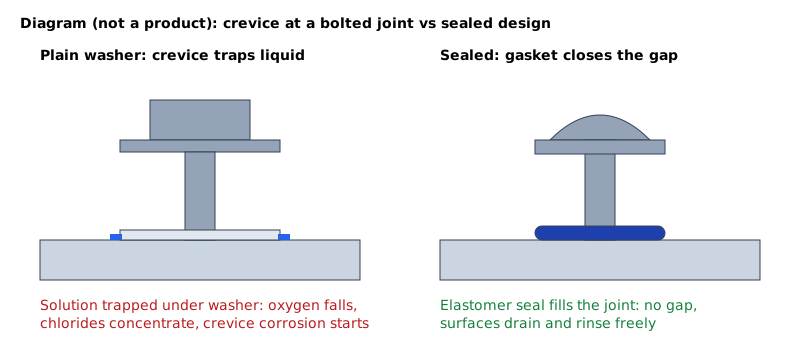 a crevice under a plain washer vs a sealed hygienic bolt joint. Schematic, not a product test report.
This guide is the starting point for hygienic fasteners and fittings in the conveyor and machine components hub. It explains why standard bolts are a problem, how sealed and EHEDG-certified designs solve it, where to use them, and how to choose the other small fittings that sit next to them.
Why standard bolts trap dirt
A bolted joint on a food machine looks closed, but it is not. Under the head and washer there is a thin metal-to-metal gap. When the machine is foamed and rinsed, capillary action draws cleaning solution and dissolved soil into that gap, and rinsing cannot get it out. The result is a crevice – a narrow gap that liquid can enter but cleaning cannot reach – and with it a harborage point (harbourage point in British English), a place where microorganisms survive cleaning and reseed the surface afterward.
The usual problem spots on a standard fastener:
| Feature | Why it traps soil | Hygienic alternative |
|---|---|---|
| Gap under head and washer | Capillary crevice, no rinsing | Elastomer seal under the head |
| Hex socket or slot | Recess holds product and detergent | Smooth domed or rounded head with external drive |
| Exposed thread beyond the nut | Thread grooves hold residue | Cut to length, cap nut with seal, or blind thread |
| Sharp edges and flat tops | Liquid does not drain | Rounded, self-draining surfaces |
| Spring and serrated washers | Many small gaps | No washers; seal does the work |
| Zinc-plated or mixed metals | Corrosion and flaking | Stainless with matching nut and seat |
In stainless joints there is a second effect. Inside the crevice, oxygen is used up and chlorides from water and detergents concentrate. The passive layer breaks down and crevice corrosion starts – often visible first as a brown stain around the bolt head. A sealed joint prevents it because no liquid enters.
Send your application data and get a fastener recommendation
How a sealed hygienic bolt works
A hygienic bolt combines three features:
- A smooth head without a recess. The head is domed or rounded so liquid drains off. It is driven externally (wrench flats) rather than by a socket that would hold soil.
- An integrated seal. An elastomer ring sits in a groove under the head. When the bolt is tightened, the seal is compressed against the seat and fills the gap. The metal head still carries the clamp load; the seal only closes the joint.
- A defined finish. Surfaces are smooth enough to clean. EHEDG guidance gives Ra ≤ 0.8 µm for product-contact surfaces; surface roughness Ra is the average height of surface irregularities, and a lower value means fewer places for soil to hold.
The seal is the part that wears. It is compressed every time the bolt is tightened, exposed to every cleaning cycle, and attacked by the chemicals used. That makes elastomer compatibility a selection criterion, not a detail: EPDM tolerates hot water, steam and many alkaline cleaners but swells in fats and oils; FKM resists fats, oils and many acids; VMQ (silicone) covers a wide temperature range but is mechanically weaker and can be cut by sharp edges.
Hygienic design, certified designs and what "certified" means
EHEDG (European Hygienic Engineering & Design Group) publishes guidelines on cleanable equipment and certifies specific designs after assessment, typically including a cleanability test. A certificate covers one bolt design, not a manufacturer, a material or a factory. 3-A Sanitary Standards work differently: authorization to use the 3-A Symbol follows a Third Party Verification. Both schemes are voluntary.
What this means in practice:
- A bolt "designed to EHEDG guidelines" has the right features, but nobody has assessed it.
- An EHEDG-certified bolt has a certificate for that exact design. Ask for the certificate and check that it names the product, not only the company.
- Using certified fasteners does not make a machine certified. It does make the bolted joints easier to defend when the machine itself is assessed. The route is described in how to get EHEDG certified, and the wider family of certified small parts in the EHEDG components introduction.
Where to use hygienic bolts
Use the zone of the machine to decide. The product-contact zone is every surface that touches product or from which product, condensate or cleaning fluid can drain back into it. The splash zone is reached by product or cleaning spray but does not touch product. The non-contact zone is neither.
| Zone | Cleaning | Fastener choice |
|---|---|---|
| Product contact | Wet cleaning, CIP or manual | Avoid fasteners where possible; where unavoidable, sealed hygienic bolts or welded studs with sealed cap nuts |
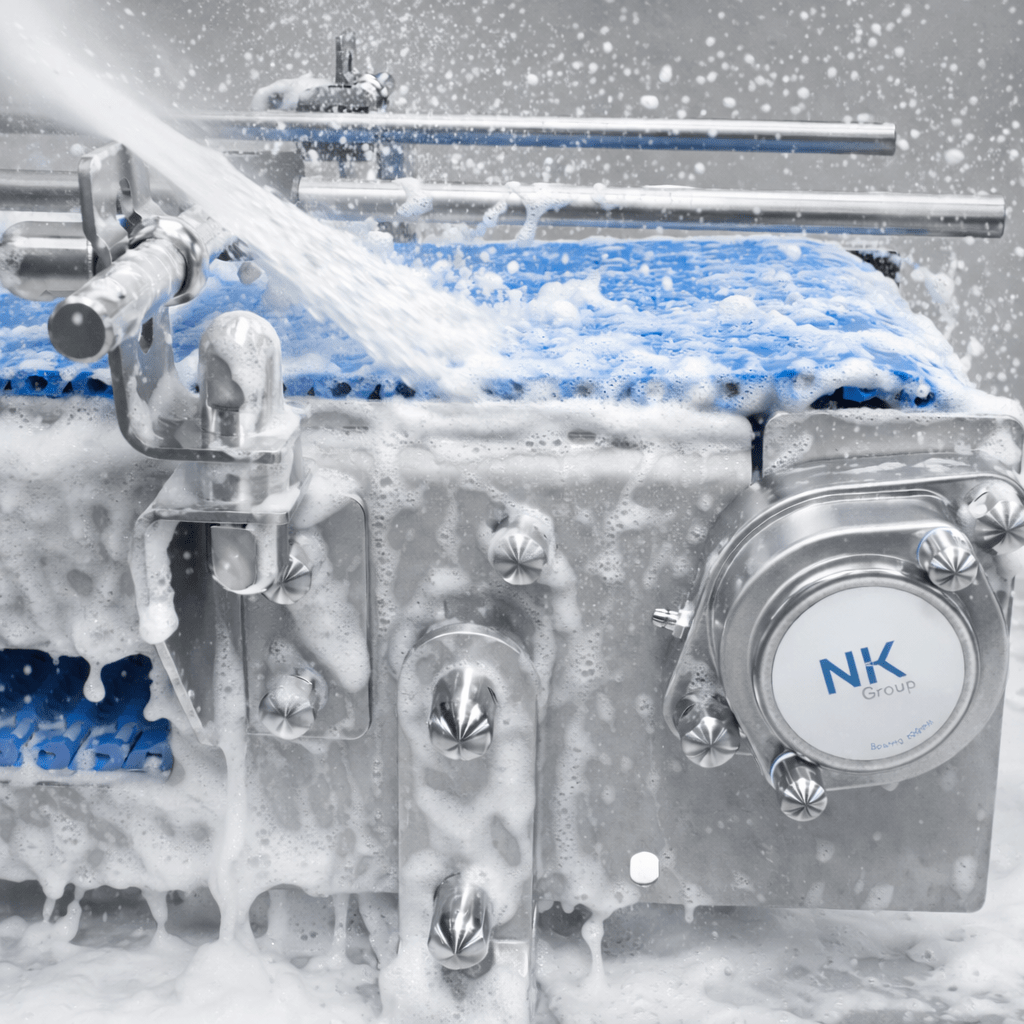
| Splash zone, wet-cleaned daily | Foam and rinse, high-pressure washdown | Sealed hygienic bolts; no socket heads, no exposed threads |
| Splash zone, dry-cleaned | Vacuum, brush, wipe | Smooth heads, minimal recesses; seal less critical but crevices still collect dust |
| Non-contact, dry | Occasional cleaning | Standard stainless fasteners usually acceptable |
CIP (cleaning in place) circulates cleaning solution through closed equipment without dismantling; COP (cleaning out of place) means parts are removed and washed separately. Bolts on CIP-cleaned surfaces are the hardest case – nothing but the solution reaches them – so product-contact designs should avoid fasteners altogether where possible.
Typical positions for hygienic bolts: guard and cover fixings over open product, conveyor side frames and wear-strip holders, hopper and chute flanges, sensor brackets, and any fixing within reach of the foam lance. Where a joint is made and unmade at every allergen changeover (cleaning between products containing different allergens), the fastener is handled often and must be both cleanable and quick to release; this is where hygienic knobs and handles take over from bolts.
Material: 304 vs 316L, and the nut
| Condition | Grade | Reason |
|---|---|---|
| Dry or mildly wet areas | AISI 304 (1.4301) | Adequate corrosion resistance at lower cost |
| Daily washdown, chlorinated or acidic cleaners, brine, meat, fish, dairy | AISI 316L (1.4404) | Molybdenum improves resistance to chloride pitting – local corrosion caused by chloride ions |
| Mixed: 316L structure, 304 bolts | Usually acceptable | Same alloy family; avoid zinc-plated or carbon-steel parts |
Match bolt, nut and seat. A stainless bolt in an aluminum bracket in a wet zone invites galvanic corrosion (one metal corrodes faster when it is in electrical contact with a more noble metal in an electrolyte). After machining or welding the seat, stainless parts should be passivated – chemically treated to restore the protective oxide layer.
Stainless threads tend to gall (cold-weld under load). Use the supplier's tightening torque, tighten steadily and, where an anti-seize compound is needed in a food area, choose one registered for incidental food contact (NSF H1). The grade choice in general is covered in AISI 316L vs AISI 304 compared in practice.
Selection method
- Decide whether a fastener is needed at all. Welding, a one-piece part or a clamp may remove the joint.
- Define the zone and cleaning method (product contact, splash or non-contact; dry, foam, high-pressure, CIP).
- Choose material by chloride exposure: 304 or 316L, with matching nut and seat.
- Choose the seal elastomer by chemicals and temperature (EPDM, FKM or VMQ).
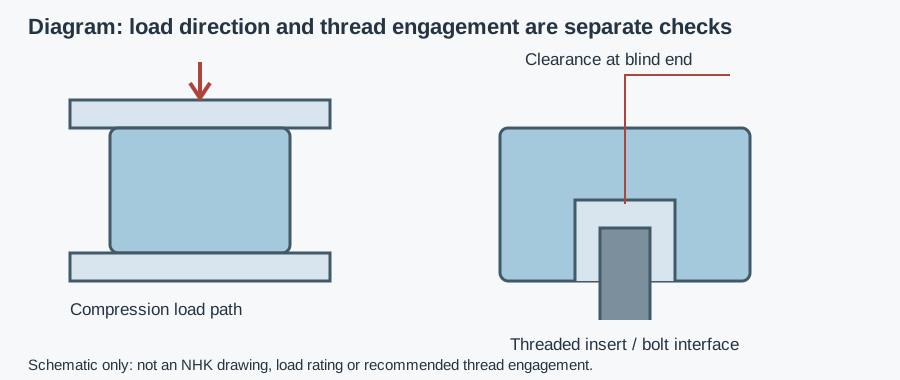
- Size the thread and length as for a standard bolt from the clamp load, and check that the seat is flat, smooth and large enough for the seal.
- Decide the nut side. A blind tapped hole is cleanest; otherwise use a sealed cap nut or keep the nut on the non-contact side.
- Request documents: material certificate, declaration of compliance for food-contact parts, and the certificate of the specific design where certification is required.
A declaration of compliance is the supplier's written statement that a material meets the applicable food-contact rules – EC 1935/2004 for all food-contact materials in the EU, EU 10/2011 additionally for plastics; for rubber seals in the US market, FDA 21 CFR 177.2600 is the usual reference.
Example (assumptions, for method only): a stainless guard over an open poultry conveyor is fixed with eight M8 socket head screws and plain washers. The line is foamed and rinsed daily with a chlorinated alkaline cleaner. Swabs at the guard fixings show recurring positives. The fix: replace the eight screws with sealed hygienic bolts in 316L with EPDM seals (no fats on the outside of the guard), remove the washers, deburr and clean the seats, tighten to the supplier's torque, and add the bolt heads to the weekly visual inspection. Thread size and length stay the same, so no holes are changed. No result is claimed here; the swab trend after the change is what confirms it.
Installation checklist
- Seats must be flat, clean, deburred and free of paint or scale; a scratched seat leaks past the seal.
- Never add washers under a sealed head.
- Tighten to the supplier's torque. An overcompressed seal extrudes beyond the head and creates a new crevice; an undercompressed seal leaves a gap.
- Do not seal with silicone beads as a substitute; beads crack and peel.
- Cut through-bolts so that no thread is left exposed, or cover the end with a sealed cap nut.
- Record the seal material in the maintenance documents so replacements match.
Inspection and failure modes
| What you see | Likely cause | Action |
|---|---|---|
| Brown ring around the head | Crevice corrosion: seal missing, crushed or chemically attacked | Replace bolt or seal; check elastomer against chemicals |
| Seal squeezed out beyond the head | Overtightening or wrong seal for temperature | Retighten to torque with a new seal |
| Black residue at the head edge | Seal not seated, rough seat | Clean and refinish the seat, refit |
| Seized or galled thread | Stainless-on-stainless without lubricant, high speed tightening | Food-grade anti-seize, slower tightening |
| Positive swabs at fixings | Socket heads or washers left in place | Replace with sealed bolts; recheck |
Inspect wet-zone fixings during routine hygiene checks: look for discolored seals, extrusion and residue at the head edge, and replace seals at the first sign of hardening or cracking.
Other hygienic fasteners and fittings: which one do I need?
Bolts are one part of a family. Each of the fittings below follows the same rules – no crevices, no recesses, sealed joints, drainable shapes – but solves a different task.
| Fitting | Task | Hygienic features to look for | Guide |
|---|---|---|---|
| Hygienic bolts and screws | Permanent bolted joints | Smooth head, integrated seal, no socket | This page |
| Hygienic nuts and cap nuts | Closing a through-bolt | Domed cap, seal on the seat side, no exposed thread | Hygienic nuts: sealed-seat selection |
| Hygienic spacers | Holding parts apart for cleaning access | Sealed ends, rounded body, no hollow core open to spray | – |
| Welding plates and studs | Fixing points without drilling through | Fully welded, ground smooth, sealed nut | – |
| Tube inserts and end plugs | Closing open tube ends of frames | Welded or sealed plug, no gap to the tube wall | Threaded tube inserts: fit and closure |
| Hinges | Opening guards and doors | Enclosed pin, no gap between leaves, removable for cleaning | Guard-hinge load and mounting checks |
| Handles, knobs and hygiene locks | Operating guards, doors and changeover parts | Rounded profile, sealed mounting, closed lock body | Hygienic handles and locks |
| Rubber buffers and threaded bumpers | Absorbing impact on frames and doors | Solid elastomer, sealed to the metal part, food-contact declared | – |
| Rod ends | Linkages and adjustable struts | Sealed joint, stainless body, minimal exposed thread | – |
A quick route: if the joint is permanent, use a sealed bolt or a weld; if it is opened at changeover, use a hygienic knob or handle; if it moves, use a hinge or rod end with an enclosed pin; if it only closes an opening, weld or plug it. Bolted fittings are often used to build conveyors, where the same principles apply to side guides and wear strips – see hygienically optimized conveyor components.
What to send for a recommendation
For any claimed hygienic certification, use the checking the exact fastener design on a certificate before relying on it in the specification.
- Thread size, lengths and quantities
- Zone and cleaning method; chemicals and temperature
- Material (304 or 316L) and seal preference, or the chemicals so NHK can suggest one
- Other fittings needed on the same machine (nuts, spacers, hinges, handles)
- Certificate or declarations needed; delivery country
An NHK technician suggests the matching fasteners and sends a quote. NHK's hygienic-bolt listing is an enquiry reference. Request the exact supplied bolt's size, alloy, seal compound, thread and drive dimensions, finish and certificate scope rather than treating the listing as approved product data. The EHEDG and 3-A standard components line identifies a category, not blanket certification of every variant.