High temperature casters need an assembly-level specification: the wheel may survive an exposure that its grease, seal or swivel cannot. High temperature castors is the British spelling; this guide uses US spelling. Start with the industrial caster sizing and assembly guide for load, mounting and travel, then add the thermal duty below.
Define the exposure before choosing a heat caster
Record temperature where the caster operates, not only an oven controller setting or the product temperature. Radiation, floor contact, rack shielding and time inside the chamber can create different component temperatures. Use representative measurements and the process information; a brief reading during entry does not establish the temperature after a loaded dwell.
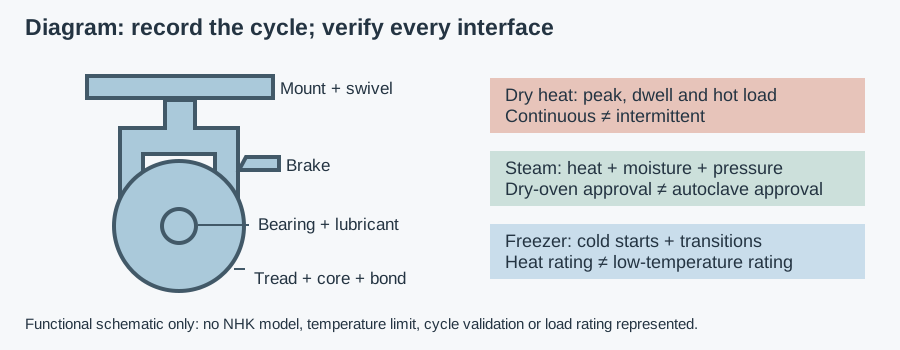
Distinguish continuous exposure from a permitted short peak. Record the duration, frequency, heating and cooling phases, and whether the rack rolls or remains stationary while hot. A peak-temperature statement without a time and load basis is incomplete. Ask the supplier to confirm the proposed assembly for the full cycle rather than interpreting a material's melting point as an operating limit.
Freezer casters are included here as a contrasting thermal duty, not because heat-resistant automatically means cold-resistant. Low-temperature start-up and transitions into warmer wet areas need their own limits. Avoid selecting an assembly from only the hottest and coldest endpoints; the route between them can matter.
Wheel materials and temperature limits: what to verify
There is no universal temperature table for material names. Special grades, reinforcements, cores, bonds and bearing arrangements change the limits. Use the following comparison to request exact product evidence; it does not assign NHK ratings or transfer one manufacturer's value to another wheel.
| Wheel family | Potential application to investigate | Required limit/evidence | Main caution |
|---|---|---|---|
| Heat-resistant phenolic | Hard-wheel dry-heat service where explicitly rated | Grade, continuous/intermittent temperature at load, wet-use restrictions | Dry-heat approval is not steam or repeated-wash approval |
| Special heat-resistant polyamide/nylon | Oven or heated-rack service for a named grade | Actual formulation, loaded limit and dimensional behavior | Ordinary nylon is not interchangeable with a special heat grade |
| Heat-resistant silicone or other rubber | Resilient tread where the compound and assembly are rated | Compound, core/bond, hot-load deformation and chemical limits | “Rubber” alone identifies neither heat capability nor freezer behavior |
| Polyurethane | Service within the exact formulation's limits | Heat/moisture exposure, core bond and cold limit | Do not extrapolate ordinary PU washdown suitability to oven duty |
| Metal wheel | Duty where the wheel and floor arrangement permit hard contact | Wheel material, bearings, lubrication and load at temperature | Metal wheel survival does not establish assembly survival or floor protection |
Send your load and thermal cycle for a caster recommendation
The PU, nylon, rubber and phenolic wheel trade-off guide covers floor protection and chemistry in more detail. For thermal selection, request the wheel code and complete caster configuration beside every stated limit. A wheel-only datasheet is insufficient when the supplied swivel head or brake differs from the tested arrangement.
Ovens and bakeries: hot loading is a separate duty
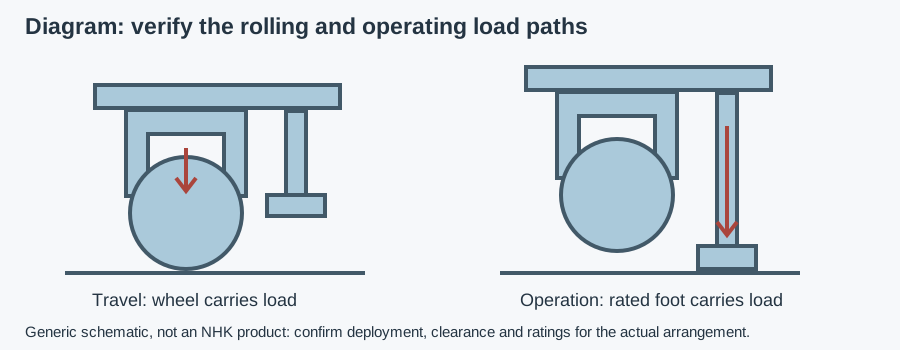
For oven racks, distinguish rolling through the route from standing loaded inside a chamber. Creep is time-dependent deformation under sustained load; heat can make stationary loading a different question from brief rolling. Ask whether the rating covers hot parking, permitted load at that temperature and any restrictions on movement immediately after exposure.
Check floor joints, thresholds and impacts after heating, as well as smooth-floor travel. A wheel chosen for a hot chamber must still negotiate the bakery route without unacceptable floor damage, push effort or damaged tread surfaces. Do not invent a thermal load multiplier; request the supplier's rating basis and use the actual support distribution.
A rack that leaves the oven for wet cleaning adds another exposure. Confirm whether washing requires cooling first and whether thermal shock or moisture is restricted. A dry-heat phenolic option with undocumented wet duty should not be accepted by assuming that all hard wheels behave alike.
Autoclaves: dry heat does not establish steam suitability
Steam cycles combine heat with moisture and pressure changes; approval for an oven alone does not establish autoclave suitability. Specify the actual cycle, including dwell, depressurization, drying and repetition. Include wheel core or bond, bearing protection, lubricant and swivel interfaces—not only the visible tread.
Ask how moisture leaves the assembly and whether the manufacturer restricts cleaning or relubrication between cycles. A closed-looking hub can retain liquid if the design and orientation do not support drainage. Confirm whether the complete configuration has appropriate documented cycle evidence; do not substitute an unspecified “high heat” label.
Caster temperature capability does not validate sterilization. Likewise, IP67 is an immersion test, not a washdown rating or autoclave approval. IP69K in ISO 20653 addresses specified hot high-pressure ingress testing, not steam sterilization or long heated dwell. Neither ingress rating is a hygiene certificate or a lubricant service-life statement.
Freezer casters: cold start, condensation and defrost
Specify the coldest temperature at the assembly, duration, load and required movement after soaking. Cold soak means enough exposure for components to approach the cold environment. Grease starting resistance and tread behavior at that condition can differ from a caster rolled into a cold room for a short visit.
Movement between cold and warm humid areas can cause condensation; defrost and wet cleaning create further water exposure. Check wheel and swivel bearing protection, cleaning access and permitted lubricant. Ice or frozen residue affecting the wheel or pedal is a reason to stop and restore the intended function, not to apply extra pushing force.
The frozen-food equipment component guide covers the wider line environment. Do not claim one wheel formulation handles rapid oven-to-freezer transitions unless the exact assembly is documented for that sequence. Endpoint limits alone do not establish repeated thermal-cycle durability.
Bearings, lubrication, brakes and stainless mounting
Wheel bearings and the swivel head may use different arrangements. Ask whether bushings, rolling elements, seals and grease are approved for temperature, speed and moisture together. A lubricant's dropping point is not its service-temperature approval; obtain the specified product and maintenance instructions rather than choosing grease from that single number.
Where incidental food contact is possible, request appropriate lubricant evidence, such as relevant NSF H1 registration, along with thermal capability. H1 status does not establish heat, steam or cold performance. Do not mix or substitute lubricants without approval, and do not prescribe an unsupported relubrication interval.
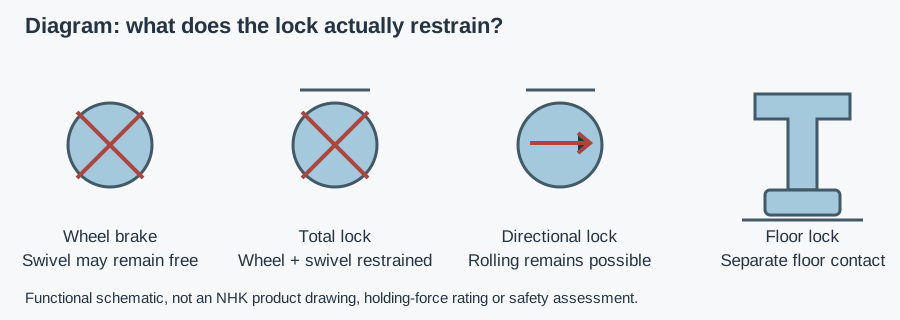
Brakes add springs, pivots and tread-contact parts. Confirm engagement and release after the specified cycle, without exposing operators to hot surfaces or uncontrolled rack movement. The brake-function and parking-limit guide distinguishes wheel locks from steering locks and fixed support; heat capability does not create a parking-force rating.
The complete stainless caster washdown guide separates mounting material from the rest of the assembly. Stainless forks or fasteners do not establish temperature limits for polymer parts, seals or grease. Confirm the actual metal grade and cleaning compatibility; neither “stainless” nor a heat rating proves hygienic cleanability.
Hygiene, certification and cleaning after thermal duty
Inspect tread cracks, chips, separating bonds, rough surfaces and residue beneath hubs or pedals. These can form harborage points, where residue survives cleaning. A splash zone receives product or cleaning spray; assess contamination transfer rather than assuming every floor wheel is directly food-contact material.
EC 1935/2004 applies within its food-contact scope; EU 10/2011 covers plastics and FDA 21 CFR 177.2600 applicable repeated-use rubber articles. Material evidence does not establish thermal durability. EN 1672-2 and EN ISO 14159 concern hygiene and cleanability, not a universal wheel-temperature range.
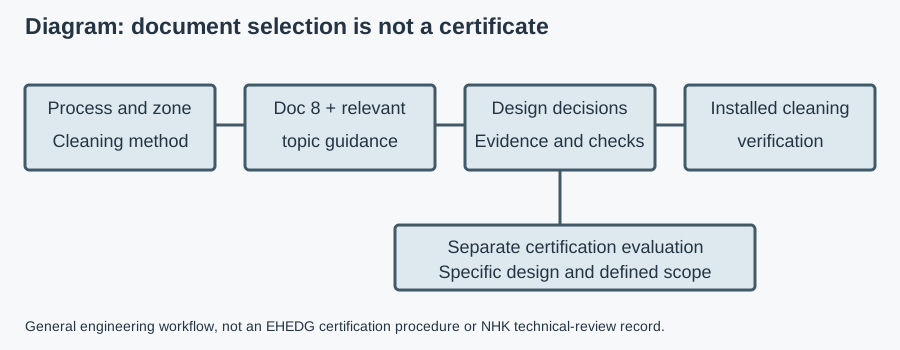
EHEDG certifies specific designs, and voluntary 3-A Symbol authorization follows Third Party Verification. Use the design-certificate scope guide when certification is required. A certificate for an NHK foot, bearing or another component cannot be transferred to a heated caster assembly.
Example: selecting a bakery rack assembly
Assumptions: a loaded bakery rack stands in a dry oven, returns across a jointed floor and is washed afterward. No temperature, load or wheel rating is assumed. This is a hypothetical specification exercise, not an NHK case or test.
The engineer records caster temperatures through the dwell and cool-down, then asks for hot stationary-load and rolling approval. A wheel-only heat claim is rejected as incomplete until bearing, lubricant, swivel and brake limits are supplied. The wash step is checked separately, including whether cooling is required and whether the tread/core joint tolerates that sequence.
Acceptance uses representative load and documented exposure conditions with a safe procedure. After the cycle, inspect surfaces, starting effort, brake release, looseness and lubricant leakage. If wet-duty evidence is missing, revise the assembly or cleaning arrangement instead of accepting a dry-heat rating as proof.
Five acceptance steps and a copyable RFQ
- Map the cycle. Record temperature at the caster, dwell, frequency, load, movement, steam/pressure or freezer exposure, and all transitions.
- Confirm the configuration. List wheel code, core/bond, axle bearing, lubricant, seals, swivel, brake and mounting; verify the assembly rating basis.
- Check the route and cleaning. Include floors, shocks, chemical exposure, cool-down restrictions, drainage and safe access.
- Inspect representative duty safely. Use approved conditions and controls; check movement, surfaces and locking function after exposure without improvised overload or heat tests.
- Document maintenance and rejection. Follow supplier intervals; remove damaged or poorly functioning assemblies from service and confirm replacements match the approved configuration.
Send loaded mass and support layout, wheel constraints, measured cycle, cleaning details, known part numbers, quantity and delivery country. The migrated industrial machine-component specification guide provides broader buying context; the buyer's guides cover the enquiry documents. No dedicated thermal-caster selector exists on this site.
Copyable request: “Confirm a complete caster assembly for the attached thermal cycle under load. State continuous/intermittent limits, hot stationary-load restrictions, cold-start limits and allowed transitions. Identify bearing, grease, seal and brake configuration, cleaning compatibility, inspection criteria and any certificate claimed for the exact design.”
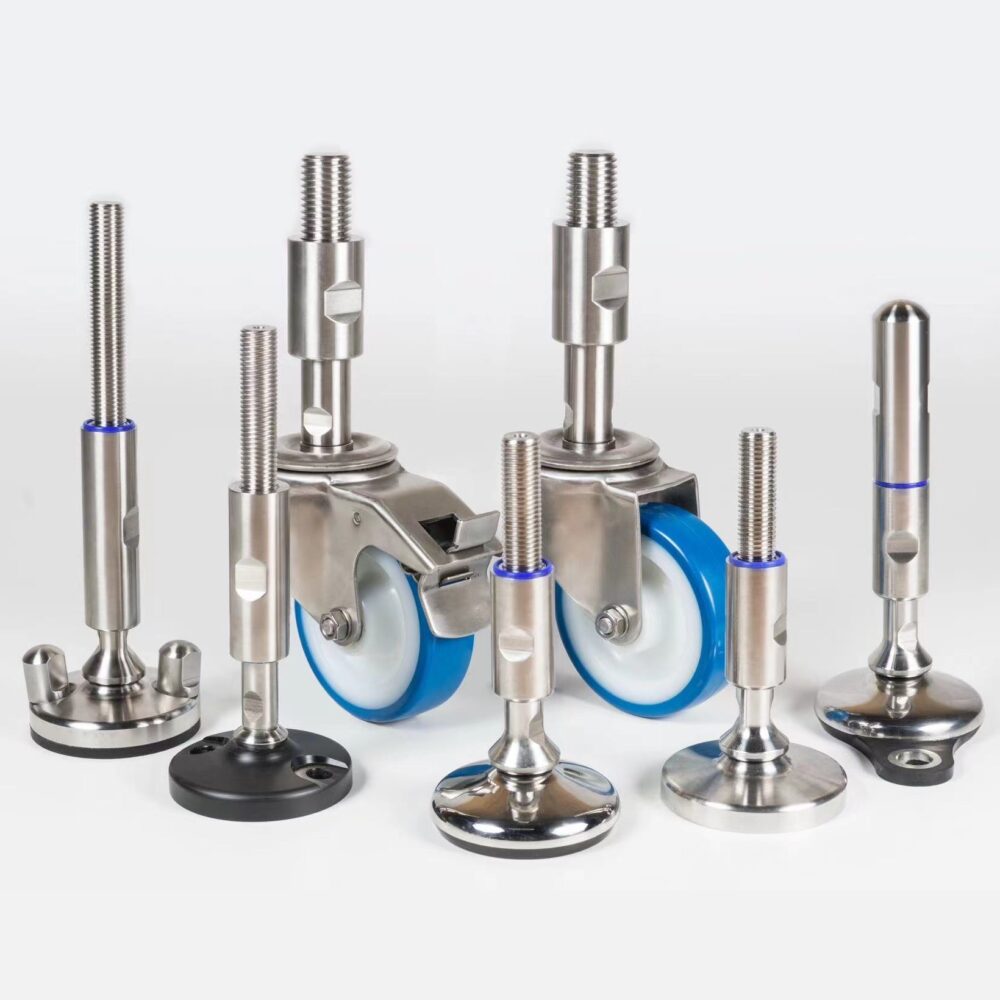
Browse NHK's stainless caster category for thermal-application enquiries as the secondary path. The checked category does not establish a specific oven, steam or freezer rating. An NHK technician can confirm availability, suggest an appropriate component and prepare a quote from the application data; no response time, stock or performance guarantee is asserted.