A certified component is a part backed by a document – issued by an independent body or the manufacturer – that confirms a specific property such as hygienic design, material grade, a test result or food-contact compliance. The advantages of certified components and parts are real, but they depend entirely on which certificate it is and what it covers. This guide explains the types of certification relevant to machine components, what each one proves, and how to use them to reduce risk and support sustainable, long-term growth.
For the specific difference between "EHEDG compliant" claims and real EHEDG certificates, see EHEDG and 3-A SSI certified components and parts.
Why certification matters
Certification is a quality-assurance mechanism: it gives the buyer evidence instead of a claim. For machine builders and processors this has three practical effects:
- Lower risk – a part verified for cleanability, material or rating is less likely to cause contamination, early failure or a non-conformity.
- Faster approvals – customers, auditors and notified bodies accept recognised documents more quickly than in-house explanations.
- Better specification – asking for certificates forces both buyer and supplier to state exactly what the part must do.
These advantages apply across regulated sectors – food, pharmaceutical and healthcare, and also aerospace and automotive, where component reliability is critical – but the documents differ by sector.
What each type of certificate proves
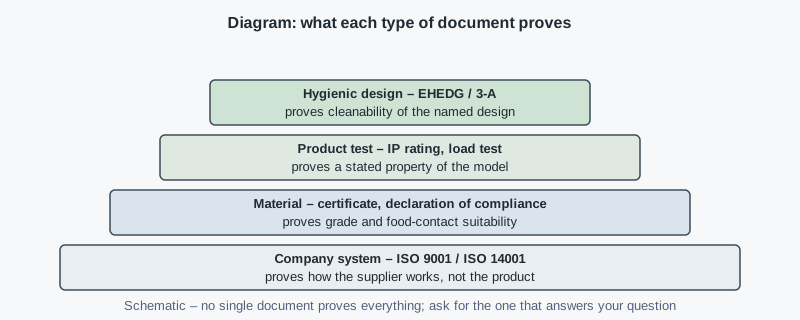
| Document | Issued by | Proves | Does not prove |
|---|---|---|---|
| EHEDG certificate | EHEDG-authorised evaluation | Cleanability of the named design | Durability, load capacity, legal compliance of a machine |
| 3-A Symbol authorisation | 3-A SSI after Third Party Verification | Conformity of a design to a 3-A Sanitary Standard | Performance outside the standard's scope |
| Declaration of compliance | Manufacturer / supplier | Food-contact material meets EC 1935/2004 (EU 10/2011 for plastics) or FDA rules | Cleanability of the design |
| Material certificate | Steel producer / supplier | Grade and composition, e.g. AISI 304 or 316L | Corrosion resistance in your specific chemicals |
| IP test report or rating | Manufacturer or test lab | Ingress protection per IEC 60529 or ISO 20653 (IP69K) | Hygiene or cleanability |
| Load or performance test | Manufacturer or test lab | Stated load, speed or life under defined conditions | Behaviour outside those conditions |
| ISO 9001 / ISO 14001 | Certification body | Supplier's quality or environmental management system | Any property of a specific product |
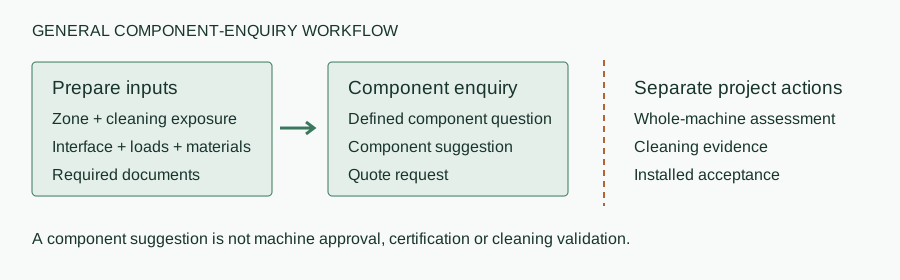
Two consequences follow. First, a logo or the word "certified" in a catalogue is not evidence – the document is. Second, you usually need several documents for one part: a hygienic levelling foot in a product area might need an EHEDG certificate, a material certificate for the stainless steel and a declaration of compliance for the base elastomer.
Hygienic design certification
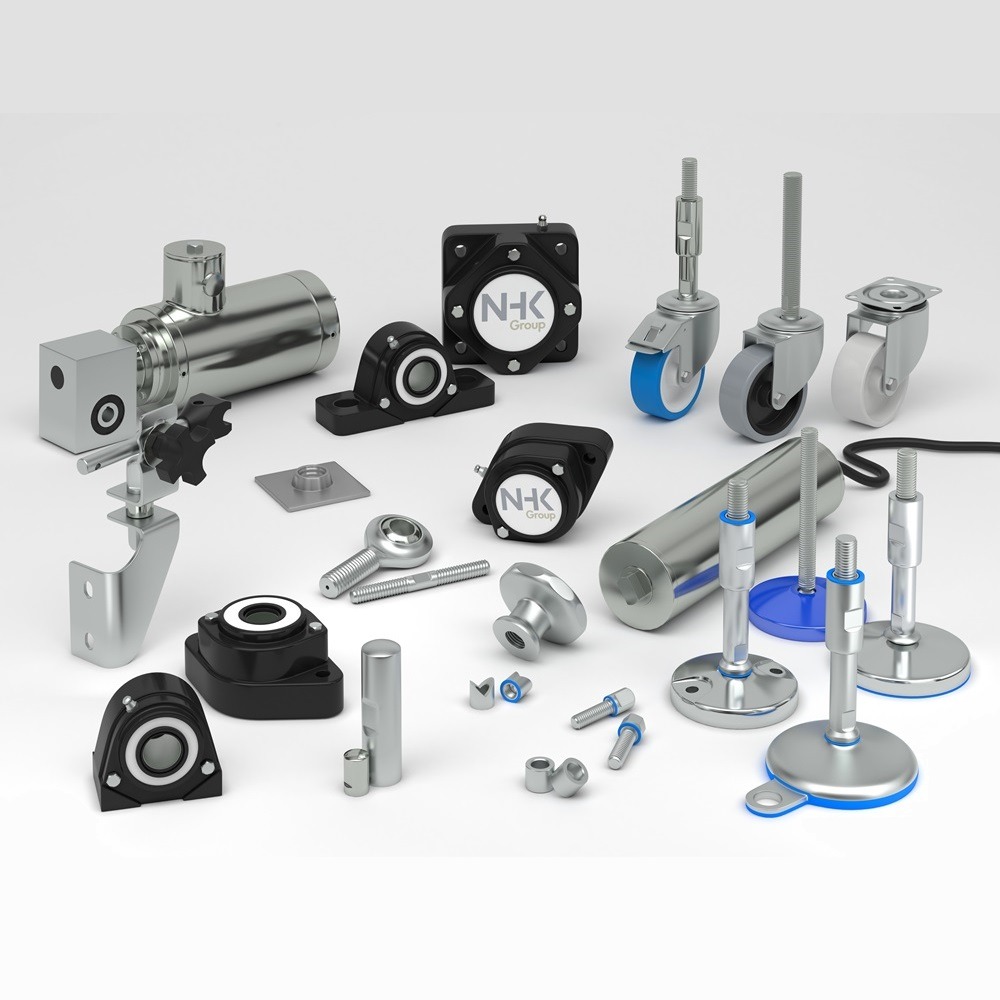
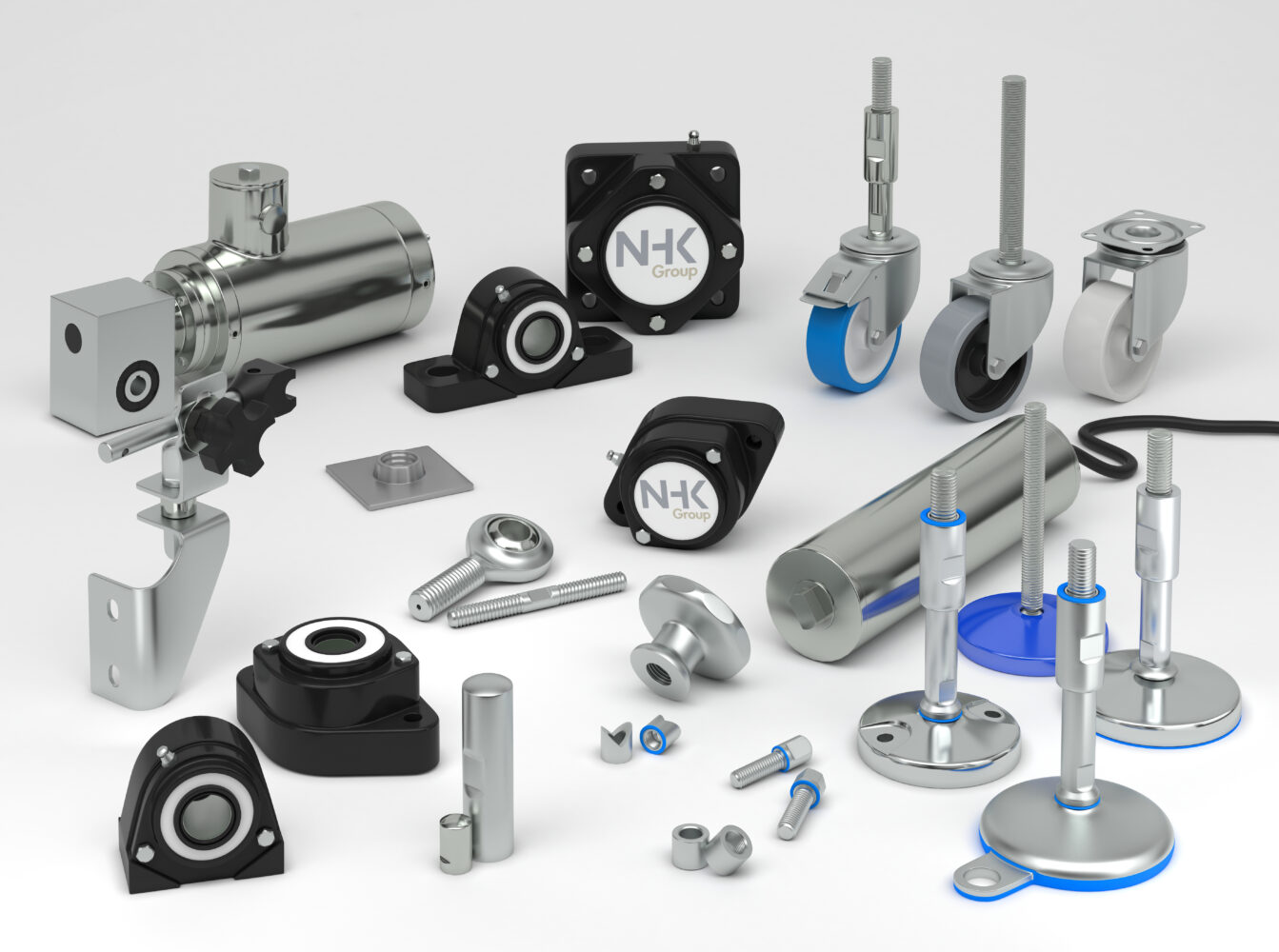
The European Hygienic Engineering & Design Group (EHEDG) certifies specific equipment designs as cleanable; 3-A Sanitary Standards, Inc. (3-A SSI) allows use of the 3-A Symbol on equipment conforming to a 3-A Sanitary Standard after a Third Party Verification. Both are voluntary. They focus on avoiding harbourage points (places where residue and bacteria survive cleaning), crevices and dead spaces, and on smooth, self-draining surfaces. An example is NHK's SHAF adjustable feet in sealed hygienic design, an EHEDG-certified design.
Ingress protection ratings
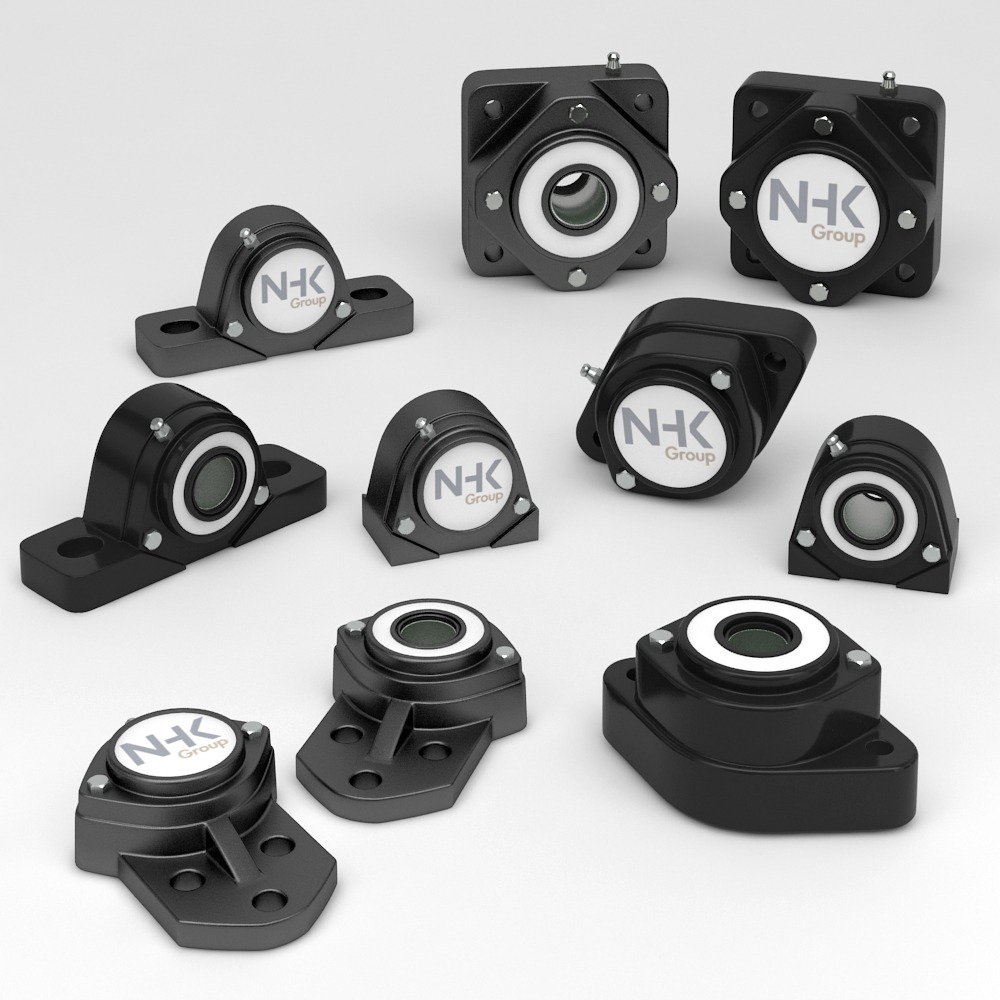
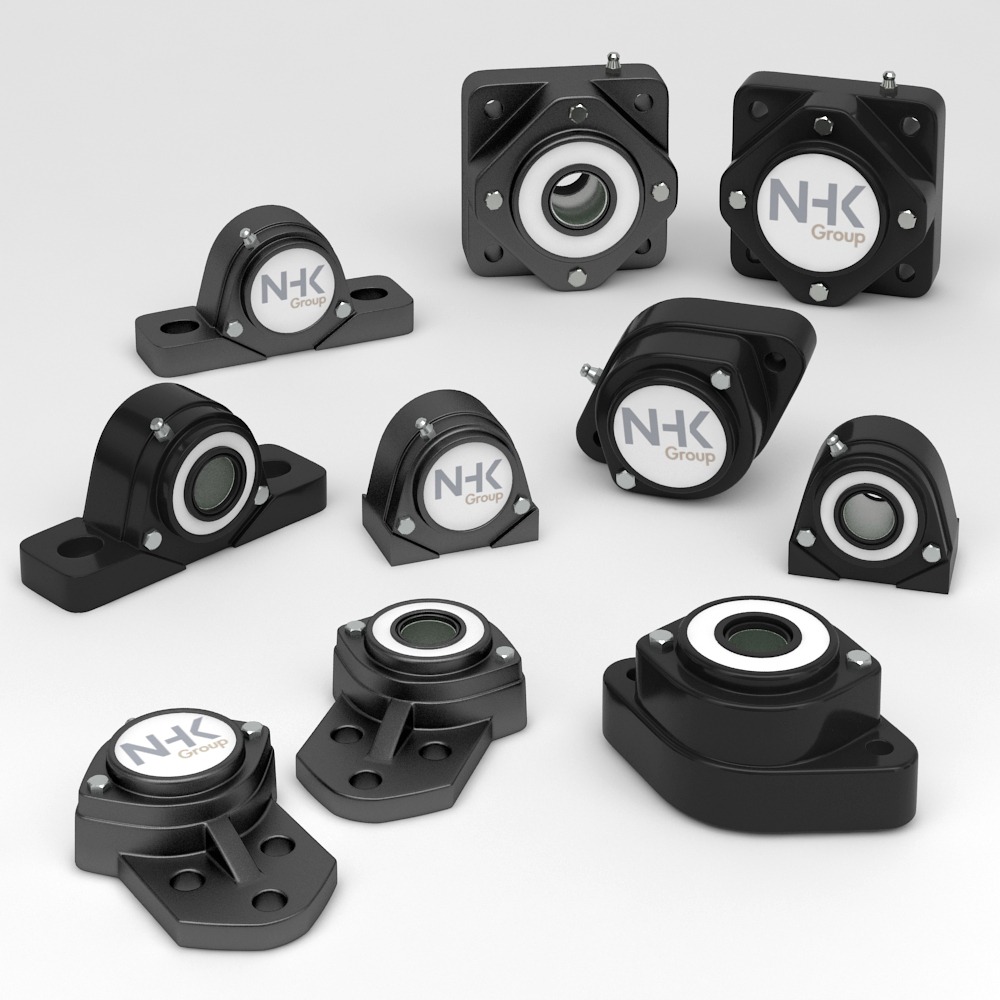
IP ratings are tests of how well a housing keeps out dust and water. IP67 confirms dust-tightness and temporary immersion; it is not a high-pressure washdown test, which is IP69K under ISO 20653. Neither says whether the outside of the part is easy to clean. See NHK's IP67 waterproof bearing house units.
Advantages in practice
Product quality and fewer failures
Parts verified against a defined standard are less likely to be specified wrongly. A material certificate showing 316L, for example, protects against a cheaper grade being substituted in a chloride environment, where it could suffer chloride pitting (local corrosion caused by chlorides). Fewer failures mean fewer replacements, returns and complaints.
Sustainability
Certification for hygienic design does not make a part "eco-friendly". The sustainability advantage is indirect: cleanable parts need less water, detergent and energy per clean, and correctly specified parts last longer, reducing waste and replacement manufacturing. Some suppliers also hold ISO 14001 for their environmental management – useful for supplier qualification, but not a product property.
Lower operating cost
Durable, correctly specified parts reduce repairs, spare parts and unplanned downtime. Cleanable designs shorten sanitation. The saving should be measured, not assumed.
Reputation and market access
Documented hygiene and material compliance make customer audits and tenders easier and support market access in the EU and US. A reputation for quality rests on that evidence, not on marketing claims.
Regulatory compliance
Certificates do not by themselves ensure compliance. Legal duties – for example food-contact material rules and machinery hygiene requirements such as EN 1672-2 – apply to the machine and its materials. Component documents are evidence that simplifies the machine builder's technical file and the processor's audits.
For how certification works and the checks needed beyond it, see ensuring quality and reliability of certified components.
How to verify a certificate
- Identify the question – cleanability, material, food contact, rating or supplier system – and the document that answers it.
- Check the scope – the certificate must name the exact model, size and variant you are buying.
- Check the issuer – an independent body for EHEDG and 3-A; the manufacturer for declarations of compliance.
- Check validity – date of issue and expiry, and whether the design has changed since.
- Cross-check – compare with the issuing body's published information where available.
- File it – keep documents with the bill of materials and the technical file.
Example
Assumptions (illustrative only): a buyer sources replacement feet and bearing units for a dairy filling area.
- Feet: EHEDG certificate naming the foot model; material certificate for 316L; declaration of compliance for the base seal.
- Bearing units: datasheet IP rating, checked against the high-pressure rinse used; declaration of compliance for any food-contact grease or seal.
- Supplier: ISO 9001 certificate as part of supplier qualification.
- Result: each claim on the order is backed by the document that actually proves it.
For the business case behind choosing certified parts, see ensuring long-term cost savings and competitive edge. For a part-by-part view of a conveyor, see why use certified conveyor parts and machinery components. Related NHK site: industrial machine leveling feet for the processing industry.