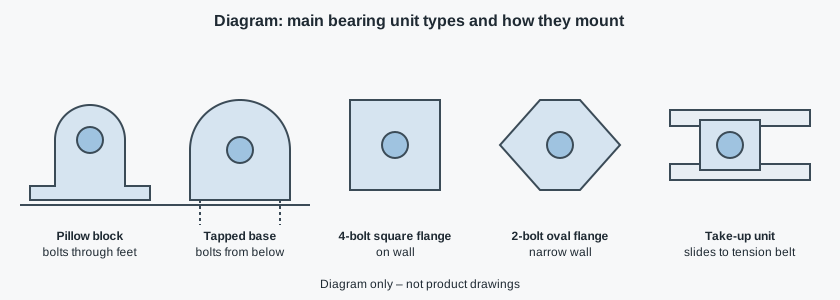
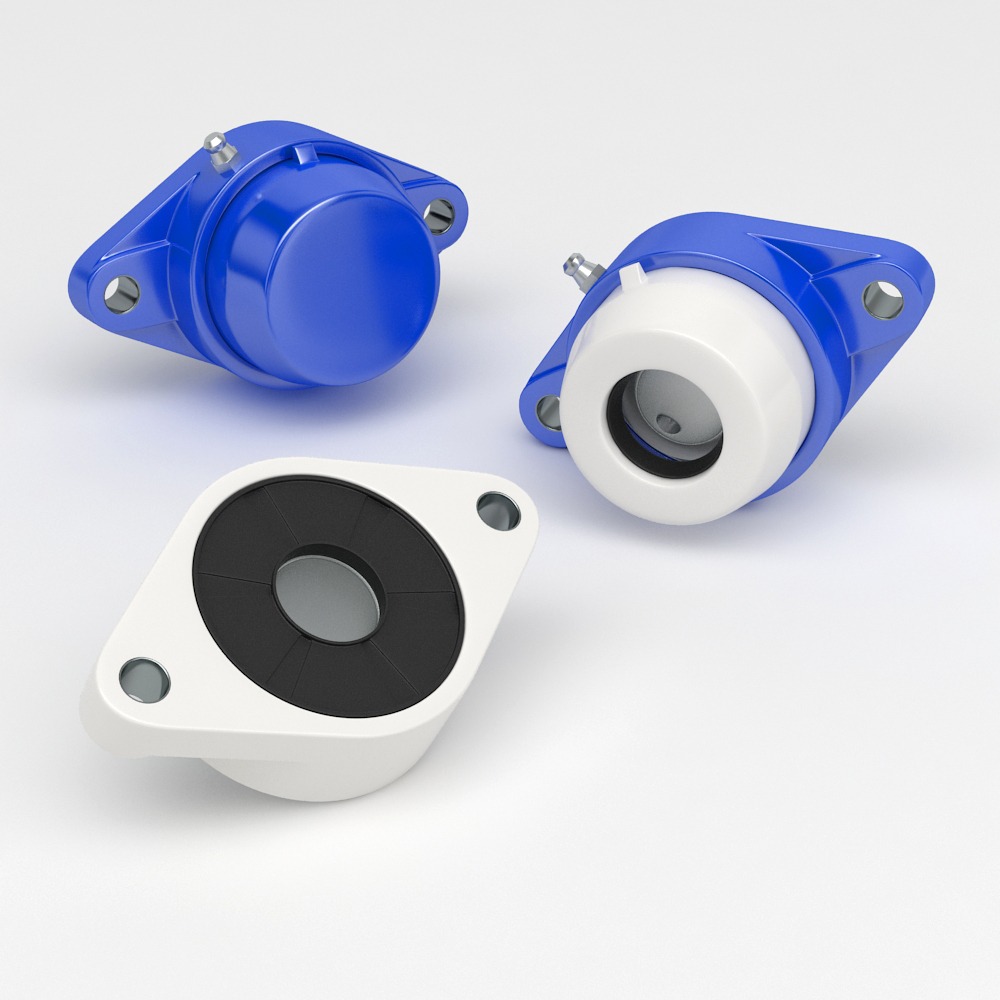
A flange bearing is a mounted bearing unit – a bearing insert held in a housing with a flat, bolted flange – that fixes a rotating shaft to a wall, side frame or panel perpendicular to the shaft. Buyers also call it a flange block, flange unit or bearing flange. This guide explains the flange types, how to choose one by load direction, which housing and seals suit which zone, and how to mount a flange bearing so it lasts. It is part of our bearing units section.
Compact two-bolt versions for small shafts are covered in miniature flange and pillow block units.
For all housing types side by side, see the overview of bearing units and bearing block types.
How a flange bearing is built
Every flange bearing has the same four parts, whatever the brand or catalogue designation:
- Insert: a deep-groove ball bearing with a spherical outer ring, so it can tilt in the housing and absorb small misalignment during mounting. The insert dimensions follow ISO 9628.
- Housing: the flanged body that carries the insert and bolts to the frame. Housing dimensions for the standard series follow ISO 3228, which is why units from different makers are often interchangeable on bolt spacing and centre height.
- Locking: set screws (UC inserts), an eccentric locking collar or an adapter sleeve fix the inner ring to the shaft.
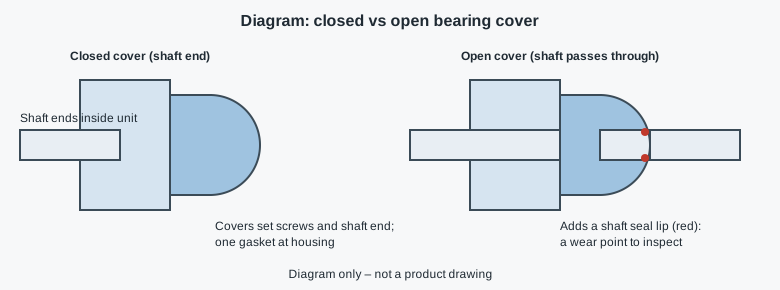
- Seals and covers: lip seals or flingers on the insert, and on hygienic versions an extra shaft seal and an open or closed end cover.
The flange sits perpendicular to the shaft; a pillow block sits parallel to it. If the mounting face is a base rail under the shaft, read our pillow block bearing guide instead. NHK's reference article on the differences between pillow block and flange bearing housings covers that choice in more depth.
Flange bearing types: 2-bolt, 3-bolt and 4-bolt
To decode catalogue codes such as F207, FL205 or P205 and find a stainless equivalent, see how to separate flange housing letters from insert size codes.
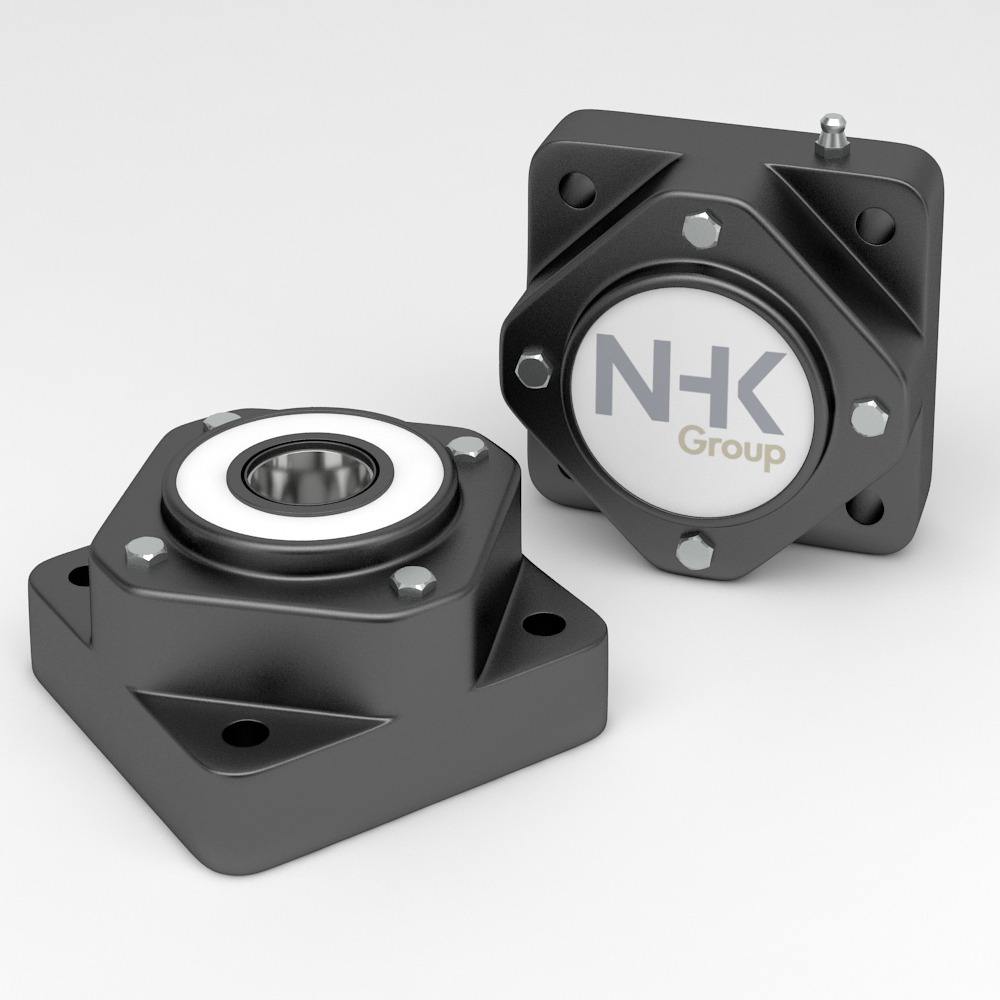
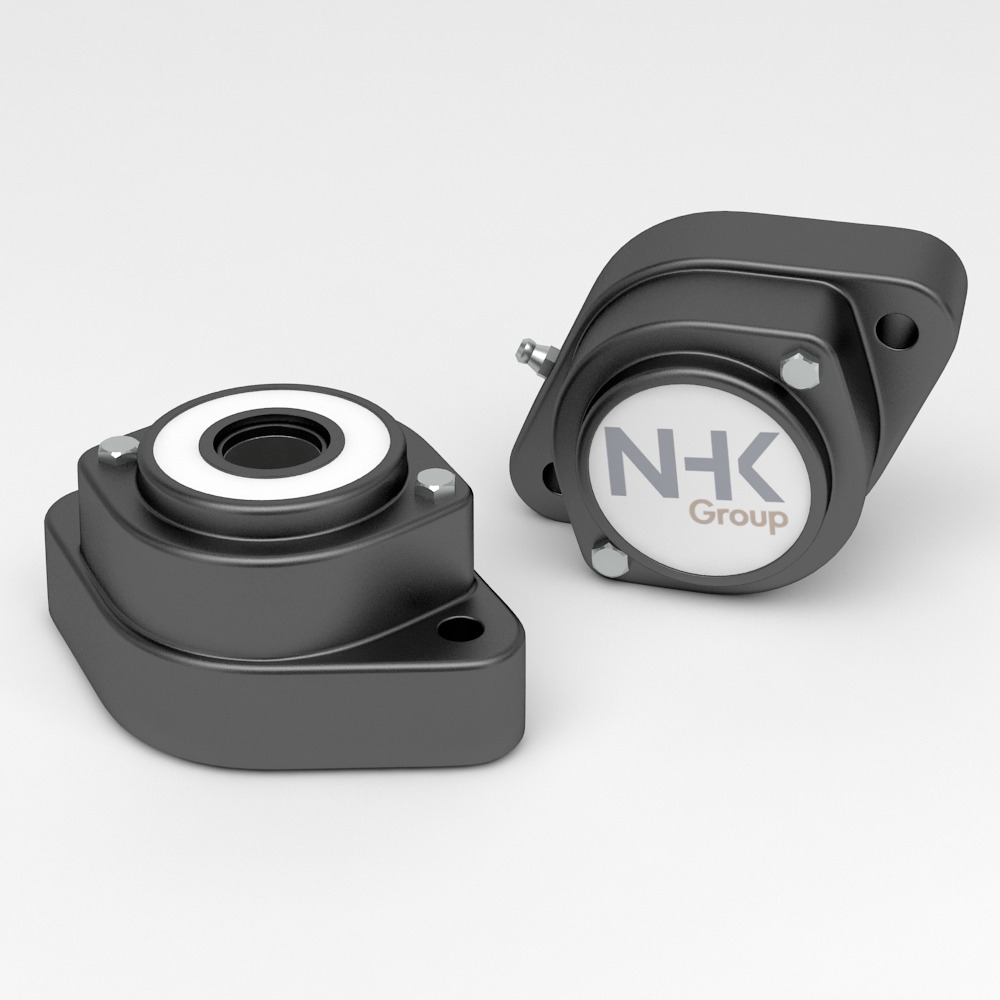
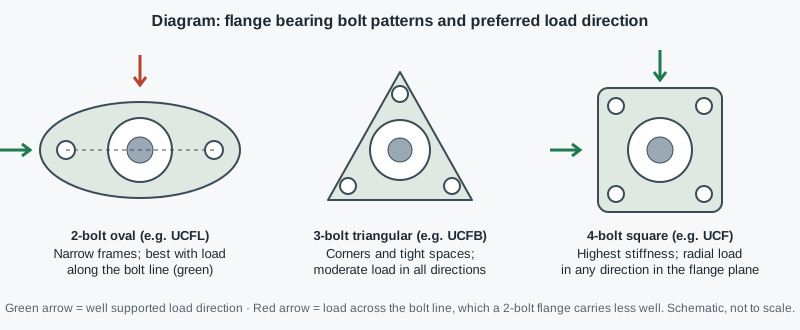 2-bolt oval, 3-bolt triangular and 4-bolt square flange bearing housings with their preferred load directions. Schematic, not a product test report.
| Type | Common designation | Bolt holes | Load capacity of the housing | Best fit | Watch out for |
|---|---|---|---|---|---|
| Oval / rhombic flange | UCFL | 2 | Good along the bolt line, weaker across it | Narrow side frames, light conveyor shafts | Load across the bolt line rocks the flange and loosens bolts |
| Triangular flange | UCFB | 3 | Moderate in all directions | Corners, tight spaces, small machines | Fewer interchangeable sizes than 2- and 4-bolt |
| Square flange | UCF | 4 | Highest stiffness, radial load in any direction | Drive shafts, sprockets, pulleys, heavier loads | Needs a larger flat mounting area |
| Piloted / cartridge flange | UCFC | 4 (round with spigot) | High, with exact centring | Shafts that must be centred in a bore | Bore tolerance in the frame must match the spigot |
Designations vary between makers; check the drawing, not only the code. For the two most common hygienic formats, see our guides to the IP67 4-hole square flange unit and the IP67 oval 2-hole flange unit.
How to choose a flange bearing in six steps
- Find the load direction at each bearing. Belt pull, chain pull, product weight and gravity act in different directions. If the resulting load on a 2-bolt flange acts across its bolt line, choose a 4-bolt or 3-bolt flange.
- Calculate the load on each bearing separately. An overhung sprocket or pulley puts most of the load on the bearing next to it (see the example below).
- Size the insert. Use the shaft diameter, speed and load to calculate basic rating life with ISO 281: L10 = (C / P)³ million revolutions for ball bearings, where C is the dynamic load rating from the maker's table and P the equivalent load. Check the housing's load limit too – it can be lower than the insert's rating, especially for plastic and pressed-steel housings.
- Choose the housing material by zone. See the table in the next section.
- Choose seals and covers by cleaning method. A closed end cover protects a shaft end; an open cover with a shaft seal is needed where the shaft passes through.
- Choose lubrication. In food plants, specify an NSF H1-registered grease where incidental contact with product is possible, and decide whether the unit is relubricated or sealed for life.
Use the RFQ checklist below to prepare the application data for a flange bearing recommendation.
Housing materials and sealing for each zone
Hygienic design separates the product-contact zone (surfaces touched by product), the splash zone (surfaces reached by product or cleaning water) and the non-contact zone. Bearings rarely sit in the product-contact zone, but on food machinery they often sit in the splash zone and get washed every shift.
| Housing material | Typical zone | Cleaning it tolerates | Trade-offs |
|---|---|---|---|
| Cast iron, painted | Dry, non-contact | Wiping, no washdown | Paint chips and rust create harbourage points – places where residues and microbes collect |
| Pressed steel | Light duty, dry | Wiping | Low cost; lower housing load capacity |
| Thermoplastic / composite with stainless insert | Splash zone, light to medium load | Low-pressure washdown, foam | No corrosion; check chemical resistance and load limit |
| Stainless steel (cast or machined) with stainless insert | Splash zone, daily washdown | Foam and high-pressure washdown, if seals are rated for it | Higher cost; check the grade – inserts are often 440C or 420 martensitic steel |
A "steel flange bearing" can mean any of these, so state the grade. Our comparison of 440C vs hardened 420 stainless steel explains why bearing inserts use martensitic steels rather than 316L.
On sealing, an IP rating is an ingress test, not a hygiene certificate. IP67 (IEC 60529) proves the housing survives temporary immersion; it says nothing about high-pressure jets. IP69K (ISO 20653) tests close-range, high-temperature, high-pressure jets. Our article on IP68 or IP69K in hygienic zones explains which test matches which cleaning regime. NHK lists sealed stainless bearing units; confirm the selected unit's cleaning compatibility from its documentation rather than assuming washdown resistance from the category name.
Example: load on two flange bearings with an overhung sprocket
Example (assumed values, for method only): a conveyor drive shaft runs in two flange bearings A and B, 600 mm apart. The drum between them weighs 2.0 kN with belt tension included, acting midway. A drive sprocket sits 80 mm outside bearing B and the chain pulls with 1.5 kN.
- Drum load: 2.0 kN ÷ 2 = 1.0 kN on each bearing.
- Sprocket load on B: 1.5 kN × (600 + 80) ÷ 600 = 1.70 kN.
- Sprocket load on A: 1.5 kN × 80 ÷ 600 = 0.20 kN in the opposite direction.
- Result, if both act in the same plane: B carries about 2.7 kN, A about 0.8 kN.
Bearing B carries more than three times the load of A. If the chain pulls across the bolt line of a 2-bolt flange at B, change that position to a 4-bolt square flange, even if A stays a 2-bolt unit. Then check L10 for B with the maker's C value and your speed.
Mounting a flange bearing: checklist
- Check that the mounting face is flat and square to the shaft; paint runs and weld spatter tilt the flange.
- Clean the shaft, remove burrs, and check the shaft tolerance the bearing maker specifies.
- Slide the unit on without hammering on the insert or seals.
- Fit and tighten the housing bolts first, to the maker's torque, with the shaft aligned.
- Turn the shaft by hand; it should run freely without binding.
- Tighten set screws or the locking collar to the maker's torque. On a shaft with two units, lock the fixed-side bearing first.
- Fit end covers and shaft seals; seal any gap between flange and frame if the zone is washed.
- Grease only as specified. Over-greasing pushes seal lips out and lets water in.
- Re-check set screws after the first hours of running.
Common failure modes and how to prevent them
| Failure | Typical cause | Prevention |
|---|---|---|
| Flange cracks or bolts loosen | Load across the bolt line of a 2-bolt flange; uneven mounting face | Use a 4-bolt flange; machine or shim the face |
| Shaft fretting, insert spins | Set screws not tightened or not re-checked; undersized shaft | Correct torque, re-check, check shaft tolerance |
| Rust and noise after washdown | Water past seals, grease washed out | Washdown-rated seals, closed covers, NSF H1 grease, avoid spraying directly at seals |
| Residues around the housing | Gaps between flange and frame, exposed threads | Seal the joint, use covers, choose hygienic housings |
Housing, seals and shaft fit are only part of the picture: bearing units also carry conveyor rollers and drums, so see our guide to hygienically optimised conveyor components for the parts around them.
What to put in a flange bearing RFQ
Before asking for certification evidence, use the documents to request with a flange-unit quotation.
Send the same details the enquiry form asks for, and you get a recommendation instead of a list of catalogue codes:
- Bolt pattern (2-bolt oval, 3-bolt or 4-bolt square) and interchange dimensions or the existing designation
- Shaft diameter and locking method
- Load per bearing and direction, speed
- Zone and cleaning method, including chemicals and temperature
- Housing and insert material
- Seal and cover type, lubrication (relubricated or sealed, NSF H1 grease)
- Documents: material certificates, food-contact declarations where relevant, and any EHEDG certificate for the specific unit
- Quantity and delivery country
After the enquiry, an NHK technician checks the application, suggests the right component and sends a quote.