Stainless steel castors are specified for corrosion exposure, but the engineering decision concerns a complete rolling support. Stainless steel casters is the US spelling; this page uses British spelling. It concentrates on wet-cleaned assemblies rather than the general industrial castor selection and load method or the detailed wheel-material comparison.
Stainless vs zinc-plated: compare the assembly, not the label
Zinc plating protects a steel substrate while the coating remains effective. Damage or unsuitable chemical exposure can expose the underlying steel. Stainless parts avoid dependence on that coating, but can still suffer local corrosion in aggressive conditions. Neither choice eliminates the need to check cleaning chemistry, geometry and the actual supplied materials.
| Assembly feature | Zinc-plated industrial option | Stainless washdown option: what to verify |
|---|---|---|
| Fork and mounting | Coated steel; assess coating condition and environment | Actual alloy and surface condition; inspect joints and drainage |
| Axle and fasteners | May differ from the fork material | Identify each part; avoid assuming an all-stainless assembly |
| Wheel tread and core | Polymer or other material independent of fork | Exact formulation, core and bond compatibility with cleaning |
| Wheel and swivel bearings | Open or protected; specifications vary | Separate protection and lubrication instructions for both |
| Brake and locking parts | Levers, springs and gaps may retain residue | Cleaning access in engaged and released positions |
| Mounting interface | Plate underside or stem threads can trap liquid | Cleanable, mechanically sound connection to the frame |
| Evidence | Rating and environmental limits for the supplied variant | Same mechanical evidence plus documented cleaning limits and any claimed certificate |
Send your washdown and mounting details for a castor recommendation
Use zinc-plated equipment only where its documented environmental limits and inspection regime fit the duty. Do not conclude that stainless automatically permits stronger detergents, hotter water or direct jets at bearings. The comparison is about corrosion mechanisms and evidence, not an invented service-life difference.
Materials: fork, fasteners, axle and stainless steel wheels
Ask for the alloy of the fork and mounting plate separately from wheel-bearing rings, axle, springs and brake parts. “Stainless” without a grade leaves the specification incomplete. AISI 304 and molybdenum-containing 316L are familiar candidates; chloride exposure, temperature, contact time and surface condition determine whether either is appropriate. The practical 316L and 304 comparison explains the material distinction without assigning a castor rating.
Specify compatible fasteners and inspect dissimilar-metal contacts. Rust staining can originate from another component, deposited iron or a damaged joint, not necessarily the fork itself. Assess the source before changing every part to a different alloy. Avoid carbon-steel tools or debris contaminating finished stainless surfaces during installation.
A solid stainless steel wheel is a different proposition from a stainless fork carrying a polymer wheel. Its rigid contact offers little tread cushioning; evaluate floor contact stress, marking, noise and grip on the actual route. Do not request “stainless steel wheels” when the intended requirement is a corrosion-resistant mounting with a floor-protecting tread.
Wheel treads: a separate chemical and floor decision
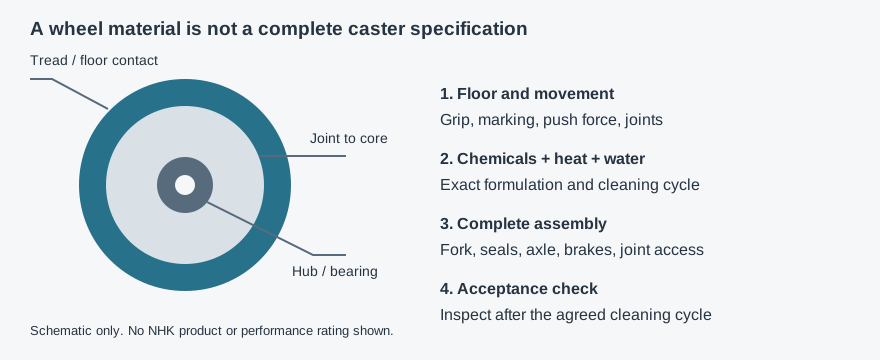
Polyurethane, polyamide and rubber products can have very different cleaning limits. Tread hardness, wheel diameter, bearing resistance and floor joints affect push effort. Where a tread is bonded to a core, its joint must survive the same environment as the rolling surface. A suitable fork cannot compensate for a swollen tread or separating bond.
Use the PU, nylon, rubber and phenolic wheel comparison for that decision. Obtain actual limits for detergent, disinfectant, temperature and duration together. Colour may assist visual inspection but is not evidence of composition, food-contact status or resistance to cleaning. Reject rough, cracked or damaged surfaces when they cannot meet the plant's cleaning criteria.
Wheel bearings, swivel heads and brakes
The oven, steam and freezer duty comparison explains why stainless mounting does not establish thermal limits for the wheel, grease or seals.
There are at least two bearing locations to consider on a swivel castor: the wheel axle and the swivel head. A sealed wheel bearing does not establish protection at the swivel. Ask whether each is sealed, lubricated for life or relubricatable, and whether cleaning requires specific orientations or avoids particular jet directions.
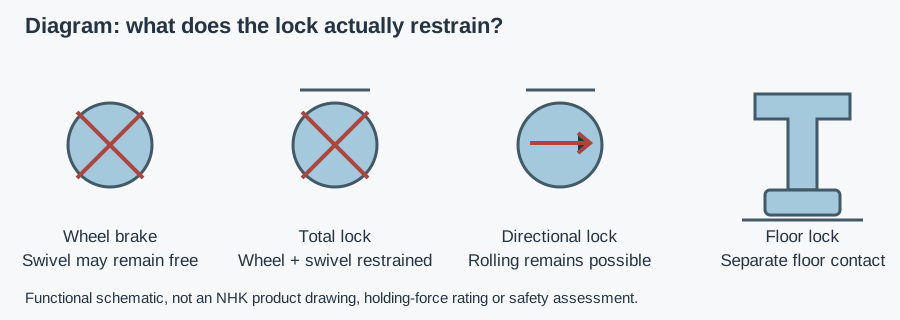
A wheel brake prevents rolling; a total lock restrains rolling and swivelling. Check the actual mechanism rather than inferring the function from a pedal. A directional lock serves steering and should not be mistaken for parking restraint. Test brake engagement on the fully loaded machine and intended floor with a safe procedure.
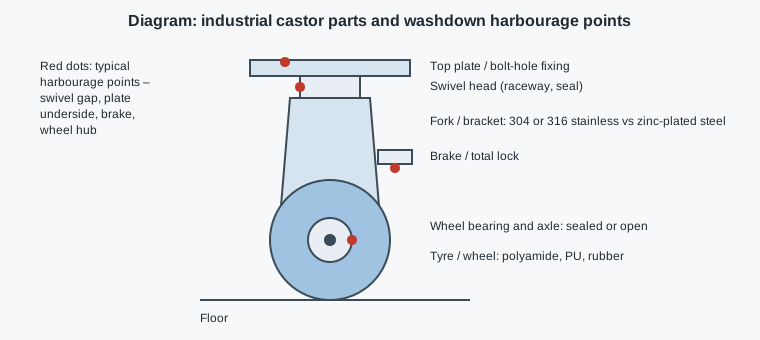
Inspect whether the brake can be cleaned in both positions. Springs, pedal undersides and the gap beside the tread can become harbourage points—places where residue survives cleaning. A stainless pedal that hides a dirty recess is not a hygienic improvement merely because it resists corrosion.
The brake mechanisms and floor-contact inspection checks also cover the pad, pivots and mounting joints of a separate floor lock; its own cleaning documentation must be checked.
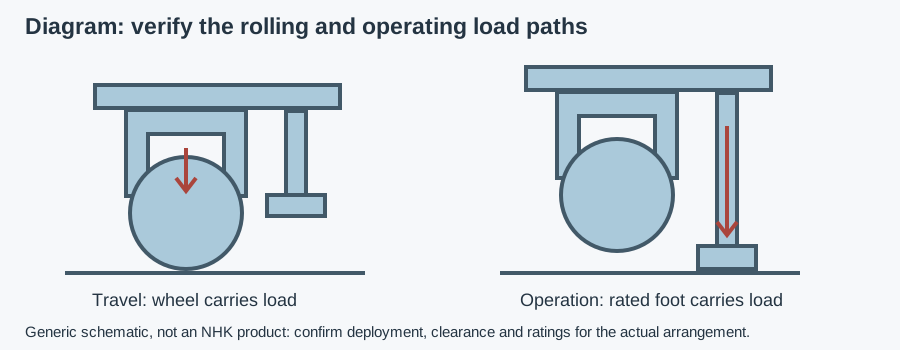
For a machine that rarely moves, compare castors with fixed levelling supports. Brakes do not level a frame or create an anchored load path. Where a levelling-castor arrangement is proposed, confirm the load rating and cleaning access of the foot as well as the wheel.
Use the fixed-support load and anchoring guide where the machine must transfer operating loads to feet rather than wheels.
Cleaning access and what ingress ratings do not prove
Check the castor through its full swivel range. Can the cleaning team reach axle ends, the hub, brake, swivel gap and plate underside without dismantling an unsafe supported machine? Self-draining surfaces shed liquid; recesses that retain wash water need a cleaning and drying solution, not just a shinier finish.
Record cleaning method, detergent and sanitiser names, concentration, temperatures at the castor, exposure time and drying. Include product residues and standing floor water. Cleaning the tread alone can carry contamination along the route while leaving the swivel or mounting joint dirty. Plan inspection after cleaning and during maintenance.
IP67 under IEC 60529 describes temporary immersion, not high-pressure washdown. IP69K in ISO 20653 refers to a different ingress test. Neither is a detergent-resistance or hygienic-cleanability certificate, and no NHK castor ingress rating is asserted here. Require test evidence and cleaning instructions for the exact assembly when a rating is claimed.
EN 1672-2 and EN ISO 14159 provide machine-hygiene references, not a universal castor specification. EHEDG certifies specific designs; 3-A Symbol authorisation follows Third Party Verification. Both are voluntary. A certificate for an NHK bearing unit, foot or another component cannot be transferred to an unrelated castor.
Check what a specific hygienic-design certificate covers before requiring certification in a castor specification.
Selection and installation: six checkpoints
- Confirm mobility. Define manual or powered movement, frequency, route, slopes and parking. Establish whether process stability requires a separate fixed support.
- Establish load. State empty and fully loaded weight, support geometry and impacts at drains. Use supplier guidance for load distribution and margins rather than assuming every castor shares equally.
- Match materials and cleaning. Obtain the component-level materials and cleaning limits before specifying stainless as a complete solution.
- Detail the fixing. Confirm plate pattern, bolt-hole or stem dimensions, frame strength, fastener grade and access. A plate fitted over an uneven surface can create both mechanical stress and a liquid-retaining gap.
- Install to instructions. Use the supplier's tightening method and torque. Do not seal or shim a joint in a way that compromises support, access or the intended drainage. Keep wheel and swivel movement free.
- Accept under duty. Check loaded steering, brake operation, floor effects and cleaning access. Record a baseline and agree inspections for wear, corrosion, play and retained residue.
For mobile conveyor modules, also assess product zones, belt removal and frame access; the conveyor cleaning and component guide covers those wider interfaces.
Example: stainless fork, unsuitable cleaning access
Assumptions: a mobile preparation table is washed daily, moved by hand and parked during production. The proposed castor has stainless mounting and a polymer tread; its alloy, capacity and cleaning limits are not supplied. This is an illustrative assessment, not an NHK installation or test.
The engineer requests a drawing and separate wheel and swivel instructions. The cleaning team checks access to the pedal underside and plate joint. A stainless fork remains a candidate, but a hidden recess or undocumented wheel formulation prevents approval until resolved. Loaded handling and parking are tested on the route. No successful washdown result or fixed material choice is assumed.
What to send for a recommendation and quote
Send application and zone; cleaning chemicals, concentrations, temperatures and contact time; total load and support arrangement; movement, floor and wheel diameter constraints; tread preference and required alloy; swivel or fixed layout, brake and parking needs; mounting drawing; documents required; quantity and delivery country.
The site's buyer's guides for component specification provide the wider purchasing context. No dedicated castor calculator or RFQ tool is currently available; send the load layout and cleaning cycle through the existing enquiry form.
Copyable specification: “Identify all materials in the supplied castor assembly. Confirm its load-rating conditions, wheel and swivel bearing protection, wheel-formulation and cleaning limits, brake function and mounting instructions. Provide drawings showing access and drainage. Any food-contact declaration or design certificate must cover the supplied variant and intended use.”
EC 1935/2004 applies within its food-contact scope; a floor castor is not automatically a food-contact article. Identify foreseeable transfer and ask for the appropriate finished-article evidence when needed. Do not substitute a material declaration for cleanable geometry or a mechanical rating.
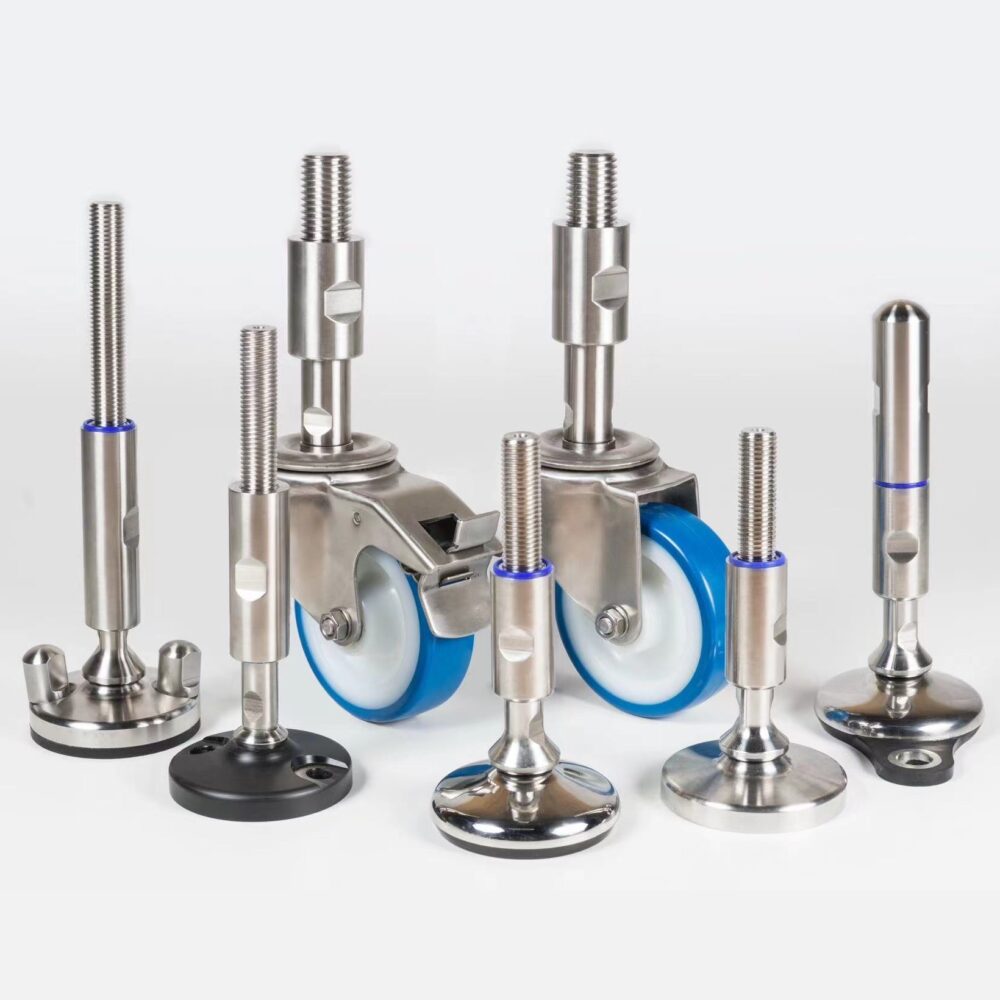
NHK's Stainless castors establishes the product category. Exact alloy, tread, bearing, brake, capacity and certificate coverage need confirmation for the proposed variant. An NHK technician uses the application information to suggest suitable components and sends a quote; this guide does not promise stock, delivery time or washdown performance.