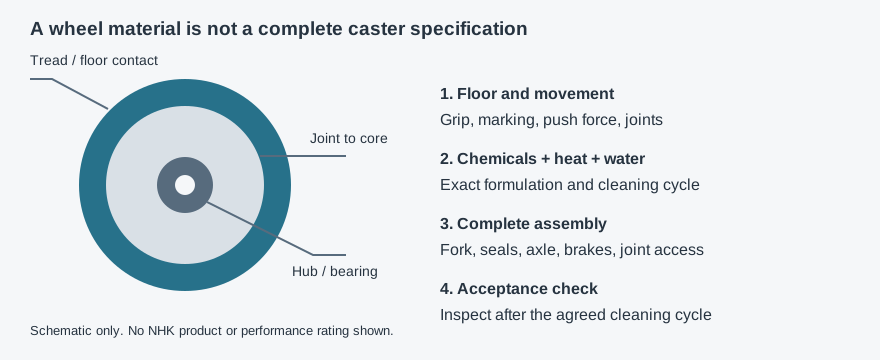
Polyurethane caster wheels are wheels with a polyurethane body or tread, often bonded to a separate core. This guide compares the wheel—not just its stainless bracket—for carts, racks and mobile machines in food plants. Polyurethane castors is the British spelling; the selection questions are the same. For forks, brakes, mounting and overall load selection, start with the industrial caster assembly guide.
PU, nylon, rubber, phenolic and stainless: comparison
These are screening tendencies, not universal ratings. Wheel diameter, tread hardness, bearing type, payload and floor condition can change the comparison. “Stainless caster” often describes the fork or mounting, not the rolling surface. Confirm whether a proposed stainless wheel is actually metal throughout or has a polymer tread.
| Wheel material | Floor protection and rolling effort | Chemicals and wet cleaning | Temperature and hygiene decision |
|---|---|---|---|
| Polyurethane / PU | A suitable resilient tread can cushion impacts and protect floors; effort varies with formulation and construction | Request exact compound compatibility; some PU types are vulnerable to hot water or humid heat | Check cleaning exposure separately from operating temperature; inspect the tread-to-core bond |
| Polyamide / nylon | Hard wheels can roll with little tread deformation on smooth floors; compare noise and point loading on sensitive surfaces | Some products suit wet duty; chemistry, moisture effects and grade still need checking | Ordinary nylon and special high-temperature grades are not interchangeable; inspect the hub and surface |
| Rubber, including hard rubber | Cushioning and grip depend on hardness; starting and rolling effort can exceed harder alternatives | Oil, fat and detergent resistance depend on compound; check marking or staining | Hard rubber is not soft rubber; inspect swelling, cracking and residue at joints |
| Phenolic | Hard wheels give little cushioning; check resilient flooring, impact and damaged floor joints | Products differ: a water-resistant listing does not establish repeated washdown suitability | A dry-heat rating is not a hot-wash approval; inspect cracks and exposed reinforcement |
| Solid stainless steel wheel | Hard metal offers no resilient tread cushioning; assess contact stress, floor marking and noise directly | Obtain the actual alloy and chemical compatibility; “stainless” is not corrosion-proof | Inspect accessible surfaces and joints; bearings, seals and grease may govern limits before the wheel body |
Send the floor and cleaning details for a wheel-material recommendation
Polyurethane caster wheels (PU or urethane): formulation checks
A PU caster wheel is not one standardized material. Polyester- and polyether-based polyurethane, additives, hardness and processing can produce different resistance profiles. Hydrolysis means chemical breakdown involving water; susceptibility depends on the formulation and exposure. Ask the supplier about repeated hot washing and humid storage, not simply whether the wheel tolerates an occasional splash.
Urethane caster wheels may have a bonded tread, a molded body or another construction. The bond to a metal or polymer core introduces a separate failure path: liquid can reach damaged edges, and changes in the tread or bond can lead to separation. A compatible tread does not establish compatibility of adhesive, core coating or bearing seals. Inspect the complete wheel after the intended cleaning cycle.
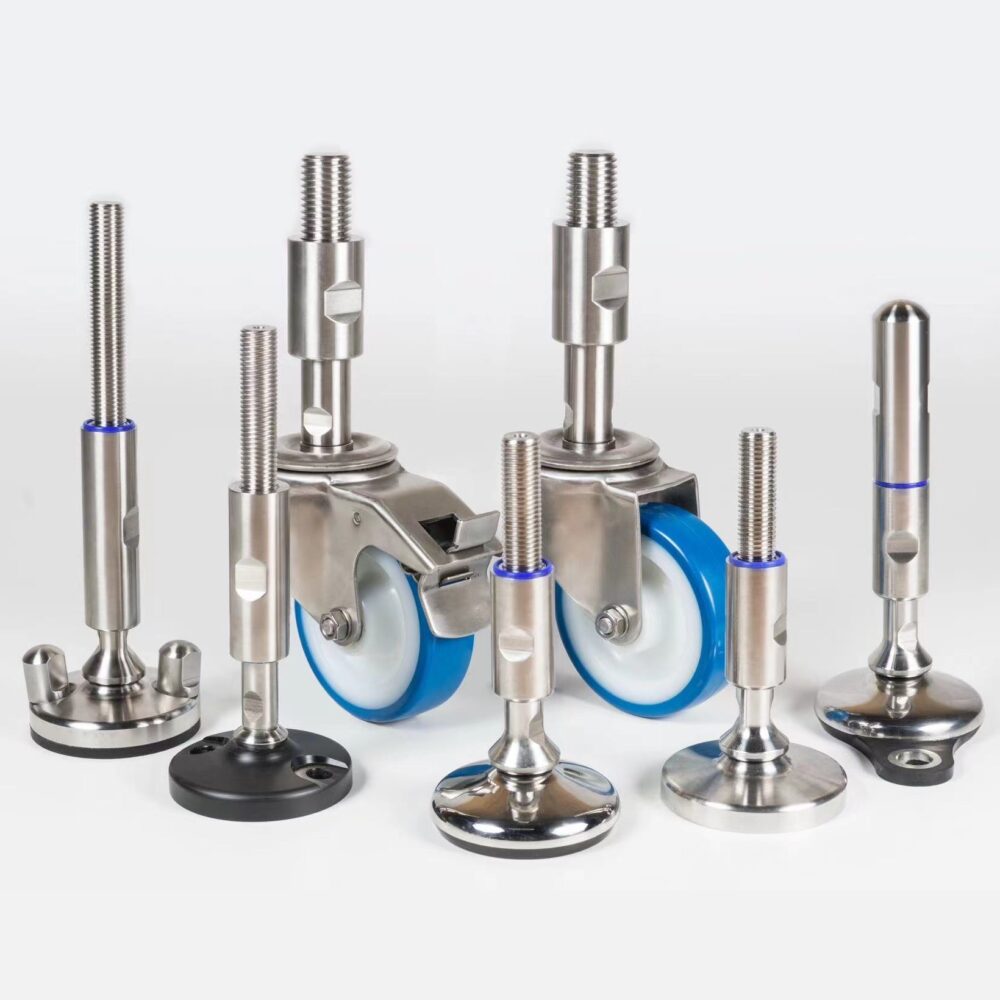
Choose PU when documented washdown compatibility and the actual floor test support the balance of cushioning and push effort. Do not choose it when the supplier cannot identify the formulation or substantiate hot-water exposure. Avoid selecting by color: a blue tread may help visual inspection, but it does not establish food-contact status or chemical resistance.
When nylon, hard rubber wheels or phenolic wheels make sense
Polyamide is often called nylon. Consider a hard nylon product where low tread deformation on a smooth floor matters, but compare starting force, vibration at joints and the floor's tolerance of concentrated contact. Ask whether moisture conditioning affects the supplied grade's dimensions or performance. An oven-rated nylon product does not transfer its temperature capability to ordinary nylon.
Hard rubber wheels sit between very resilient rubber tires and rigid materials, depending on the compound. They may be candidates where cushioning and grip matter, but verify whether the required loaded wheel marks the floor or requires excessive effort. Oils and fats cannot be assessed from “rubber” alone. Record cleaning agents alongside product residues, because both contact the tread.
Phenolic wheels are commonly considered for hard-wheel or heat-related service. Supplier instructions differ on wet use, so exclude an undocumented phenolic wheel from repeated washdown rather than extrapolating from dry service. Chips, cracks or exposed reinforcement are rejection points: even if the wheel still rolls, the surface may no longer be acceptably cleanable.
A six-step selection method for food plants
Use the complete-assembly heat and cold checks for oven, autoclave or freezer exposure rather than extending a tread's material claim to its bearings and swivel.
- Map the route and zone. Record floor finish, damaged tiles, joints, drain grates, slopes and standing water. A splash zone is reached by product or cleaning spray; a non-contact zone is not intended to touch food. Trace where wheel contamination could transfer rather than assuming every floor wheel is a food-contact article.
- Write the cleaning cycle. List detergent and sanitizer names, concentrations, temperatures at the wheel, contact times, pressure-cleaning practice and drying. Hot water, chemicals and repeated exposure must be considered together.
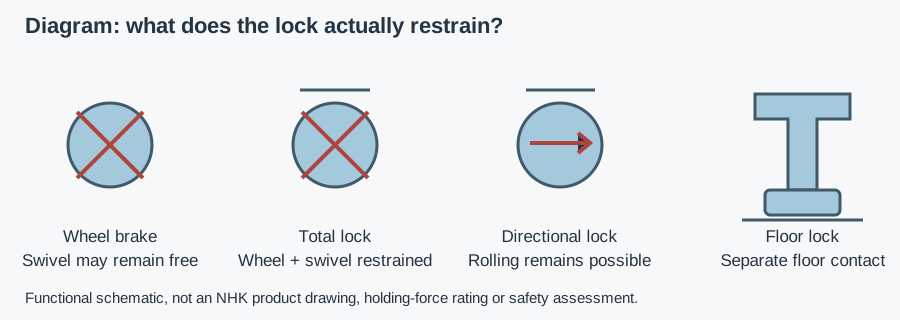
- Separate wheel and caster requirements. Specify tread, core, axle, fork, swivel, seals and brake. A sealed wheel bearing does not protect an open swivel head. Check that cleaning can reach both sides without trapping liquid under the mounting plate.
- Set the mechanical duty. State total loaded weight, support arrangement, speed, manual or towed use and impacts. Confirm load distribution and margins with the caster supplier; do not divide equally by all wheels without checking uneven-floor support. Compare mobile supports with fixed leveling feet if movement is only occasional.
- Compare actual samples under load. Check starting, straight rolling, swiveling and crossing joints on the intended floor. A tread that rolls easily straight ahead can still need substantial swivel effort. Define acceptable operator effort and floor condition with the plant before accepting a sample.
- Approve evidence and inspection. Match product codes to chemical data, assembly limits and drawings. Agree acceptance checks after cleaning and reject damage or persistent residue. Our harsh-environment component specification guide explains why water, heat, chemicals and soil should be assessed together.
Hygiene, food contact and what certificates do not prove
For the mounting, swivel and brake rather than the tread alone, use the complete stainless assembly verification guide.
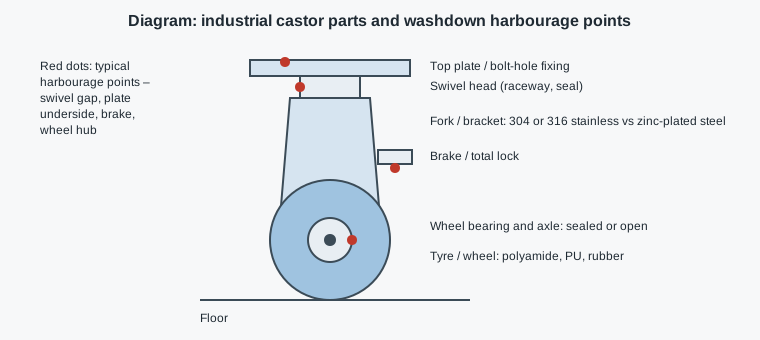
Harborage points are places where residue can remain through cleaning. On casters, inspect tread joints, axle ends, brake recesses and swivel bearings. Smooth visible tread is insufficient when a hub recess retains soil. EN 1672-2 and EN ISO 14159 provide machine-hygiene design references; neither supplies a universal wheel-material compatibility chart.
EC 1935/2004 concerns materials intended for food contact, including foreseeable transfer under its scope. A wheel on a food-plant floor is not automatically in food contact. Where contact is relevant, request evidence for the exact finished article and conditions. EU 10/2011 adds requirements for plastic food-contact materials within its scope; FDA 21 CFR 177.2600 addresses rubber articles for repeated use, not every polymer or wheel. Do not treat a generic “FDA” label as a complete declaration.
EHEDG certifies specified equipment designs, not polyurethane, nylon or stainless as material families. 3-A Symbol authorization follows Third Party Verification and is also voluntary. Check the scope of hygienic-design certification before putting a certificate requirement in the wheel RFQ. An ingress rating likewise does not establish cleanable geometry or compatibility with detergents.
If the machine should operate on feet rather than its wheels, use the fixed-support load and anchoring checks before treating caster brakes as the final support system.
Example: a washed cart on a sensitive floor
Assumptions: a manually pushed ingredient cart has a bonded PU tread, crosses drain joints and is foam-cleaned before rinsing. The floor coating is sensitive to marking. No wheel capacity, cleaning temperature or material rating is assumed, and this is not an NHK installation or test.
The engineer shortlists a documented PU wheel and a nylon alternative. Both require assembly data for the actual cleaning cycle. Loaded samples are checked for starting and swivel effort, floor marks and impact at the drains. PU remains a candidate only if the formulation and tread bond are supported for washing; nylon remains a candidate only if floor loading and handling are acceptable. Neither passes solely because its catalog says “food industry.” The decision records the evidence and remaining acceptance checks, not an invented winner.
Inspection and failure checks
| Symptom | What to check | Action before replacement |
|---|---|---|
| Tread softens, swells or becomes sticky | Chemical exposure and time; actual formulation; recent sanitizer changes | Isolate the affected cart; confirm compatibility of the replacement compound |
| Tread lifts from its core | Bond edges, impact damage, wash exposure and core corrosion | Reject separating wheels; investigate construction and cleaning conditions |
| Hard wheel chips or floor marks appear | Overload, drain impact, bearing seizure and floor condition | Check load path and wheel geometry; do not just fit a harder material |
| Cart becomes difficult to push | Flat spots, debris, brake drag, wheel bearing and swivel resistance | Separate mechanical faults from tread choice using loaded checks |
| Residue remains after washing | Hub recesses, brake, axle ends and plate underside | Correct access or select a cleanable arrangement; verify cleaning again |
Avoid adjusting axle fasteners by feel without supplier instructions: excessive clamping can impede rotation, while looseness can create play. Inspect replacement dimensions and fixing interfaces. Replacing one wheel with a different diameter can change load distribution even when the new wheel's own capacity appears adequate.
Copyable specification and information to send NHK
“Supply a caster assembly for the stated food-plant route. Identify wheel code, tread formulation and core construction; provide limits for the listed chemicals, operating and cleaning temperatures, exposure time and moisture cycle. Confirm assembly load rating and its test conditions, bearing and brake arrangement, mounting dimensions, and access for cleaning. Provide applicable material declarations or design certificates for the supplied variant.”
Attach the floor description, empty and fully loaded weights, support layout, movement speed, wheel diameter constraints, cleaning schedule, zone, quantity and delivery country. State any stainless alloy requirement without assuming every mounting uses that grade. For mobile conveyor sections, check the frame and product zone as well as the wheel; our conveyor-type and cleaning-access guide gives that wider context.
Use the buyer's application-data checklist to organize the wheel specification and supporting documents before enquiring.
NHK lists a Stainless castors category. That description does not establish a stainless wheel or confirm PU availability. Use the NHK catalog for product identification and send the application details for a recommendation and quote. Wheel formulations, capacity and cleaning limits need confirmation for the proposed product; no NHK test performance is asserted here.