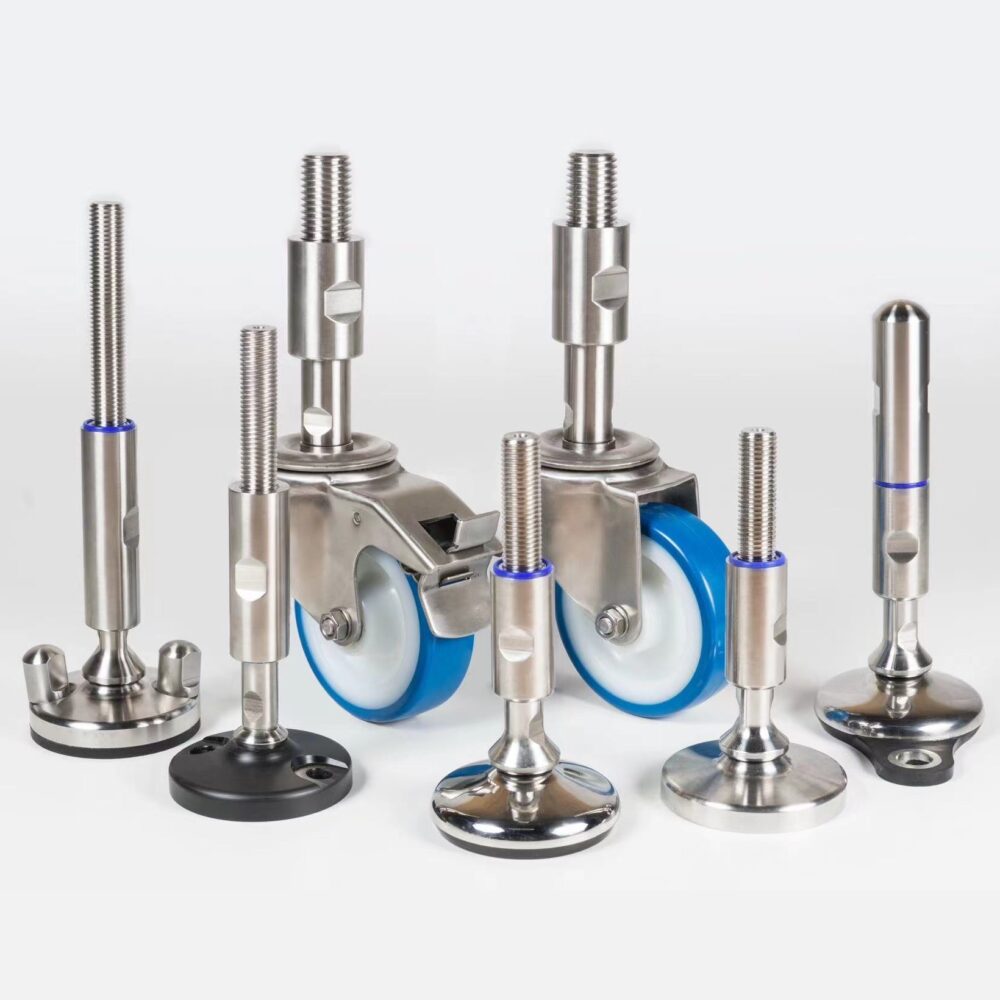
Industrial castors are wheel assemblies – a mounting plate or stem, a swivel or fixed fork, a wheel and its bearing, often a brake – that carry machines, racks and carts that must move. In food plants the choice is driven by load, floor, cleaning method and corrosion. This guide covers industrial casters (the American spelling), heavy duty industrial castors and machine castors on one page: materials, wheels, brakes, load calculation and cleaning. It is the pillar of the castors cluster in Levelling feet and castors.
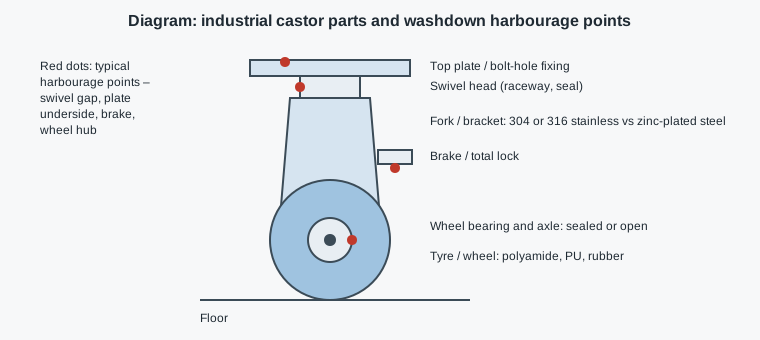 Industrial castor parts and washdown harbourage points. Schematic, not a product test report.
Selection criteria at a glance
| Criterion | Options | What decides it in food plants |
|---|---|---|
| Housing and fork material | Zinc-plated steel, AISI 304 stainless, AISI 316 stainless | Wet cleaning and chlorides: zinc plating corrodes and flakes; 304 for general washdown, 316 near salt, brine or chlorinated cleaners |
| Wheel / tyre | Polyamide (nylon), polyurethane (PU), rubber, phenolic | Floor type, noise, load, chemicals, temperature |
| Wheel bearing | Plain bore, roller, ball – open or sealed | Sealed bearings keep water and residue out; open bearings hold dirt |
| Type | Swivel, fixed, swivel with brake/total lock, levelling castor | Steering, parking and whether the machine must stand still during production |
| Fixing | Top plate, single bolt hole, threaded stem | Frame design; plate underside and threads are crevices to manage |
| Load class | Per-castor load rating at defined conditions | Calculated load per castor with uneven-floor allowance (see below) |
| Cleanability | Open fork, few recesses, self-draining surfaces | Foam and rinse or high-pressure washdown frequency |
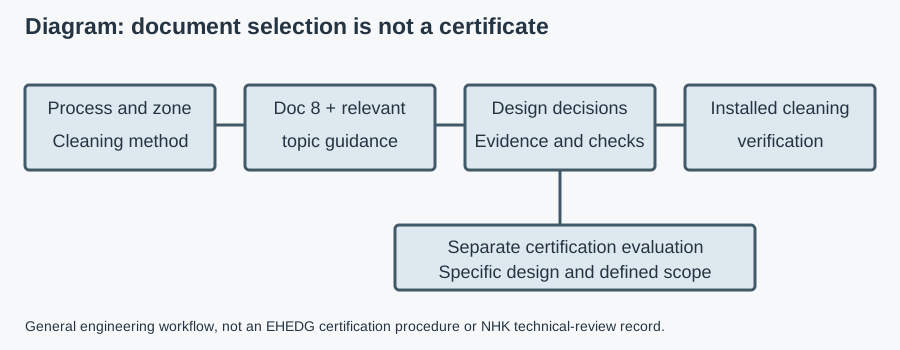
| Documents | Material certificates, food-contact declaration where the wheel can contact product, EHEDG certificate only if the specific design has one | Customer audits and tenders |
Harbourage points are places where residues and microbes collect and survive cleaning – on castors usually the swivel head gap, the underside of the top plate, the brake mechanism and the wheel hub. Self-draining means surfaces shed water instead of holding it.
Send your application data and get a castor recommendation
Stainless vs zinc-plated castors
For component-level materials, bearing protection and brake access, use the stainless steel castors washdown checklist alongside this general load guide.
Zinc-plated steel castors are cheap and adequate in dry warehouses. In washdown areas, alkaline foam and acid descalers attack the zinc layer; once it is breached the steel rusts, and flakes of plating or rust can be carried into product areas by water and carts. Stainless steel forks and plates avoid that. AISI 304 suits most food washdown; AISI 316 adds molybdenum for better resistance to chloride pitting – local corrosion caused by salt, brine or chlorine-based cleaners – and is the safer choice in meat, seafood and cheese brining areas.
Mixing stainless forks with zinc-plated fasteners, or mounting stainless castors on a painted mild-steel frame, creates galvanic corrosion risk at the contact in wet conditions. Specify fasteners in the same stainless grade.
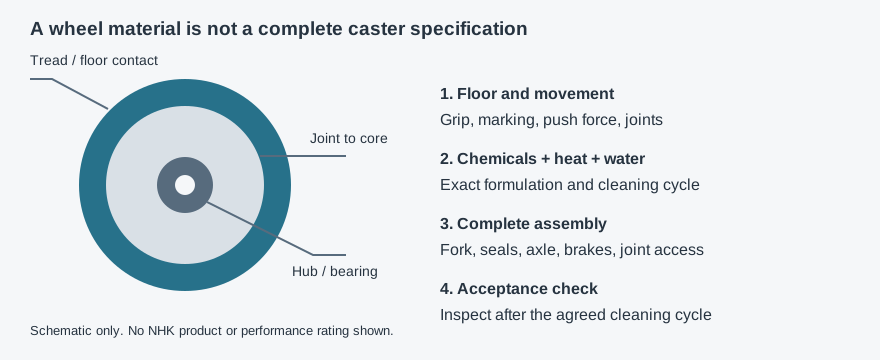
Wheel materials
| Wheel | Strengths | Limitations |
|---|---|---|
| Polyamide (nylon) | Hard, low rolling resistance, resists water and many cleaning chemicals | Noisy, can damage soft or tiled floors, little shock absorption |
| Polyurethane (PU) tread | Quiet, protects floors, good wear | Some grades soften with hot water or hydrolyse over time; check grade |
| Rubber | Quiet, grips, damps vibration | Higher rolling resistance; check oil and fat resistance |
| Phenolic | High-temperature duty such as ovens | Brittle on impact; hard on floors |
Wheel colour (blue or white) makes worn fragments easier to spot during inspection; it is not a material guarantee. Where the wheel can contact product – for example racks pushed through product areas – ask for a declaration of compliance under EC 1935/2004 for the wheel material.
For a closer comparison of polyurethane caster wheels and alternative tread materials, check floor protection, cleaning exposure and the complete wheel construction before selecting a grade.
Brakes and locks
For heated racks or cold rooms, the high temperature casters selection guide separates dry heat, steam cycles and freezer duty from ordinary wheel-material selection.
- Wheel brake stops the wheel turning but lets the castor swivel.
- Total lock blocks both wheel rotation and swivel – the right choice for a machine that must not drift during operation.
- Directional lock holds a swivel castor straight for long pushes.
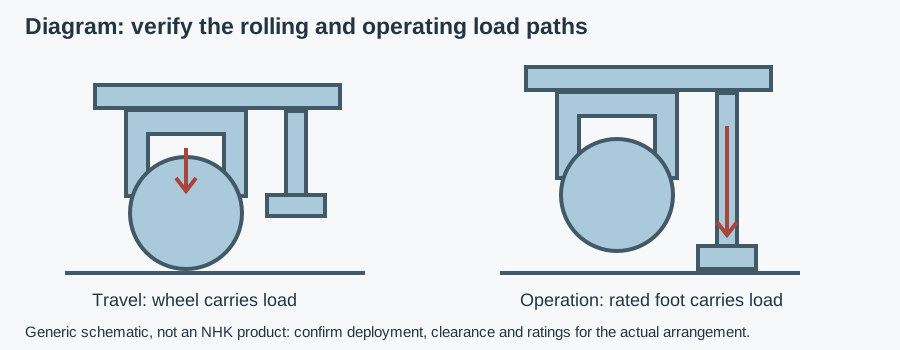
For separate floor-contact devices, use the floor lock selection and limits guide to distinguish parking restraint from steering and load-bearing support.
Brakes add a lever, a spring and gaps. Choose designs where the mechanism is open enough to rinse, and include it in the cleaning instruction. Where a machine is moved only for cleaning and then stands for weeks, a levelling castor or castor-plus-foot combination is often better than relying on brakes. For a combined unit, check rolling versus deployed-foot support requirements before selecting its mechanism and capacity.
Load per castor – calculation method
On a real floor not every castor carries load at the same time. A common rule is to assume that only three of four castors carry the load:
Load per castor = (machine weight + payload) ÷ (number of castors − 1) × factor
The factor covers shock from thresholds, drains and floor joints and fast pushing; choose it from the duty, and confirm the method with the castor supplier.
Example (assumptions, for method only): a mobile mixer weighs 450 kg with 150 kg of product, four castors, factor 1.3 for floor drains. Load per castor = 600 ÷ 3 × 1.3 = 260 kg. Select castors whose rated load at the supplier's stated conditions is at least 260 kg each. Heavy duty industrial castors are needed when this figure, not the machine weight alone, exceeds standard ratings.
Wheel diameter matters too: larger wheels roll over drains and gaps with less force and damage. The same uneven-floor logic applies to feet; see the industrial levelling feet guide.
Cleaning and inspection
- Foam and rinse with the castor turned through its swivel range so the head and brake are reached.
- Avoid aiming high-pressure jets directly at wheel and swivel bearings unless the design is sealed for it; IP ratings are ingress tests, not hygiene ratings.
- Lift or tilt mobile equipment periodically to clean the plate underside and check the frame contact.
- Inspect weekly: wheel wear and flat spots, cracked treads, swivel play, brake function, rust spots, loose bolts.
- Replace castors in sets on one machine so loads stay even.
Common failure modes
- Zinc-plated castors flaking after a few months of foam cleaning.
- Wheel bearings seizing because water entered unsealed bearings and the grease washed out.
- PU treads delaminating under hot water.
- Machines creeping during operation because only wheel brakes were fitted.
- Overloaded castors because the load was divided by four on an uneven floor.
What to specify in an RFQ
Before asking for certification evidence, use the scope checks for a claimed hygienic component.
- Application and zone (product, splash, dry)
- Cleaning method and chemicals
- Load per castor (calculated) and wheel diameter
- Type: swivel, fixed, total lock, levelling castor
- Fork/plate material (304/316) and wheel material
- Fixing: plate dimensions, bolt hole or stem thread
- Documents needed and quantities, delivery country
Send these details to NHK
An NHK technician suggests suitable castors and sends a quote. NHK lists stainless castors; confirm wheel material, fixing, brake arrangement and load capacity for the selected model rather than treating the category as a specification. For zone thinking around the machine, see hygienic zones in factory layouts. For certificate checks, see what EHEDG and 3-A component claims mean. For operating support, see machine-foot stability and vibration checks.