Hygienic nuts close the nut side of a threaded joint without leaving inaccessible residue traps. This guide concentrates on the seat, projecting stud and cap clearance; the hygienic bolt and fastener design guide provides the wider joint context. Assess both ends of a through-bolt rather than replacing its head and leaving the nut untouched.
Hygienic nuts: selection criteria at the joint
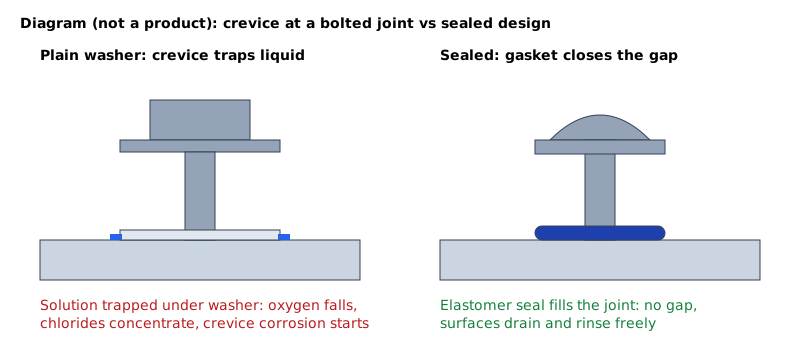
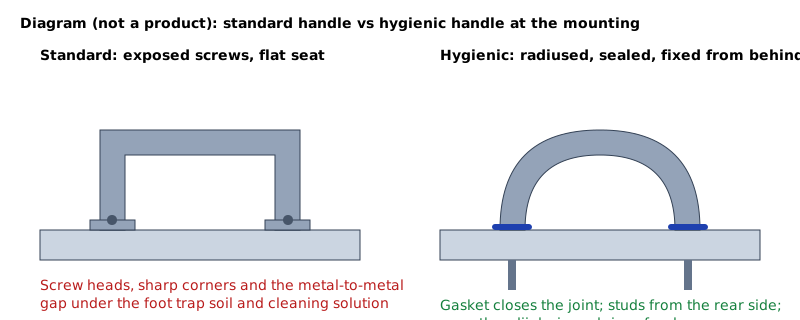
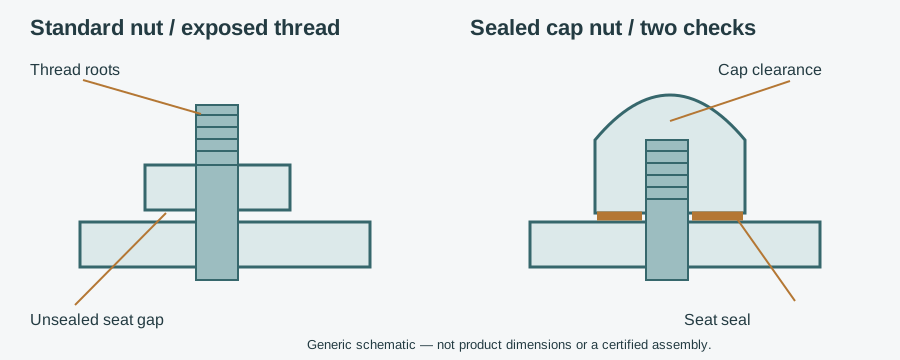
A standard hex nut can leave thread above its top and a narrow metal-to-metal gap beneath its bearing face. A conventional cap nut covers the end but does not necessarily seal the face. Hygienic designs may combine an integrated seat seal with a rounded closed cap; other configurations need a separate documented thread-sealing arrangement.
| Criterion | What to specify | What to reject or resolve |
|---|---|---|
| Joint location | Product-contact, splash or protected non-contact zone | Assuming the underside is outside cleaning exposure |
| Thread closure | Closed cap or documented closure for a through-thread | Visible thread or an uncleanable opening in the exposed zone |
| Seat sealing | Approved seal arrangement and mating-face geometry | A dome used as evidence that the underside is sealed |
| Cap depth | Usable internal depth, stud projection and tolerance stack | Stud bottoming before the nut reaches its intended seat |
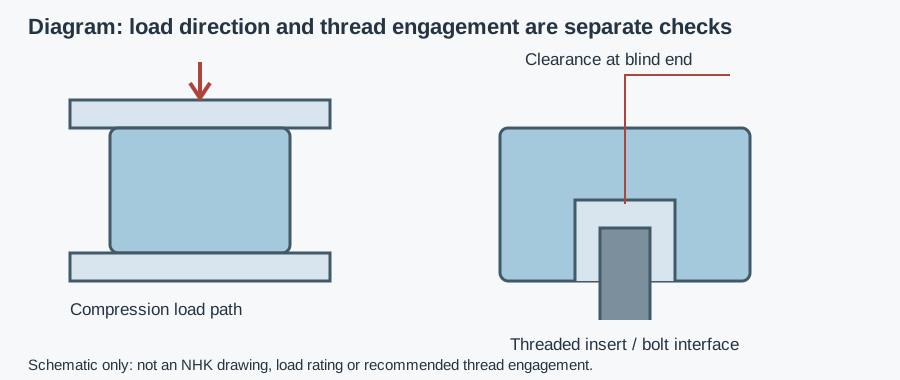
| Mechanical connection | Required engagement, clamp duty and tightening method | Selecting from thread diameter without checking the load path |
| Material and seal | Metal grade and exact compound against operating/cleaning exposure | Generic stainless or food-grade wording without limits |
| Service access | Wrench access, safe removal and seal replacement | A tool that damages the seal or a hidden face no one can inspect |
| Evidence | Exact design identity, documents and installation restrictions | A certificate for a different part or unspecified variant |
Send your joint and cleaning data for a hygienic-fastener recommendation
Start from the existing joint drawing and supplier instructions. A replacement may need a larger seating footprint or different internal depth despite sharing the old thread designation. Resolve those interfaces before ordering; a visually smoother nut is not a verified one-for-one replacement.
Why exposed threads and standard nut seats retain soil
A crevice is a narrow gap that liquid or soil can enter but cleaning cannot reliably reach. Thread roots, washer interfaces and the underside of a nut are potential crevices. A harborage point is a location where contamination survives the cleaning procedure. A clean-looking outer face does not show what remains behind the seat.
Cleaning solution can enter an unsealed interface, leaving residue when the exterior dries. Product powders can also pack into threads in a dry area. Changing from wet to dry cleaning does not make a hidden cavity harmless; select the design from the actual residue and access rather than assuming only water creates a problem.
Where the joint must remain removable, define how its interfaces will be sealed or exposed for cleaning. Where it need not be removable, relocating or eliminating the attachment may be preferable. The migrated standard-component substitution guide helps assess the location before choosing a replacement.
Hygienic cap nuts: sealing the seat is not covering the thread
A rounded cap can enclose a stud end and reduce external recesses. An integrated seal can close the seat perimeter when compressed against the approved mating surface. Those are separate functions: a closed top does not seal the base, and a base seal does not close a through-thread above it.
The metal bearing faces and threaded connection must provide the mechanical load path as designed. The elastomer closes an interface; do not treat it as a substitute for structural engagement. Ask whether the design uses a defined stop or another compression-control feature and follow its assembly instructions. No universal torque or seal compression is assumed here.
Inspect the mating face for scratches, burrs, distortion and insufficient seal footprint. A seal over a slot, curved edge or weld discontinuity may not operate as intended. Specify a matching approved seat instead of forcing the seal to bridge a damaged surface. Avoid extra washers or sealant unless they are explicitly part of the documented configuration.
For joints using a standoff, check the spacer end faces and clamped stack as well as the nut. A sealed top closure cannot compensate for an open spacer bore or an unsealed lower interface.
Where sanitary nuts are needed — and where they are not
The product-contact zone touches food. The splash zone receives product or cleaning spray; include foreseeable drip and transfer routes on the assessment drawing. Protected non-contact locations may allow conventional stainless fasteners if they meet mechanical, corrosion and cleaning requirements. The word sanitary is not a separate certificate class.
EN 1672-2 and EN ISO 14159 address machine hygiene and cleanability, not a universal nut model. Prefer eliminating difficult joints from product-contact surfaces where feasible. When a removable joint remains, specify a cleanable arrangement and relevant food-contact evidence. A buyer may additionally require a certified design, but neither certification scheme is mandatory simply because a nut is installed in a food plant.
Typical review points include covers over open product, sensor brackets, side-guide attachments and removable panels. Check the complete conveyor frame and component interface layout before deciding that changing the nut solves the surrounding access problem. A fully welded attachment may remove a through-hole, but its weld transition still needs assessment.
Materials and seal compounds: specify the exposure
AISI 304 and 316L are common options to consider, not asserted NHK nut specifications. 316L generally offers improved resistance to chloride pitting compared with 304; neither is immune. Record product salts, detergent/disinfectant identity, concentration, temperature, contact time and rinsing/drying. Request compatibility evidence for the exact supplied metal and surface condition.
Use the compound compatibility and seal selection guide for the detailed screening method. EPDM, FKM and VMQ silicone are elastomer families with different behaviour. EPDM is often considered for water-based cleaning exposure, FKM for oil/fat exposure, and silicone where thermal flexibility is relevant; compound formulation and combined exposure decide suitability. Do not rank them from one chemical or a family name. Ask for resistance data, replacement identity and assembly limits.
Food-contact scope also differs from chemical resistance. EC 1935/2004 is the general EU framework for food-contact materials; EU 10/2011 covers plastics, not every rubber seal. FDA 21 CFR 177.2600 concerns applicable rubber articles for repeated use. Request evidence for the actual compound and intended use rather than accepting a generic FDA badge.
The stainless grade selection guide helps frame the metal request. Record seal colour for replacement control, but do not infer compound, food-contact compliance or cleanability from colour alone. Replacing a ring with one that merely fits can alter compression, swelling and service behaviour.
Installation: engagement, cap clearance and seal condition
- Isolate and secure the assembly. Follow the approved energy-isolation and support procedure before removing a nut that holds a guard or other load-bearing part.
- Identify the thread. Confirm diameter, pitch, form, condition and required engagement; do not force a nut onto a near-matching thread or reuse damaged stainless threads.
- Check the clamped stack. Establish stud projection when all mating parts are at their intended position. Compare it with usable cap depth and required engagement, including dimensional tolerances.
- Inspect the seat and seal. Clean approved surfaces, remove burrs through the agreed repair procedure and verify the correct seal identity and orientation. Do not stretch or cut a ring to fit.
- Tighten to instructions. Use the supplier's method and approved lubrication condition where applicable. Torque rising because the stud hits the cap does not prove the seat is clamped correctly.
- Inspect and document. Check final seating, seal continuity and access, then record the component, seal, tightening procedure and cleaning restrictions for maintenance.
A welded stud needs its own attachment and projection checks; the welding-plate and stud mounting guide covers that upstream interface. Do not shorten a stud on site without assessing engagement, material condition and the machine builder's requirements.
Inspection and failure diagnosis after cleaning
| Observation | Possible cause | Check | Corrective direction |
|---|---|---|---|
| Residue at the seat perimeter | Missing, damaged or improperly seated seal | Isolated removal and mating-face inspection | Correct the seat/compound/configuration and reassemble |
| Seal protrudes or splits | Compression error, incompatible compound or damage | Assembly instructions and actual cleaning exposure | Replace the seal and resolve the cause, not just visible extrusion |
| Nut feels tight but joint moves | Bottoming, insufficient engagement or another stack problem | Stud projection, cap depth and mechanical connection | Correct interfaces before accepting the joint |
| Thread seizes during removal | Galling or damaged/contaminated threads | Thread condition and tightening/lubrication method | Replace damaged parts and follow the approved method |
| Local staining returns | Retained chemicals, damaged seal or surface contamination | Exposure, drainage and seat condition | Resolve the retention/corrosion path before refitting |
Galling is adhesive damage that can seize stainless mating threads. Do not compensate with higher power-tool force. Investigate the supplier's assembly conditions and any approved anti-seize rather than adding an unverified lubricant near product. Recheck after a cleaning-method change or repeated dismantling; there is no universal inspection interval for every seal and duty.
EHEDG compliant nuts: verify the exact certificate
Treat EHEDG compliant or designed to EHEDG guidelines as a design claim unless certification evidence is supplied. EHEDG certifies specific equipment designs, not companies, materials or entire factories. A certified fastener does not certify the complete machine. 3-A Symbol authorisation follows Third Party Verification and needs its own scope check; both schemes are voluntary.
Ask the supplier for the current certificate and exact part/design identity. Use the register-search and certificate-scope checklist to check the official register, certificate holder, listed sizes/configurations, seal restrictions and installation conditions. Match the purchased article and its replacement seal to that scope. Stop approval if the document concerns a bearing or foot rather than the nut being ordered.
NHK's component certificate C2300067, checked on November 7, 2026, lists 3A Nut, 3A Corner nut, 3A Spacer nut and 3A Welded spacer nut, each marked M5–48, plus a Silicone Seal ring marked M5–48. It is EL Class I AUX and states validity through December 31, 2026. Those are certificate-list identities and ranges, not a dimensional chart or confirmation that every replacement ring is approved. The document references evaluated drawings and installation instructions; request the relevant match for the supplied configuration.
The product names beginning “3A” in that EHEDG document do not independently establish 3-A Symbol authorisation. Verify that authorisation separately if required. No nut alloy, tightening torque or nut-specific seal formulation is established by the certificate equipment list.
NHK's component documents are published on NHK's certifications. Request a documented match for the proposed nut rather than assuming every item in a certified-components category is covered. Material and food-contact declarations answer different questions from hygienic-design certification.
Example and copyable nut specification
Example — hypothetical assumptions, not NHK field data. A removable cover above a food conveyor has projecting studs and ordinary cap nuts. The OEM proposes sealed replacements for foam-and-rinse cleaning. No thread size, torque, temperature, seal compound or certification is assumed.
The engineer measures the fully clamped stack, checks cap clearance and required engagement, and reviews the seating face. QA supplies the actual cleaning chemistry and acceptance requirements. Procurement requests a matching nut/seal drawing and certificate scope. If no compatible seat can be provided, redesign the connection rather than accepting a dome as proof of hygienic closure.
Copy and complete: “Nut-side closure for the attached joint: __. Product-contact/splash/non-contact location: __. Thread designation, pitch, stud projection and clamped-stack tolerances: __. Required engagement and mechanical duty: __. Seat footprint and seal arrangement: __. Metal grade and cleaning exposure: __. Exact compound and material/contact evidence: __. Design certificate and configuration required: __. Part numbers if known, quantity and delivery country: __.”
Use the buyer's component document and enquiry guides to organise the joint drawing and evidence request before ordering.
Send these fields through the existing enquiry form below so NHK can assess the joint, confirm available components and prepare a recommendation and quote. NHK states its approved line lists a nut, corner nut, welded spacer nut and spacer nut as EHEDG-certified products. Browse the NHK hygienic small-component line as the secondary path; do not infer a particular grade, dimension, seal or certificate scope from the category name. No nut load rating or delivery promise is made here.