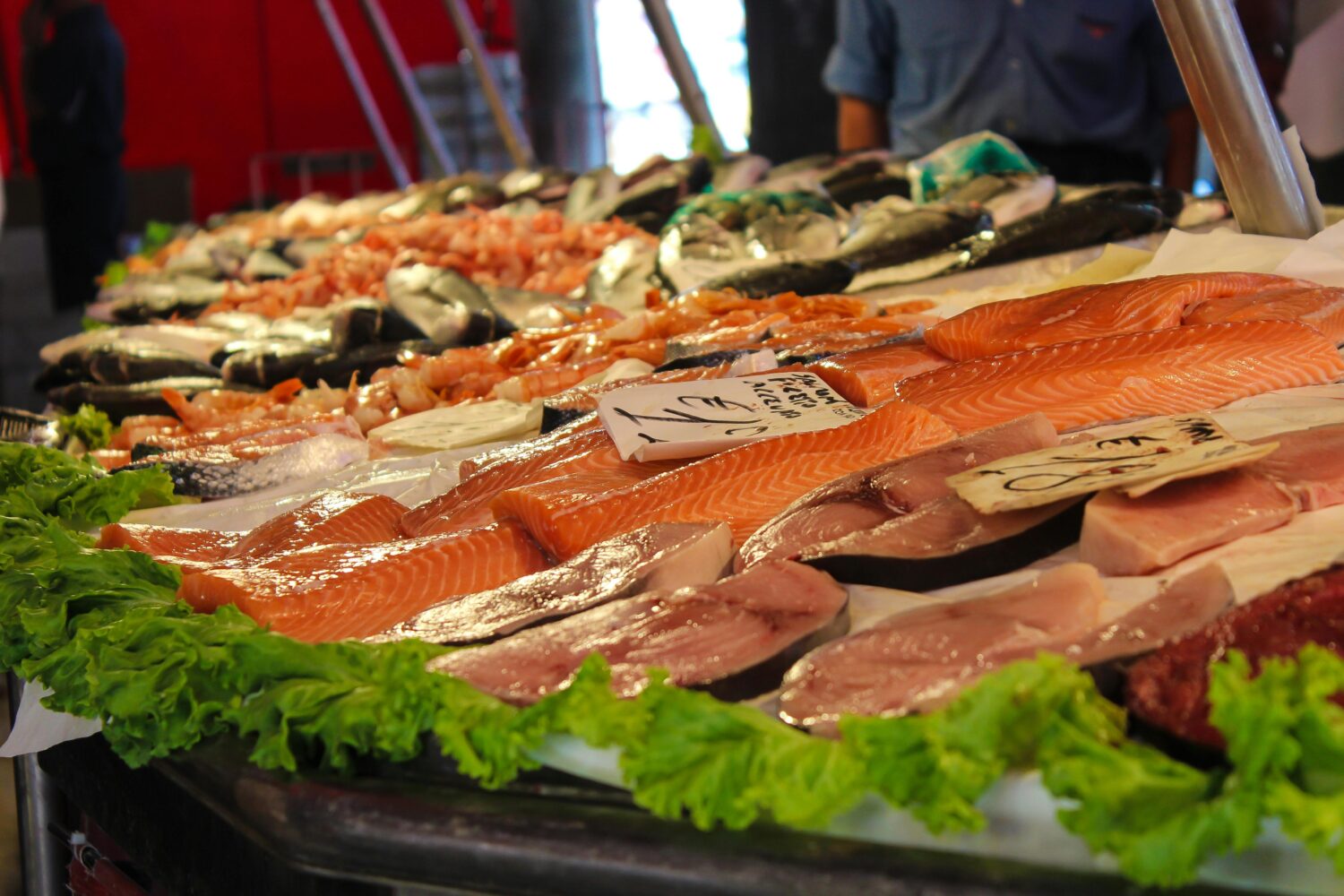
Sustainable seafood is fish and shellfish caught or farmed at a rate that the population can replenish, with limited harm to the marine ecosystem. Overfishing is the opposite: harvesting faster than the species' natural ability to replenish, which reduces stocks and disrupts ecosystems. This page summarises what the research says, explains the terms used in fisheries debates, and then turns to the part of the chain this site is about – the seafood processing plant, where hygiene and equipment decide how much of the landed catch actually reaches consumers.
What the research says about overfishing
| Year | Source | Finding |
|---|---|---|
| 2003 data (2004 report) | FAO, State of World Fisheries and Aquaculture | Of assessed stocks, about one-quarter were overexploited, depleted or recovering from depletion (16 %, 7 % and 1 %) and needed rebuilding |
| 2006 | Study in Science (Boris Worm et al.) | About one-third of fished stocks had collapsed (below 10 % of maximum observed abundance); projected collapse of all stocks within fifty years if trends continued – the origin of the "2048" figure |
| 2009 | Update by Worm with critic Ray Hilborn | Good fisheries management can revive depleted stocks and make them commercially viable again |
| 2020 | Analysis published in August 2020 | Seafood production could theoretically increase sustainably by 36–74 % by 2050, depending on "policy reforms, technological innovation, and the extent of future shifts in demand" |
Views differ. The National Fisheries Institute, a US seafood trade group, has argued that observed declines reflect natural fluctuations and that technology will reduce human impact. The research record since 2009 points to one consistent conclusion: the outcome depends on management.
Key terms in the overfishing debate
- Bycatch: non-target species caught unintentionally.
- Quotas / total allowable catch: limits on how much of a species may be caught in a period.
- Catch shares: a system allocating a portion of the total allowable catch to individuals or groups.
- Fishing mortality: the rate at which fishing removes fish from a population.
- Recruitment: new individuals added to a population, typically through reproduction.
- Overexploited / depleted / rebuilt stock: harvested beyond sustainable levels / reduced to very low levels / recovered to its target level.
- Ecosystem overfishing: fishing that changes the structure and function of an ecosystem.
- Fishing down: targeting smaller, less valuable species after larger ones are depleted.
- Fish print: a measure of human fishing impact on fish populations and ecosystems.
- Illegal fishing: fishing in violation of national or international law.
- Industrial vs recreational fisheries: large-scale commercial operations vs fishing for sport.
- Trawling: dragging a net through the water to catch fish.
- Marine protected area (MPA): ocean region designated for conservation.
- Aquaculture: farming fish and other aquatic organisms to supplement wild catch.
Consumers can steer demand towards abundant, well-managed species using advisory lists such as the Monterey Bay Aquarium's Seafood Watch programme (seafoodwatch.org).
Where processors fit in sustainable seafood
For how seafood plants compare with other sectors in hygiene risk and component choice, see our guide to food production equipment.
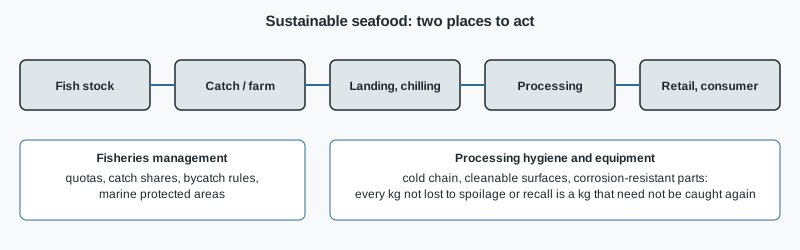
A processing plant does not set quotas. What it controls is how much of what is landed is lost – to spoilage from cold-chain breaks, to contamination, to rework and to recalls. A kilogram of fillet discarded after a positive Listeria swab was still fished. Reducing that loss is the processor's direct contribution to sustainable seafood.
Equipment risks specific to seafood plants
| Risk | Why it matters in seafood | Equipment response |
|---|---|---|
| Chloride pitting | Seawater, brine, salted products and chlorinated cleaners attack stainless steel | AISI 316/316L or higher in wet zones; avoid crevices where chlorides concentrate |
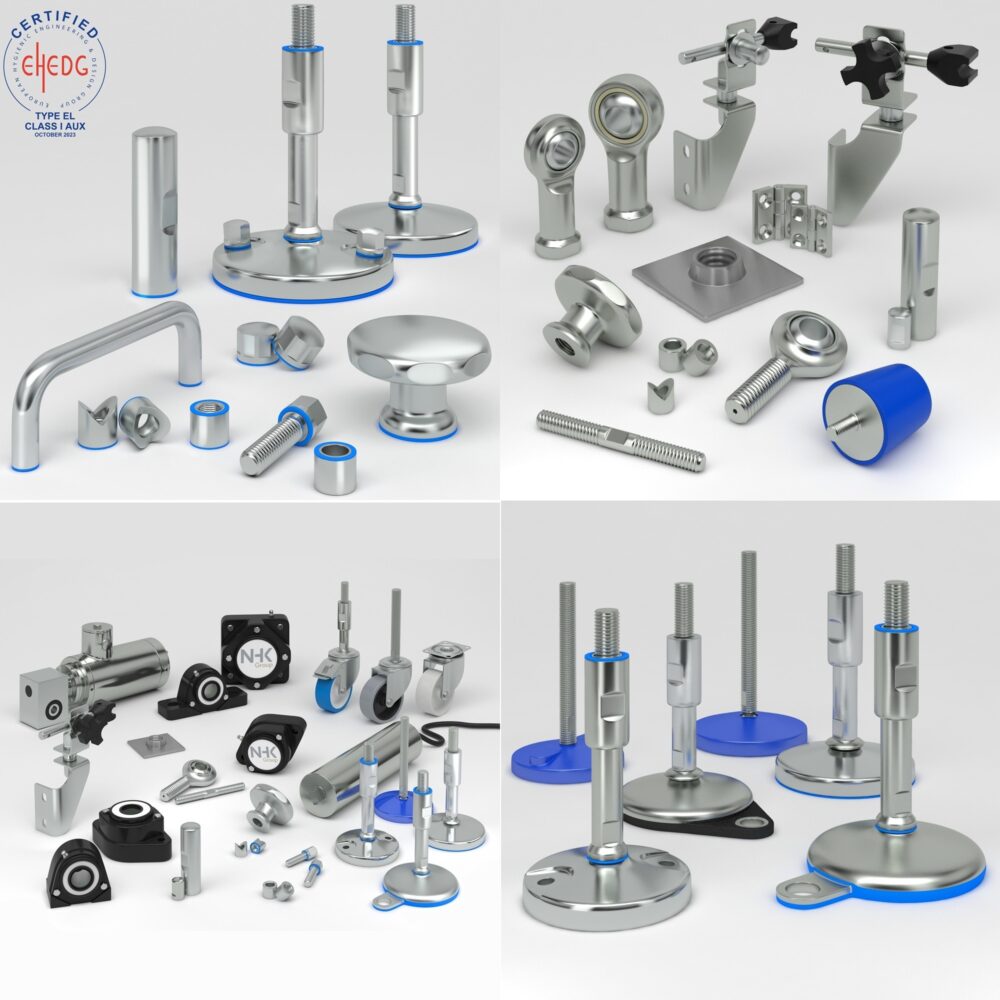
| Listeria harbourage | Cold, wet environments allow Listeria to persist in crevices | Crevice-free, self-draining parts; sealed feet and fasteners without exposed thread |
| Galvanic corrosion | Mixed metals in salt water corrode faster | Same-material fasteners or isolation |
| Seal degradation | Fish oils, cleaning chemicals and low temperatures stress elastomers | Check elastomer compatibility (EPDM, FKM, VMQ) for the specific media |
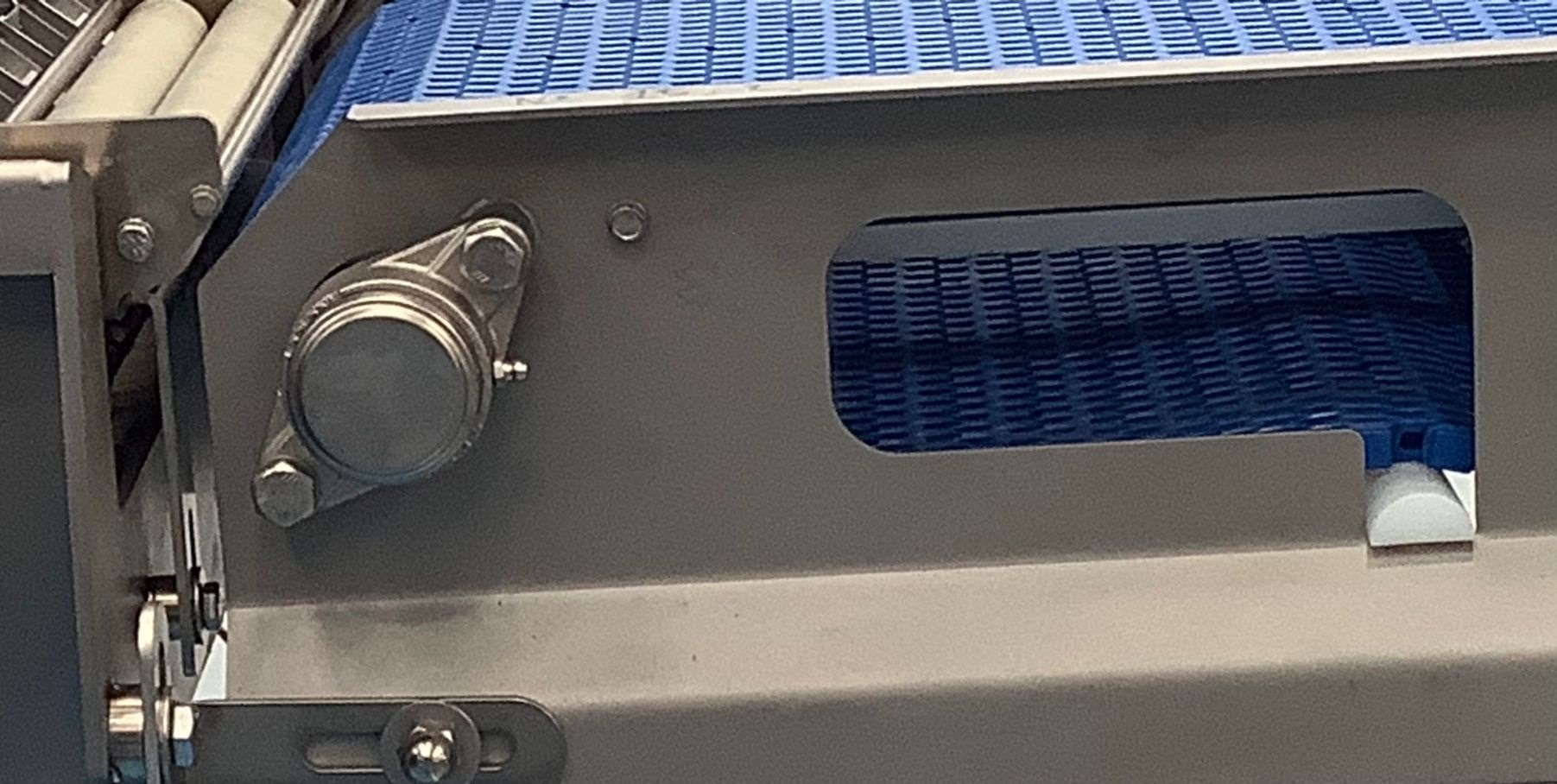
| Bearing water ingress | Frequent washdown | Sealed or waterproof bearing units and lubrication suited to food plants |
Terms used: a harbourage point is a crevice or dead space where product residue and microorganisms survive cleaning; the splash zone is any surface reached by product or cleaning water; passivation is the chemical treatment that restores stainless steel's protective oxide layer after fabrication.
Selecting components for a seafood line – step by step
- Map the zones: product-contact, splash and non-contact, and where seawater or brine is present.
- Choose material by chloride exposure: 304 for dry areas; 316/316L or higher where chlorides reach the surface.
- Remove harbourage points: sealed fasteners and levelling feet, rounded, self-draining shapes, no horizontal ledges.
- Match the cleaning method: foam and low-pressure rinse vs high-pressure washdown; IP ratings describe ingress, not hygiene.
- Request documents: material certificates and EC 1935/2004 declarations of compliance for food-contact parts.
- Verify: swab results and corrosion inspection after the first months in service.
For bearing choices in washdown areas see sealed stainless bearing units for hygienic industries; for conveyor types, see conveyors in food, cosmetic and chemical industries; for equipment by processing step, see seafood sustainability solutions.
Example – assumptions stated, not a real case. A salmon filleting line rinses with chlorinated water and is foam-cleaned daily. Inspection finds rust staining around zinc-plated frame fasteners and exposed threads on levelling feet in the splash zone. The plant replaces them with stainless fasteners and sealed feet in a grade suited to chlorides, and tracks swab results and product holds over the following quarter to judge the effect.
Common mistakes
- Specifying 304 throughout a line that handles brine.
- Treating IP69K-rated parts as automatically hygienic.
- Mixing zinc-plated and stainless parts in wet zones.
- Ignoring the frame, feet and fasteners because they are "non-contact" – they are in the splash zone.