Certified conveyor parts and machinery components are parts whose design or material has been assessed against a named hygiene scheme – such as EHEDG, 3-A or food-contact regulations – and documented with a certificate or declaration. For machine builders in the food and pharmaceutical industries, they are a way to bring checked evidence into a conveyor rather than relying on catalogue wording. This guide goes through a conveyor part by part: what certification can prove for each, what it cannot, and what to request.
Why conveyor hygiene matters in food and pharma
Conveyors touch product over long distances and are cleaned often, which makes their design decisive. Poor design leads to contamination, which poses health risks and can lead to costly recalls and damage to the brand. The hygienic design principles that apply are well known:
- Smooth surfaces without cracks and crevices (narrow gaps) where bacteria can harbour.
- Easy cleaning: every part accessible and cleanable, with no dead spaces (areas cleaning flow cannot reach).
- Non-toxic materials that do not react with the product or cleaning agents.
- Sealed joints that prevent contaminants from accumulating.
These principles apply most strictly in the product-contact zone (surfaces the product touches or drains back from) and the splash zone (surfaces wetted by product or cleaning spray). For the overall design approach, see the conveyor and machine components hub.
What "certified" actually proves
The word is used loosely. Four kinds of evidence are often mixed up:
| Evidence | Issued by | Applies to | What it proves | What it does not prove |
|---|---|---|---|---|
| EHEDG certificate | EHEDG, after evaluation of the design | A specific equipment or component design | The design meets EHEDG hygienic design criteria | That every installation is hygienic; material compliance |
| 3-A Symbol authorisation | 3-A SSI, after Third Party Verification | A specific design to a 3-A Sanitary Standard | Conformity with that 3-A standard (mainly dairy, North America) | Use outside the standard's scope |
| Food-contact declaration of compliance | The manufacturer | A material or article (EC 1935/2004; EU 10/2011 for plastics; FDA 21 CFR, e.g. 177.2600 for rubber) | The material is suitable for food contact under stated conditions | Cleanable geometry |
| NSF listing | NSF International | A product against a specific NSF/ANSI standard | Conformity with that standard | Anything outside that standard |
| IP rating (IEC 60529; IP69K in ISO 20653) | Test laboratory or manufacturer | Enclosures, motors, bearing units | Resistance to water and dust ingress in a defined test | Hygiene or cleanability |
Both EHEDG and 3-A are voluntary. Neither certifies companies, factories or materials – only designs. An "FDA-approved belt" in practice means the belt material complies with relevant FDA regulations, declared by the manufacturer.
Component by component
Conveyor frame
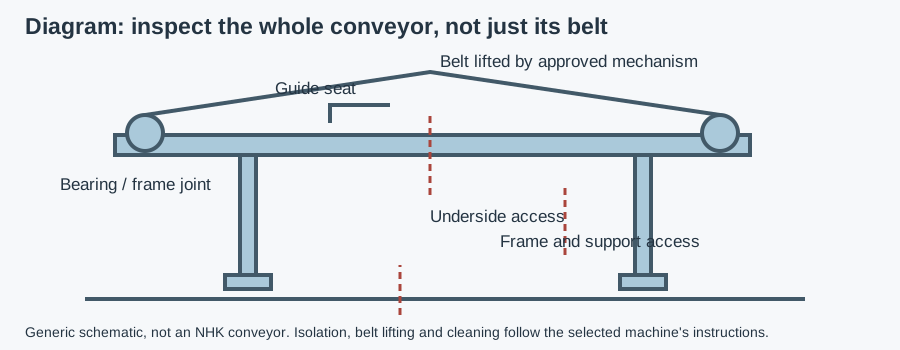
For assembly-level selection, check the frame access, support and cleaning acceptance guide alongside component evidence.
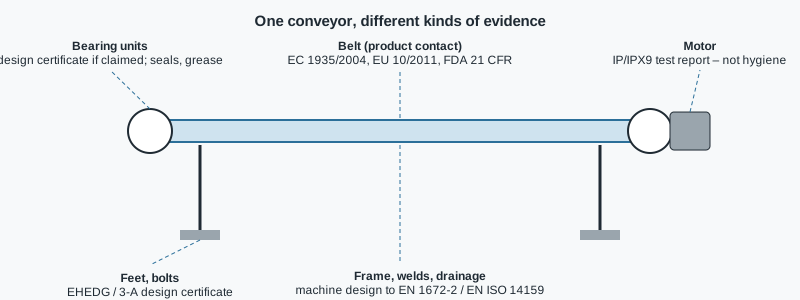
Stainless steel conveyors resist corrosion and are easy to clean, but the frame is designed by the machine builder, so its hygiene rests on design to EN 1672-2 and EN ISO 14159: open profiles, self-draining surfaces (no flat ledges where liquid pools), continuous ground welds and no lap joints. Use AISI 316L where salt, brine or chlorinated cleaners raise the risk of chloride pitting (local pits started by chlorides); 304 is often sufficient elsewhere. Passivate after welding to restore the oxide layer.
Belts
Belts are in product contact, so material evidence matters most: a declaration of compliance for the exact belt type, under EC 1935/2004 and EU 10/2011 for plastics, or a statement of compliance with FDA 21 CFR for the US. Check the conditions in the declaration – food type, temperature, contact time.
Bearing units
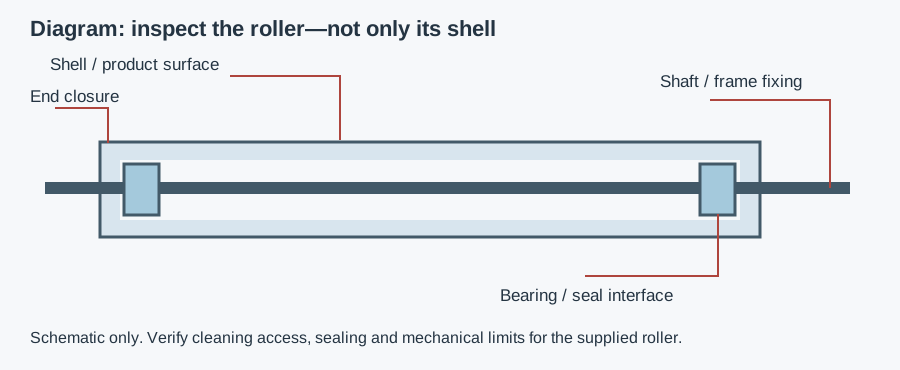
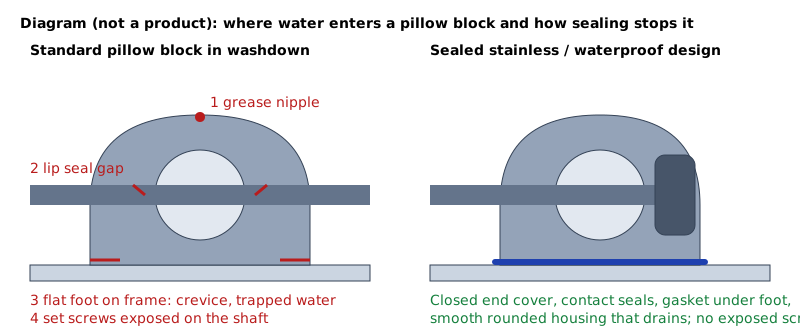
Hygienic bearings are designed to withstand frequent washdowns and to prevent lubricant leakage. Look for sealed housings with no open grease paths, crevice-free mounting and food-grade lubricant. An IP rating describes ingress resistance; a hygienic design certificate, where one exists for that unit, describes cleanability. They are different documents.
Motors and drives
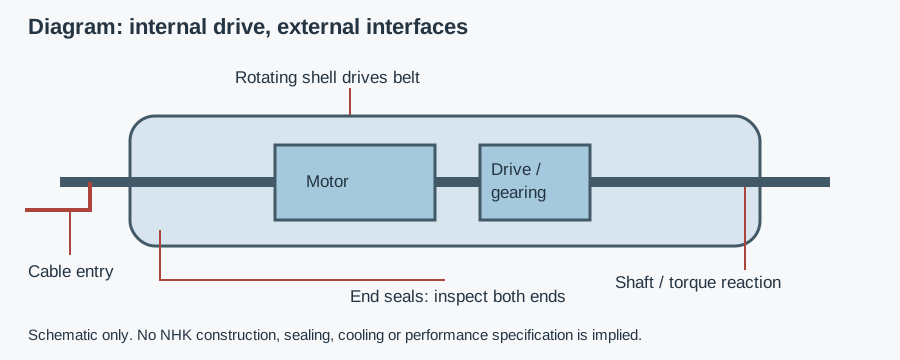
Sealed motors protect internal components from contamination and are easier to clean, especially smooth-bodied, fan-less designs. Their IP or IPX9 rating is a test report, not a hygiene certificate.
Feet and fasteners
Levelling feet and bolts sit in the splash zone and are classic harbourage points (places where microbes survive cleaning) when they have exposed threads. These are among the component types where certified designs are available, which makes them an efficient upgrade.
Seals
Seal elastomers – EPDM, FKM, VMQ (silicone) – differ in resistance to fats, acids, alkalis and temperature. Ask for food-contact declarations and check compatibility with the cleaning chemicals.
How to select certified components: a method
- Map zones on the conveyor: product contact, splash, non-contact.
- Define cleaning: dry clean, foam, high-pressure washdown, CIP/COP (cleaning in place, or out of place after dismantling), with chemicals and temperatures.
- Assign the required evidence per component from the table above – material declarations for contact parts, design certificates where hygiene risk is highest.
- Prioritise splash-zone components with threads, gaps or seals.
- Write it into the RFQ (see below).
- Verify at incoming inspection: the certificate names the scheme, the design and the holder, and matches the delivered part number.
- Monitor in use: inspect for wear or contamination and replace parts that no longer meet hygienic requirements.
Example – assumptions stated, not a real project. A machine builder designs a conveyor for a ready-meal plant with daily foam cleaning and high-pressure rinse. The belt runs in the product-contact zone; the frame, feet, bolts and bearing units are in the splash zone. Requirements: belt with an EC 1935/2004 and EU 10/2011 declaration for the stated food types; feet and bolts in a certified hygienic design; sealed stainless bearing units with food-grade grease, plus an ingress test report covering the washdown; frame in 316L with sloped cross-members. The motor gets a high-pressure ingress rating, specified as an ingress requirement only.
What to write in the RFQ
- Scheme and document type: "EHEDG certificate for the supplied design" or "declaration of compliance to EC 1935/2004 and EU 10/2011" – not just "certified".
- Zone, cleaning method, chemicals and temperatures.
- Material grade (AISI 304 or 316L) and elastomer type.
- Copy of certificates and declarations with the delivery, matching part numbers.
Failure modes to avoid
- "Certified" with no named scheme – treat as unverified.
- Certificate for a different variant than the one delivered.
- IP rating treated as a hygiene certificate.
- Certified parts mounted in a frame with ledges and lap joints – the frame still traps soil.
- Belt declaration that does not cover the food type or temperature.
What certified components deliver
Used correctly, certified components reduce contamination risk, make cleaning and maintenance more predictable, and supply documents that support regulatory compliance and customer audits. Training staff in cleaning and maintenance, and regular inspection, keep those benefits. Any effect on cleaning time or downtime should be measured on your own line. For deciding where certification matters most, see prioritizing certified components and parts and the overview of advantages of certified components and parts.
Product lines for stainless equipment, levelling castors and load feet and other components are listed at NHK Machinery Parts.
Conclusion
Use certified conveyor parts where they add checked evidence – contact materials and splash-zone components with threads, gaps or seals – and ask for the exact document. Combine them with a hygienically designed frame and a maintained cleaning routine.