A welding plate is a steel plate, usually with a tapped hole, welded onto a machine frame to give a strong, permanent fixing point – a threaded plate that works like a nut that can never turn or fall off. On stainless food and pharma machinery it solves a specific problem: how to bolt guards, brackets, bearing units and sensors to hollow frame tubes without drilling holes that open the tube to water and product.
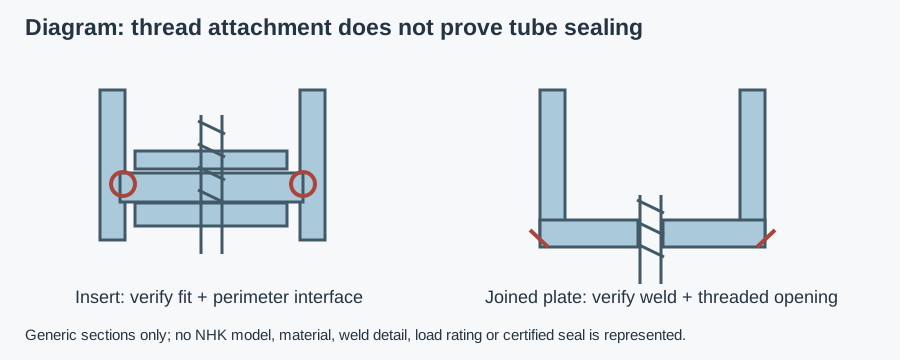
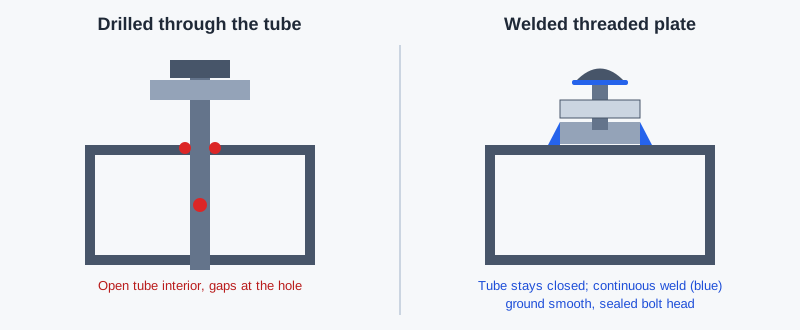 a bolt drilled through a hollow frame tube with a threaded plate welded onto the tube. Schematic, not a product test report.
Welding plates belong to the hygienic fasteners family; the bolts screwed into them are covered in the hygienic bolts guide.
For an attachment at the tube end rather than on its side, compare the insert retention and cavity-closure checks.
Types of welding plates and threaded plates
| Type | Description | Typical use | Notes |
|---|---|---|---|
| Single-hole threaded plate | Square or round plate, one tapped hole | Brackets, guards, sensor mounts | Most common fixing point |
| Multi-hole threaded plate | Two or four tapped holes on a pattern | Bearing units, motor brackets | Hole pattern must match the part |
| Threaded washer plate | Washer-shaped plate with tapped center | Thin sheet, round tubes | Larger weld perimeter than a weld nut |
| Weld nut | Nut with a weld face or projections | Sheet-metal panels | Small footprint; harder to weld all around |
| Blank welding plate | Plain plate, drilled or tapped on site | Custom positions | Machining after welding needs clean-up |
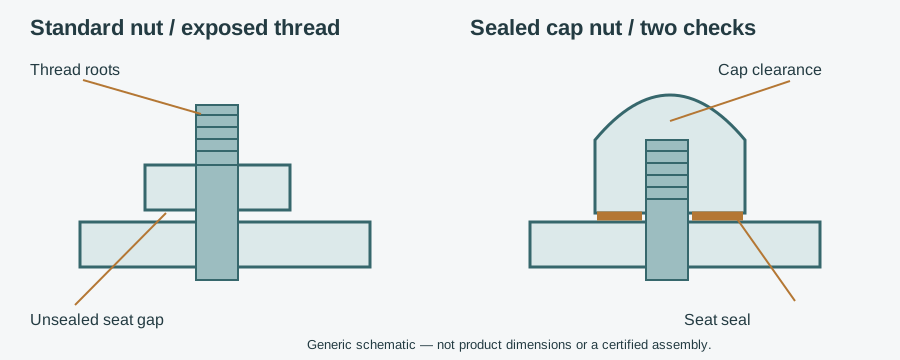
| Weld stud | Threaded stud welded to the surface | Covers, panels | Exposed male thread; nut needs sealing |
Use the sealed closure checks for a projecting stud to specify the nut, engagement and seating face together.
"Threaded steel plate" in purchasing can mean carbon steel. On frames that are cleaned wet, carbon steel plates rust and contaminate the surrounding stainless with iron. Use stainless plates on stainless frames.
Send your application data and get a welding plate recommendation
Choosing the grade
| Condition | Grade | Why |
|---|---|---|
| Dry and general areas, 304 frame | 304L (1.4307) | Weldable, matches the frame |
| Washdown with chlorinated cleaners, salt, brine | 316L (1.4404) | Molybdenum improves resistance to chloride pitting (local attack by chloride ions) |
| Mixed frame (316L tube) | 316L | Never weld a lower grade onto a higher-grade frame in a wet zone |
The "L" (low carbon) matters for welded parts. In standard-carbon grades, welding heat can form chromium carbides along grain boundaries next to the weld – sensitization – leaving a narrow band with lower corrosion resistance. Low-carbon grades largely avoid this. Use matching filler metal; a filler of a lower grade turns the weld into the weak point. Grade selection in general is covered in AISI 316L vs AISI 304.
Sizing: thickness, outline and thread
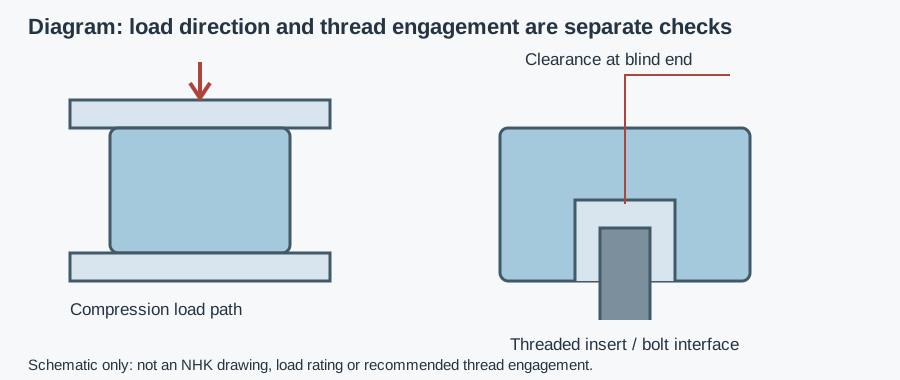
- Thread engagement. The plate must be thick enough for the bolt to engage a full working length of thread. A common rule of thumb for steel nuts is engagement of about one thread diameter; confirm with the bolt supplier's data for stainless threads.
- Bolt length. Check that the bolt does not bottom out against the tube wall behind the plate. Either use a blind tapped hole of known depth, or make sure the tube is not drilled through.
- Outline. The plate should be large enough for a continuous fillet weld all round, but not overhang the tube edge. Rounded corners are easier to weld and clean.
- Edge distance. Keep the hole far enough from the plate edges that welding heat does not distort the thread.
Example (assumptions, for method only): a bearing unit with M12 bolts is to be fixed to a 40 × 40 × 2 mm 316L tube. Tapping the 2 mm wall would give only about one and a half threads, far below a useful engagement. A 316L threaded plate thick enough for full engagement, welded all round on top of the tube, provides the thread; the tube stays closed. The plate thickness itself is taken from the bolt supplier's engagement recommendation – no value is assumed here.
Welding and finishing procedure
- Prepare – degrease plate and frame; use stainless-only tools to avoid iron contamination.
- Protect the thread – fit a plug or sacrificial bolt.
- Position – use a jig so hole patterns line up with the mating part.
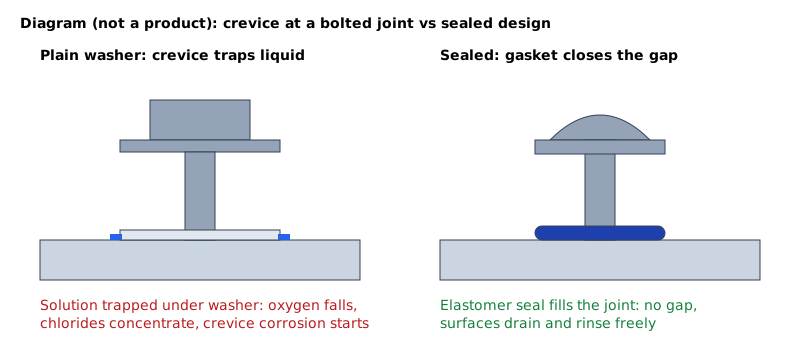
- Weld continuously all around – a stitch or tack weld leaves crevices (narrow gaps that liquid enters but cleaning cannot reach) between plate and tube.
- Grind and blend – remove the weld bead to a smooth, rounded transition with no undercut or porosity.
- Remove heat tint – the discolored oxide next to the weld has reduced corrosion resistance; remove it by pickling or mechanical means.
- Passivate – an acid treatment that removes free iron and restores the passive surface.
- Check the thread – run a tap or thread gauge through; clean residues.
Use the post-weld treatment and finished-dimension checks when agreeing preparation, finishing and inspection with the processor.
Where the plate is in the product-contact zone (surfaces that touch product or drain onto it), the finished surface should be smooth; EHEDG guidance of Ra ≤ 0.8 µm for product-contact surfaces is the usual reference.
The weld-area finish specification and measurement guide explains why a result from the surrounding flat face does not automatically accept the weld transition.
Hygienic mounting on the plate
The plate is only half the joint. In the product-contact and splash zone (surfaces reached by spray or splash):
- Bolt the part with a sealed, rounded bolt head rather than a hex head with washer.
- Seal the contact face between part and plate, or design the part to sit on a sealed spacer – see stainless steel spacers and spacer nuts.
- Make sure no thread protrudes on the far side.
- Position plates so their top surfaces drain – avoid flat ledges that hold water.
Handles and locks fitted to guards follow the same approach – see hygienic handles and locks. On conveyors, welding plates often carry side guides, sensors and bearing units; see the role of high-quality conveyor components.
Failure modes seen on site
| Problem | Cause | Prevention |
|---|---|---|
| Rust line around the weld | Heat tint not removed; iron contamination | Pickling/passivation; stainless-only tools |
| Residue and biofilm under the plate edge | Stitch weld, gap between plate and tube | Continuous weld, ground smooth |
| Stripped thread | Plate too thin; galling of stainless threads | Correct thickness; clean threads, suitable anti-seize |
| Hole pattern misaligned | Plates welded without a jig; distortion | Jig, symmetric welding, low heat input |
| Water inside the frame tube | Tube drilled or tapped through | Blind thread in the plate; tube stays closed |
What to write in the RFQ
For any claimed hygienic certification, use the supplier evidence for a certified fixing design before relying on it in the specification.
- Type and outline (square, round, washer), number of holes and pattern
- Thread size and plate thickness; blind or through thread
- Grade: 304L (1.4307) or 316L (1.4404); material certificate EN 10204 3.1 if traceability is needed
- Edge finish and surface finish (Ra); passivated or not
- Frame tube size and wall thickness it will be welded to
- Zone and cleaning method; bolt and seal type to be used
- Declaration of compliance with EC 1935/2004 if the area can contact food
- Quantities and delivery country
An NHK technician reviews the fixing point and the parts you mount on it, then suggests components and sends a quote. To browse, see NHK's hygienic machinery components in stainless steel and the hygienic-bolt listing.