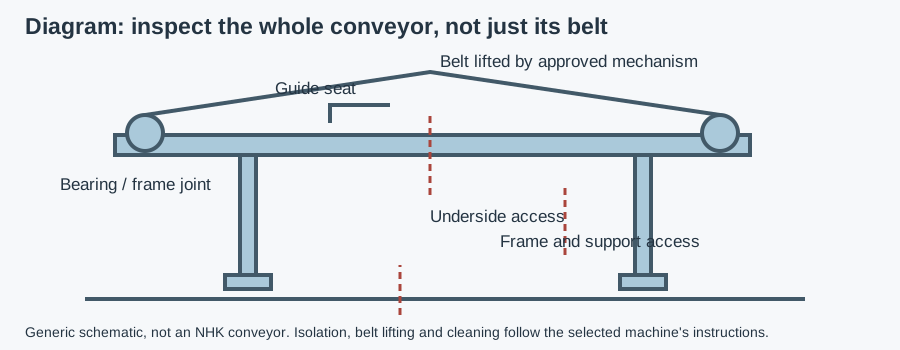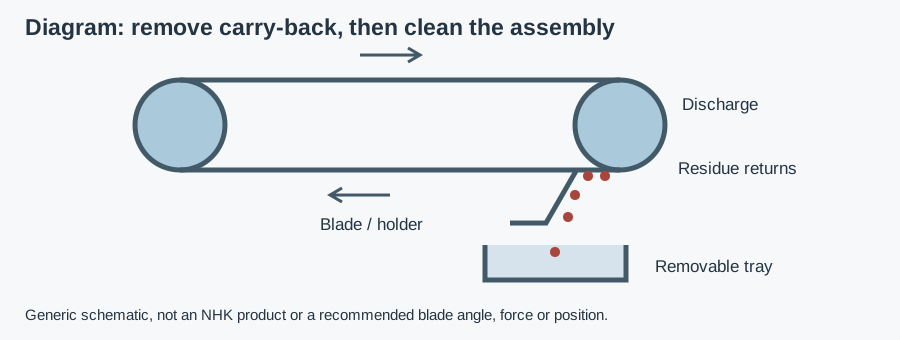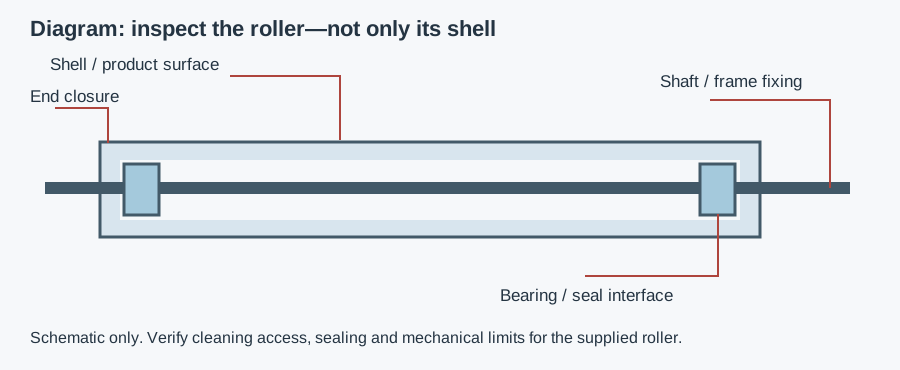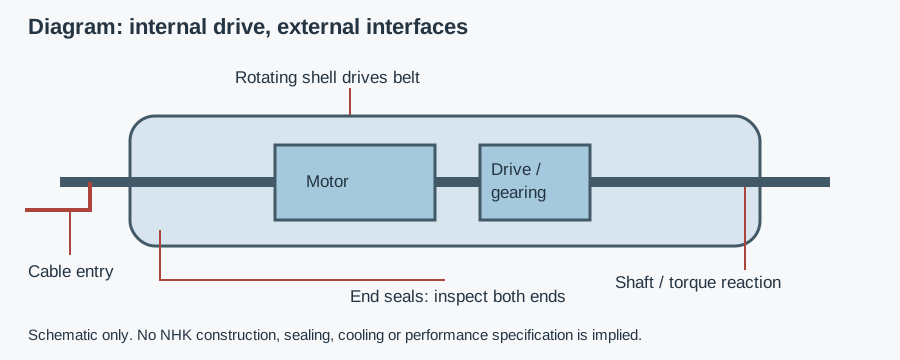
High-quality conveyor components are machinery parts – bearing units, rollers, guides, feet, fasteners and seals – whose materials, sealing and geometry are matched to the stresses of the environment they work in. In harsh environments such as wet food processing, “quality” is not a premium label. It is the ability to survive daily washdown, cleaning chemicals, temperature cycles and soil without corroding, leaking grease or harbouring bacteria. This guide explains how to turn that idea into specification criteria.
What counts as a harsh environment?
A harsh environment combines several stresses that degrade ordinary components quickly:
- Water: daily washdown, sometimes with high-pressure or hot jets, plus constant humidity.
- Chemicals: alkaline and acid detergents, chlorinated disinfectants, salt and brine from the product.
- Temperature: hot cleaning water followed by chilled production, or ovens and freezers on the same line.
- Soil and abrasion: fat, protein, sugar, flour, bone fragments or glass particles.
The zone matters as much as the stress. A product-contact zone touches food directly; the splash zone is reached by product or cleaning spray; a non-contact zone stays dry. Requirements step up from non-contact to product contact.
How each stress damages conveyor components
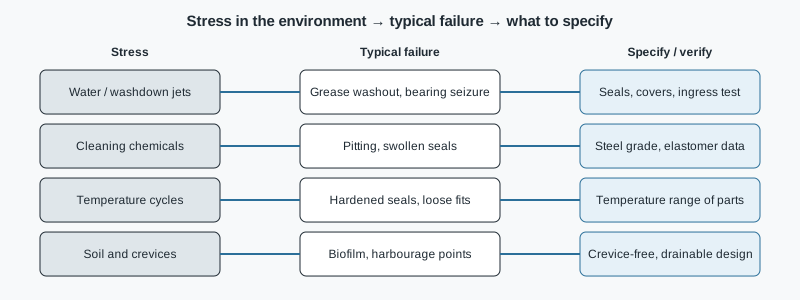
Failures in harsh environments are rarely random. Each stress produces a recognisable failure:
- Water washes grease out of bearings and enters through worn seals, causing noise, then seizure.
- Chemicals cause chloride pitting (small, deep corrosion pits started by chlorides) in lower stainless grades, and swell or harden elastomers that are not compatible.
- Temperature cycles harden seals, loosen press fits and, in sealed cavities, pump moist air in and out.
- Soil collects in crevices (narrow gaps) and harbourage points (places where microorganisms survive cleaning), where it forms biofilm.
Specifying high-quality conveyor components: criteria and evidence
The table links each attribute engineers choose by to the evidence a supplier should be able to show.
| Attribute | What to specify | Evidence to request | Typical mistake |
|---|---|---|---|
| Steel grade | AISI 304 for general wet areas; 316/316L with chlorides, brine or aggressive disinfectants | Material certificate (EN 10204 3.1 where needed) | “Stainless” without grade |
| Plastics | Food-contact grade in product and splash zones | Declaration of compliance to EC 1935/2004 and EU 10/2011 | Assuming colour or “FDA” wording is enough |
| Elastomers | EPDM, FKM or VMQ chosen for cleaning chemicals and temperature | Compatibility data, food-contact declaration (e.g. FDA 21 CFR 177.2600) | One seal material for every line |
| Ingress protection | Rating that matches the cleaning method | IP test report (IEC 60529 / ISO 20653) | Treating IP67 as a washdown rating |
| Hygienic geometry | No exposed threads, crevices or dead spaces; self-draining surfaces | Drawings; EHEDG certificate or 3-A authorisation where critical | Hidden gaps under feet and brackets |
| Surface finish | Ra ≤ 0.8 µm in product contact (EHEDG guidance) | Measured Ra or finish specification | Specifying polish only by appearance |
| Lubrication | Food-grade grease for incidental contact | NSF H1 registration | Standard grease in splash zones |
For a deeper look at side guides, rods and brackets specifically, see hygienically optimized conveyor components. For a fixing on a hollow frame, review the threaded weld-pad and finishing checklist.
For mobile conveyor frames, use the floor and cleaning specification for wheel materials to assess the tread and complete castor separately.
Check the castor assembly's cleaning access and component documentation for the mounting, swivel and brake as well as the wheel.
Selection method in six steps
For rotating supports, use the roller load-layout and sealing checklist to turn the general environmental requirements into a part specification.
- Map the zones on the conveyor: product contact, splash, non-contact.
- List the stresses per zone: cleaning method (dry, foam, CIP/COP, high-pressure), chemicals and concentrations, temperature range, product soil.
- Translate each stress into a failure risk using the diagram above.
- Set criteria from the table for each risk; stricter criteria in product-contact and splash zones.
- Request the evidence with the quotation; reject parts where the supplier cannot document a critical criterion.
- Compare cost per year of service, including cleaning time and expected replacements, not unit price.
Example – assumptions stated, not measured data. A meat-processing conveyor is foamed daily with an alkaline chlorinated cleaner and rinsed at moderate pressure. Bearings are in the splash zone; feet stand in floor water. Applying the method: 304 is at risk of pitting from chlorides, so 316-grade parts are considered for exposed fasteners; bearing units need sealed covers and food-grade grease; elastomers must be checked against chlorinated alkaline detergent; feet need a sealed, crevice-free design without exposed thread. The procurement team compares two suppliers on documented evidence first, price second.
Where quality pays: maintenance, downtime and cleaning
The source article stressed reduced maintenance, downtime and long-term savings. These are real effects, but their size depends on the plant. The mechanisms are:
- Fewer unplanned replacements when seals, grease and steel grade suit the cleaning regime.
- Shorter, more reliable cleaning when surfaces drain and have no crevices – which also reduces water and chemical use.
- Lower contamination risk, and with it lower risk of product loss and recalls.
To quantify the benefit, record current replacement frequency, cleaning time per shift and any hygiene non-conformities before and after a change.
Compliance: what standards do and do not cover
- EC 1935/2004 applies to all food-contact materials; EU 10/2011 adds rules for plastics.
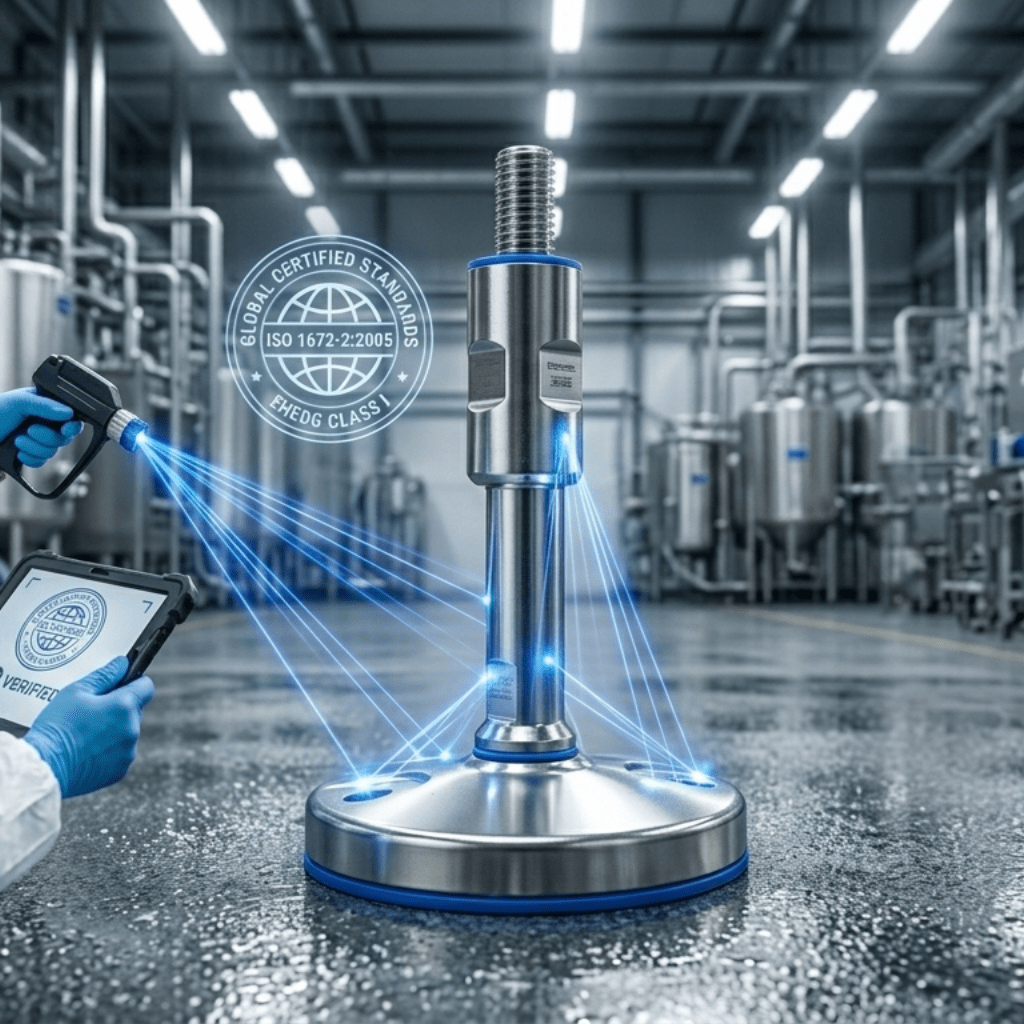
- EN 1672-2 sets hygiene requirements for food processing machinery.
- EHEDG certifies specific equipment designs; 3-A Symbol authorisation follows a Third Party Verification. Both are voluntary.
- IP ratings are ingress tests, not hygiene certifications.
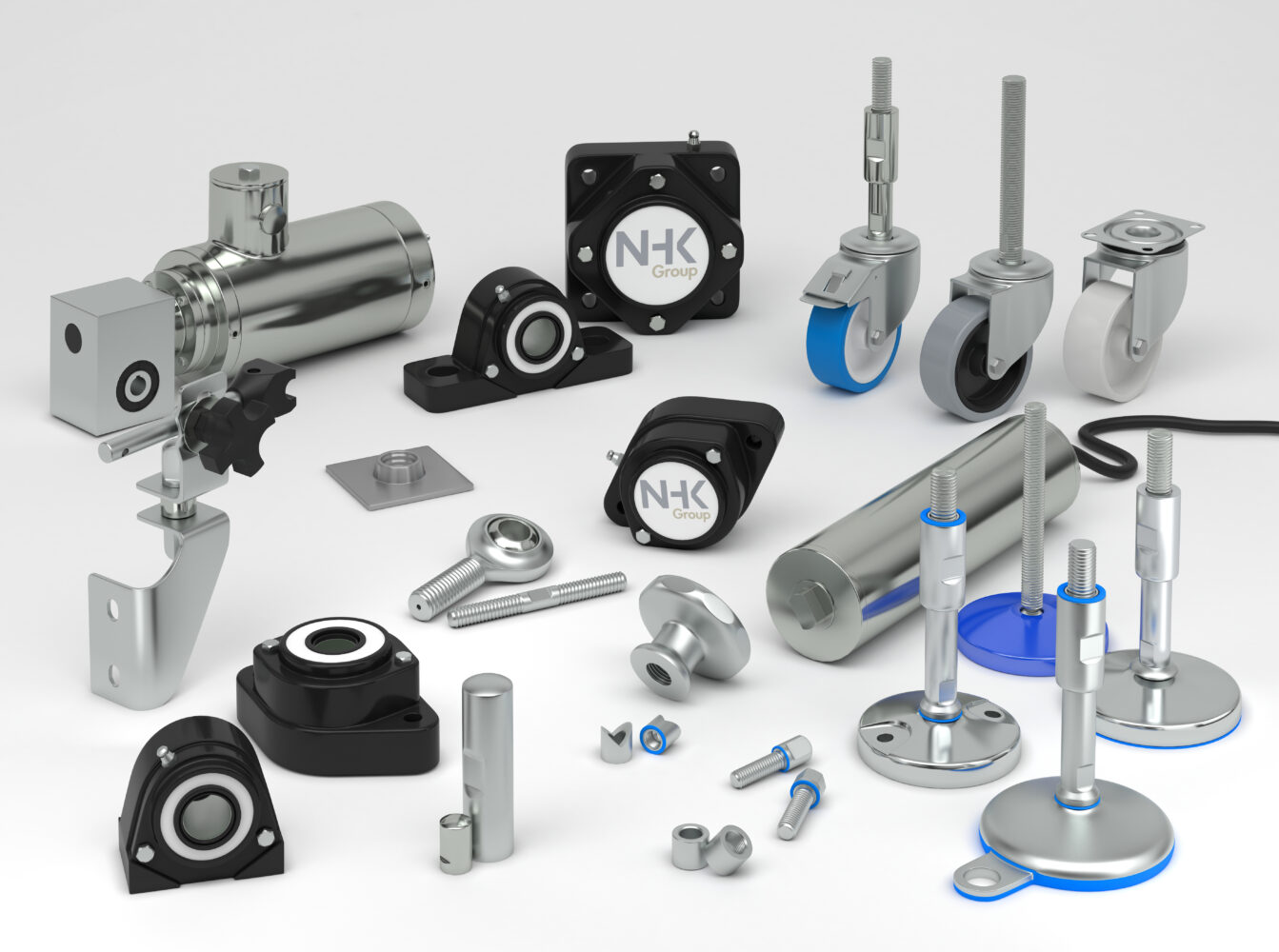
A component is not “compliant with all standards”; a specific design meets specific requirements. Ask which ones. NHK lists its certified hygienic components separately from its general range.
Inspection checklist for components in harsh areas
- Check bearing units for grease leakage, noise and damaged covers.
- Look for rust staining or pits on fasteners and brackets, especially near drains.
- Inspect elastomer seals for swelling, cracking or hardening.
- Check for soil residues after cleaning at joints, threads and under feet.
- Confirm replacement parts match the original specification, not just dimensions.
- Record findings so recurring failures can be traced to a stress.
For splash-zone bearings, units such as IP67 waterproof bearing units with spherical inserts illustrate the sealed-cover approach; remember that IP67 is an immersion test, so confirm suitability for jet cleaning separately. More on supplier selection for uptime and cost is in competitive manufacturing landscape.
Conclusion
High-quality conveyor components play a vital role in harsh environments only when “quality” is defined by the environment: map the stresses, link them to failures, and specify documented evidence for each. NHK Machinery Parts publishes its component range for comparison against such a specification.