Food processing machinery – slicers, formers, mixers, fillers, conveyors and packaging machines – is built from the same few assemblies: a frame, a drive, a product-handling section such as a conveyor, bearings, fasteners and feet. Whether a machine can be cleaned depends on how each of those assemblies is designed and joined. This guide takes a typical machine apart and gives the hygienic design rules for each part, so that machine builders and buyers can review any machine – not just a particular type. For an overview of equipment by process step, see food processing equipment.
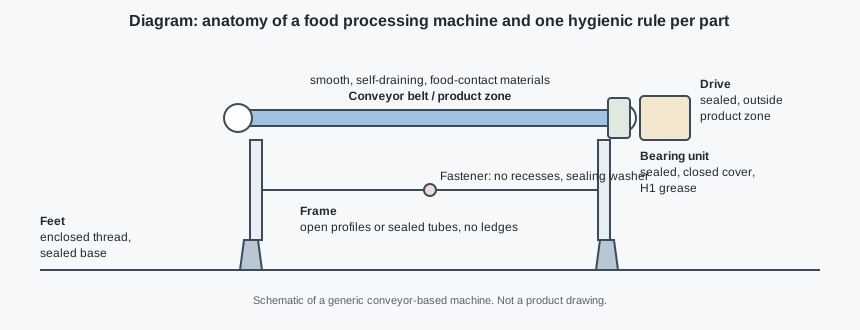 the anatomy of a food processing machine with one hygienic rule per part. Schematic, not a product test report.
The assemblies of a food processing machine and their hygienic rules
| Assembly | Typical hygiene problem | Hygienic design rule | What to specify |
|---|---|---|---|
| Frame | Ledges, hollow sections, crevices at joints | Open profiles or fully sealed tubes; sloped surfaces; continuous welds | Profile type, weld finish, no open tube ends |
| Drive | Motor and gearbox shedding grease, fan blowing contamination | Place outside or below the product zone; sealed or washdown-capable housings | Location, enclosure, drip direction |
| Product section (conveyor, hopper, cutting head) | Residues on contact surfaces, hard-to-reach corners | Smooth, self-draining surfaces; generous radii; tool-free removal for cleaning | Material, surface roughness, removability |
| Bearings | Water and caustic entering, grease washing out | Sealed stainless or hygienic units with closed covers; food-grade grease | Housing material, seal type, grease, cover |
| Fasteners | Socket recesses, exposed threads, gaps under washers | Hygienic bolts with smooth heads and sealing washers; minimise fasteners in splash zone | Bolt type, seal material, location |
| Feet | Exposed threads, open joint to frame | Enclosed thread, sealed base and frame joint | Load, thread, base, fixing, material |
| Seals and gaskets | Swelling, cracking, gaps where residues collect | Flush, defined compression; compatible elastomer | EPDM, FKM or VMQ by product and chemicals |
Self-draining surfaces let water run off instead of standing. Crevices are gaps too narrow for cleaning to reach. The splash zone is everywhere product splash and cleaning water reach without direct product contact – on most machines, the whole area below and beside the product section.
Send your machine data and get a component recommendation
Frames: open or closed, and how they are joined
The frame is the largest surface on most food machines and the one cleaned least carefully. Two approaches work:
- Open frames of flat bar or open profiles, where every surface is visible and reachable by spray and brush. Horizontal surfaces are turned on edge or sloped so water runs off.
- Closed frames of round or square tube, fully sealed by welding. A closed tube must stay closed – a drilled hole for a bracket, or an open end, lets water and residue in where nobody can clean it.
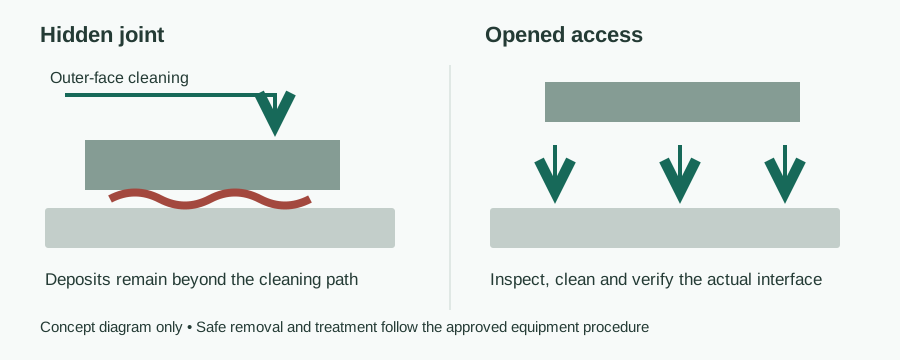
Joints matter more than profiles. Bolted lap joints in the splash zone create crevices; continuous welds ground smooth do not. Where a bolted joint is needed for maintenance, seal it with a gasket and hygienic fasteners. Brackets welded on with stand-off spacers leave a cleanable gap instead of a crevice.
Drives: keep them out of the product zone
Motors and gearboxes carry grease, fans and cooling fins that collect dirt. The rules are simple and often broken:
- Place drives outside or below the product zone so that anything dripping falls away from the product.
- Use enclosures suited to the cleaning method – a washdown area needs housings designed for it.
- Avoid fan-cooled motors blowing across the product section.
- Route cables in sealed, sloped conduits or with stand-offs, not lying flat on frame members.
Conveyors and the product section
The product section is in the product-contact zone: surfaces that touch product or from which liquid drains back onto it. Here materials must comply with EC 1935/2004 (and EU 10/2011 for plastics), surfaces must be smooth – EHEDG guidance gives Ra ≤ 0.8 µm for product-contact surfaces, where Ra is the average surface roughness – and corners need radii that cleaning can reach. Belts, guides and scrapers should come off without tools for cleaning. The guide to side guides and conveyor components covers the conveyor details.
Bearings, fasteners and feet: the bought-in parts
These three are usually bought from catalogues, and they are where many otherwise hygienic machines fail an audit:
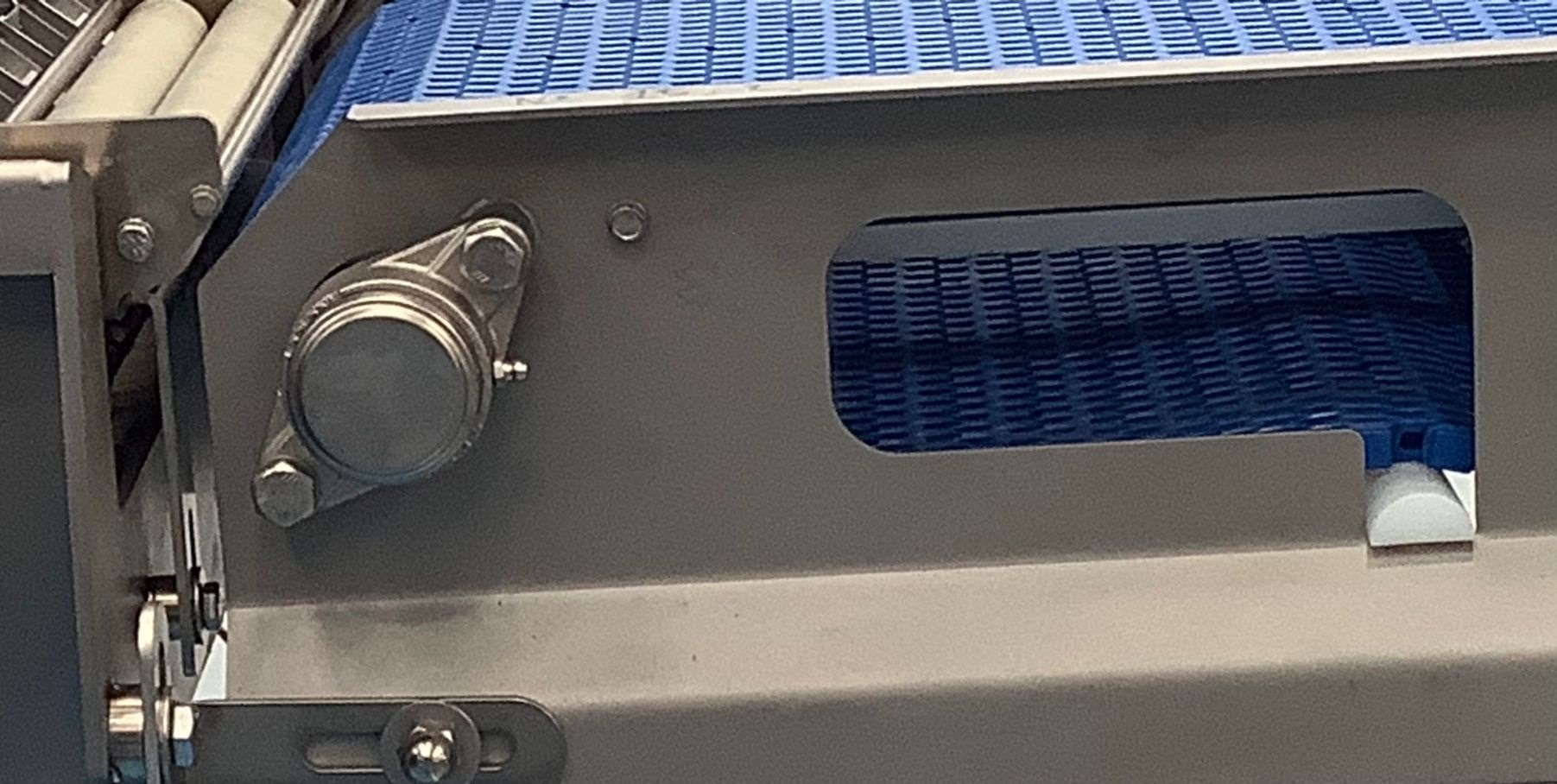
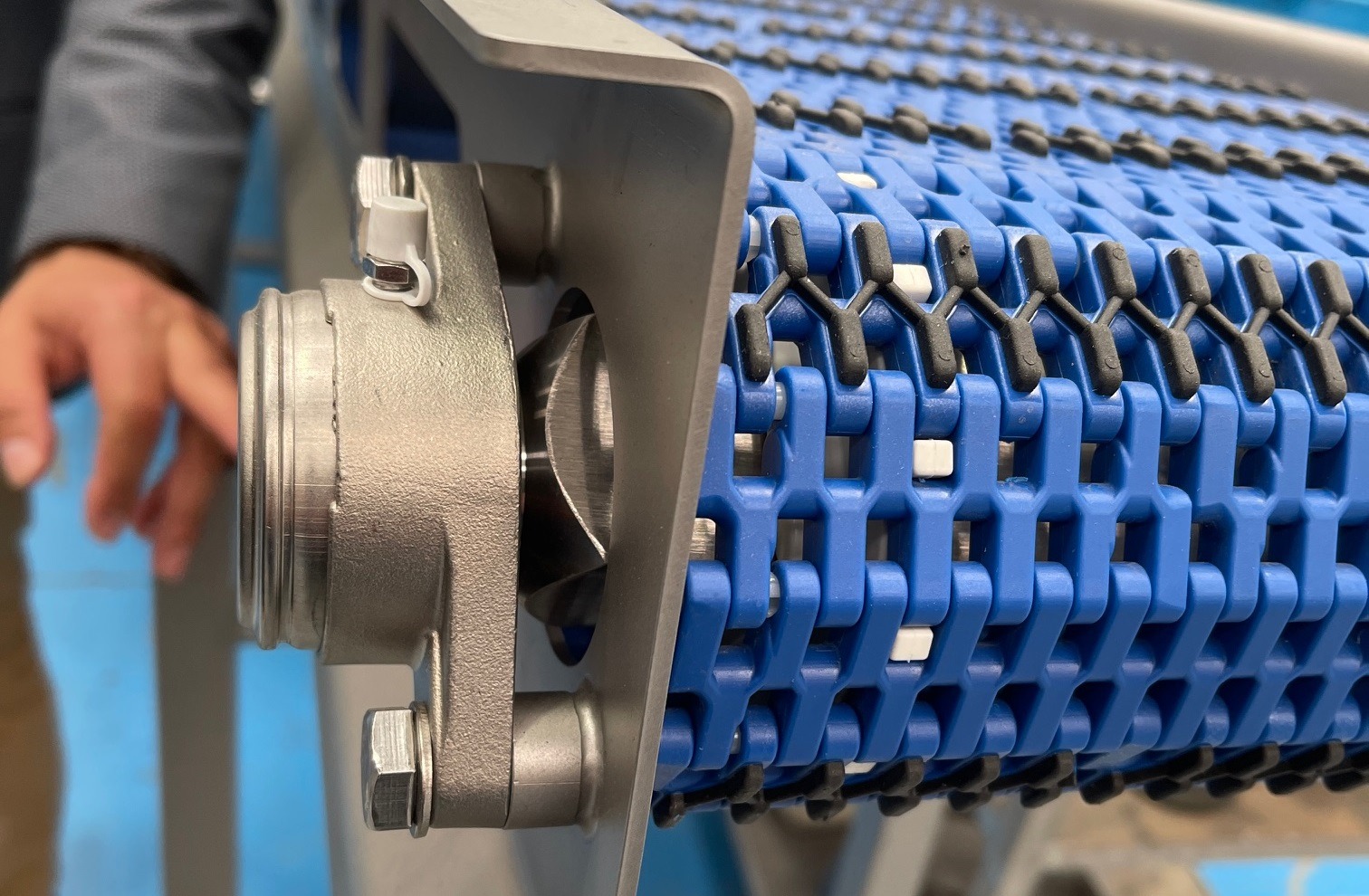
- Bearings: cast iron units rust; open-end units let water reach the shaft and set screws. Use sealed stainless or hygienic units with closed covers and food-grade (NSF H1) grease, mounted so that cleaning spray does not hit the seal head-on. Browse NHK's conveyor components and machinery parts; assess bearing requirements separately using documentation for the selected unit.
- Fasteners: replace socket-head and hex bolts in the splash zone with hygienic bolts, or move the joint out of the zone. A stainless bolt with a standard washer still traps water.
- Feet: use hygienic levelling feet with enclosed thread; size each foot as if only three of four carry the load on an uneven floor, plus a safety factor for dynamic loads.
Which standard parts can stay is set out zone by zone in standard parts in hygienic design.
The baking and chocolate process-to-component guide applies these assembly checks to dry dust, sticky residues, allergens and temperature boundaries.
Materials across the machine
- AISI 304 for most frames and components; 316L where chlorides from brine, seawater or chlorinated cleaners cause chloride pitting (local pits in stainless steel).
- Passivation – a chemical treatment that restores the passive layer on stainless steel after welding or machining – reduces corrosion at welds and cut edges.
- Do not mix stainless with zinc-plated or carbon steel parts: in wet conditions they cause galvanic corrosion where the metals touch.
- Elastomers chosen for compatibility with product (fat) and cleaning chemicals; ask for declarations of compliance.
Example
Assumed situation, for method only: a machine builder reviews a meat slicer infeed conveyor before an EHEDG-guided redesign. The table above gives six findings: a closed square-tube frame with two drilled bracket holes; a gear motor mounted above the belt at the discharge end; cast iron flange bearings with open ends; 30 socket-head bolts in the splash zone; exposed-thread feet; and EPDM belt-scraper seals in contact with fatty product. Changes: weld-on brackets with stand-offs instead of drilled holes, motor moved below the belt line, stainless sealed bearings with closed covers, hygienic bolts, hygienic levelling feet, and FKM seals after checking compatibility with the cleaning chemicals.
Common mistakes
- Drilling into closed tube frames after assembly.
- Mounting drives above the belt "for access".
- Using stainless parts and assuming they are hygienic – shape and joints decide cleanability.
- Leaving cable trays flat on the frame where residues collect.
- Treating feet, bearings and bolts as purchasing decisions rather than design decisions.
The broader principles are in the core of hygienic design in food processing machinery; for sector examples, see dairy processing equipment and adaptable machinery for poultry processing.
What to send for a recommendation
Before asking for certification evidence, use the document checks for the bought-in machine components.
- Machine type and a drawing or photo
- Cleaning method: dry, foam, low or high pressure, chemicals
- Bought-in parts to review: bearings, bolts, feet, seals – with sizes and loads
- Material grade (AISI 304 or 316L)
- Certificate needed, if any (EHEDG, 3-A)
- Quantities and delivery country
Send these details to NHK
An NHK technician suggests suitable hygienic components for the machine and sends a quote.